George Du Maurier’s Christmas Dream

gdm.jpg

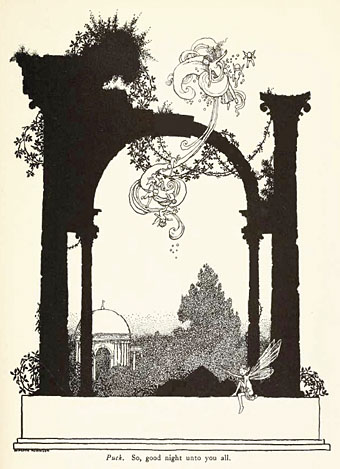
A Little Christmas Dream (Punch Magazine, December 26th, 1868).

Mr. L. Figuier, in the Thesis which precedes his interesting work on the world before the Flood condemns the practice of awakening the youthful mind to admiration by means of fables and Fairy Tales, and recommends in lieu thereof, the study of the Natural History of the World in which we live.

Christmas would be a bit more worthwhile with a few of these things patrolling the streets. George Du Maurier (1834–1896) gave the world the character of Svengali is his novel Trilby (1894) and that character’s name lives on even if the novel goes largely unread today. He turned to writing late when his eyesight failed and he was no longer able to maintain his career as an illustrator. Post-Beardsley, those illustrations and satires of Victorian life can seem rather stilted but VTS has examples of his more imaginative work, including this piece.

{ feuilleton } will be quiet for a couple of days while I visit family but, as is the custom here, the archive feature will be enabled to throw up random samples from the past.

Elsewhere on { feuilleton }
The illustrators archive

Images by Robert Altman

images1.jpg

It’s taken a while but the DVD format has slowly followed the CD with the reissue of obscure works that have been out of circulation for far too long. Robert Altman’s blandly-titled Images has been on my “When The Hell Will I See That Again?” list for about 25 years, having been shown a couple of times on TV in the UK before vanishing into the cinematic ether. It’s been out on DVD (Region 1 only) for a few years now but it’s taken me this long to see it again. In a way the film’s elusiveness suits a drama concerned with hallucinations.

Altman made Images in 1972 between two films that received far more attention and acclaim, the eccentric Western, McCabe and Mrs Miller and his Raymond Chandler update, The Long Goodbye. Images seems to have been poorly-received at the time although Susannah York deservedly won a best actress award at Cannes. Today it comes across as a minor exercise in mastery of the medium equivalent to Francis Coppola’s deft delivery of The Conversation between Godfathers 1 and 2. And, like The Conversation, it’s only “minor” because of the scale of Altman’s other achievements. For many directors this would be a career peak.

images2.jpg

Images is a kind of Altmanesque riposte to Roman Polanki’s Repulsion. Both films concern women having trouble with the men in their lives which may or may not be the cause of a mental breakdown which becomes progressively worse throughout the film. Polanski’s take on this far is more overt, with Catherine Deneuve already withdrawn from the world at the outset. Susannah York’s character, Cathryn, is a children’s writer who seems at first to be relatively stable until her life is increasingly intruded upon by the ghost of a former (dead) lover and other hallucinations from her past. This is played out in and around a cottage in a spectacular part of Ireland where she’s staying with her husband. Most of Altman’s films go for laughs even when the subject matter is inherently serious. Images, along with a handful of his other works, has no leavening humour at all and, like Repulsion, crosses into all-out horror at times. Unfortunately this makes it difficult to discuss without spoiling the film’s many surprises.

images3.jpg

Seeing this again was essentially like seeing it for the first time, not least because it’s a widescreen film that I only ever saw on TV in an inferior pan-and-scan version. The photography was by Vilmos Zsigmond, one of the great cinematographers of the 1970s and Altman’s favourite cameraman at that time. The production design is filled with mirrors, glass and wind-chimes, all of which complement Cathryn’s brittle mental state and which continually catch her in their reflections. The music by a pre-bombast John Williams is very good and is superbly augmented by Stomu Yamash’ta whose percussion ensemble is credited with the unnerving “sounds” which contribute so much to the atmosphere. Susannah York’s performance is excellent and serves as a reminder of what a great actress she was, frequently making the most of difficult roles in films such as The Killing of Sister George, The Maids or The Shout.

images4.jpgThe screenplay for Images was all Altman’s work apart from Cathryn’s voiceovers where she reads (or writes in her head) parts of her novel. These were extracts from a real fantasy book for children, In Search of Unicorns, written by the actress, one of two she wrote in the 1970s. Those extracts add to the verisimilitude as well as being sufficiently naive and otherworldly to contrast with the very adult events being shown on the screen.

So I can finally tick this one off the list although I now have an urge to see Altman’s curious and not altogether successful science fiction film, Quintet. No. 1 on the “When The Hell Will I See That Again?” list remains Deep End from 1971, the first British film by Jerzy Skolimowski who later made The Shout. According to a recent Sight & Sound feature the film is caught in some legal limbo so I could still be in for a long wait.

Previously on { feuilleton }
Robert Altman, 1925–2006

The art of Jean Carriès, 1855–1894

carries_frog.jpg

The Frog with Rabbit Ears (1891).

La matière de l’étrange, an exhibition of ceramic grotesques by Jean Carriès is currently running at the Petit Palais, Paris, through to January 27th, 2008. Carriès doesn’t feature in any of my books about eccentric or fantastic artists which I find surprising, his work is very peculiar by 19th century standards, looking like the creation of a Rodin obsessed by Lautréamont. Carriès’ series of “horror masks” are so similar to the earlier series of heads by sculptor Franz Messerschmidt I suspect there may be an influence there. And like Rodin, Carriès also had unsuccessful plans for a monumental gateway ornamented with his figures and scowling faces. Unlike Rodin, his plaster draft of the work was destroyed by a criminally unsympathetic curator but the Petit Palais exhibition attempts a reconstruction based on a model by Eugène Grasset.

Thanks to Nathalie for the tip!

English article at The Art Tribune
French page with video of the exhibition

carries_faun.jpg

Head of a Faun (1890–92?).

carries_mask.jpg

Grotesque mask, element for the Monumental Door (1891–94).

Elsewhere on { feuilleton }
The fantastic art archive

Previously on { feuilleton }
The Masks of Medusa
Bernini’s Anima Dannata
The art of Franz Xaver Messerschmidt, 1736–1783
The art of Stanislav Szukalski, 1893–1987