Turntablism

mikiphone.jpg

“What you got back home, little sister, to play your fuzzy warbles on? I bet you’ve got little save pitiful portable picnic players…”

Core77 posts some examples of portable music players from the 1920s and 1930s just in time for Record Store Day today. The Mikiphone above is a Swiss “pocket phonograph” from 1924. There’s a follow-up post with examples from later decades including a rather dubious (and not very successful) “Highway hi-fi phonograph” from Chrysler. For more recent novelties, try Kelli Anderson’s paper record player.

Back at Record Store Day, The Guardian sent two men in search of British record shops and included Manchester on their list of stops. Kudos for finding Beatin’ Rhythm, a great place for psychedelic albums, but I’d have headed to King Bee instead of Sifters. Some more links:

Independent record stores increase for the first time in a generation
The Wire‘s Record Store Day Roundup
Win Mute’s Record Store Day vinyl

Deutsche Kunst und Dekoration #19

dkd19-01.jpg

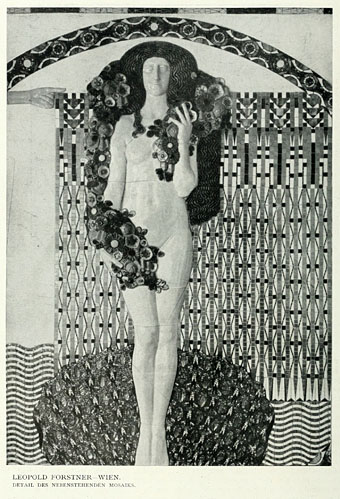
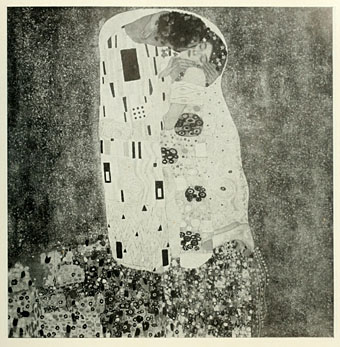
Water Serpents I by Gustav Klimt. See it in colour here.

Continuing the delve into back numbers of Deutsche Kunst und Dekoration, the German periodical of art and decoration. Yesterday’s post concerned a Klimt-like artist, today volume 19, covering the period from October 1906 to March 1907, includes further work by Klimt himself. The Wiener Werkstätte, with whom Klimt was affiliated, continues to dominate these editions, understandably so when the architecture, art and design being produced by the group was some of the most advanced in the world. In addition to the customary graphics and interiors there’s also some examples of dress design by Gustav Klimt which I hadn’t seen before.

As usual, anyone wishing to see these samples in greater detail is advised to download the entire number at the Internet Archive. There’ll be more DK&D next week.

dkd19-02.jpg

A portrait of Margaret Stonborough-Wittgenstein by Gustav Klimt. The sitter was the sister of Ludwig Wittgenstein.

dkd19-03.jpg

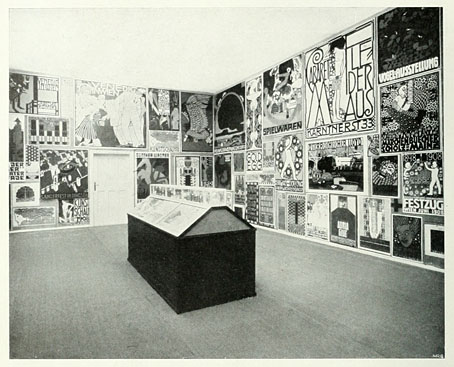
A poster by Koloman Moser.

Continue reading “Deutsche Kunst und Dekoration #19”

Weekend links 54

starowieyski.jpg

Film and opera posters by Franciszek Starowieyski (see below).

• At first glance, Jerzy Skolimowski’s new film, Essential Killing, sounds like Joseph Losey’s Figures in a Landscape (1970) reworked for our era of renditions, torture and war without end. The trailer is here; Sight & Sound liked the film and dismissed any Losey comparisons. The Quietus interviewed the director this week, and there’s also a video interview here.

“He was trying to tell the truth about war. In the 1950s the US was telling itself a mythic, grandiose, heroic story about the second world war and GI Joe saving the world. [James] Jones was saying, ‘That wasn’t the war I saw, I want to write something more honest and realistic. Whatever the mid-America myth, one of the things men were doing was giving blow jobs for money.'”

From Here to Eternity is published in an uncensored edition.

Edogawa Rampo‘s sinister short story The Human Chair concerns a man who conceals himself inside a chair. Taiwanese artist Lan Hungh may have had Rampo’s story in mind for his Demolished Chair art piece about which we’re told “Hungh’s flaccid penis is the only body part that’s visible, and becomes hard as soon as anyone starts discussing the chair or sitting on it.” BUTT magazine spoke to the artist.

…unaware of their double standards, the police objected to the portrayal of men in Harrison’s work as demeaning. There was Hugh Hefner squeezed into a bunny girl costume, a beefy but emasculated Captain America wearing false breasts and a stars ‘n’ stripes-patterned basque, and Valerie Solanas, the radical feminist who tried to murder Andy Warhol, stamping on his Brillo box artwork.

A piece about artist Margaret Harrison whose work is on show at Payne Shurvell, London.

Connecting Science and Art: “Novelist Cormac McCarthy (!), filmmaker Werner Herzog, and physicist Lawrence Krauss discuss science as inspiration for art and Herzog’s new film on the earliest known cave paintings.”

• At Tumblr: Gurafiku, “a collection of visual research that encompasses the history of Japanese graphic design”, and Archidose.

• “Michael Moorcock’s Modem Times 2.0 is a good introduction to the literary legend.”

• The Spring 2011 edition of Periwinkle Journal (Queer Art + Creativity) is now live.

• Rick Poynor (again) on [Franciszek] Starowieyski’s Graphic Universe of Excess.

• Coudal now have a page of links for the great Terrence Malick.

Wake in Progress is Finnegans Wake illustrated.

Brown Study, a blog by Jay Babcock.

• RIP Sidney Lumet.

Ry Cooder & The Moula Banda Rhythm Aces: Let’s Have a Ball is a film by Les Blank of a fantastic performance by Cooder’s band in Santa Cruz, California, in 1987. It’s not available on DVD but most of it can be seen on YouTube.

Deutsche Kunst und Dekoration #18

dkd18-01.jpg

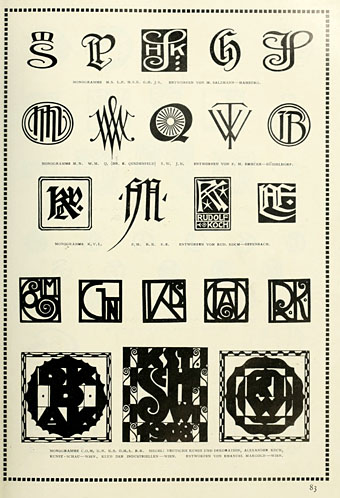
Continuing the delve into back numbers of Deutsche Kunst und Dekoration, the German periodical of art and decoration. There’s yet another frustrating jump in the numbers here, from volume 16 to volume 18 which covers the period from April to September 1906. Inside there’s more rectilinear interior design from the Wiener Werkstätte (above) as well as a great deal of less interesting interior design from elsewhere. The most notable feature of this edition is the article on the illustration work of Marcus Behmer, a member of Adolf Brand’s pioneering gay rights circle in Berlin whose drawings from this volume were featured in an earlier post.

As usual, anyone wishing to see these samples in greater detail is advised to download the entire number at the Internet Archive. There’ll be more DK&D next week.

dkd18-02.jpg

dkd18-03.jpg

Continue reading “Deutsche Kunst und Dekoration #18”

Weekend links 53

egyptian.jpg

Ancient Egyptian capitals from The Grammar of Ornament (1856) by Owen Jones at Egyptian Revival.

• Golden Age Comic Book Stories has been pulling out all the stops recently with entries for Will Bradley, Alphonse Mucha’s Documents Decoratifs (a companion volume to Combinaisons Ornementales), and pages from My Name is Paris (1987) illustrated by Michael Kaluta, an Art Nouveau-styled confection which features scenes from the Exposition Universelle of 1900. Related: Alphonse Mucha in high-resolution at Flickr.

The Sinking Of The Titanic by Gavin Bryars at Ubuweb, the first release on Brian Eno’s Obscure label in 1975. Bryars’ Titanic is an open composition which has subsequently been reworked and re-recorded as more information about the disaster has come to light. The accompanying piece on that album, Jesus’ Blood Never Failed Me Yet, is the only version you need unless you want Tom Waits ruining the whole thing in the later recording.

• Hayley Campbell claims to have the worst CV in the world but she has a better way with words than most people with bad CVs. She’ll be giving a talk with Tim Pilcher entitled Sex, Death, Hell & Superheroes at The Last Tuesday Society, 11 Mare Street, Bethnal Green, London, on April 8th. Just don’t shout “Xena!” if you attend.

Monolake live at the Dis-Patch Festival Belgrade, Serbia, 2007; 75 minutes of thumping grooves. Related: A video by Richard De Suza using Monolake’s Watching Clouds as the soundtrack.

• “I preached against homosexuality, but I was wrong.” Related: Gay Cliques, a chart, and Sashay shantay épée at Strange Flowers, the last (?) duel with swords fought in France.

• Mixtapes of the week: Electronica from John Foxx and Benge at The Quietus, and Ben Frost mashing up early Metallica, Krzysztof Penderecki, and late Talk Talk for FACT.

• A 40 gigpixel panorama of the Strahov Philosophical Library, Prague, described by 360 Cities as the world’s largest indoor photo.

How Hollywood Butchered Its Best Movie Posters; Steven Heller on Saul Bass.

• Back issues of Coilhouse magazine are now available to buy in PDF form.

Absinthe minded: The ruin of bohemians is back in all the best bars.

Fade Into You (1993) by Mazzy Star.