Jean Cocteau: Autoportrait d’un inconnu

cocteau1.jpg

The title translates as “self-portrait of an unknown” although “unknown man” would be better English. The phrase is a curious one to apply to Jean Cocteau, an artist (or “poet”, to use his favourite epithet) who was known for his creative work from a very early age. Director Edgardo Cozarinsky uses Cocteau’s own narration from a collection of documentary films to chart the evolution of a polymathic public life, following the progress of Cocteau’s art from the poetry of his youth (which the older man deemed “absurd”), to his involvement with the Ballets Russes, his films and plays, and his later flourishing as a painter of murals like those in the Chapelle Saint-Pierre de Villefranche-sur-Mer.

cocteau2.jpg

In one of the later scenes Cocteau is shown talking to a wax figure of himself, describing the dummy as the one who goes out into the world to receive the plaudits and brickbats accorded to “Jean Cocteau” while the real Cocteau stays quietly at home in the south of France. The quotidian Cocteau would be the “unknown” in this respect; there’s no mention of his life with Jean Marais, for example, but I’m happy enough to spend an hour listening to him talking about his art. The reference to brickbats is a reminder that in France he was often reviled during his lifetime, regarded as a dilettante and a fraud. This was especially the case in André Breton’s Surrealist circle where those who wanted to avoid excommunication had to support the master’s lasting animus against the unknown poet.

cocteau-dali.jpg

A pair of Surrealist untouchables, 1953.

Given this, I was amused to see a brief shot of Cocteau signing a wall with the most notorious member of Breton’s long list of outcasts, Salvador Dalí. Cocteau was friends with Dalí in later years, and in one of the film clips mentions the painter introducing him to the concept of “phoenixology” or the revival of dead matter. Dalí had biological science and his own immortality in mind but for Cocteau the idea becomes a metaphor for the artistic process, something we see in Le Testament d’Orphée and La Villa Santa Sospir when he pieces together the petals of disassembled flowers.

I was watching a copy of Cozarinsky’s film which may be downloaded at Ubuweb. The narration is in French throughout but English subtitles are available here.

Previously on { feuilleton }
Orphée posters
Cocteau and Lovecraft
Cocteau drawings
Querelle de Brest
Halsman and Cocteau
La Belle et la Bête posters
The writhing on the wall
Le livre blanc by Jean Cocteau
Cocteau’s sword
Cristalophonics: searching for the Cocteau sound
Cocteau at the Louvre des Antiquaires
La Villa Santo Sospir by Jean Cocteau
Weekend links 731

electrical.jpg

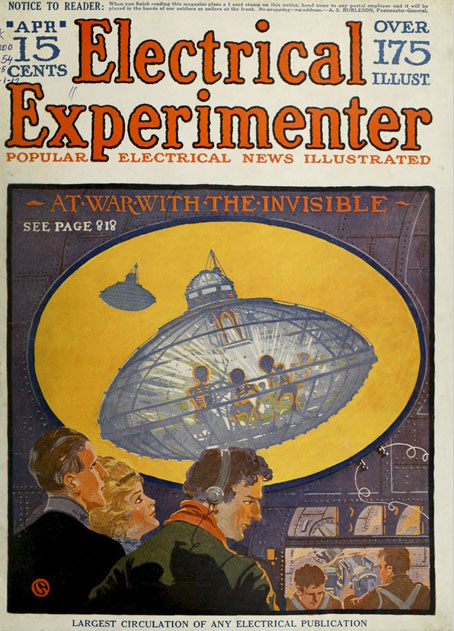
The Electrical Experimenter, Vol. 5, no. 1. April, 1918. Electrical cover art by Vincent Lynch.

• Coming soon from Rocket 88 Books: Electricity and Ghosts, a collection of art and graphic design by John Foxx/Dennis Leigh. The book itself has been designed with a regular Foxx collaborator, Jonathan Barnbrook. Last year I put together a post collecting Dennis Leigh’s book covers.

• At Strange Flowers: Lavinia Schulz and Walter Holdt, their Expressionist dance costumes, and their short, tempestuous lives. There’s more about the couple’s costumes and dances here.

• New music: Road to Mandalay by Laurie Anderson; Panorama (French Soundtracks & Rarities) by Various Artists; The Passage Of Time by Cosmos In Collision.

• At Public Domain Review: Raffaele Mainella’s illustrations for Nos Invisibles (1907), a Spiritualist text by Clotilde Briatte (writing as Charles d’Orinio).

Dennis Cooper’s favourite fiction, poetry, non-fiction, film, art, and internet of 2024 so far. Thanks again for the link here!

John Cale’s favourite music. Also The Records That Made Me by Carsten Nicolai/Alva Noto.

The mysterious mirrored monolith returns.

• RIP Donald Sutherland.

BBC Sound Effects.

Electricity (1967) by Captain Beefheart & His Magic Band | Electricity (1980) by Orchestral Manoeuvres In The Dark | Electricity (1995) by Pet Shop Boys

Atomos

awvfts1.jpg

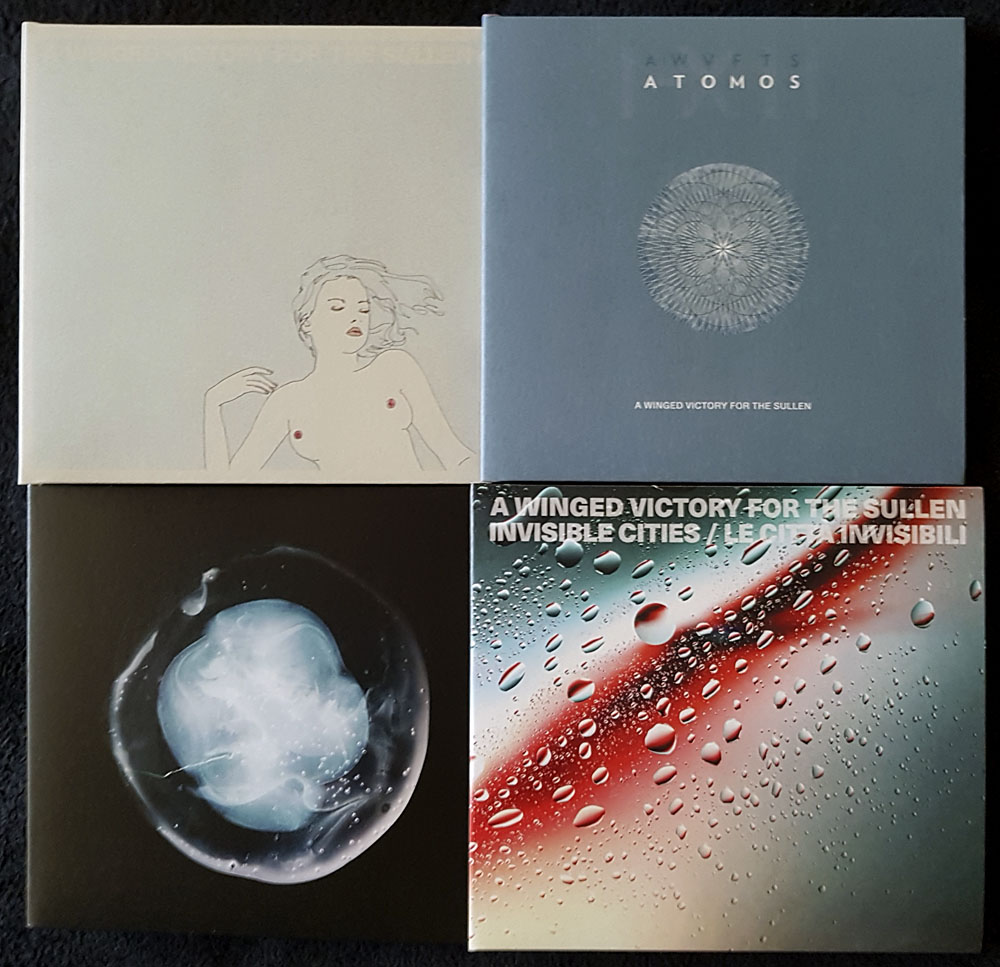
A Winged Victory For The Sullen (2011) / Atomos (2014) / The Undivided Five (2019) / Invisible Cities (2021).

A quartet of albums by A Winged Victory For The Sullen (Adam Wiltzie and Dustin O’Halloran) that have been regular visitors to my CD player over the past couple of weeks, especially the second one Atomos. Wiltzie and O’Halloran have been active as A Winged Victory For The Sullen since 2011 but their discography is a small one so I’ve been doing my usual thing of looking around for lengthy live recordings to avoid over-playing the studio albums. What you have here are four different performances of Atomos, most of which don’t vary much on the visual side but, for three of them at least, music is the primary concern.

awvfts2.jpg

Atomos (2014).
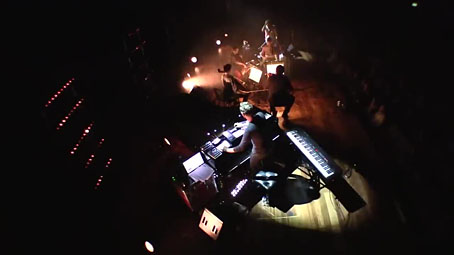
The music was originally commissioned by Wayne McGregor as a score for a dance piece so I was pleased to find a recording of the whole thing at McGregor’s Vimeo channel. Atomos works well enough as a standalone composition but seeing it presented like this throws a new light on the music. This is also the only place you can hear Atomos IV which for some reason is missing from the CD and vinyl releases.

awvfts3.jpg

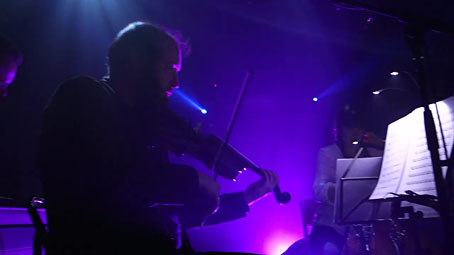
Boiler Room, Barbican, London (2014).
Boiler Room concerts are always good value, being long sets, professionally filmed and recorded.

awvfts4.jpg

Flèche d’Or, Paris (2014).
A performance filmed in a smaller venue with a single camera. The camera-work is from the amateur “hosepiping” school but the sound is excellent and you get a lot of close shots of the string players.

awvfts5.jpg

BBC Proms (2015).
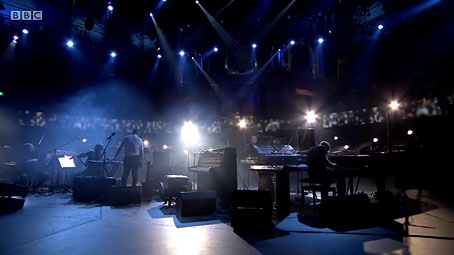
Mary Anne Hobbs presents the group at the cavernous Royal Albert Hall, together with a performance by pianist Nils Frahm who, at the time, was sharing a label with AWVFTS. A few of Wayne McGregor’s dancers also appear in this one. Half of the session is devoted to Frahm but he’s very good so it’s worth staying with.

Previously on { feuilleton }
Jóhannssonia
More Invisible Cities (and an invisible author)

Weekend links 700

demorgan.jpg

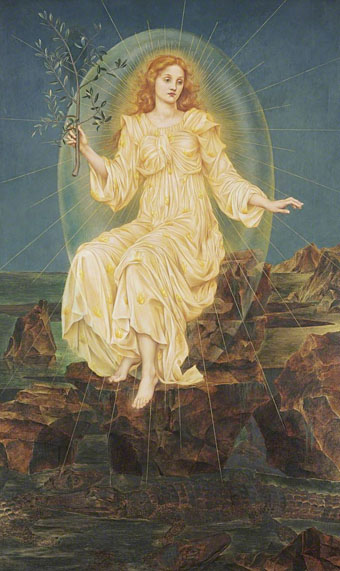
Lux in Tenebris (1895) by Evelyn De Morgan.

• “NASA celebrates the worm logo designer, Richard Danne“. Until I read this story (and this one) I wasn’t aware that the NASA logos were known as The Meatball and The Worm.

The Red Shoes: behind the scenes of the classic Powell and Pressburger film – in pictures. Related: Kings of the movies: Martin Scorsese on Powell & Pressburger.

• The 700th weekend post happens to arrive on Alan Moore’s 70th birthday. Many happy returns to the Northampton Magus.

Fundamentally, we face a choice. Either:

• it’s a coincidence that, of all the possible values that the finely tuned constants of physics may have had, they just happen to have the right values for life;

or:

• the constants have those values because they are right for life.

The former option is wildly improbable; on a conservative estimate, the odds of getting finely tuned constants by chance is less than 1 in 10-136. The latter option amounts to a belief that something at the fundamental level of reality is directed towards the emergence of life. I call this kind of fundamental goal-directedness ‘cosmic purpose’.

As a society, we’re somewhat in denial about fine-tuning, because it doesn’t fit with the picture of science we’ve got used to. It’s a bit like in the 16th century when we started getting evidence that our Earth wasn’t in the centre of the universe, and people struggled to accept it because it didn’t fit with the picture of the universe they’d got used to. Nowadays, we scoff at our ancestors’ inability to follow the evidence where it leads. But every generation absorbs a worldview it can’t see beyond. I believe we’re in a similar situation now with respect to the mounting evidence for cosmic purpose. We’re ignoring what is lying in plain view because it doesn’t fit with the version of reality we’ve got used to. Future generations will mock us for our intransigence.

Philip Goff, professor in philosophy at Durham University, making an argument for cosmic purpose

• At Spoon & Tamago: Exploring Japanese Hell through art from the 12th to 19th century.

• New music: Turning The Prism by Ben Frost, and Sanctuary Of Desire by Steve Roach.

• Mix of the week is DreamScenes – November 2023 at Ambientblog.

• DJ Food looks at Tomi Ungerer’s Electric Circus posters.

• At Dennis Cooper’s: Alain Resnais Day.

Strange Flowers visits the Villa Stuck.

Diet Of Worms (1979) by This Heat | Opera Of Worms (1981) by Van Kaye & Ignit| Wormhole (2002) by Cliff Martinez

Weekend links 649

chihuly.jpg

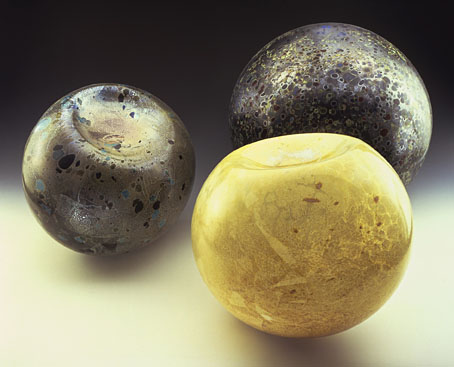
Niijima Floats: Mottled Blue Black Float with Silver Leaf (1991) by Dale Chihuly.

• “Blue whale songs fall below the range of human hearing. If you want to listen to one, to actually hear its ethereal patterns of wobbly pulses and haunting moans, you have to speed it up by at least two-fold. But according to Hildebrand and McDonald’s instruments, the tonal frequencies of the songs had been sinking to even greater depths for three straight years. ‘This is weird,’ Hildebrand thought. To figure out if it was just an anomaly or something more, Hildebrand and McDonald embarked on a quest to find some really old songs. Eventually they got their hands on some of the earliest known recordings, created by the Navy in the 1960s and stored on analog cassettes. They were floored. The frequencies had declined by 30 percent over 40 years.” Kristen French on a mysterious development in blue whale songs.

• “She didn’t see it as a game, or for divination, but as a model of the universe.” Joanna Moorhead on the Tarot designs of Leonora Carrington.

• “A collection of blogs about every topic”: ooh.directory. (Ta to whoever added this place to the list.)

• New music: Pop Ambient 2023 by Various Artists, and Aeolian Mixtape by Quinta.

• At Public Domain Review: The Tanzmasken of Lavinia Schulz and Walter Holdt.

• At Wormwoodiana: Mark Valentine on mazes and labyrinths. (Previously)

• At Spoon & Tamago: Paper-cut cityscapes by kirie artist Hiroki Saito.

• At Smithsonian Magazine: The Unrivaled Legacy of Dale Chihuly.

• Mix of the week: Neo-Medieval Mix by Moon Wiring Club.

• Old music: Back To The Woodlands by Ernest Hood.

• At Dennis Cooper’s: Jacques Rivette Day.

Weyes Blood’s favourite music.

(Gorgeous Curves Lovely Fragments Labyrinthed On Occasions Entwined Charms, A Few Stories At Any Longer Sworn To Gathered From A Guileless Angel And The Hilt Edges Of Old Hearts, If They Do In The Guilt Of Deep Despondency.) (2004) by Akira Rabelais | The Private Labyrinth (2008) by The Wounded Kings | Labyrinths (2018) by Jonathan Fitoussi & Clemens Hourrière