Hugo Steiner-Prag’s Golem

golem1.jpg

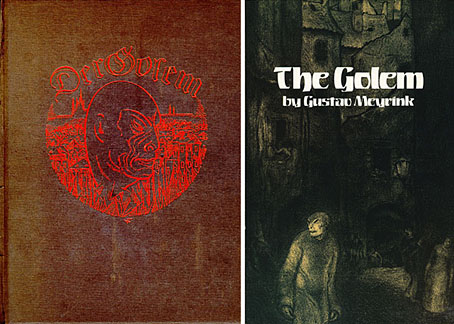
Der Golem, first edition (1915) and Dover reprint (1986).
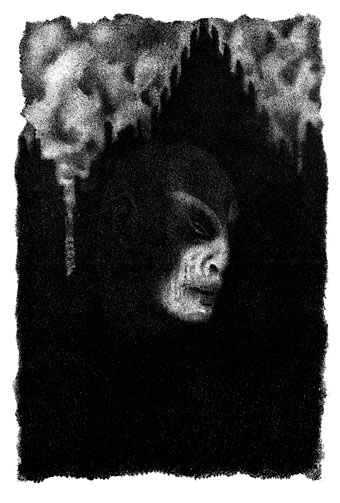
Illustrations by Hugo Steiner-Prag.

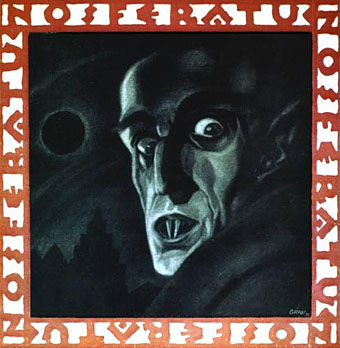
Before leaving Prague (for the time being), it’s worth mentioning the lithograph illustrations by Hugo Steiner-Prag (1880–1945) for Gustav Meyrink’s The Golem. These atmospheric drawings always remind me of the production sketches Albin Grau created for Murnau’s Nosferatu, eine Symphonie des Grauens in 1922. Grau was an occultist as well as a horror aficionado and would certainly have read Meyrink’s book which was a Europe-wide bestseller when first published. The success of the novel inspired Paul Wegener’s first Golem film (now lost) which in turn helped fuel the demand for horror films that led eventually to Nosferatu.

nosferatu.jpg

Nosferatu poster by Albin Grau (1922).

There’s little of Steiner-Prag’s work available on the web but the Dover paperback above contains all the illustrations. The novel has been re-translated recently but I’ve yet to read one of the more recent editions to see how it compares with Dover’s 1928 Madge Pemberton version.

golem3.jpg

The Golem by Hugo Steiner-Prag (1915).

Elsewhere on { feuilleton }
• The illustrators archive

Previously on { feuilleton }
• Nosferatu
• Barta’s Golem

Steven Soderbergh’s Kafka

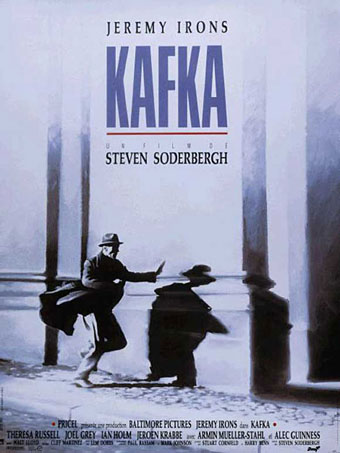
kafka_poster.jpg

Do you detect a theme this week? The recent Pragueness had me watching this favourite film again. I unfairly dismissed Soderbergh after his debut, Sex, Lies and Videotape (1989), which I found to be two hours of yuppie tedium despite its winning the Palme D’Or at Cannes. The prize did enable him to make Kafka (1991), however, so I shouldn’t complain although I didn’t get to see this until it turned up on TV years after its release. The film was a major flop and put Soderbergh in the wilderness until Out of Sight (1998), his first outing with George Clooney.

Kafka is one of a small group of works wherein well-known writers become embroiled in stories which parallel their fiction. Joe Gores’ Hammett (filmed by Wim Wenders in 1982) did this with Dashiell Hammett while Mark Frost in his novel, The List of Seven, had a pre-Sherlock Holmes Arthur Conan Doyle becoming involved in a Holmesian mystery. The screenplay for Kafka by Lem Dobbs has the author falling in with anarchist revolutionaries in order to solve the death of a co-worker and a bureaucratic conspiracy. This was obviously too clever for a general audience, being littered with references to Kafka’s life and work and also to German Expressionist cinema with names like “Orlac” and “Murnau” comprising key plot elements. Dobbs wrote a couple of other noteworthy screenplays after this, Dark City, a noirish fantasy that does what The Matrix did only with greater imagination, and The Limey (1999), another Soderbergh film with a great performance by Terence Stamp as a vengeful Cockney gangster on the loose in Los Angeles.
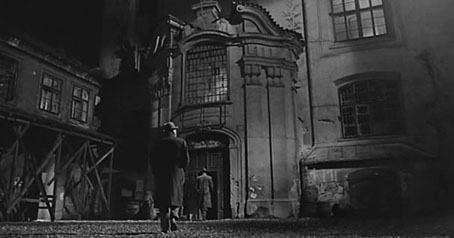
kafka.jpg

Alan Bennett had already written something similar to Kafka in his 1986 TV film for the BBC, The Insurance Man, which concerns a dye worker becoming enmeshed in the labyrinthine bureaucracy of the Worker’s Accident Insurance Institute where Kafka worked as a clerk. Daniel Day-Lewis made a marvellous Franz Kafka in Bennett’s play, and was much more suited to the role than Jeremy Irons is in Soderbergh’s film. This is a shame since everything else about Kafka is excellent, from Walt Lloyd’s moody photography, and the fabulous cymbalom-inflected score by Cliff Martinez, to the cast which includes the wonderful Theresa Russell, Joel Grey, Ian Holm and, in one of his last performances, Alec Guinness.

Kafka is also the Prague film par excellence, making great use of the city’s Old Town and landmarks such as the Charles Bridge and Prague Castle, a building which dominates the story as well as many of the outdoor scenes. In fact I find myself watching it as much for the settings than anything else. Soderbergh enjoys cinematic pastiche and Kafka owes a great deal to The Third Man (which did for post-war Vienna what Kafka does for Prague) and—inevitably—Orson Welles’ Kafka adaptation, The Trial. Theresa Russell brings Vienna with her via Nicolas Roeg’s Bad Timing, Joel Grey was in Cabaret, of course, and Alec Guinness isn’t so far removed from his role as retired spy George Smiley in the BBC’s John le Carré films. And halfway through the film there’s a great surprise which I won’t spoil here.

Kafka is available on DVD finally, although if you’re in the US you’ll have to import it. Soderbergh has talked about reworking the film in a longer version which I’d like to see if he ever gets round to it. Not an easy film to find but it’s worthy of your attention.

Previously on { feuilleton }
• Kafka and Kupka
• Alexander Hammid
• How to disappear completely
• Karel Plicka’s views of Prague
• Giant mantis invades Prague
• Nosferatu
• Barta’s Golem

Alexander Hammid

prague_castle.jpg

Two short films by Maya Deren’s husband are now available for viewing at Ubuweb. I’ve known about Hammid’s work for years but this is the first time I’ve seen any of it so these additions are very welcome. In a reversal of the usual state of affairs, the works of the wife overshadowed those of the husband even though they collaborated on Deren’s most famous film, Meshes of the Afternoon (which is also at Ubuweb).

Of the pair of films, Na Prazskem Hrade (At Prague Castle) (1931) is the most interesting for this Prague fetishist, a disjointed study of the architecture of the city’s castle which turns the building into an expressionist collage. Two obvious associations arise while watching this; one is Franz Kafka who lived for a time in the castle’s Hradčany district at 22 Golden Lane and whose novel, The Castle (1926), is inspired by the dominating presence of the building. The other is the Nazi invasion which took place a few years after the film was made and caused its maker and his wife to flee to America. The Nazi high command controlled the country from Prague Castle so the brief glimpse of marching soldiers in one shot can be seen as an ominous presentiment of the future. The castle has featured in bigger budget productions more recently, including one of my cult films, Steven Soderbergh’s Kafka (1991), and the underrated The Illusionist (2006) where Prague masqueraded as turn-of-the-century Vienna.

Previously on { feuilleton }
• Jan Švankmajer: The Complete Short Films
• Meshes of the Afternoon by Maya Deren
• How to disappear completely
• Karel Plicka’s views of Prague
• Giant mantis invades Prague
• Barta’s Golem

London Pride

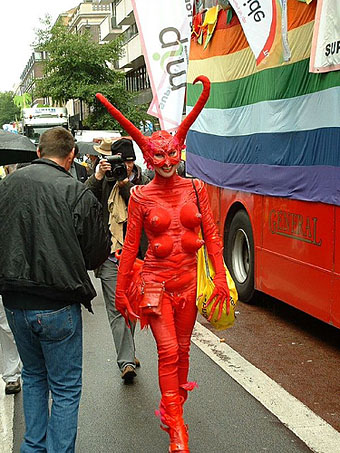
london_pride.jpg

One of the exotic creatures at today’s London Pride march. More pictures at this Flickr pool. Marchers braved wet weather and renewed terrorist threats after two unexploded car bombs were found on Friday. (And where that matter is concerned, The Register has a rebuke to the inevitable hysterics.)

nc-17.jpg

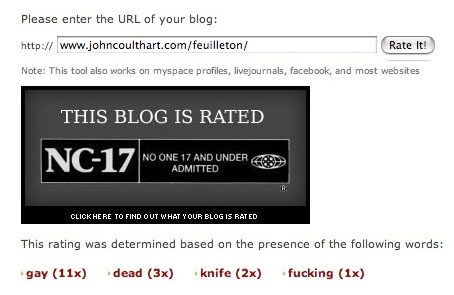
On a related note, this site has a feature that allows you to see how your blog (or page) would be rated by the MPAA. As Queerty notes, overuse of the word “gay” pushes up the supposed offensiveness quotient, something which results in this page receiving an NC-17 rating when it scans the past month of postings. Yes, it’s only a bit of web silliness but when the real Motion Picture Ass. of America has been shown to treat gay themes or stories with greater restriction than straight ones then it’s probably more accurate than its creators suspect.

Update: also in The Register, an ex-armed forces bomb-disposal operator explains why the London “terror clowns” shouldn’t be dignified with the hysteria they’ve been receiving.

Luther Gerlach’s Los Angeles

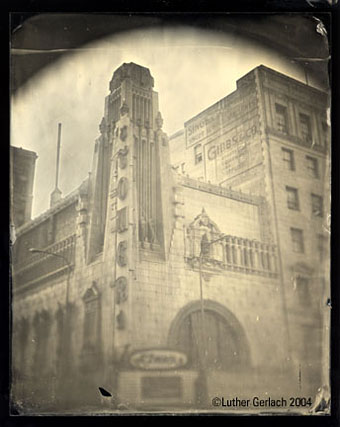
gerlach.jpg

Contemporary Los Angeles via Luther Gerlach’s wet-plate photography.

Using antique cameras he restores himself, and a wet-plate photographic process dating from 1851, Luther is completely immersed in this compelling method of vintage process. Gerlach says, “Quite often I feel as if my soul is in the past and my mind is in the future.” His ability to combine past and present becomes even more evident as he transports glass-plate film, restored cameras, lenses, precious metals and solutions to each photo location via his converted van. His unique use of the wet-plate process, combined with his contemporary style and provocative subject matter has propelled his work on the covers and featured editorial in respected publications, such as; View Camera, Celebrated Living, Shutterbug, and Montecito Journal to mention a few.

Previously on { feuilleton }
• The Bradbury Building: Looking Backward from the Future
• Downtown LA by Ansel Adams