The Late Show: Thomas Pynchon

pynchon1.jpg

Among other things, I’ll remember 2021 as the year of Too Much Work, but it’s also been the year of reading several thousand pages of Thomas Pynchon’s prose. After finally getting through Gravity’s Rainbow back in June (having also read V. and The Crying of Lot 49) I continued with the rest of the Pynchon oeuvre, working my way through Vineland, Mason & Dixon, and Inherent Vice. And after reading the latter I watched the film adaptation again which I found to be much more enjoyable and less confusing the second time round. (Moral: read the novel first). I’m currently ploughing through Against the Day, not worrying too much about how all the various episodes are supposed to join together.

pynchon2.jpg

The commendable inaccessibility of Pynchon the man means that documentary features about his books are scarce. Television abhors an authorial vacuum which is why so many TV documentaries about long-dead or otherwise unavailable writers resort to the cliches of a silhouette hammering away at a typewriter, or an actor in period clothing scribbling in a dimly-lit room. The BBC, in the days when it still used to make programmes about books and writers, often evaded the absurdities of docu-drama by the simple expedient of having a suitable actor read portions of prose, which is what we have in this all-too-brief Pynchon feature from 1990. The Late Show was a nightly fixture on BBC 2 at this time, with a remit to cover anything newsworthy in the cultural sphere. Vineland was about to be published in Britain so editor David Gale was called upon to explain to viewers the lure of Pynchon’s novels and their mysterious author. It’s a fascinating piece which achieves in a mere 19 minutes what Thomas Pynchon – A Journey into the Mind of [P.] barely manages in an hour and a half. As with the Dubinis documentary, there’s some discussion of the authorial enigmas but Gale keeps the novels to the fore. It’s amusing with hindsight to hear about the critical disappointment that greeted the arrival of Vineland—Pynchon’s first novel after a silence of 17 years—knowing that the monumental Mason & Dixon would be published a few years later. Commentary is supplied by publishing heavyweights Tom Maschler, Dan Franklin and John Brown (two of whom describe their meetings with the elusive author), together with critic Rhoda Koenig and critic/poet Eric Mottram, here interviewed with a picture of one of his favourite authors, William Burroughs, peering over his shoulder.

Previously on { feuilleton }
Esoterica 49
Pynchonian cinema
Going beyond the zero
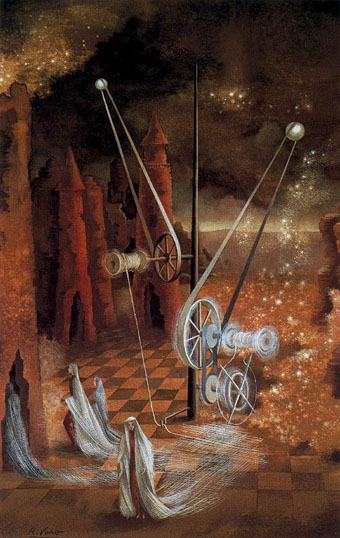
Pynchon and Varo
Thomas Pynchon – A Journey into the Mind of [P.]

Weekend links 601

innocents.jpg

The Innocents (1961), one of the great cinematic ghost stories.

• “Out of the many adaptations, Jack Clayton’s [The Innocents] is considered the benchmark. The film celebrated its 60th anniversary this year, having premiered in London on the 24th of November, 1961. Considering the sheer number of competitors to Clayton’s version, it is telling of the film’s qualities that it still stands far and above its many peers. In fact, it is difficult to see James’s story without those stark black-and-white images of the film coming to mind, as well as its stunning central performance by Deborah Kerr. Suffice to say, 60 years on, James’s screen ghosts still haunt.” Adam Scovell on the many adaptations of The Turn of the Screw by Henry James.

• “I wanted to turn sex into art because art makes sense of life.” Jack Fritscher talks to photographer Rick Castro about gay S&M fetishes, Drummer magazine, Robert Mapplethorpe, and his BDSM porn studio, Palm Drive Video.

• “Fela was a very good human resources manager.” Lemi Ghariokwu, creator of over 2,000 album covers, talks to Nathan Evans about his time working for Fela Kuti.

I’ve been approached several times to ‘make an NFT’. So far nothing has convinced me that there is anything worth making in that arena. ‘Worth making’ for me implies bringing something into existence that adds value to the world, not just to a bank account. If I had primarily wanted to make money I would have had a different career as a different kind of person. I probably wouldn’t have chosen to be an artist. NFTs seem to me just a way for artists to get a little piece of the action from global capitalism, our own cute little version of financialisation. How sweet—now artists can become little capitalist assholes as well.

Brian Eno on the fool’s-goldrush du jour

• At Vimeo: The Snail on the Slope, a film of generative processes by Vladimir Todorovic based on the strange science-fiction novel by Arkady and Boris Strugatsky.

• At Dangerous Minds: an exploration of Eight Songs for a Mad King by Peter Maxwell Davies, “one of the most insane pieces of music ever written”.

• “This is how one ought to see, how things really are.” Ido Hartogsohn on Aldous Huxley’s mescaline experiments.

• Always an essential guide: The Wire magazine’s releases of year.

• The end of December brings us Alan Bennett’s diary at the LRB.

• At Dennis Cooper’s: Ryoji Ikeda Day.

Innocenti (1992) by Brian Eno | Innocent Square [excerpt] (2011) by Christian Skjødt Hasselstrøm | First In An Innocent World (2016) by The Pattern Forms

René Bull’s Russian Ballet

bull06.jpg

L’Oiseau de feu.

I’m sure I’ve said this before but one reason I spend so much time scouring the Internet Archive is in the hope of turning up gems like this recent arrival. The Russian Ballet was a study by Alfred Edwin Johnson of the Ballets Russes, written for an English readership and published in 1913 shortly after Diaghilev’s company had staged their historic performance of Le Sacre du printemps in Paris. Johnson discusses this event, which he attended, but he gives equal space to examinations of the company’s other ballets, from earlier avant-garde pieces like L’après-midi d’un faune to that hardy perennial, Swan Lake. In place of production sketches or photographs we have René Bull’s many illustrations, in colour plates and black-and-white drawings, with the chapters being announced by a title in a graphic style that matches the theme of each ballet. I’d only seen a few of these before on a Flickr page so it’s a treat to see the whole book at last.

bull01.jpg

Schéhérazade.

Johnson’s discussion has a tendency to falter when faced with the difficulty of describing a wordless artistic medium. The problem is compounded by the radical nature of many of the ballets, so that Bull’s illustrations become an essential component of the book, giving a flavour of the costumes and dances while the author attempts to relate the emotional qualities of the performances. Bull’s work here isn’t as elaborate is in his illustrated Rubáiyát but then the drawings are serving a documentary purpose.

bull02.jpg

Schéhérazade.

bull03.jpg

Schéhérazade.

bull04.jpg

Narcisse.

Continue reading “René Bull’s Russian Ballet”

Weekend links 600

window.jpg

My kind of window. From a collection of machine-learning images by Unlimited Dream Co. Via Bruce Sterling.

• “I will never call myself a queer. That word is one of the things that I detest that has happened, and it’s almost being forced now. For me, you cannot separate that word from the hatred and violence that once accompanied it. When I read it being used in The New York Times, I think, ‘It’s their word and they can fucking have it all they want.’ I will never use ‘queer.’ It’s an ugly word.” John Rechy, still active at the age of 90, talking to Jeff Weiss about hustling, social opprobrium, and his pioneering books.

• “At a time when we are being constantly told that humanity is destroying the planet, it is somehow comforting to see nature not merely outlasting, but triumphing over humanity’s constructions—as nature does in many of Piranesi’s Views of Rome.” Alasdair Palmer on Piranesi’s peerless renderings of Roman ruins.

• “The magical aspect of Get Back is its total refusal to adhere to the standard tropes of music documentaries. There are no talking heads commenting on the Beatles’ greatness, no continual barrage of quick edits and highlights.” Geeta Dayal on Peter Jackson’s resurrection of the Fab Four.

But men are not traditionally meant to be objects of art. “Men look at women,” John Berger wrote. “Women watch themselves being looked at.” When men look at men, however, they break rules. “I didn’t set out to be radical,” says Miller. “But I was at a fair and I had a huge nude on a stand by Michael Leonard. I’d only been open ten minutes and a woman started having a go and saying it’s filth. What I found fascinating is she’d walked past a whole span of female nudes. I think society is just immune to female nudity. People don’t see it. If you take this to the straight world of an art fair, it provokes reactions other dealers don’t get. There isn’t anyone else like me.”

Tony Wilkes talks to Henry Miller, owner of an art gallery devoted to the male form

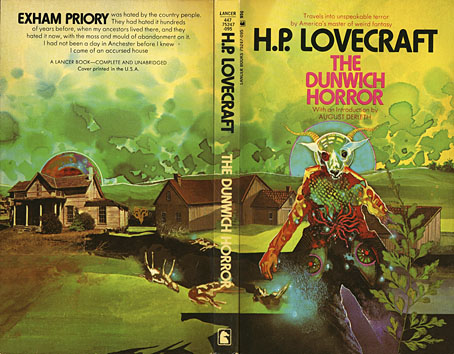
• “I imagine men with starched collars, horrified by an animal with no hard edges to grab onto, no solidity to venerate. Something low, lateral, creeping.” Fiona Glen on “Devil Fish”, Cthulhu and cephalomania.

• I like glowing things so Brian Eno’s glowing record turntable has an immediate appeal. A shame it’s a very limited production which is almost certainly sold out by now.

• The next release on the Ghost Box label will be A Letter from TreeTops by Pneumatic Tubes.

• At Dangerous Minds: A Sight for Sore Eyes Vol. 1, a visual history of The Residents.

• At Wormwoodiana: Mark Valentine on the supernatural thrillers of Archie Roy.

• Mix of the week: A reflection on 2021 at A Strangely Isolated Place.

Swan River Press looks back over a year of book production.

• New music: Spherical Harmonics by Joseph Hyde.

Octopus’s Garden (1969) by The Beatles | The Kraken (2006) by Hans Zimmer | Kraken (2017) by Dave Clarkson

The Knowles’ Norse Fairy Tales

knowles01.jpg

More tales from the northern lands, and a book illustrated by two people this time. The Knowles were a pair of brothers, Reginald Lionel (1879–1954) and Horace John (1884–1954), who produced several illustrated editions together while also working independently. Sibling illustrators are unusual but not unprecedented; the Knowles’ contemporaries included the Robinson brothers—Charles, William (Heath) and Thomas—who worked together on an edition of Hans Christian Andersen’s stories. Norse Fairy Tales (1910) is a collection of folk stories that overlap in places with the more familiar tales from Denmark and Germany. The book was compiled by FJ Simmons from Norwegian collections by Peter Christen Asbjørnsen and Jørgen Moe which had been translated into English by George Webbe Dasent. Simmons says in his introduction that he edited (or bowdlerised) his selection a little in order to make some of the pieces suitable for a young readership although he doesn’t give any details. His book is one I ought to have gone looking for sooner after I swiped part of a related illustration for a CD design some time ago. A drawing by Reginald Knowles of a troll walking among trees appears in a source book of Art Nouveau graphics which I’ve borrowed from for many years. Reginald’s trees proved to be perfect for the CD. This was a lazy move on my part but I’d been asked to rescue a design which wasn’t working, and the deadline was a tight one.

knowles16.jpg

Simmons may have trimmed some of the texts but Norse Fairy Tales still runs to 55 stories that fill 500 pages for which the Knowles’ provide full-page illustrations, a few colour plates and many smaller drawings. Each artist is identifiable by their initials. All the black-and-white art is pen-and-ink but Horace’s drawings imitate the style of early wood engravings, a look that works well with the material, while Reginald’s drawings would be identifiable even without his initials since his work tends to be a little more stylised, as with the sinuous trees that I borrowed. This is an impressive book that might be better known if there wasn’t such a profusion of illustrated Brothers Grimm and Hans Andersen collections. Find out what the trolls are getting up to here.

(Note: the Internet Archive scan has excessively browned pages. All the images here have been run through filters to remove the colouration.)

knowles15.jpg

knowles14.jpg

knowles13.jpg

Continue reading “The Knowles’ Norse Fairy Tales”