Haunter latest

haunter2006_spread.jpg

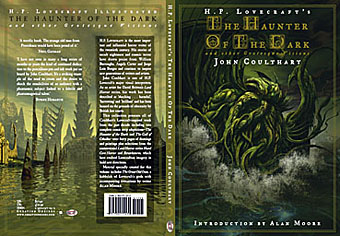
My book of Lovecraft adaptations and illustrations, The Haunter of the Dark and other Grotesque Visions (Creation Oneiros), is now available for pre-order from a number of outlets, including Amazon.com, Amazon.co.uk and Barnes & Noble.

Publication is officially set for September 15th, 2006.
Sample pages and other news here.

“At its far edge, horror shades into beauty, and it is far beyond
that edge that Coulthart takes us, into terrible magnificence.”
Alan Moore, in the book’s introduction

“A terrific book, haunting and beautiful.
That writer from Providence would have been proud…”
Neil Gaiman

Nova Swing

nova_swing.jpg

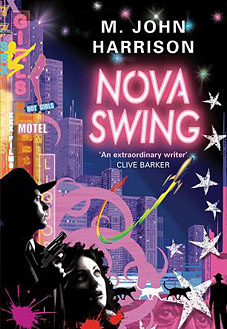
The always excellent M John Harrison has a new sf novel out soon, Nova Swing, set in the same future as his masterful Light. You can read a sample of it on his website.

Harrison, along with Moorcock, Ballard, Alan Moore and Iain Sinclair, is one of Britain’s finest living writers. He’s the creator of one of my favourite fantasy cities, Viriconium, and author of a number of intelligent (and often disturbing) novels and short stories. He’s one of the few living writers equally adept at working with the big three genres—sf, fantasy and horror—whilst also being able to write straightforward “literary” fiction with far greater facility than the usual suspects that clog the Booker lists. The novels don’t come very often so a new one is an event, and something worthy of your attention.

Davy Jones

davy_jones.jpg

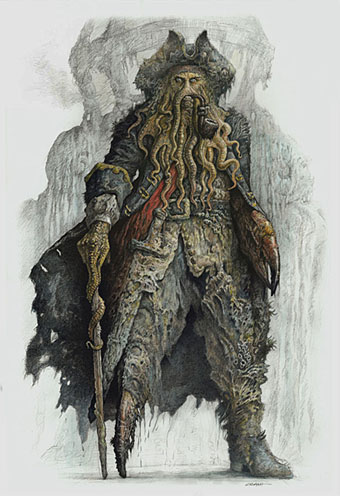
No, not the dreadful singer from The Monkees but he of the undersea locker and also the new villain in Pirates of the Caribbean: Dead Man’s Chest. Bill Nighy plays this splendidly-designed character, with the assistance of some CGI to get those tentacles working. I’ve still not seen the first film but the look of this makes me more interested in the series as a whole.

Aside from William Hope Hodgson‘s sea tales, the pirates plus voodoo/Sargasso Sea angle has rarely been exploited properly in fiction. Tim Powers had a go in On Stranger Tides but the results fell rather flat. In film there’s been hardly anything apart from the Hammer oddity The Lost Continent (1968), based on Uncharted Seas, a Dennis Wheatley potboiler that plundered Hodgson’s Sargasso Sea stories. The new Pirates film may be about to amend this situation; Davy Jones looks like something dreamed up after a heavy diet of Hodgson and HP Lovecraft.

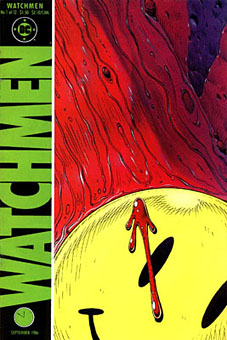
Watchmen

watchmen.jpg

This year sees the 20th anniversary of the publication of Watchmen by Alan Moore and Dave Gibbons. The landmark comic book, one of the few to deserve the designation “graphic novel”, remains a particular favourite of mine, and one that still excites for its consummate command of the comics medium. The following is a very long round table discussion with Watchmen‘s creators from issue 100 of Fantasy Advertiser, first published in March 1988. It’s surprising that this doesn’t seem to have been posted anywhere else on the web as it’s an excellent discussion about this great book.

Spoiler warning: this piece discusses in depth just about every revelation in the story so you’d be advised to skip it if you haven’t read the book.

MARTIN SKIDMORE: Alright, let’s have a starting point… just what is it about Watchmen that distinguishes it from other…
STEVE WHITAKER: Cream cheeses?
MS: …superhero comics on the market?
DAVE GIBBONS: Is this in the form of direct questions to us, or…
FIONA JEROME: No, we’re all gonna talk.
DG: Well, I’ll have a schnoozle then…
SW: The thing that I think distinguishes Watchmen from other comics is that the series holds together more like a novel. Your climax isn’t in the last 3 panels in Watchmen 12. There are long quiet tracts with exciting bits or…moderately exciting bits (LAUGHTER) In terms of Jack Kirby Wham! Smash! Pow! it’s all very quiet. There’s a lot of suffering but…
MS: …it’s all emotional rather than physical suffering.
ALAN MOORE: It’s a difficult question for me and Dave to answer, probably one that you could answer better, but if I had to say anything then it’s the degree of structure that me and Dave have applied to it—I can’t think of many examples of that degree of structure, that degree of layering.
FJ: I was going to say: especially visually you don’t get such a use of motif certainly not in American comics.
MS: Doug Moench has used it occasionally.
FJ: But not with the same complexity and not filling-in with written structure as well.
PETER HOGAN: The thing is: you’re given a world. The characters, alright, they’re based on the Charlton Characters but they’re new as of page 1. Even so, they’re characters with a history that comes out over the course of the thing… Their world has a history… it has a cohesion to it.
SW: Something that quite interests me now we’re talking about structure and stuff, is the symmetry—there is a real symmetry to Watchmen and the way the characters are set up.
DG: Two arms… two legs. (LAUGHTER)
MS: Perhaps the Comedian and Rorschach…
SW: I was thinking more of Osterman and Ozymandias.
MS: That’s right—the intellectual and physical, chaos and law…
AM: It’s difficult pinning down what’s symmetrical to what—I mean to me, at least to some extent, there’s an equally good case for contrasting Nite Owl and Rorschach.

Continue reading “Watchmen”

Dunwich

dunwich.jpg

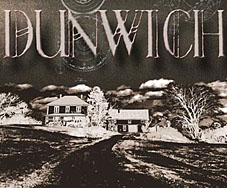
Christian Matzke writes to inform me that his short film, Dunwich, based on two HP Lovecraft stories, The Dunwich Horror and The Terrible Old Man, is in production, and that he and co-director Sarah Tarling used my Dunwich Horror adaptation as inspiration. I’m very pleased to hear this, of course, and look forward to seeing how their prequel to the events in Lovecraft’s story turn out. The film’s website has more information.