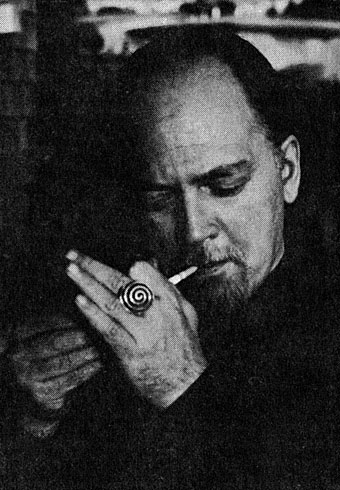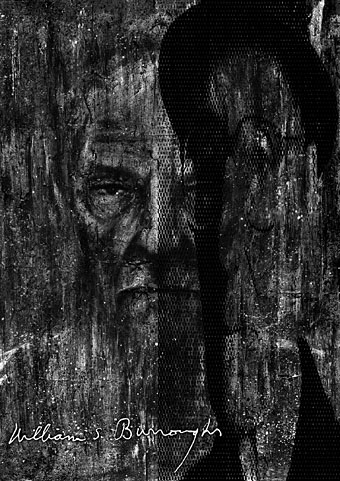
Robert Anton Wilson, 1932–2007

raw.jpg

There are few people who really change your life but Robert Anton Wilson—who died earlier today—certainly changed mine. Wilson’s Illuminatus! trilogy (written with Robert Shea) was my cult book when I was at school in the 1970s, a rambling, science fiction-inflected conspiracy thriller that opened the doors in my teenaged brain to (among other things) psychedelic drugs, HP Lovecraft, James Joyce, William Burroughs and Aleister Crowley as well as being a crash-course in enlightened anarchism. I’ve had people criticise the books to me since for their ransacking of popular culture but this was partly the point, they were collage works, and they worked as a perfect introduction for a young audience to worlds outside the usual circumscribed genres.

The philosophical side of Wilson’s work was probably the most important at the time (and remains so now), his “transcendental agnosticism” made me start to question the adults around me who were trying to force my life to go in a direction I wasn’t interested in at all. I’m sure I would have resisted that kind of pressure anyway but the value of RAW’s writings in Illuminatus! and the later Cosmic Trigger came with being given an intelligent rationale for those decisions; I couldn’t necessarily articulate why I was “throwing my life away” by wanting to drop out of the whole education system but Wilson’s work had convinced me it was the right thing to do. I still mark the true beginning of my life as May 1979, the month I left school for good.

He wouldn’t want us to be maudlin, I’m sure. It’s typical for a writer who spent so much of his life writing about drugs and coincidences that he managed to die on Albert Hofmann’s birthday. So I’ll just say thank you Robert, for changing my life. And Hail Eris!

Previously on { feuilleton }
The Absolute Elsewhere

The Poet and the Pope

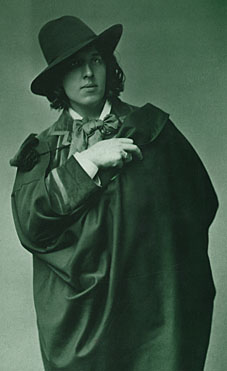
oscar.jpgIrony never rests in the world of religion these days. I suspect Oscar would be pleased by this attention, he had an audience with Pius IX when he was a young man and wrote a poem, Urbs Sacra Aeterna, to celebrate the occasion. As noted earlier, a recent Out.com article explored rumours that the Vatican may be more friendly with Dorothy than is usually supposed.

Vatican comes out of the closet and embraces Oscar
Although Oscar Wilde had a gay relationship, the Vatican is championing his razor-sharp moral maxims, not his lifestyle.

Richard Owen
Friday, January 5th, 2007
The Times

Oscar Wilde, poet, playwright, gay icon and deathbed convert to Catholicism, has been paid a rare tribute by the Vatican. His aphorisms are quoted in a collection of maxims and witticisms for Christians that has been published by one of the Pope’s closest aides.

Wilde (1854-1900) had long been regarded with distaste by the Vatican — a dissolute and disgraced homosexual who was sentenced for acts of gross indecency over his relationship with Lord Alfred Douglas.

The book, compiled by Father Leonardo Sapienza, head of protocol at the Vatican, includes such Wildean gems as “I can resist everything except temptation” and “The only way to get rid of a temptation is yield to it” — hardly orthodox Catholic teaching.

Father Sapienza said that he had devoted the lion’s share of Provocations: Aphorisms for an Anti-conformist Christianity to Wilde because he was a “writer who lived perilously and somewhat scandalously but who has left us some razor-sharp maxims with a moral”. The book also includes contributions from the Colombian philosopher Nicolás Gómez Dávila.

Father Sapienza said that Wilde had been a great writer of powerful force and dazzling intelligence who was now chiefly remembered not for his promiscuity but for plays such as The Importance of Being Earnest and An Ideal Husband as well as moral tales such as The Picture of Dorian Gray, in which a vain young man pays a terrible price for selling his soul to gain eternal youth.

Father Sapienza said that he wanted to “stimulate a reawakening in certain Catholic circles”. Christianity was intended to be a radical cure, not a humdrum remedy for the common cold: “Our role is to be a thorn in the flesh, to move people’s consciences and to tackle what today is the No 1 enemy of religion — indifference.”

“What a surprise!” La Repubblica’s said. “A homosexual icon has been accepted by the Vatican.” Orazio La Rocca, a Vatican watcher, described the book as a bombshell.

Pope Benedict XVI is a stern opponent of gay marriage and has reinforced Catholic teaching that homosexuality is a disorder. On the other hand he has belied his reputation as a hardliner since his election, reserving most of his fire for apathy and relativism in an attempt to revive Christian faith in Europe.

Wilde, who was married and had two children, was arrested and tried in 1895 over his relationship with Lord Douglas (known as Bosie), son of the Marquess of Queensberry, who had accused Wilde of sodomy. The writer sued Queensberry but lost and was sentenced to two years’ hard labour.

He displayed a long fascination with Catholicism, once remarking: “I am not a Catholic — I am simply a violent Papist.” He was born in Dublin to a Protestant family but fell under the spell of Catholicism at Oxford. He even made a journey for an audience with the Pope, but declared: “To go over to Rome would be to sacrifice and give up my two great Gods: Money and Ambition.” The way for Wilde’s rehabilitation was paved six years ago by a Jesuit theologian, Father Antonio Spadaro. On the centenary of Wilde’s death, he raised eyebrows by praising the “understanding of God’s love” that had followed Wilde’s imprisonment in Reading.

Father Spadaro said that at the end of his life Wilde had seen into the depths of his own soul and in his last works, such as De Profundis, had made “an implicit journey of faith”. He said that Wilde had come to see that God was capable of “breaking hearts of stone and entering into them with mercy and forgiveness”.

The wit and wisdom of Wilde

• Those who see any difference between soul and body have neither.
• I am not in favour of long engagements. They give people the opportunity of finding out each other’s character before marriage.
• One’s real life is often the life that one does not lead. I see an intimate connection between the life of Christ and the life of the artist. Christ’s place indeed is with the poets.
• I can resist everything except temptation.
• We are all in the gutter, but some of us are looking at the stars.
• It is the confession, not the priest, that gives us absolution.
• The only way to get rid of a temptation is to yield to it.
• There is only one thing in the world worse than being talked about, and that is not being talked about.
• Children begin by loving their parents; as they grow older they judge them; sometimes they forgive them.
• Nothing makes one so vain as being told that one is a sinner.
• In this world there are only two tragedies. One is not getting what one wants, and the other is getting it.
• What is a cynic? A man who knows the price of everything and the value of nothing.
• Experience is the name everyone gives to their mistakes.
• What a pity that in life we only get our lessons when they are of no use to us.

Previously on { feuilleton }
Gay for god
The Picture of Dorian Gray I & II

SAJ again

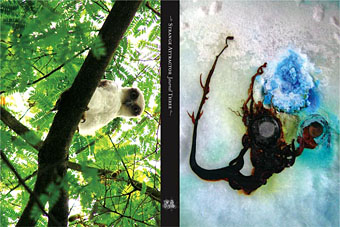
saj3.jpg

Yes, it’s that magazine again, the perfect thing to feed your head for the new year.
Mark P and SAJ are profiled in the latest Wire.

Ken Hollings rides the world’s subcultural currents mapped by London’s Strange Attractor.

The Wire #275, January 2007

Strange Attractor is well named. There’s really no escaping it. Starting out as a series of live events, it has slowly transmuted into an annual publication, set up an online clearing house for the weird and the wonderful and recently made its first move towards establishing itself as a publishing house. “Strange Attractor celebrates unpopular culture,” runs its mission statement. “We declare war on mediocrity and a pox on the foot soldiers of stupidity. Join us.” Who could possibly resist such a challenge? Sooner or later you have to get involved. (In the interests of full transparency: the writer of this article has taken part in a number of Strange Attractor evenings and is a regular contributor to Strange Attractor Journal.)

With orders for the Strange Attractor publications coming in from all over the world, and mainstream media like The Independent On Sunday praising it for producing “one of the most weirdly beautiful, beautifully weird magazines of the past hundred-odd years” a bigger problem presents itself. How do you celebrate unpopular culture without losing its unpopularity?

“There’s certainly no business plan,” admits Strange Attractor Journal‘s publisher and chief editor, Mark Pilkington. “We’re really making it all up as we go along. I hope that Strange Attractor‘s approach to culture is simultaneously that of the archaeologist, the ethnographer, the anthropologist, the occultist, the showman and the curator.”

It’s a heady mix. The first two issues, both book-sized anthologies running to more than 200 and 400 pages apiece, have presented material ranged across such elusive topics as mind control experiments, mould art, hair sculpture, cargo cults, neglected gods and forgotten waxworks. Such a list limits more than it clarifies, however. Strange Attractor Journal is concerned less with the unexplained than with the unexpected. You never know what it will cover next.

“I think Strange Attractor is refreshing to people in that it manages to straddle several cultural channels while still following its own agenda,” Pilkington admits, “and it’s one not driven by the same obvious memes. But at the same time it’s important that it doesn’t become obscurantist for its own sake—some things are lost for a reason, others will only resurface when the time is right.”

Strange Attractor‘s wayward eclecticism dates back to a series of monthly events begun in the summer of 2001 by Pilkington in collaboration with artist John Lundberg and continuing over the next two years. Staged at London’s Horse Hospital venue, they gave an early indication of the loose network of experimental enterprises that was starting to come into existence, linking outsider artists with cultural anthropologists, textual hackers and practising occultists.

“We’d mix talks, films, music, presentations, each night being themed around a different topic,” Pilkington recalls. “I rather pretentiously called them ‘information happenings’. Subjects ranged from conspiracy theory to theremins, Esperanto to magick, hoaxes, illusions and psychic deceptions: basically anything that interested us and could draw people that we liked or wanted to meet into one place.” Highlights included a live and bloody demonstration of psychic surgery, sci-fi movie themes played on vintage electronic instruments and a live Lovecraft-influenced Chaos Magick ritual with a soundtrack performed “by a band who couldn’t see what was going on.”

After Lundberg enrolled at the National Film and Television School, Pilkington went solo but eventually grew tired of doing regular live events, deciding instead to do something that would last longer: hence the Journal.

The notion of outliving the moment, of being around for more than just a quick cultural fix, is very much a part of SAJ‘s overall look and feel. The first thing you notice is that the front and back cover of each issue is devoid of text or title, which only appears on the book’s spine. If you want to know who the contributors are, you’ll have to look inside.

“For me, it was about giving as much space as possible to striking images and therefore making them stand out on the bookshelf,” Pilkington explains. “I imagined people being aware that something was wrong with the cover but perhaps not being able to put their finger on it.”

The absence of cover copy also binds together the Journal‘s various contributors in the anonymity of a collective endeavour. “We’re lucky enough to live in an age where we can clearly trace the influences of the past on our present,” Pilkington continues, “and it’s not always today’s most celebrated ideas, musicians and writers who will be remembered. This notion of timelessness is very important to what SAJ is and does. I’d like the books to be as irrelevant to a reader 100 years in the future as it would be to someone 100 years in the past. It’s a re-manipulation of the notion of built-in obsolescence.”

The Journal‘s pages teem with old woodcuts, antiquated typefaces and intricate layouts, giving the impression of having been produced in some parallel past: one that runs counter to established tenets of historical development. Having previously worked as a journalist for periodicals as varied as Fortean Times, Bizarre and The Guardian, Mark Pilkington remains keenly aware of what’s going on around him.

“There’s a particularly vibrant, very loose cultural network in London at the moment,” he remarks, “one that incorporates music and sound, ideas and information, visual arts and almost anything else you’d care to imagine. It’s inevitable that these people, places and events all bounce off and influence each other in a kind of subcultural Brownian motion.”

As well as working closely with designer Alison Hutchinson, readying volume three for publication, Pilkington has also been getting Strange Attractor Press up and running. Its first book to date, The Field Guide: The Art, History And Philosophy Of Crop Circle Making by Rob Irving and John Lundberg, is a particularly cerebral blend of art theory, paranormal phenomena, hoaxes and speculations, ruggedly bound and designed to fit snugly inside your knapsack while out exploring the British countryside. Conventional wisdom says it shouldn’t work, but Strange Attractor‘s own particular blend of parlour magic proves that it does.

“I sometimes see myself as a medium,” Mark reveals, “a channel for all the material that has formed Strange Attractor. I’ve been incredibly lucky with the amazing contributions the Journal has attracted so far.”

There’s no escaping it. Strange Attractor really is well named.

Strange Attractor Journal Three, and The Field Guide: The Art, History And Philosophy Of Crop Circle Making by Rob Irving & John Lundberg, are available now.

www.strangeattractor.co.uk

Previously on { feuilleton }
Strange Attractor Journal Three
How to make crop circles

Angels 4: Fallen angels

delville_satan.jpg

The Treasures of Satan by Jean Delville (1894).

Some more favourite paintings today. Jean Delville produced a splendidly strange portrayal of Satan as an undersea monarch lording it over a sprawl of intoxicated, naked figures. When Savoy Books decided to put together the definitive version of David Lindsay’s equally strange fantasy novel, A Voyage to Arcturus, I felt this was the only painting adequate to the task of filling out the cover. That was in 2002; a year later Gollancz used the same painting on the cover of their Fantasy Masterworks paperback edition of the book. Lindsay’s book has been plagued by bad cover art for years so we managed to raise the bar for future editions. Delville was one of the great painters of the Symbolist school, all his work is worth looking at.

There are numerous representations of Lucifer but Franz Stuck’s is especially striking and apparently caused viewers to cross themselves before it when it was first exhibited.

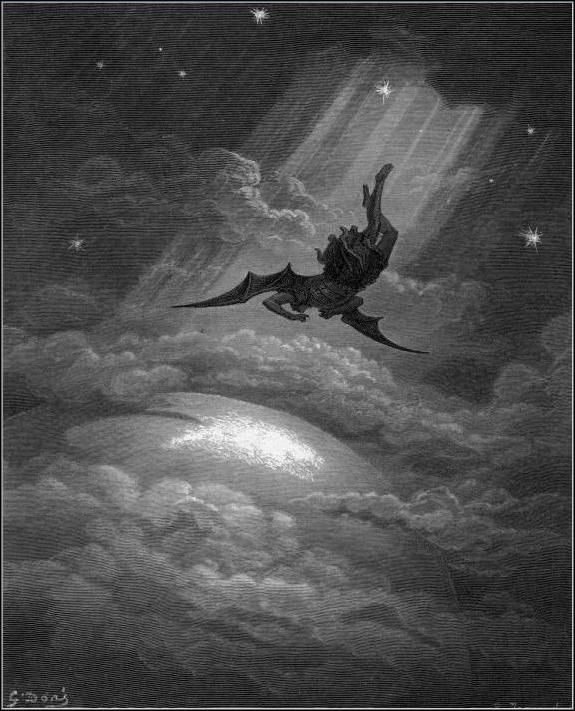
Gustave Doré’s tumbling figure is from his illustrated edition of Paradise Lost, a book full of armour-clad, spiky-winged angels. Some of those wings have even found their way into my work via the miracle of Photoshop.

stuck_lucifer.jpg

Lucifer by Franz Stuck (1890).

dore_lucifer.jpg

Paradise Lost by Gustave Doré (1866).

Elsewhere on { feuilleton }
The etching and engraving archive

Previously on { feuilleton }
The art of Thomas Häfner, 1928–1985