Cubist Cthulhu

cubist_cthulhu.jpg

Well maybe it isn’t, but the phrase occurred to me a few days ago so I thought I’d try some sketching and see what emerged. In one interpretation of The Call of Cthulhu it’s conceivable that Lovecraft intended his abomination to look like this, given the description of R’lyeh in the story:

Without knowing what Futurism is like, Johansen achieved something very close to it when he spoke of the city; for instead of describing any definite structure or building, he dwells only on broad impressions of vast angles and stone surfaces—surfaces too great to belong to anything right or proper for this earth, and impious with horrible images and hieroglyphs. I mention his talk about angles because it suggests something Wilcox had told me of his awful dreams. He said that the geometry of the dream-place he saw was abnormal, non-Euclidean, and loathsomely redolent of spheres and dimensions apart from ours. Now an unlettered seaman felt the same thing whilst gazing at the terrible reality.

An alien monstrosity might be even more terrifying if it didn’t resemble anything organic or remotely earthly. For a more traditional impression of the Spawn from the Stars, my drawing from The Great Old Ones can be found here.

Elsewhere on { feuilleton }
The Lovecraft archive

Revenant volumes: Bob Haberfield, New Worlds and others

moorcock_citadel.jpg

The Singing Citadel (1970).

Michael Moorcock’s Elric books are being prepared for republication by Del Rey in the US next year. I’ve assisted with some minor parts of this preparation, including sourcing pictures from Savoy’s edition of Monsieur Zenith the Albino. (Anthony Skene’s albino anti-hero is a precursor of Moorcock’s albino anti-hero.)

Discussion of the Elric books with Dave at Savoy prompted my excavation of this battered Mayflower paperback from the retired book boxes. This slim volume collected four fantasy stories: the title piece (possibly the first Elric story I read), Master of Chaos, The Greater Conqueror and To Rescue Tanelorn…. I’d forgotten about the garishly strange cover, one of many that Bob Haberfield produced for Moorcock’s books during the 1970s. Haberfield is one of a number of cover artists from that period who worked in the field for a few years before moving on or vanishing entirely. The swirling clouds derived from Tibetan Buddhist art identify this as one of his even without the credit on the back; later pictures were heavily indebted to Eastern religious art and while technically more controlled they lack this cover’s berserk intensity. Haberfield’s site has a small gallery of his splendid paintings, including a rare horror work, his wonderfully eerie cover for Dagon by HP Lovecraft.

Searching for more Haberfield covers turned up these two examples, both part of the SciFi Books Flickr pool, a cornucopia of pictures by vanished illustrators. Browsing that lot is like being back inside the In Book Exchange, Blackpool, circa 1977. The digitisation of the past continues apace at the Old-Timey Paperback Book Covers pool and the Pulp Fiction pool. Don’t go to these pages if you’re supposed to be doing something else, it’s easy to find yourself saying “just one more” an hour later.

new_worlds.jpg

And in other Moorcock-related news, Jay alerts me today to the existence of an archive of New Worlds covers, something I’d been hoping to see for a long time. New Worlds was one of the most important magazines of the 1960s, mutating under Moorcock’s editorship from a regular science fiction title to a hothouse of literary daring and experiment. As with so many things in that decade, the peak period was from about 1966–1970 when the magazine showcased outstanding work from Moorcock himself, JG Ballard, Brian Aldiss, Harlan Ellison, Samuel Delany, M John Harrison, Norman Spinrad and a host of others. For a time it seemed that a despised genre might be turning away from rockets and robots to follow paths laid down by William Burroughs, Salvador Dalí, Jorge Luis Borges and other visionaries. We know now that Star Wars, Larry Niven and the rest swept away those hopes but you can at least go and see covers that pointed to a future (and futures) the world rejected.

Elsewhere on { feuilleton }
The book covers archive
The illustrators archive

Previously on { feuilleton }
Barney Bubbles: artist and designer
100 Years of Magazine Covers
It’s a pulp, pulp, pulp world

Thomas Allen’s paperback art

thomas_allen2.jpg

Topple (2006).

thomas_allen1.jpg

Mate (2006).

ellroy.jpg

American artist Thomas Allen constructs witty and clever dioramas using figures cut from the covers of old pulp paperbacks. Probably not the future James Avati and co. anticipated for their paintings but it certainly gives their art a new lease of life. Things have come full circle since Allen’s constructions have been used to decorate a series of James Ellroy reissues. Allen’s prints are currently on display at the Foley Gallery, New York, until March 3rd.

Elsewhere on { feuilleton }
The book covers archive

Perfume: the art of scent

perfume1.jpg

I’ve yet to see Tom Tykwer’s film of Patrick Süskind’s novel, Perfume—The Story of a Murderer, and remain reluctant to do so; it’s a rule in cinema that good books make bad films and vice versa. Perfume is a good book and a favourite of mine which makes the prospect of film adaptation even more worrying. (As an aside, Tykwer dispels the persistent rumour that Stanley Kubrick dismissed Perfume as an unfilmable novel.)

Reservations apart, I’ve been listening to the tremendous soundtrack all week after a recommendation from a friend (hi Philip!). The music is credited to Reinhold Heil, Johnny Klimek and the director, and features the near unprecedented involvement of conductor Simon Rattle and the Berlin Philharmonic, an orchestra that rarely stoops to the level of the film soundtrack. This prompted speculation about the distinct challenge Süskind’s book presents to a designer: how best to represent the entwined strands of Grenouille’s career as a perfumier and a murderer of young women?

Continue reading “Perfume: the art of scent”

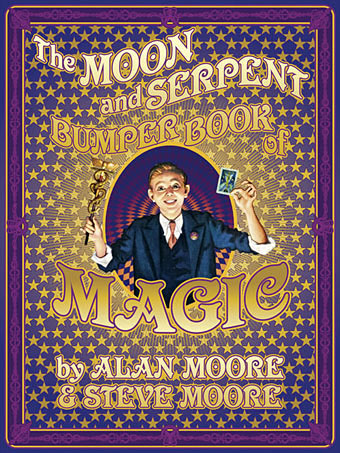
Of Moons and Serpents

mas.jpg

It’s lunar, it’s serpentine, it’s grandly thaumaturgical. Cover design by yours truly.

Via Top Shelf:

Splendid news for boys and girls, and guaranteed salvation for humanity! Messrs. Steve and Alan Moore, current proprietors of the celebrated Moon & Serpent Grand Egyptian Theatre of Marvels (sorcery by appointment since circa 150 AD) are presently engaged in producing a clear and practical grimoire of the occult sciences that offers endless necromantic fun for all the family. Exquisitely illuminated by a host of adepts including Kevin O’Neill, Melinda Gebbie, John Coulthart, José Villarrubia and other stellar talents (to be named shortly), this marvelous and unprecedented tome promises to provide all that the reader could conceivably need in order to commence a fulfilling new career as a diabolist.

Its contents include profusely illustrated instructional essays upon this ancient sect’s theories of magic, notably the key dissertation “Adventures in Thinking” which gives reliable advice as to how entry into the world of magic may be readily achieved. Further to this, a number of “Rainy Day” activity pages present lively and entertaining things-to-do once the magical state has been attained, including such popular pastimes as divination, etheric travel and the conjuring of a colourful multitude of sprits, deities, dead people and infernal entities from the pit, all of whom are sure to become your new best friends.

Also contained within this extravagant compendium of thaumaturgic lore is a history of magic from the last ice-age to the present day, told in a series of easy-to-absorb pictorial biographies of fifty great enchanters and complemented by a variety of picture stories depicting events ranging from the Paleolithic origins of art, magic, language and consciousness to the rib-tickling comedy exploits of Moon & Serpent founder Alexander the False Prophet (“He’s fun, he’s fake, he’s got a talking snake!”).

In addition to these manifold delights, the adventurous reader will also discover a series of helpful travel guides to mind-wrenching alien dimensions that are within comfortable walking distance, as well as profiles of the many quaint local inhabitants that one might bump into at these exotic resorts. A full range of entertainments will be provided, encompassing such diverse novelties and pursuits as a lavishly decorated decadent pulp tale of occult adventure recounted in the serial form, a full set of this sinister and deathless cult’s never-before-seen Tarot cards, a fold-out Kabalistic board game in which the first player to achieve enlightenment wins providing he or she doesn’t make a big deal about it, and even a pop-up Theatre of Marvels that serves as both a Renaissance memory theatre and a handy portable shrine for today’s multi-tasking magician on the move.

Completing this almost unimaginable treasure-trove are a matching pair of lengthy theses revealing the ultimate meaning of both the Moon and the Serpent in a manner that makes transparent the much obscured secret of magic, happiness, sex, creativity and the known Universe, while at the same time explaining why these lunar and ophidian symbols feature so prominently in the order’s peculiar name. (Manufacturer’s disclaimer: this edition does not, however, reveal why the titular cabal of magicians consider themselves to be either grand or Egyptian. Let the buyer beware.)

A colossal and audacious publishing triumph of three hundred and twenty pages, beautifully produced in the finest tradition of educational literature for young people, The Moon and Serpent Bumper Book of Magic will transform your lives, your reality, and any spare lead that you happen to have laying around into the purest and most radiant gold.

A 320-Page Super-Deluxe Hardcover, co-written by Alan Moore and Steve Moore, and illustrated by various luminaries from the comic book field.

Cover design by John Coulthart.

A 2009 RELEASE!
ISBN 978-1-60309-001-8