Design as virus 3: the sincerest form of flattery

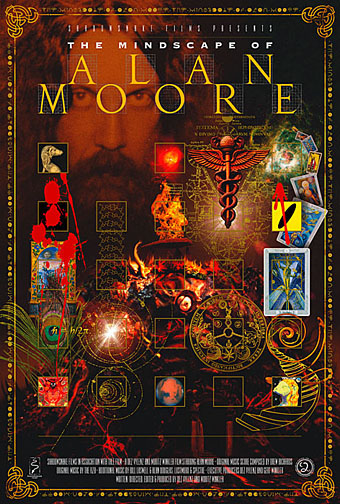
mindscape.jpg

The Mindscape of Alan Moore; film poster by John Coulthart (2003).

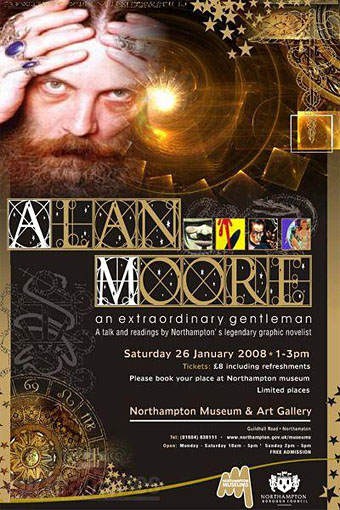
moore_poster.jpg

Alan Moore: An Extraordinary Gentleman;
event poster by unknown designer (2008).

Previously on { feuilleton }
Design as virus 2: album covers
Design as virus 1: Victorian borders

Beardsley’s Salomé

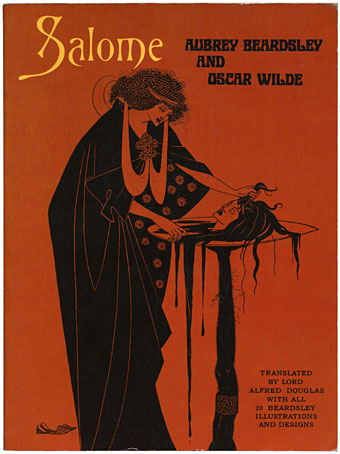
salome1.jpg

So the first book purchase of the year turns out to be the original Dover edition of Beardsley and Wilde’s Salomé. This appeared in 1967, a year after the major V&A exhibition which introduced Beardsley’s work to a new generation and commenced the Beardsley craze that lasted into the Seventies. Not that I’m in desperate need of these drawings, having most of them several times already in different Beardsley books, but this volume is worth having since the reproductions are large size, very sharp and they took enough care to ensure that the uncensored versions of the drawings were used. The book also includes the complete text of Wilde’s play and Robert Ross’s Note on Salomé from 1930 which I don’t have elsewhere.
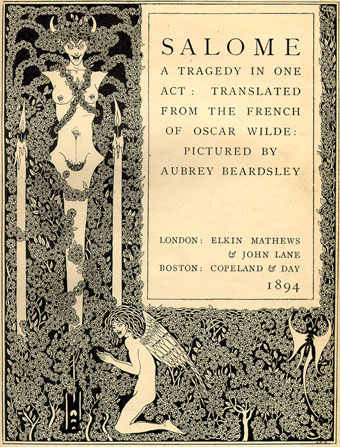
salome2.jpg

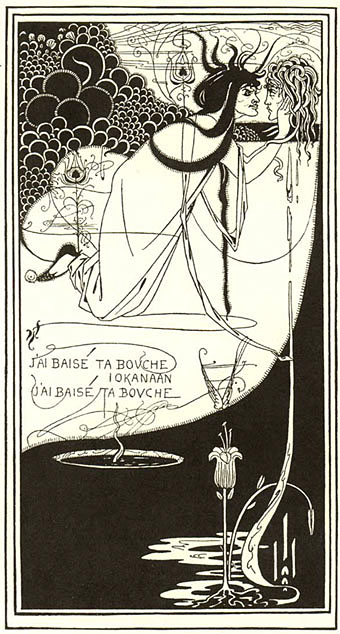
Beardsley’s work was subject to many censorship actions during his career but the Salomé book caused the most trouble (his later erotic works were private editions so don’t really count). The original title page shown here had the semi-erect penis of the winged boy and the pendulous genitals of the herma removed while one drawing, The Toilette of Salomé, was deemed too much and had to be redrawn entirely. That picture did contain a masturbating page boy so it’s perhaps not so surprising. There was such a lot to offend Victorian sensibilities in Beardsley’s work at this time, whether overt or surreptitious, that it’s remarkable the book was printed at all. His art was so radically different from anything else being done in 1894 that many people had difficulty accepting these pictures as illustrations at all, regardless of the content. As a result they missed salacious details that would have finished the career of a lesser artist. Wilde’s play was equally scandalous and could only be performed in France, having been banished from the London stage. As Robert Ross says in his Note:

Wilde used to say that Salomé was a mirror in which everyone could see himself. The artist, art; the dull, dullness; the vulgar, vulgarity.
salome3.jpg

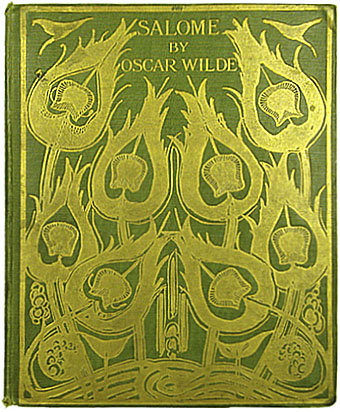
The sense of shock extended back to Beardley’s original Salomé drawing (also included in the Dover volume) which appeared in the first number of The Studio in 1893, some of the readers of that magazine finding the detail of the spilled blood nourishing a phallic lily a grotesque detail too far. The Studio drawing was reworked and simplified as The Climax for Salomé. You can see the complete set of illustrations here. Neither that collection nor the Dover book include a picture of the original cover, however, whose splendid gold-on-green peacock feathers look a lot more impressive than Beardley’s rough design. So here it is.
salome4.jpg

Download the 1906 US edition of Salomé free at the Internet Archive

Elsewhere on { feuilleton }
The book covers archive
The illustrators archive
The Salomé archive

Bruges-la-Morte

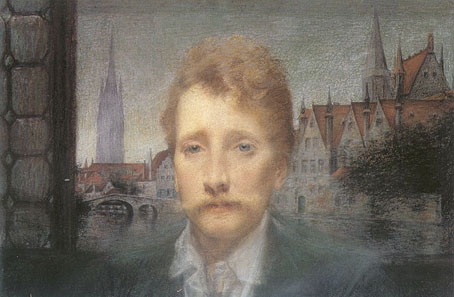
rodenbach.jpg

Portrait of Georges Rodenbach by Lucien Lévy-Dhurmer (1895).

Georges Rodenbach’s short, atmospheric novel is one of the key texts of Symbolism, not only for its themes but also for the art it either inspired or complemented. Bruges-la-Morte was first published in 1892 and the recent Dedalus Books edition, edited by Alan Hollinghurst and with a new translation by Mike Mitchell and Will Stone, was reprinted late last year.

Bruges-la-Morte…concerns the fate of Hugues Viane, a widower who has turned to the melancholy, decaying city of Bruges as the ideal location in which to mourn his wife and as a suitable haven for the narcissistic perambulations of his inexorably disturbed spirit. Bruges, the ‘dead city’, becomes the image of his dead wife and thus allows him to endure, to manage the unbearable loss by systematically following its mournful labyrinth of streets and canals in a cyclical promenade of reflection and allusion. The story itself centres around Hugue’s obsession with a young dancer whom he believes is the double of his beloved wife. The consequent drama leads Hugues onto a plank walk of psychological torment and humiliation, culminating in a deranged murder. This is a poet’s novel and is therefore metaphorically dense and visionary in style. It is the ultimate evocation of Rodenbach’s lifelong love affair with the enduring mystery and haunting mortuary atmosphere of Bruges.

Continue reading “Bruges-la-Morte”

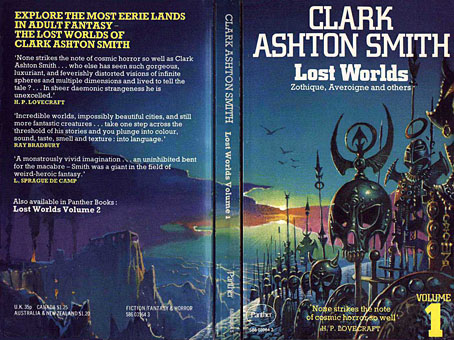
Clark Ashton Smith book covers

smith1.jpg

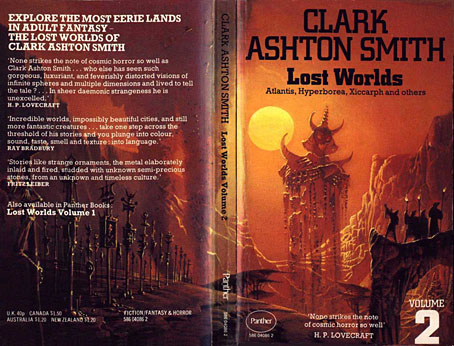
I hadn’t looked at Eldritch Dark, the premier Clark Ashton Smith site, for a while so it’s good to see they now have a substantial collection of CAS covers from books, magazines and fanzines. The ones shown here are further examples of my Panther Books fetishism and were the first CAS titles I came across in the mid-Seventies. The artist is Bruce Pennington who produced much fine sf and fantasy art during this period and whose spiky, bone-strewn paintings are especially suited to cosmic horror vistas or the more apocalyptic end of the fantasy spectrum. He also painted a couple of Lovecraft-related covers for Panther, hence his inclusion in the forthcoming Lovecraft art book from Centipede Press.

smith2.jpg

• Bruce Pennington at ImageNETion: I | II | III | IV

Elsewhere on { feuilleton }
The book covers archive
The illustrators archive

Previously on { feuilleton }
Witness my hand and official seal