Weekend links 5

kamekura.jpg

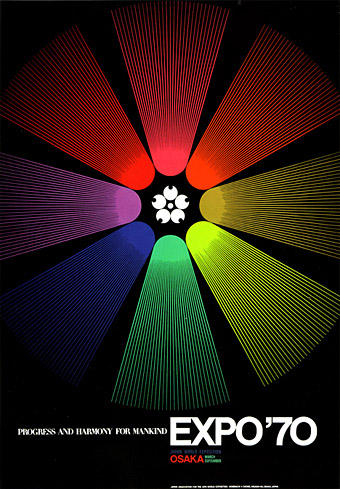
A poster design by Yusaku Kamekura. More here, via A Journey Round My Skull.

First of all this week, there’s a new interview posted which I gave last year to Crows ’n’ Bones magazine. The replies skate around the usual subjects (Cthulhu et al) and you also find out why I don’t think design and illustration for music is going to vanish as soon as some people think.

• A Journey Round My Skull has announced The Raymond Roussel Illustration Contest which is open to all.

• Cover designs: David Pearson on redesigning Cormac McCarthy’s UK covers, a huge improvement on the previous Picador series. Also, The Robert Lesser Pulp Art Collection.

• Last year I discussed Teleny, Or the Reverse of the Medal, the novel of gay erotica attributed to Oscar Wilde, giving a mention in passing to Jon Macy’s comic strip adaptation of the book. That adaptation has now been published and is available via his website.

bradley_kiss.jpg

The Kiss (1896) by Will Bradley.

• More Art Nouveau (because too much is never enough): Will Bradley’s work at Golden Age Comic Book Stories. Can’t understand how I missed this one.

• A discussion: The Magic Mystery and Melancholy of Five Leaves Left by Nick Drake.

• Sandi Vincent’s Flickr pages overflow with Graphis Annual goodness.

• A new edition of the Arthur Radio Voyage is available to download. And Trunk Records’ Jonny Trunk has a mix of obscure vinyl for you.

• Song of the week: We Want War by These New Puritans. Slow motion shots in the video are a plus.
Keim & Czeschka’s Nibelungen

czeschka1.jpg

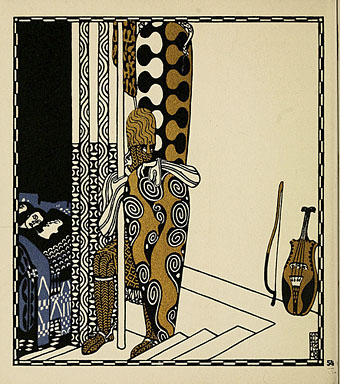
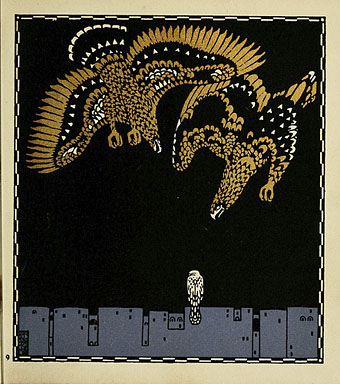
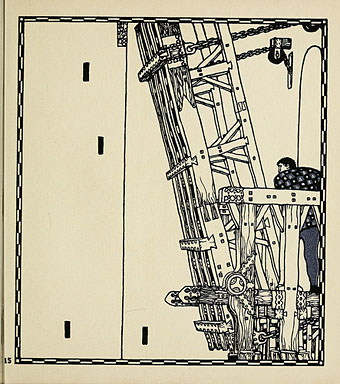
It’s all Art Nouveau again round here while I go through back issues of Jugend preparing a series of posts about the artists and graphics featured in that magazine. Just now, however, I’m too busy to do anything substantial so this will have to suffice, some of the illustrations by Carl Otto Czeschka (1878–1960) for a 1909 adaptation of the Nibelungen Saga by Franz Keim (1840–1918), for which Czeschka utilised the rectilinear style of Art Nouveau popularised by the Wiener Werkstätte.

This small, almost square volume in the popular series of children’s books is rather unassuming in its external appearance, only sporting a small vignette with the title on the cover. Carl Otto Czeschka (1878–1960) was responsible for the complete design of the text to be found inside, and interspersed it with the illustrations characteristic of his work. These reveal his credentials as an outstanding artist of the Secessionist school and the Jugendstil. The eight double-page spreads coloured in clay block technique and rare gold prints, in particular, contributed to the volume’s fame. (More.)

The rest of the pages can be seen on this great Art Nouveau site which has a wealth of material from the period.

czeschka2.jpg

czeschka3.jpg

Elsewhere on { feuilleton }
The illustrators archive

Le livre blanc by Jean Cocteau

cocteau1.jpg

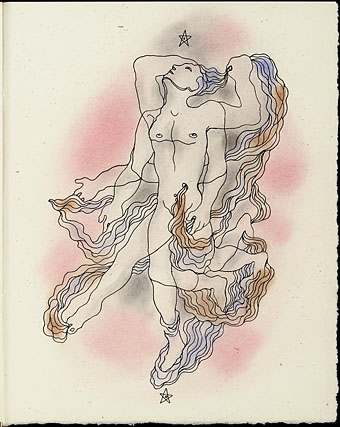
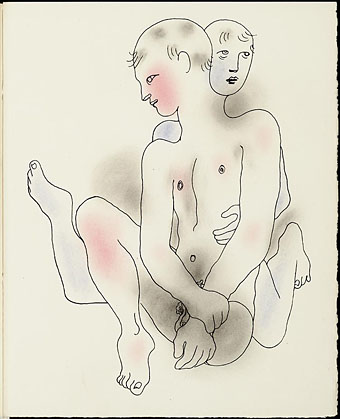
Two illustrations by Jean Cocteau for his homoerotic novel Le livre blanc. Cocteau never publicly acknowledged his authorship of the book but his illustrations (coloured by MB Armington) decorated the second edition published by Éditions du Signe in 1930. He also provided an introduction. The Koopman Collection has further illustrations and page scans.

Cocteau wrote Le livre blanc in 1927 in Chablis, where he was staying with Jean Desbordes, the successor to Cocteau’s great love. Cocteau’s drawings have been described as obscenely pious. They are established by quick, flowing lines, partially erotic and often sultry, featuring classical elements such as busts and centaurs. Erotic images were popular articles in France, where they were sold under the counter; people were extra careful about homosexual erotica. Cocteau described his first sexual experiences in Le livre blanc: his excitement upon seeing a naked peasant boy on horseback and two naked young gypsies on his father’s estate. (More.)

cocteau2.jpg

Elsewhere on { feuilleton }
The gay artists archive

Previously on { feuilleton }
Cocteau’s sword
Cristalophonics: searching for the Cocteau sound
Cocteau at the Louvre des Antiquaires
La Villa Santo Sospir by Jean Cocteau

Exposition Universelle catalogue

exposition1.jpg

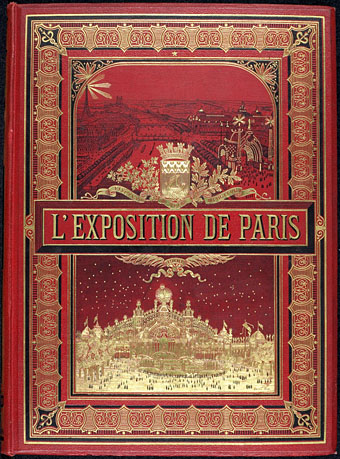
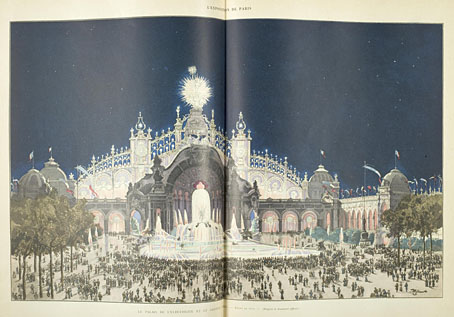
Regular visitors here will know that the Paris Exposition Universelle of 1900 is never far away, and this is another addition to the surfeit of information about that event. Following last week’s delve into University of Heidelberg’s digital archives—which I really ought to have properly investigated when I first looked at them last year—I’ve been going deeper into their collection which isn’t always easy when many parts of the site are German-only. One section is devoted to books from 19th century expositions with a sub-section of works concerned with the Exposition Universelle.

exposition2.jpg

The Palace of Electricity.

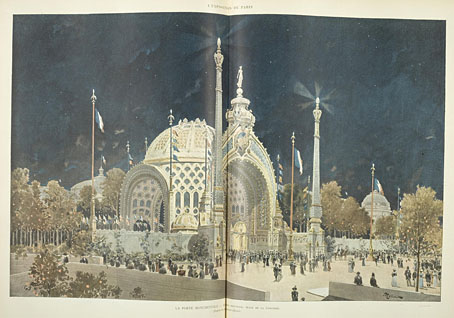
Among various publications they have the lavish three-volume exposition catalogue which is a real treat to see, not least for its quality. Much of the content is familiar from other books but new views of these remarkable Winsor McCay-like structures are always welcome.

The three volumes are here, here and here.

exposition3.jpg

Main entrance gate.

Previously on { feuilleton }
Exposition Universelle publications
Exposition cornucopia
Return to the Exposition Universelle
The Palais Lumineux
Louis Bonnier’s exposition dreams
Exposition Universelle, 1900
The Palais du Trocadéro
The Evanescent City