Joseph Balthazar Silvestre’s Alphabet-album

silvestre01.jpg

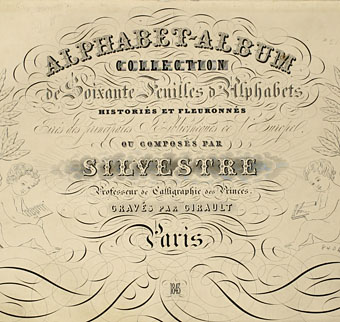
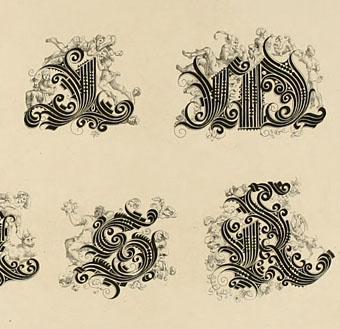
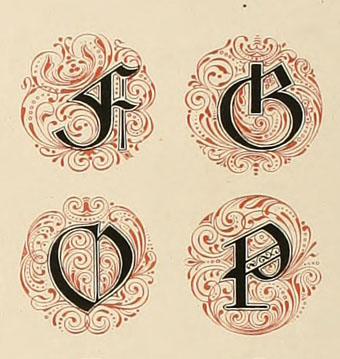
Monsieur Silvestre’s Alphabet-album, a collection of decorative alphabets, has a lengthy subtitle—Collection de Soixante Feuilles d’Alphabets Historiés et Fleuronnés, tirés des Principales Bibliothèques de l’Europe—and is a good example of how the 19th century, always characterised as a period of over-elaborate decoration, contains the seeds of 20th-century design. Silvestre’s book dates from 1843 yet contains several examples of sans serif or rectilinear lettering which wouldn’t have looked out of place a hundred years later. There’s also some fine examples of over-elaborate lettering, of course, with the usual embellishments and calligraphic flourishes, and also a page of letterforms based on tree shapes, a common sight in Victorian graphics.

silvestre02.jpg

silvestre03.jpg

Continue reading “Joseph Balthazar Silvestre’s Alphabet-album”

Anna & the Juniper Dog

juniper.jpg

The Juniper Dog strained its twisted roots against an ember red sky, snarling out swarms of night moths, barking flocks of owls from its splintery jaws. It howled the sea. Spat stars. Clouds roiled and clotted through the tree dog’s teeth.

Anna & the Juniper Dog was published this summer although it’s a tale which seems more suited to the gloom of autumn. (Having said that, summer this year was so persistently cold, wet and dreary it’s been autumn in all but name.) The story is by Geoff Cox, and the slim clothbound volume from Blackmaps Press comes profusely illustrated by Rohan Daniel Eason, and with an accompanying CD containing 30 minutes of beautiful instrumentals by Martin Roman Rebelski. This is the second book in a trilogy of tales about Cox’s Anna character, wherein we follow Anna through a succession of dream-like episodes freighted with mysteries, epiphanies and ritual moments.

eason.jpg

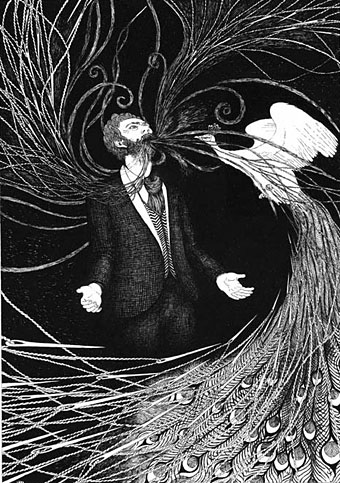
“Thorns burst from the Old Man’s mouth.”

The combination of another character named Boy, and various encounters with anthropomorphic animals, reminded me of Mervyn Peake’s wonderful Boy in Darkness, while the illustrations bring to mind the cross-hatched art of Edward Gorey. Eason’s drawings add a great deal to the fairytale atmosphere without merely replicating Cox’s evocative descriptions. The icing on the cake is a book design by La Boca with the attention to detail this kind of self-contained project requires: the typesetting uses the ligatures common to better typefaces but which one seldom sees employed today. A great example of the book as an object to be treasured, and ideal reading (and listening) for longer and chillier evenings.

Weekend links 74

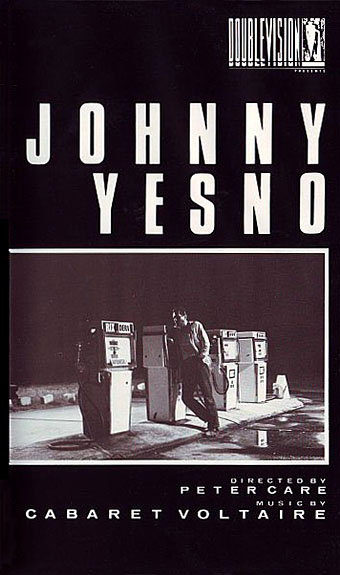
johnnyyesno.jpg

Johnny YesNo video cover, 1983. Design by Neville Brody.

Being a Cabaret Voltaire enthusiast of long standing it was good to hear last week about the imminent reappearance of Johnny YesNo, an hour-long film by Peter Care for which the Cabs provided the soundtrack. Mute Records will be releasing Care’s debut on DVD in a set which includes two versions of the film together with two music CDs. I never got to see the original release on CV’s VHS label, Doublevision; for most of the 1980s I didn’t even have a colour TV never mind a video recorder so I missed all CV’s videocassettes aside from Gasoline In Your Eye. The new edition will be available in November. Brainwashed has a list of the contents while The Quietus posted a clip from the new “redux” version. (And before anyone tells me it’s on YouTube…yeah, everything is on YT in shitty quality and barnacled with the misanthropy-inducing drivel which passes there for comment. If I’m going to watch something for the first time I’d prefer it to be on a shiny disc, thanks.)

• The world has noticed Terrence Malick again following the release of The Tree of Life. Malick’s second feature is returning briefly to UK cinema screens, an event which prompted David Thomson to ask Is Days of Heaven the most beautiful film ever made?

• This week in imaginative art: S. Elizabeth on The Fantastical Fairy Tale Art of Sveta Dorosheva, AS Byatt on the strange paintings of Richard Dadd (there’s another Dadd article here), and Rick Poynor on Chris Foss and the Technological Sublime.

Ethan Hein demonstrates how Alan Lomax came to have copyright control over many songs he had nothing to do with simply by recording traditional music.

Visual Vitriol:  The Street Art and Subcultures of the Punk and Hardcore Generation, a book by David Ensminger.

• More Club Silencio: Inside David Lynch’s Paris nightclub and a gallery of photos.

Histoire un-Naturelle, selected works by Ruth Marten.

Come hither: The deceptive beauty of orchids.

Facsimile Dust Jackets.

• More Peter Care: Just Fascination (1983) by Cabaret Voltaire | Sensoria (1984) by Cabaret Voltaire | Rise (1986) by Public Image Ltd.

SteamPunk Magazine

steampunkmag.jpg

The phone line trouble was resolved quicker than I expected thanks to a couple of efficient engineers and a new line. Normal service is now resumed.

Last month seemed to be one rush job after another, of which this was one of the results, a cover for a forthcoming collection of pieces from SteamPunk Magazine. Another collage work mostly, juxtaposed against one of the photos I took years ago of rusting rail bridge supports in central Manchester. Those photos get used a lot when I need some organic textures: one of the others fills in the background of the cover for Jeff VanderMeer’s Finch. I really ought to get some fresh pictures.

I’m not sure when this collection will be out but when it is the news will be mentioned here. And while we’re on the subject, it’s worth mentioning again that SJ Chambers, co-editor with Jeff V of The Steampunk Bible, will be appearing at The Last Tuesday Society in London this coming Tuesday. Details here.

Previously on { feuilleton }
Morlocks, airships and curious cabinets
The Steampunk Bible
Steampunk Reloaded
Steampunk overloaded!
More Steampunk and the Crawling Chaos
Steampunk Redux
Steampunk framed
Steampunk Horror Shortcuts

Weekend links 73

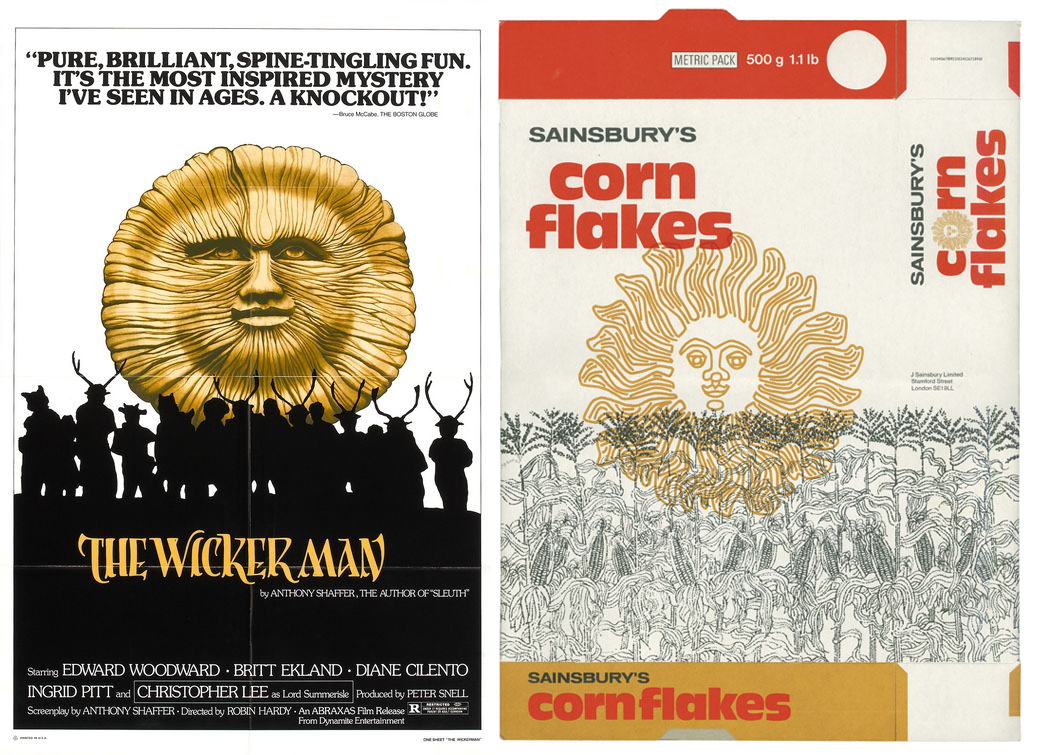
sun2.jpg

Johnny Trunk of Trunk Records reissued the soundtrack to The Wicker Man in 1997. Mr Trunk’s latest delve into the cultural past is Own Label: Sainsbury’s Design Studio, a book from Fuel examining the supermarket chain’s packaging design of the 1960s and 1970s. Creative Review shows some examples while I have to note the uncanny similarity between one of the posters for The Wicker Man and an old Sainsbury’s corn flakes box. Now we see that the Old Weird Britain wasn’t only hiding in the fields and the folk songs but was also lurking on the supermarket shelves.

Related: a new DVD set from the BFI, Here’s a Health to the Barley Mow: A Century of Folk Customs and Ancient Rural Games. And let’s not forget the ley lines of Milton Keynes, and a new edition of Ritual by David Pinner, said to be the novel which inspired The Wicker Man.

• “He wrote me…” Sans Soleil (1983), Chris Marker’s beguiling accumulation of memories, dreams and reflections, is recalled in a Quietus piece entitled Things that Quicken the Heart. Not the first time on DVD as it says there (Nouveaux Pictures released it with La Jetée in 2003) but it’s good to know it’s being reissued.

• Marker’s film references Tarkovsky’s Stalker a couple of times, most notably in the comment, “On that day there will be emus in the Zone.” Geoff Dyer has what he describes as “a very detailed study” of Stalker out next year.

I don’t like those commentators who keep on saying that London will never be the same again. London is always the same again. I remember those comments were made very loudly after the [July 2005] terrorist attacks – “London will never be the same again, London has lost its innocence” – it was all nonsense. London was exactly the same again the following day. Rioting has always been a London tradition. It has been since the early Middle Ages. There’s hardly a spate of years that goes by without violent rioting of one kind or another. They happen so frequently that they are almost part of London’s texture. The difference is that in the past the violence was more ferocious, and the penalties were more ferocious – in most cases, death.

Peter Ackroyd, reminding us that the Four Horsemen of the Apocalypse don’t wear hoodies and ride bikes.

Wolf Fifth: “rare vinyl records from the golden era of avant garde and experimental music”. And in FLAC as well, not crappy mp3; I want to hear all those scratches uncompressed, dammit!

Another great mix at FACT, this time compiled by snd who throw together Morton Feldman, Siberian shamen, Einstürzende Neubauten, Dome, Oval and many others.

• Colin Marshall asks “how weird is Australia?” in an appraisal of Nicolas Roeg’s Walkabout.

A Comprehensive Solution to the Tokyo Umbrella Problem.

• More poster art from Hapshash and the Coloured Coat.

Morbid Excess, a series of drawings by May Lim.

Conrad Schnitzler (1937–2011) by Geeta Dayal.

Neopolitan cephalopods.

Willow’s Song (1973) by Paul Giovanni & Magnet | The Willow Song (1989) by The Mock Turtles | Wicker Man Song (1994) by Nature and Organisation.