Cthulhu God

cthulhugod.jpg

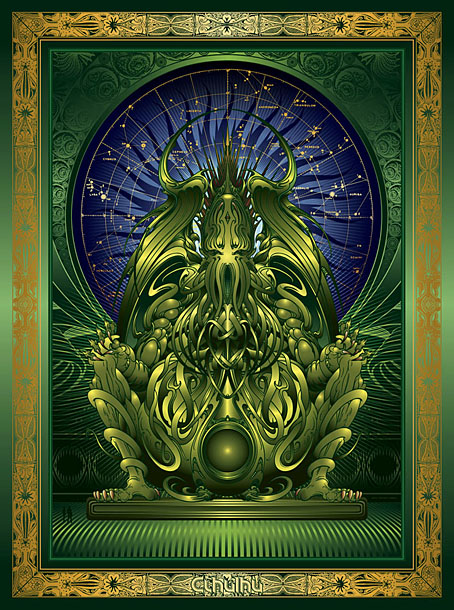
Happy Cthulhumas. I found the time over the past couple of weeks to finish a piece of art begun in September 2008, something I’d half-completed then abandoned due to pressure of other work. I’d quite forgotten about this until I discovered the files when going through some archive discs. What began as a pencil outline is now a lavish piece of vector art which I’ll shortly be making available as a poster design.
cthulhugod2.jpg

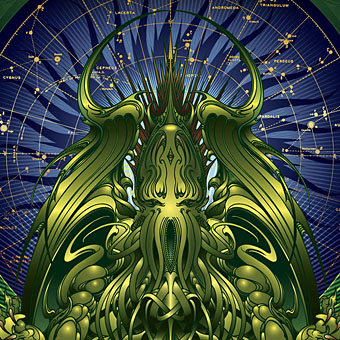
I’ve enjoyed creating vector pictures recently, it’s a different discipline to using Photoshop (although the initial art often starts in the sister application), and the hard lines and flat shapes remind me of the similar effects I used to get when I was painting with gouache. Some areas of this piece remain a little too flat but I didn’t want to start shading everything using gradient meshes; if you start down that road you may as well do the whole thing as a Photoshop painting—or a real painting, for that matter. That said, I wouldn’t mind giving this the hyper-realist treatment at a later date.
cthulhugod3.jpg

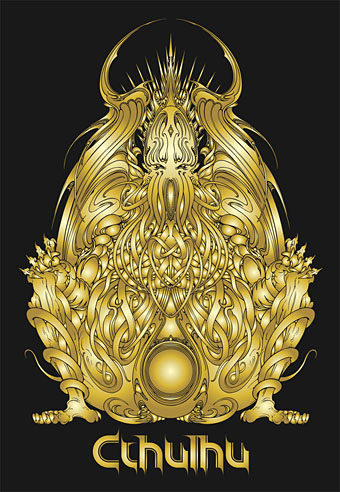
The original idea was to do a kind of “Cthulhu Buddha”, something like the above variation only coloured with more finesse. I kept thinking this was an original idea only to belatedly realise when I set the figure against a temple background that I’d been imitating the kind of massive Lovecraftian idols that populate the comic strips of Philippe Druillet. The one below is a good example.
Continue reading “Cthulhu God”

Weekend links 88

zarnowerowna.jpg

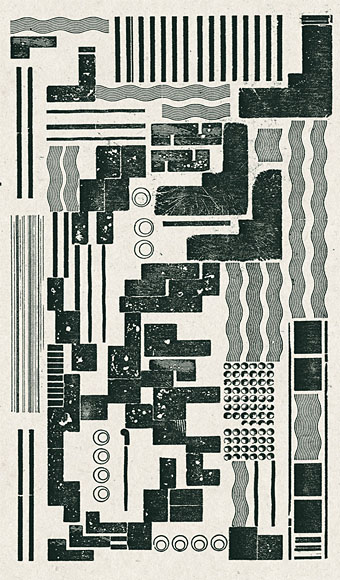
Typographic Composition (1924) by Teresa Zarnowerówna from a post about Polish graphic design at 50 Watts.

• “Direct action is a matter of acting as if you were already free… […] …the link between military and money systems remains the dirty secret of capitalism.” A lengthy and essential interview with “anarchist anthropologist” David Graeber, author of Debt: The First 5000 Years.

• “…it was after being told by an art director that he preferred her images of women to men that Toyin [Ibidapo] began to shoot boys in an attempt to prove him wrong. Something that Cult of Boys does perfectly.”

The pornographic imagination is deeply intertwined with the pain and horror of life. Some of that comes from our basic biological reality, which is unpleasant enough, and much of it comes from our social structures. Biological life has been completely degraded and continues to become more and more degraded in novel and more horrific ways, so it is inevitable that our horrible social structures – our schools, prisons, families, slaughterhouses and farms – become sites for the pornographic imagination.

Stephen Beachy discusses his novel, boneyard.

• “To my right is a wall bracket that, on closer inspection, turns out to be a human face made of porcelain fruits. The anteater rests on top of the television.” Jonathan Jones meets Jan Švankmajer.

Anselm Kiefer‘s new exhibtion at White Cube, London, takes its name and some inspiration from Fulcanelli’s alchemical exegesis, Le Mystère des Cathédrales (1926).

• Today (Sunday, 11th December) on Resonance FM at 8.00pm GMT, Alex Fitch talks to Alan Moore about HP Lovecraft and related matters.

Nick Hydra is putting all 112 issues of occult encyclopaedia Man, Myth & Magic online.

• Ira Cohen ‘s 1968 film The Invasion of Thunderbolt Pagoda is available again on DVD.

• Colleen Corradi Brannigan’s paintings of Italo Calvino’s Invisible Cities.

• “Margate’s a bloody toilet!” Can you handle The Reprisalizer?

• Bibliothèque Gay on Cocteau’s Le livre blanc (in French).

• Josie & the Pussycats in A Clockwork Orange.

Lovely Book Covers

Words With The Shaman (1985) by David Sylvian w/ Jon Hassell, Steve Jansen & Holger Czukay – I: Ancient Evening | II: Incantation | III: Awakening (Songs From The Treetops).

Thought-Forms and Auras

leadbeater01.jpg

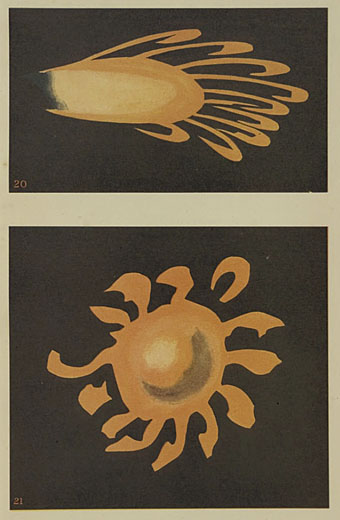
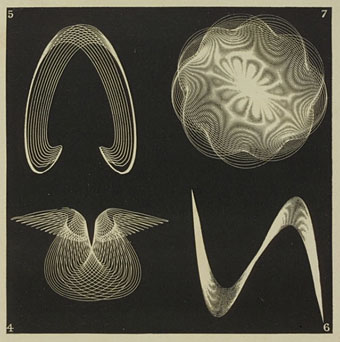
Like yesterday’s squid, some of these Theosophist illustrations from Thought-Forms (1905) by Charles Webster Leadbeater & Annie Besant, and Man Visible and Invisible: Examples of different types of men as seen by means of trained clairvoyance (1902) by Leadbeater alone, have been reproduced for years in books yet you seldom see the complete set. The University of Heidelberg has scans of both volumes so I’ll direct the curious there for detailed explanations of the illustrations which were intended to graphically portray mental states, and the auras which Theosophists believed surrounded the human body. The diagrams above are harmonographs created by pendulum motion, and evidently seemed sufficiently strange for Leadbeater and Besant to interpret them as representations of emotional experience. They’ve always made me think of the similar pendulum drawings used by Saul Bass in his Vertigo title sequence, although I’ve never seen any indication that Bass had these particular diagrams in mind. In the pictures below there’s also a suitably spiky depiction of an angry person’s aura, and representations of music emerging from a cathedral in the form of polychrome mushroom clouds.

leadbeater02.jpg

leadbeater03.jpg

Continue reading “Thought-Forms and Auras”

Le Poulpe Colossal

poulpe1.jpg

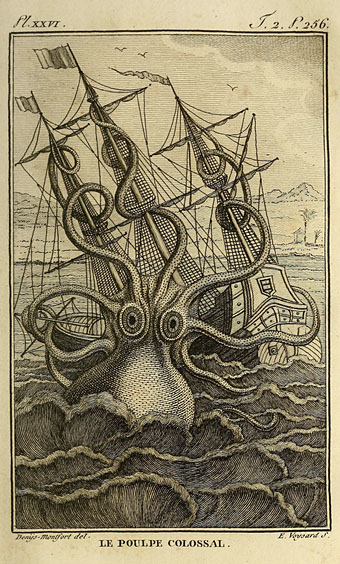
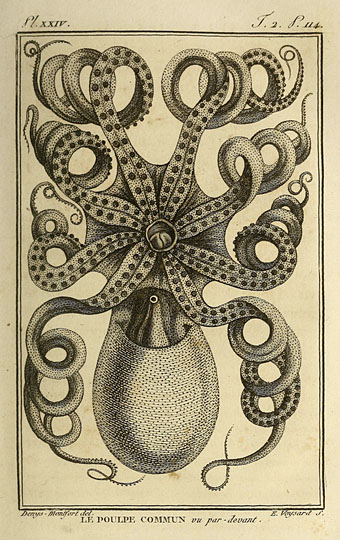
If this isn’t quite the ur-Kraken of illustration history, it’s one of them, reproduced countless times when sea monster depictions are required. The source is Histoire naturelle, générale et particuliere, des mollusques, animaux sans vertèbres et a sang blanc (1802) by Felix de Roissy, some of whose other illustrations are in this Flickr set from the Biodiversity Heritage Library.

poulpe2.jpg

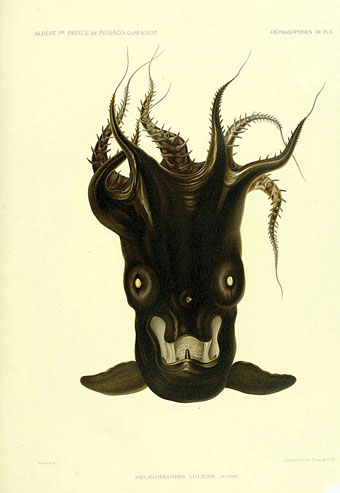
There are further cephalopodic curios in the BHL Mollusks and Invertebrates sets, the example below being from Résultats des campagnes scientifiques accomplies sur son yacht (1889), a fine collection of what the French would call aquarelles.

poulpe3.jpg

Previously on { feuilleton }
Abysmal creatures
Fascinating tentacula
Jewelled butterflies and cephalopods
The art of Rune Olsen
Octopulps
Coming soon: Sea Monsters and Cannibals!

Cheeky Frawg Books

cheeky1.jpg

Being a new ebook imprint from Ann & Jeff VanderMeer:

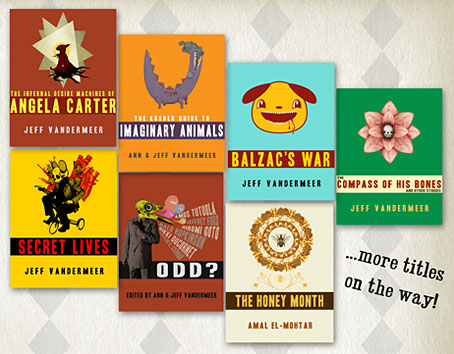
Cheeky Frawg Books has launched a new website. Does it sell our ebooks? Yes! But very…cheekily. It’s an interactive and mysterious experience you truly won’t want to miss, in a 180-degree scrollable environment. Free content, hidden treasures, singing fish, the animated Myster Odd video, and, of course, the full catalogue of Cheeky Frawg ebooks, including Amal El-Mohtar’s The Honey Month and the ODD? anthology, featuring Jeffrey Ford, Caitlin R. Kiernan, Amos Tutuola, Hiromi Goto, Nalo Hopkinson, and many more.

Cheeky Frawg specializes in quality, self-aware e-books. We hand-craft every e-book on a letterpress using only the best, most perfectly formed 00000s and 111111s.  Forthcoming titles include the legendary The Encyclopedia of Victoriana by Jess Nevins, It Came From the North: Finnish Weird edited by Jukka Halme and Tero Ykspetäja, Jagganath by Swedish sensation Karin Tidbeck and Don’t Pay Bad for Bad by iconic Nigeria writer Amos Tutuola.

Note: A percentage of direct sales in December will go to aid iconic fantasy editor, artist, and writer Terri Windling, who is suffering from financial woes.

cheeky2.jpg

In the first run of titles is the ebook edition of The Kosher Guide to Imaginary Animals whose print edition I designed a while back. And mention of Amos Tutuola reminds me that I’ve had a copy of his My Life in the Bush of Ghosts for years and still not read it. While we’re on the subject of Ann & Jeff’s projects, a reminder that Weird Fiction Review is still posting unique pieces of weird fiction, interviews and essays.

Previously on { feuilleton }
Weird Fiction Review