Oz: The Tin Woodsman’s Dream, a film by Harry Smith

smith1.jpg

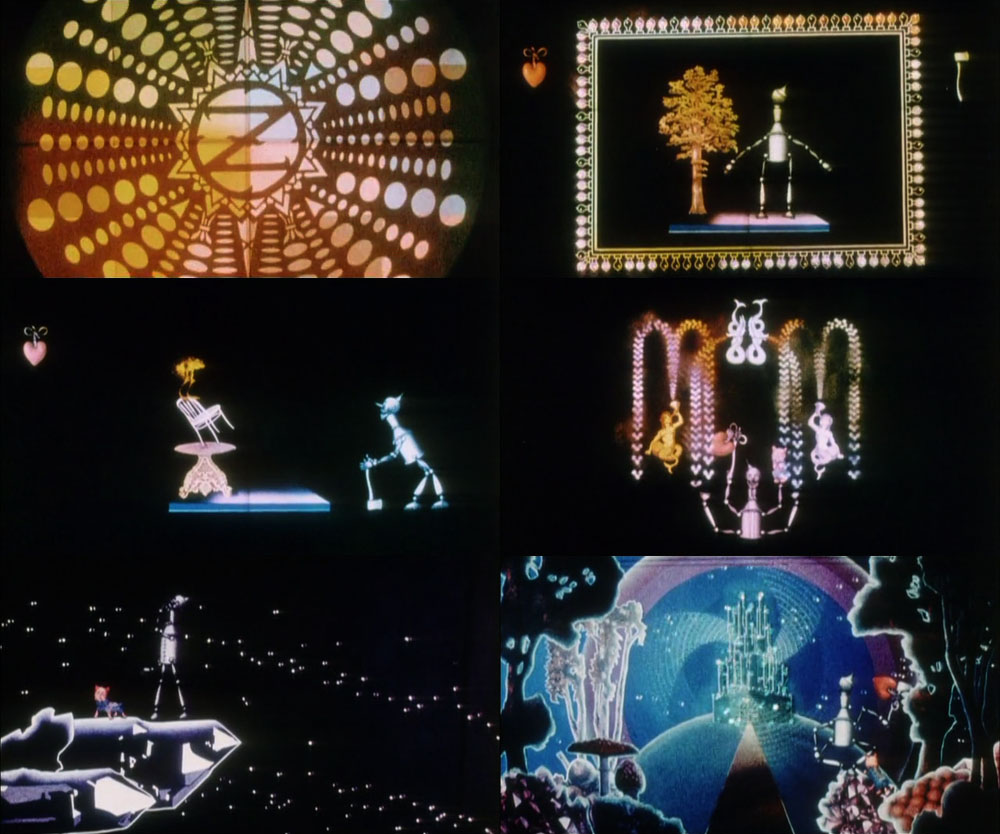
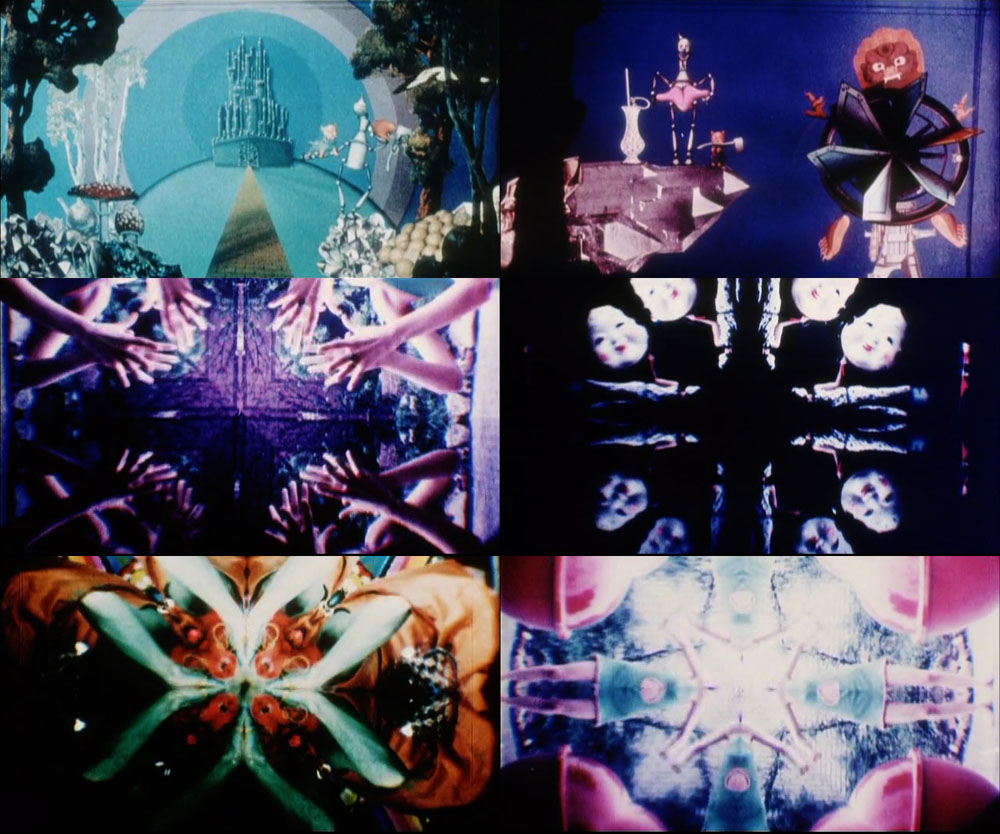
Ubuweb slipped into archival stasis earlier this year, which means that everything uploaded there will remain as it is but we won’t be seeing anything new. I don’t know when this Harry Smith short was posted there but it’s one I haven’t seen before. (There’s also a copy at Rarefilmm where I evidently missed it.) Oz, The Tin Woodsman’s Dream was made in 1967, and is one of the fragments of a much longer film that would have adapted L. Frank Baum’s The Wonderful Wizard of Oz using a similar cutout animation technique to that deployed by Smith for Heaven and Earth Magic. The adaptation remained unfinished after Smith’s backer died but the extant pieces (including another self-contained short, The Magic Mushroom People of Oz) show him working in widescreen 35mm for the first time.
smith2.jpg

All of Smith’s films were given opus-style numbers: Heaven and Earth Magic is no. 12, The Magic Mushroom People of Oz is no. 13, and The Tin Woodsman’s Dream is no. 16. As with the films of Len Lye and other animation pioneers, Smith’s early shorts are often given a “psychedelic” label even when they predate the popular use of the term. The Tin Woodsman’s Dream is one of those where the psychedelic quotient becomes overt, comprising a few minutes of animated play with the title character and a small dog, followed by many minutes of kaleidoscoped film footage that’s more redolent of its period than Smith’s other films. I’m happy to watch the kaleidoscopics but this is the kind of thing that any number of film-makers might easily do. The Woodsman, the dog and the other characters are inhabitants of Smith’s inner landscape, as are the fly agaric mushrooms that appear here and in his other films. It’s a shame we didn’t get to see more of them. There’s no soundtrack for this film so you can either watch the gesticulations in a Stan Brakhage silence or find 15 minutes of music to match the visuals.

Previously on { feuilleton }
Number 10: Mirror Animations, a film by Harry Smith
Number 11: Mirror Animations, a film by Harry Smith
Meeting Harry Smith by Drew Christie
Heaven and Earth Magic by Harry Smith
Harry Smith revisited
The art of Harry Smith, 1923–1991

Weekend links 731

electrical.jpg

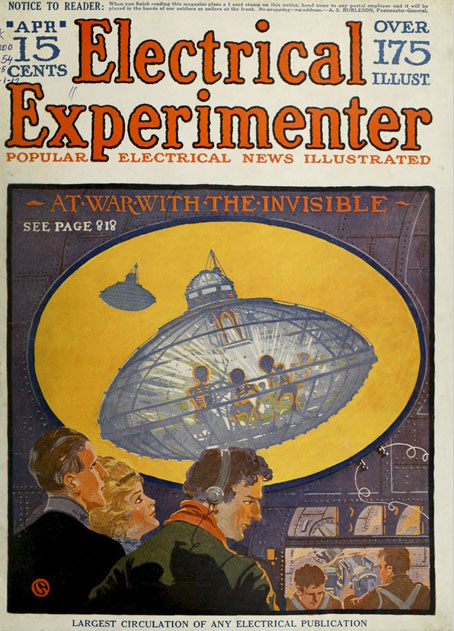
The Electrical Experimenter, Vol. 5, no. 1. April, 1918. Electrical cover art by Vincent Lynch.

• Coming soon from Rocket 88 Books: Electricity and Ghosts, a collection of art and graphic design by John Foxx/Dennis Leigh. The book itself has been designed with a regular Foxx collaborator, Jonathan Barnbrook. Last year I put together a post collecting Dennis Leigh’s book covers.

• At Strange Flowers: Lavinia Schulz and Walter Holdt, their Expressionist dance costumes, and their short, tempestuous lives. There’s more about the couple’s costumes and dances here.

• New music: Road to Mandalay by Laurie Anderson; Panorama (French Soundtracks & Rarities) by Various Artists; The Passage Of Time by Cosmos In Collision.

• At Public Domain Review: Raffaele Mainella’s illustrations for Nos Invisibles (1907), a Spiritualist text by Clotilde Briatte (writing as Charles d’Orinio).

Dennis Cooper’s favourite fiction, poetry, non-fiction, film, art, and internet of 2024 so far. Thanks again for the link here!

John Cale’s favourite music. Also The Records That Made Me by Carsten Nicolai/Alva Noto.

The mysterious mirrored monolith returns.

• RIP Donald Sutherland.

BBC Sound Effects.

Electricity (1967) by Captain Beefheart & His Magic Band | Electricity (1980) by Orchestral Manoeuvres In The Dark | Electricity (1995) by Pet Shop Boys

The art of Hannes Bok, 1914–1964

bok01.jpg

Altars of Patagonia (1946)

Like the huge cache of Virgil Finlay art that turned up at the Internet Archive a couple of years ago, the pictures here are from a two-volume collection made by an enthusiast gathering together yet more illustrations from the pulp magazines of the 1940s and 50s. Hannes Bok (real name Wayne Francis Woodard) wasn’t as prolific as Virgil Finlay, but the careers of the two men intersected in the pages of Weird Tales where they both used stipple shading to compensate for the poor reproduction of pulp paper. Bok’s work tended to be more stylised than Finlay’s, with a quirkiness that makes his art easy to spot once you’ve seen a few examples.

bok02.jpg

Boomerang (1947)

The two volumes contain a total of over 300 illustrations so any selection will only be a small sampling. Many of the drawings were new to me. The first volume is mostly work from magazines such as Weird Tales and the minor SF mags; the second includes book covers, calendar illustrations and other work. As with the Finlay collections, both volumes are available in a range of file formats which include cbz files, a format I prefer to pdf for browsing image-heavy documents. For more about cbr/cbz files, see the end of this post.

bok03.jpg

Cross of Mercrux (1942)

bok04.jpg

Daughter of Darkness (1941)

bok05.jpg

Dimensional Doors (1944)

Continue reading “The art of Hannes Bok, 1914–1964”

Weekend links 730

beardsley.jpg

Cover Design for ‘The Yellow Book’ Vol.I (1894) by Aubrey Beardsley.

• “[Dorian Gray’s] version of Decadence filled the popular imagination when Decadence became an ostentatiously stylish zeitgeist—stylish being the operative word. For Decadent style encapsulated the attitude of being hellbent on thrilling experiences.” The danger of Decadence is also its value. We need more of it, says Kate Hext.

• At Swan River Press: Of Wraiths, Spooks and Spectres. Robert Lloyd Parry, in an interview with John Kenny, talks about the researches that led to the compiling of his latest ghost-story collection, Friends and Spectres.

• The latest pictorial accumulation from DJ Food is a collection of late-60s concert posters by Jim Michaelson, an artist whose designs look like Mad magazine going fully psychedelic.

• Old music: Future Travel by David Rosenboom; new music: Taking Shasta Mountain (By Strategy) by John Von Seggern & Dean DeBenedictis.

• At Public Domain Review: Hunter Dukes on Rückenfiguren, views of the human back as a subject in the history of art.

• In a week when Adobe has been in the news for pissing off its users, a list of alternatives for Adobe software.

• At Spoon & Tamago: Hokusai-inspired erasers reveal Mt. Fuji the more they get used.

• At Unquiet Things: A celebration of Annie Stegg Gerard’s enchanting worlds.

• Mix of the week: DreamScenes – June 2024 by Ambientblog.

• At The Quietus: The Strange World of…Diamanda Galás.

Wraith (2002) by Redshift | El Wraith (2002) by Amon Tobin | Wraith (2015) by John Carpenter

Friends and Spectres

spectres1.jpg

Presenting my latest cover illustration for Swan River Press, and another story collection edited by Robert Lloyd Parry:

Friends and Spectres is a companion volume to Ghosts of the Chit-Chat (2020), an anthology of ghost stories by authors who had been members of the Cambridge University Chit-Chat Club along with M. R. James. Here the associations with MRJ are less formal, but stronger and more enduring: for it is the bond of genuine friendship that ties these writers to him.

The majority of pieces here were originally published under pseudonyms, and over half appeared first in amateur magazines or local newspapers. All deal with the supernatural, and several of the stories are themselves spectres—or more properly “revenants”, only now re-emerging into the light after decades of oblivion. There are rediscoveries here of “lost” tales by Arthur Reed Ropes, E. G. Swain, and the enigmatic “B.”

My cover for the earlier volume showed an imaginary interior for one of the meetings of the Chit-Chat Club where James first read his own ghost stories. The new cover shows a more accurate exterior view of the grounds outside the King’s College Chapel. Given the quantity of pictorial reference I thought this might be relatively easy to do but I had a problem finding a view that matched the one I had in mind, a twilight view of the west end of the chapel seen front-on rather than at a sharp angle. Views of the chapel from the banks of the river have been standing as an emblem of the university itself for a very long time but the majority of these are angled views. My solution was to work from a collage of three different reference photos in order to have enough drawing to fill out the spread of the jacket.

spectres2.jpg

Friends and Spectres is another of Swan River’s small hardbacks which in this case is limited to 500 copies. Given the following that Mr Parry has accumulated via his readings of James’ stories I imagine this one will go quickly, so anyone interested is advised to pre-order now.

Previously on { feuilleton }
Ghosts of the Chit-Chat