Henry Keen’s illustrated Webster

keen2.jpg

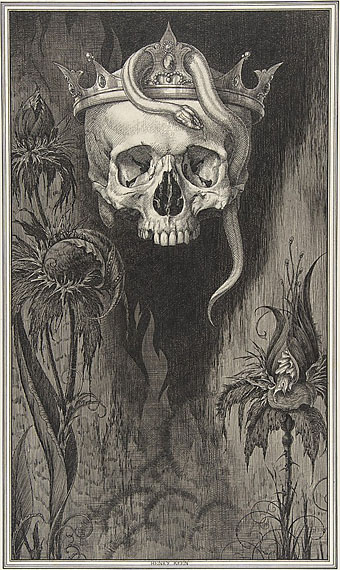
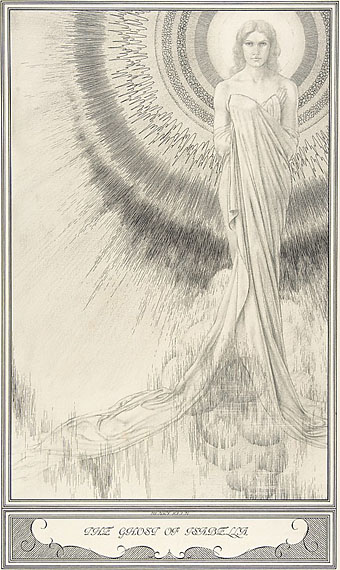
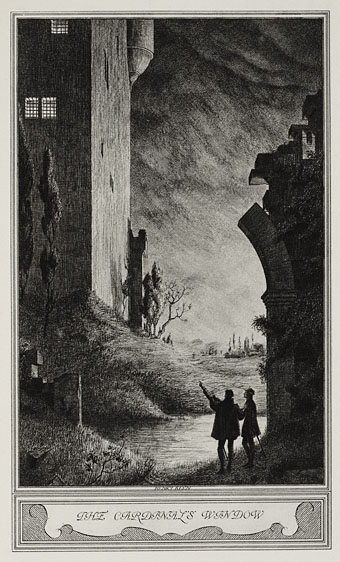
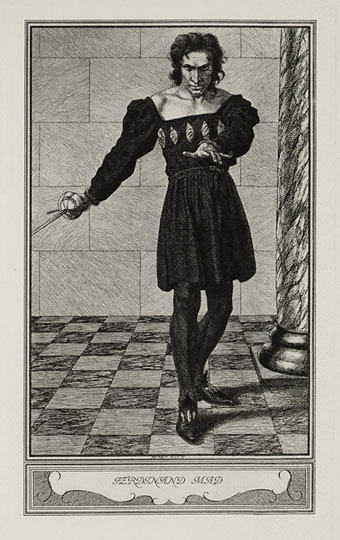
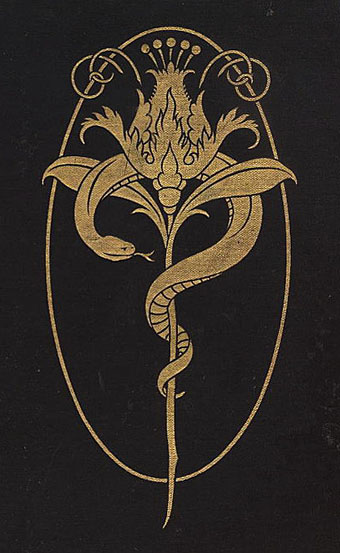
More gorgeous work from elusive British illustrator Henry Keen (1871–1935). These are some of the ink drawings Keen provided for a 1930 edition of John Webster’s Jacobean tragedies The Duchess of Malfi and The White Devil. In addition to eleven full-page illustrations there are decorative embellishments, and as usual it’s a shame there isn’t anywhere with a complete set of the artwork. I’m tempted to track down some of Keen’s books myself, this one seems especially good. That crowned skull is not only worthy of Carlos Schwabe, it makes me wonder why Webster wasn’t given more attention from earlier artists. Probably because the plays were too strong for 19th century tastes, violent revenge drama wasn’t what anyone wanted on stage at the time. Swinburne admired Webster’s work but then Swinburne wasn’t exactly a typical Victorian.

Thanks to ~Wunderkammer~ for the tip!

keen3.jpg

keen4.jpg

keen5.jpg

keen1.jpg

Elsewhere on { feuilleton }
The illustrators archive

Previously on { feuilleton }
Henry Keen’s Dorian Gray

Weekend links 98

postcard.jpg

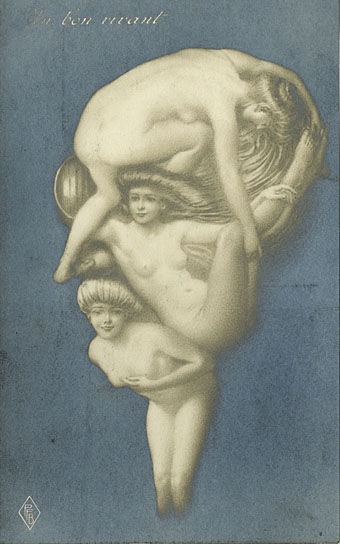
The Arcimboldo Effect again. An undated postcard from the image section of A Virtual Wunderkammer: Early Twentieth Century Erotica in Spain.

“I took George Clinton and Bootsy Collins to the Battle Station for the first time, and they left feeling like they’d just had a close encounter,” said the bassist and music producer Bill Laswell, who met Rammellzee in the early 1980s and remained one of the few people who saw him regularly.

Rammellzee’s Work and Reputation Re-emerge

• Also in the NYT: China Miéville on Apocalyptic London: “Everyone knows there’s a catastrophe unfolding, that few can afford to live in their own city. It was not always so.” Reverse the perspective and find Iain Sinclair writing in 2002 about Abel Ferrara’s The King of New York: “A memento mori of the century’s ultimate city in meltdown.”

• The Inverted Gaze: Queering the French Literary Classics in America by François Cusset. Related: Glitterwolf Magazine is asking for submissions from LGBT writers/artists/photographers.

• The vinyl releases of Cristal music by Structures Sonores Lasry-Baschet continue to be scarce and unreissued. Mark Morb has a high-quality rip of the group’s No. 4 EP here.

Henri’s Walk to Paris, the children’s book designed by Saul Bass in 1962, is being republished. Steven Heller takes a look.

As the critic Jon Savage points out, even rock’n’roll’s very roots, the blues, contained a weird gay subculture. The genre was home to songs such as George Hannah’s Freakish Man Blues, Luis Russell’s The New Call of the Freaks, and Kokomo Arnold’s Sissy Man Blues. “I woke up this morning with my pork grindin’ business in my hand,” offers Arnold, adding, “Lord, if you can’t send me no woman, please send me some sissy man.”

Straight and narrow: how pop lost its gay edge by Alexis Petridis

David Pelham: The Art of Inner Space. James Pardey interviews the designer for Ballardian.

BBCX365: Johnny Selman designs an entire year of news stories.

• Sarah Funke Butler on Nabokov’s notes for Eugene Onegin.

• Leslie S. Klinger on The cult of Sherlock Holmes.

How piracy built the US publishing industry.

SynthCats

The Light Pours Out Of Me (1978) by Magazine | Touch And Go (1978) by Magazine | Motorcade (1978) by Magazine | Feed The Enemy (1979) by Magazine | Cut-Out Shapes (1979) by Magazine.

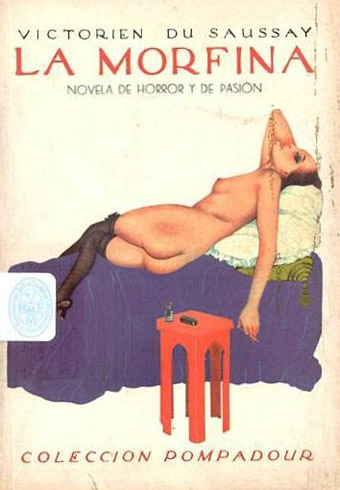
La Morphine by Victorien du Saussay

morphine1.jpg

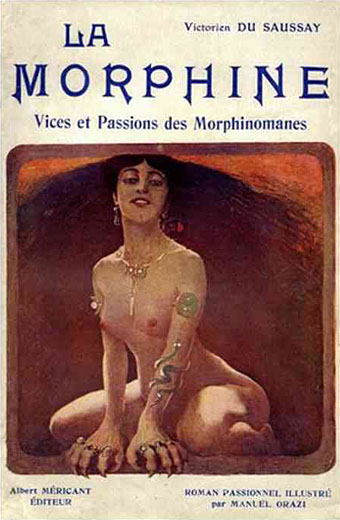
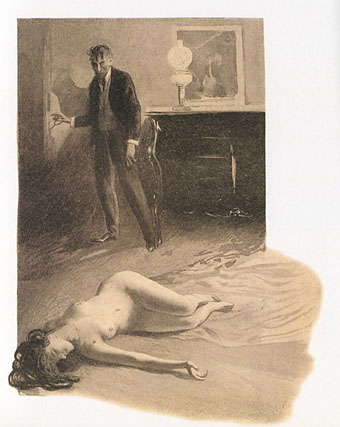
Manuel Orazi’s illustrations (above and below) have been travelling the recursive paths of the Tumblr labyrinth recently. I was hoping to find covers for other editions but the third image here (from 1930) is the only one that’s turned up. La Morphine, Vices et passions des morphinomanes by Victorien du Saussay was published in 1906, and is described by Barbara Hodgson as “a stark novel of addiction, failed cures, incest, indecent exposure and adultery” (In the Arms of Morpheus: The Tragic History of Laudanum, Morphine, and Patent Medicines (2001)). Orazi apparently produced 22 interior illustrations but (again) they don’t appear to be available for the moment.

morphine2.jpg

morphine3.jpg

Elsewhere on { feuilleton }
The book covers archive

Previously on { feuilleton }
Haschisch Hallucinations by HE Gowers
Manuel Orazi’s Salomé
Demon rum leads to heroin
La belle sans nom
German opium smokers, 1900

The Piper at the Gates of Dawn

witw1.jpg

Illustration by W. Graham Robertson (19o8).

(No, this doesn’t concern Pink Floyd.)

The chapter – The Piper at the Gates of Dawn – is normally dropped because it jars, seems so strange compared to all the others and, to some, is vaguely homoerotic. [Kenneth] Grahame thought it essential.

Thus Mark Brown discussing the curious seventh chapter of The Wind in the Willows (1908) wherein Mole and Rat have a mystical encounter with the Greek god of nature in the British countryside:

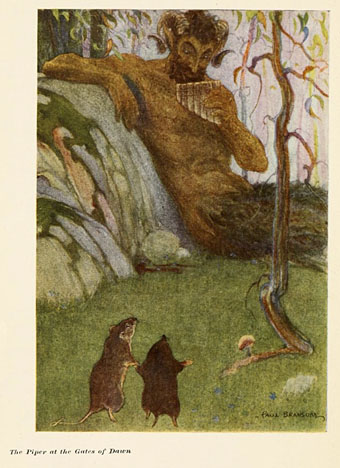
Perhaps he would never have dared to raise his eyes, but that, though the piping was now hushed, the call and the summons seemed still dominant and imperious. He might not refuse, were Death himself waiting to strike him instantly, once he had looked with mortal eye on things rightly kept hidden. Trembling he obeyed, and raised his humble head; and then, in that utter clearness of the imminent dawn, while Nature, flushed with fullness of incredible colour, seemed to hold her breath for the event, he looked in the very eyes of the Friend and Helper; saw the backward sweep of the curved horns, gleaming in the growing daylight; saw the stern, hooked nose between the kindly eyes that were looking down on them humorously, while the bearded mouth broke into a half-smile at the corners; saw the rippling muscles on the arm that lay across the broad chest, the long supple hand still holding the pan-pipes only just fallen away from the parted lips; saw the splendid curves of the shaggy limbs disposed in majestic ease on the sward; saw, last of all, nestling between his very hooves, sleeping soundly in entire peace and contentment, the little, round, podgy, childish form of the baby otter. All this he saw, for one moment breathless and intense, vivid on the morning sky; and still, as he looked, he lived; and still, as he lived, he wondered.

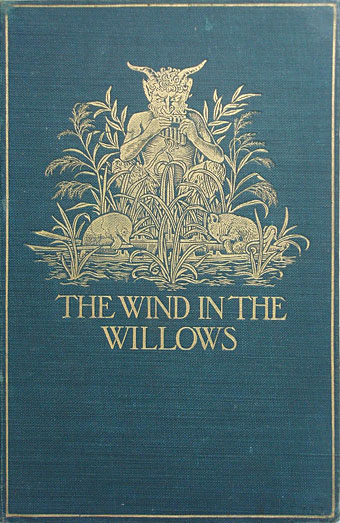
Brown’s article concerns a forthcoming exhibition, Writing Britain: Wastelands to Wonderlands, at the British Library, part of the summer’s Olympic celebrations. Kenneth Grahame’s hand-written text of chapter seven will be on display together with a later Arthur Rackham illustration of the goat god. The Library makes a point of noting that the Pan chapter is sometimes excised from the book although I’m not sure how often this occurs, it’s been present in all the editions I’ve seen including the cheap paperback edition I have somewhere. W. Graham Robertson’s rather fine drawing above (showing Mole and Rat bowing to their presiding deity) embellishes the first UK edition. Paul Bransom’s illustration below is the frontispiece to a 1913 US edition.
witw2.jpg

Illustration by Paul Bransom (1913).

One benefit of this bit of news has been finding Robertson’s illustration which gives Brown’s use of “homoerotic” a slight twist. Robertson was a children’s illustrator and playwright who Neil McKenna in The Secret Life of Oscar Wilde (2003) describes as being a member of the surreptitiously gay art world in London during the 1890s. (If there’s to be any dissent about this let’s note that one of his plays was entitled Pinkie and the Fairies…) Robertson knew Oscar Wilde but fell in with the contra-Wilde fraternity, notably Robert de Montesquiou, so gets left out of many accounts of Wilde’s circle. He was however immortalised by John Singer Sargent in this well-known portrait. I’ll be writing a little more about Robertson and Sargent’s painting at a later date. For more about the surprising recurrence of Pan in Victorian and Edwardian literature, see this earlier post.

Writing Britain: Wastelands to Wonderlands at the British Library opens on May 11th and runs throughout the summer.

Elsewhere on { feuilleton }
The illustrator’s archive

Previously on { feuilleton }
The Great God Pan
Peake’s Pan

Amy Sacker, book designer

sacker1.jpg

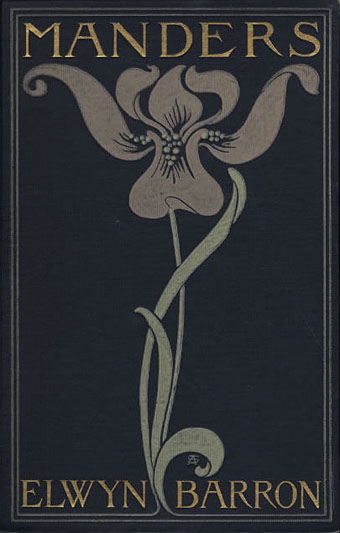
Manders: A Tale of Paris (1899) by Elwyn Barron.

Amy Sacker (1872–1965) was an American book designer, illustrator and bookplate artist, one of a number of female designers and illustrators whose careers began in the last years of the 19th century. I’ve mentioned before how women struggled at this time for acceptance in the male-dominated spheres of painting and sculpture. Those who insisted on pursuing an artistic career were encouraged to concentrate their impulses in the decorative arts with the result that women are a lot more visible in the illustration and design of this period. (See this earlier post about Margaret Armstrong, and these pages at Princeton University Library about women printers, binders and book designers.)

sacker2.jpg

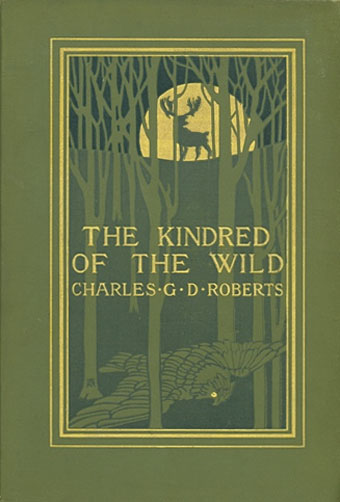
The Kindred of the Wild (1902) by Charles G. D. Roberts.

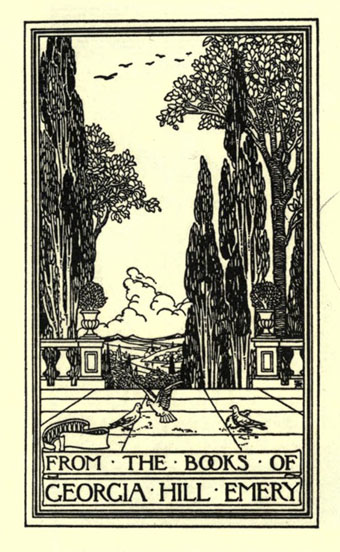
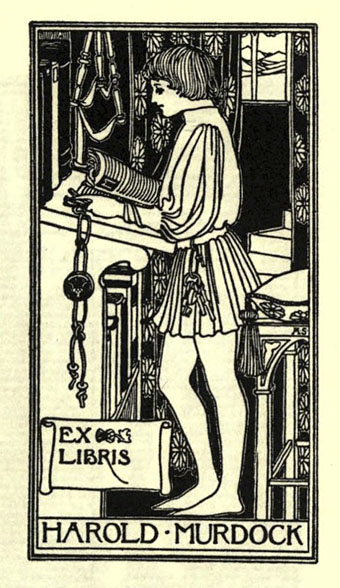
The cover above is from the Amy Sacker website which features information about Ms Sacker’s bookbindings, illustrations and bookplate designs. A recent post here mentioned the Troutsdale Press collection of Amy Sacker bookplates from which the two examples below are taken. These often show people in Renaissance or medieval garb drawn in a style reminiscent of Walter Crane. More of them can be seen at the Internet Archive while the University of North Carolina archive has 120 examples of her cover designs.

sacker3.jpg

sacker4.jpg

Elsewhere on { feuilleton }
The book covers archive

Previously on { feuilleton }
Troutsdale Press bookplates
Margaret Armstrong book designs