Chickamauga

chickamauga.jpg

They were men. They crept upon their hands and knees. They used their hands only, dragging their legs. They used their knees only, their arms hanging idle at their sides. They strove to rise to their feet, but fell prone in the attempt. They did nothing naturally, and nothing alike, save only to advance foot by foot in the same direction. Singly, in pairs and in little groups, they came on through the gloom, some halting now and again while others crept slowly past them, then resuming their movement. They came by dozens and by hundreds; as far on either hand as one could see in the deepening gloom they extended and the black wood behind them appeared to be inexhaustible. The very ground seemed in motion toward the creek.

Chickamauga (1891) by Ambrose Bierce

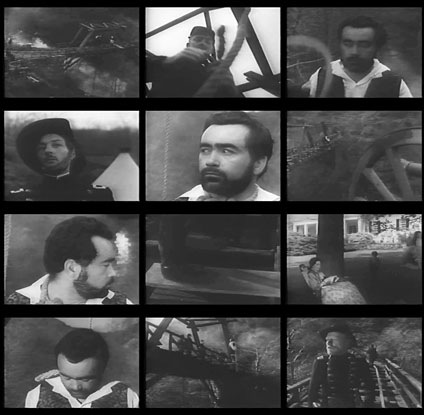
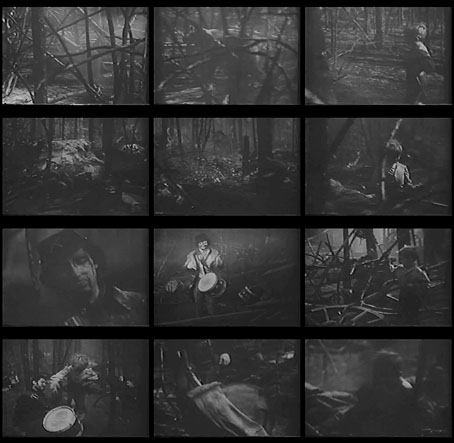
Chickamauga (1962) is another of Robert Enrico’s three short films based on the Civil War stories of Ambrose Bierce. The withdrawal of hope at the end of An Occurrence at Owl Creek Bridge may seem bleak but that story is positively cheerful beside the horrors of Chickamauga in which a small deaf boy wanders from home to find a new playground in the aftermath of one of the bloodiest battles of the Civil War. The story is grim enough for it to find its way into horror anthologies which is where I first read it. Once again Enrico’s adaptation is very faithful, and the way he uses songs as a commentary makes more sense of the similar use in An Occurrence at Owl Creek Bridge. This copy of the film is another grainy one from VHS but it’s the only one you’ll see for now. The same YouTube channel has the third of the director’s Bierce adaptations, The Mockingbird, a lesser piece than the other two but still worth a watch, not least because these films have been out of circulation for so long. See also: Robert Enrico’s Civil War Trilogy by Justine Smith.
Previously on { feuilleton }
An Occurrence at Owl Creek Bridge
An Occurrence at Owl Creek Bridge
occurrence.jpg

Still with the short films, this is one I’ve known about for years but only recently seen. La Rivière du Hibou was Robert Enrico’s 1962 adaptation of the oft-reprinted Civil War story by Ambrose Bierce, An Occurrence at Owl Creek Bridge. Enrico made three such films from Bierce’s stories, this being the most celebrated; in addition to gaining awards it was also screened as part of The Twilight Zone series which makes me wonder how I’ve managed to miss it for so long. As an adaptation it’s very faithful if you overlook the awkward interjection of a song halfway through.

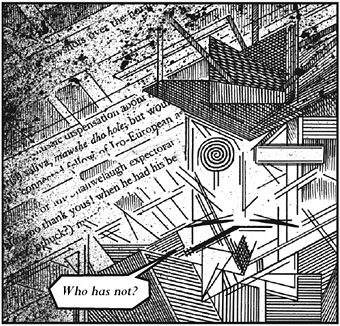
This particular tale I now find overly familiar since I adapted it in comic strip form in 2003 for the Ambrose Bierce number of Graphic Classics. That strip was one of the last comics I produced, a somewhat misguided attempt at using 3D software. My adaptation involved a great deal of guess-work at the military and other details so I watched Enrico’s opening scene with a sense of relief that his version isn’t so different from my own. The shots here are from this grainy copy of the film. There’s a better copy here from the Twilight Zone screening with Spanish subtitles added.

Weekend links 113

leonard.jpg

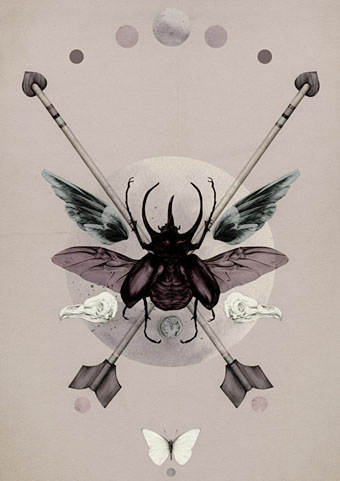
Wunderkammer (2011) by Emma Leonard.

As someone who was eight years old at the time of the Apollo moon landing, I remember calculating that I would be thirty-nine in the magic year 2000 and wondering what the world would be like. Did I expect I would be living in such a world of wonders? Of course. Everyone did. Do I feel cheated now? It seemed unlikely that I’d live to see all the things I was reading about in science fiction, but it never occurred to me that I wouldn’t see any of them.

A quote from Of Flying Cars and the Declining Rate of Profit, an essay by David Graeber. Related: Another World: David Graeber interviewed by Michelle Kuo at Artforum.

Constellation, a series of portraits by Kumi Yamashita: “This body of work consists of three simple materials that, when combined, produce the portraits: a wooden panel painted a solid white, thousands of small galvanized nails, and a single, unbroken, common sewing thread.”

Nicole Rudick at The Paris Review on the history of psychedelic art. Related: The psychedelic art and design of Keiichi Tanaami. Also Manifesting the Mind: Footprints of the Shaman, a two-hour documentary about psychedelic drugs.

• Already mentioned here, The Lost Tapes, a 3-CD collection of previously unreleased recording by the mighty Can, is out on Monday. There’s a preview of ten of the tracks here.

• “I can’t think of anybody who would have a good word to say for centipedes…” Duncan Fallowell (a Can associate for many years) interviewed William Burroughs in 1982.

Herb Lubalin: American Graphic Designer and the Herb Lubalin Study Center’s Flickr sets.

Strange Flowers goes to the movies with everyone’s favourite Bavarian king, Ludwig II.

The Sphinx’s Riddle: The Art of Leonor Fini at the Weinstein Gallery, San Francisco.

• More Teutonica: A Spacemusic Primer by Dave Maier.

Van Dyke Parks: return of a musical maverick.

Forty Posters for Forty Years at Pentagram.

Donovan’s Colours (1968) by Van Dyke Parks | Sailin’ Shoes (1972) by Van Dyke Parks | Clang Of The Yankee Reaper (1975) by Van Dyke Parks.

James Joyce in Reverbstorm

jj1.jpg

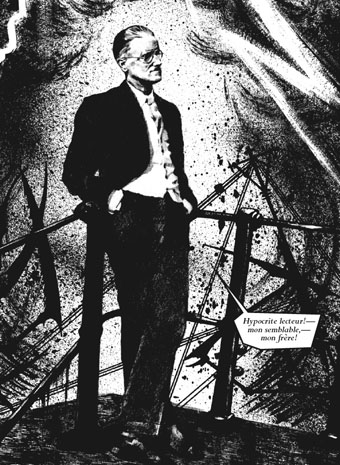
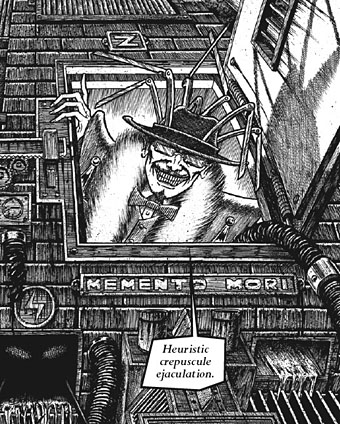
A post for Bloomsday with a handful of the many and varied appearances of James Joyce in the forthcoming Reverbstorm book. Ulysses was published ninety years ago this year. Among the usual commemorations BBC Radio 4 will be dramatising the entire novel throughout the day.

jj2.jpg

But as before the lightning the serried stormclouds, heavy with preponderant excess of moisture, in swollen masses turgidly distended, compass earth and sky in one vast slumber, impending above parched field and drowsy oxen and blighted growth of shrub and verdure till in an instant a flash rives their centres and with the reverberation of the thunder the cloudburst pours its torrent, so and not otherwise was the transformation, violent and instantaneous, upon the utterance of the word.

James Joyce, Ulysses (1922)

jj3.jpg

Prison and place and reverberation
Of thunder of spring over distant mountains
He who was living is now dead
We who were living are now dying
With a little patience

TS Eliot, The Waste Land (1922)

jj4.jpg

Continue reading “James Joyce in Reverbstorm”

Recovering Viriconium

viriconium01.jpg

Detail from Assassination in the Night (c. 1600?) by Monsù Desiderio.

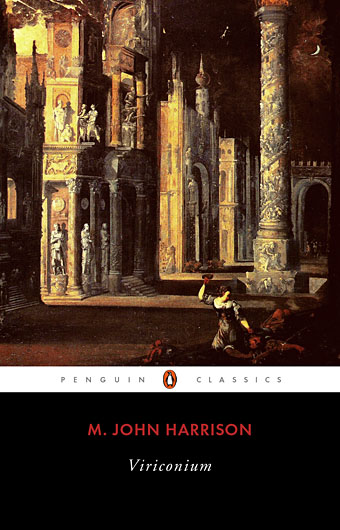
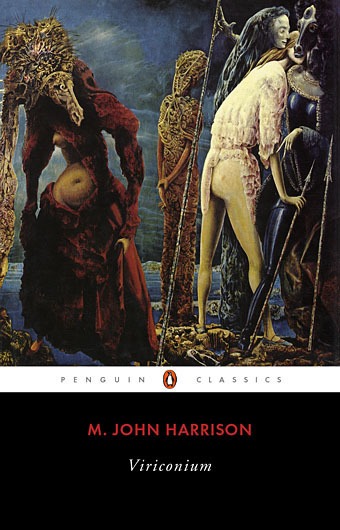
Yesterday’s post looked at some of the past cover designs for M. John Harrison’s Viriconium books. This post makes a few suggestions for how they might be presented in the future. Since these are mostly covers that I’d like to see they’re not necessarily ideal for the audience a publisher might be aiming at, cover design is usually a three-way process involving designer, author and publisher. In the end I’ve resisted the temptation to draft a range of original cover proposals—writing these posts has taken long enough—so almost everything here uses pre-existing art. If I was designing covers for all four Viriconium books, however, and the brief was to orient them towards a fantasy readership, the first thing I’d try would be a series of four imaginary Tarot designs. A peculiar pack of Tarot cards is a recurrent feature of the books so I’d create four emblematic cards that featured significant elements and characters from each. The characters wouldn’t be too well defined, they’d be stylised, maybe even silhouettes. Each card would feature a dominant presence: offhand these would be one of the geteit chemosit for The Pastel City, a locust for A Storm of Wings, the Barley Brothers for In Viriconium and a Mari Lwyd horse skull for Viriconium Nights. These presences together with the human characters would loom over a silhouette city at the foot of each card whose outlines would change appearance from book to book, evolving gradually from a fantastic outline of domes and towers to something that resembles a contemporary city. The colours and treatments would show a similar evolution from the bright and bold styles of the Pamela Colman Smith Tarot deck to something more photographic, collaged from elements closer to our world. Maybe.

That’s an idea for the four individual books. All the examples here use the convenience of the omnibus edition so a single image (or pair of images) has to somehow represent the entire series. To save time and effort I’ve taken the liberty of hijacking a couple of Penguin Books layouts. I hope Penguin doesn’t mind, and I should also apologise to Harrison’s UK publishers, Gollancz, for making one of their authors jump ship. The Viriconium omnibus is certainly good enough to be considered a modern classic. Penguin’s recent template for its Modern Classics series happens to be very easy to apply to a wide range of artwork.

viriconium04.jpg

The Anti-Pope (1942) by Max Ernst.

Penguin has a long tradition of using pre-existing art on its covers, especially on those in its Penguin Classics series. You can almost make this into a parlour game: match your favourite novel with the best choice of painting. The tradition was extended to its science fiction titles in the early 1960s when the art of Max Ernst was featured several times along with the work of other Surrealists. Max Ernst is a favourite artist of mine so this is one I can’t resist. Many of Ernst’s decalcomania paintings of the 1940s would suit Viriconium but The Anti-Pope with its horse heads seems especially suitable.

Also on the Penguin sf covers was a picture by the mysterious “Monsù Desiderio” one of whose works can be seen at the top of this post. Desiderio was a 17th-century painter with a vague enough presence—works have been attributed to both François de Nomé and Didier Barra—and a line in gloomy architectural fantasias to make him an ideal Viriconium artist.

Continue reading “Recovering Viriconium”