Alchemically Yours

alchemically_yours1.jpg

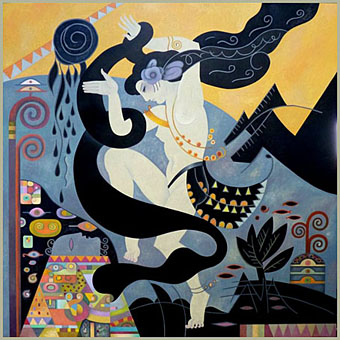
Ars, Scientia, Magia (2007) by Jesse Bransford.

Another art exhibition, and another group show at Observatory in Brooklyn, NYC, where some of my Lovecraft drawings were shown last year. Alchemically Yours is an alchemy-themed contemporary art show curated by Phantasmaphile‘s Pam Grossman, and she has this to say about the exhibition:

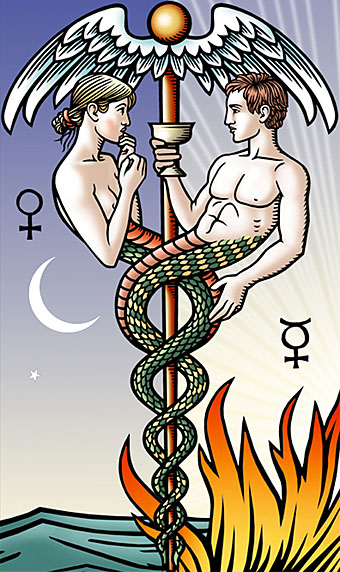
Like dreams, alchemy speaks in pictures. At first glimpse, alchemical manuscripts from the 16th and 17th centuries look like a panoply of hallucinations. They feature images of fornicating kings and queens. Suns and moons shining in stereo. Lions and serpents and eggs, oh my. Black and white and red all over. Secret codes and effulgent iconographies teeming with meaning, yet ultimately ineffable. These pictures beget picturing. They’re signs that beg to be resignified; to be reinterpreted and refined.

The participants in Alchemically Yours have done just that. Varying in medium and style, each piece in this exhibition pays homage to the alchemic tradition—all the while affirming that the artist fills the role of alchemist in the present-day. For who better can elevate the mundane, turn the sub- into the sublime? From the prima materia of color and canvas comes great and vivid work.
alchemically_yours2.jpg

Caduceus (detail, 2011) by Robert M. Place.

The participating artists are Jesse Bransford, Molly Crabapple, Ted Enik, Marina Korenfeld, Adela Leibowitz, Sara Antoinette Martin, Ann McCoy, Robert M. Place, Ron Regé, Jr., J.L. Schnabel, Hunter Stabler, Panos Tsagaris.

Alchemically Yours opens on Saturday, May 7th, 2011, 7–10pm and will run from May 8th to June 12th, 2011.

Previously on { feuilleton }
Laurie Lipton’s Splendor Solis
The Arms of the Art
Splendor Solis
Amphitheatrum Sapientiae Aeternae
A Love Craft: Art Inspired by Monsters, Madness and Mythos
Cabala, Speculum Artis Et Naturae In Alchymia
Vision Quest
Digital alchemy
Fata Morgana: The New Female Fantasists
Weekend links 54

starowieyski.jpg

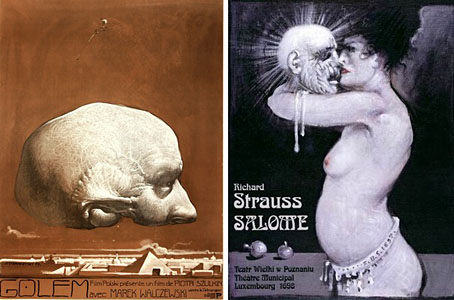
Film and opera posters by Franciszek Starowieyski (see below).

• At first glance, Jerzy Skolimowski’s new film, Essential Killing, sounds like Joseph Losey’s Figures in a Landscape (1970) reworked for our era of renditions, torture and war without end. The trailer is here; Sight & Sound liked the film and dismissed any Losey comparisons. The Quietus interviewed the director this week, and there’s also a video interview here.

“He was trying to tell the truth about war. In the 1950s the US was telling itself a mythic, grandiose, heroic story about the second world war and GI Joe saving the world. [James] Jones was saying, ‘That wasn’t the war I saw, I want to write something more honest and realistic. Whatever the mid-America myth, one of the things men were doing was giving blow jobs for money.'”

From Here to Eternity is published in an uncensored edition.

Edogawa Rampo‘s sinister short story The Human Chair concerns a man who conceals himself inside a chair. Taiwanese artist Lan Hungh may have had Rampo’s story in mind for his Demolished Chair art piece about which we’re told “Hungh’s flaccid penis is the only body part that’s visible, and becomes hard as soon as anyone starts discussing the chair or sitting on it.” BUTT magazine spoke to the artist.

…unaware of their double standards, the police objected to the portrayal of men in Harrison’s work as demeaning. There was Hugh Hefner squeezed into a bunny girl costume, a beefy but emasculated Captain America wearing false breasts and a stars ‘n’ stripes-patterned basque, and Valerie Solanas, the radical feminist who tried to murder Andy Warhol, stamping on his Brillo box artwork.

A piece about artist Margaret Harrison whose work is on show at Payne Shurvell, London.

Connecting Science and Art: “Novelist Cormac McCarthy (!), filmmaker Werner Herzog, and physicist Lawrence Krauss discuss science as inspiration for art and Herzog’s new film on the earliest known cave paintings.”

• At Tumblr: Gurafiku, “a collection of visual research that encompasses the history of Japanese graphic design”, and Archidose.

• “Michael Moorcock’s Modem Times 2.0 is a good introduction to the literary legend.”

• The Spring 2011 edition of Periwinkle Journal (Queer Art + Creativity) is now live.

• Rick Poynor (again) on [Franciszek] Starowieyski’s Graphic Universe of Excess.

• Coudal now have a page of links for the great Terrence Malick.

Wake in Progress is Finnegans Wake illustrated.

Brown Study, a blog by Jay Babcock.

• RIP Sidney Lumet.

Ry Cooder & The Moula Banda Rhythm Aces: Let’s Have a Ball is a film by Les Blank of a fantastic performance by Cooder’s band in Santa Cruz, California, in 1987. It’s not available on DVD but most of it can be seen on YouTube.

Dalí and the City

dali.jpg

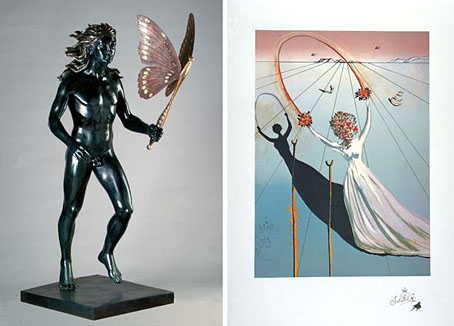
left: Lady Godiva with Butterflies; right: Alice in Wonderland.

London already has a number of Salvador Dalí works on display but there’s even more to see this month with an exhibition at Moor House, London Wall, where a handful of minor pieces are on show until 30th June, 2011. Dalí and the City features the artist’s Alice in Wonderland sculpture as well as the print shown here, and also some Tarot card designs. The masculine form of Lady Godiva above can be taken as further confirmation of Dalí’s recurrent interest in gender confusion. The Independent has more examples from the show while this page has details of opening times.

Previously on { feuilleton }
Dalí’s Elephant
Dalí in Wonderland
Dirty Dalí
Impressions de la Haute Mongolie revisited
Dalí and Film
Salvador Dalí’s apocalyptic happening
Dalí Atomicus
Impressions de la Haute Mongolie

Anamorphosis

quays1.jpg

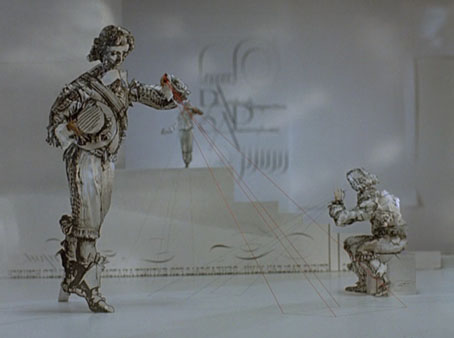
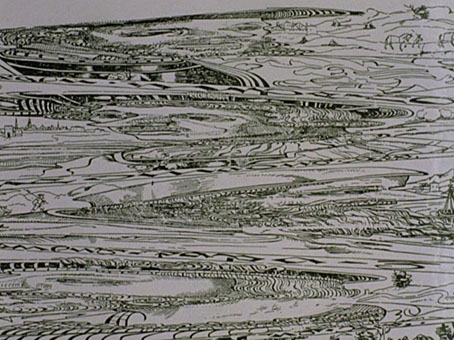
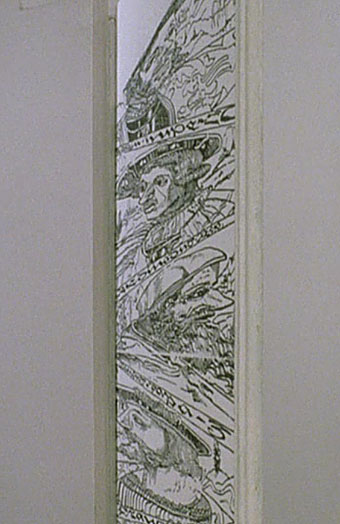
Some anamorphosis for All Fool’s Day. De Artificiali Perspectiva, or Anamorphosis (1991) is a short film by the Brothers Quay which can be seen in two parts at YouTube. (And I’d urge anyone interested to avail themselves of the essential double-disc collection of the Quays’ early work which includes this film.) There are plenty of sites devoted to anamorphosis such as this one but films tend to explain the effect better than still pictures by showing the stages of transformation to or from pictorial coherence. The stills below, for example, work better in motion than they do here. The Quay’s first feature, Institute Benjamenta (1995), also features some anamorphosis with a mural on the walls of a passage in the film’s strange school for servants.

quays2.jpg

Also at YouTube there’s a short video demonstration of mirror anamorphosis, a variation where the distorted picture corrects itself when viewed with a mirrored tube. Musician Rick Wakeman used this effect for an album he released in 1976, No Earthly Connection, a work whose cover art is more impressive than the music it embellishes. The album came with a thin sheet of mirrored plastic which could be folded to create a viewing device.

quays3.jpg

Previously on { feuilleton }
The Ambassadors in detail
False perspective
Trompe l’oeil

The Salomé paintings of Caroline Smith

smith_seduction.jpg

Seduction.

One of a series of paintings by a British artist, and what a great series it is with echoes of ancient art as well as Gustav Klimt. Also further evidence that this theme isn’t a wholly masculine preoccupation.

Elsewhere on { feuilleton }
The Salomé archive