Dalí and Film

dali1.jpg

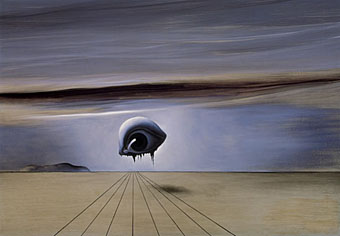
Study for the Dream Sequence in Spellbound by Salvador Dalí (1945).

A new exhibition exploring Salvador Dalí’s connections with cinema begins at Tate Modern this weekend. Interesting seeing Dalí’s gradual reappraisal by the art establishment after years of dismissal but then it is nearly twenty years after his death.
dali2.jpg

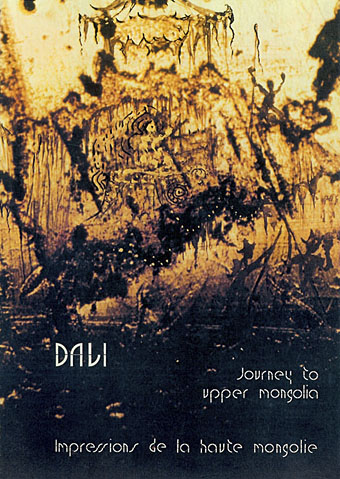
One welcome result of this event is an interview in the Tate’s online magazine with film director José Montes Baquer whose Dalí collaboration, Impressions of Upper Mongolia, Hommage to Raymond Roussel, I wrote about last year. This is the only substantial discussion of this curious film I’ve seen anywhere so it’s fascinating to discover that it came about as a result of Dalí urinating on a pen.

He said: “In this clean and aseptic country, I have been observing how the urinals in the luxury restrooms of this hotel have acquired an entire range of rust colours through the interaction of the uric acid on the precious metals that are astounding. For this reason, I have been regularly urinating on the brass band of this pen over the past weeks to obtain the magnificent structures that you will find with your cameras and lenses. By simply looking at the band with my own eyes, I can see Dalí on the moon, or Dalí sipping coffee on the Champs Élysées. Take this magical object, work with it, and when you have an interesting result, come see me. If the result is good, we will make a film together.”

The interview also includes a few more tantalising glimpses of the film’s images and in the same magazine there’s a piece by Roy Disney remembering Dalí’s encounter with his uncle, Walt.

Previously on { feuilleton }
• Ballard on Dalí
• Fantastic art from Pan Books
• Penguin Surrealism
• The Surrealist Revolution
• The persistence of DNA
• Salvador Dalí’s apocalyptic happening
• The music of Igor Wakhévitch
• Dalí Atomicus
• Las Pozas and Edward James
• Impressions de la Haute Mongolie
Peter Eudenbach’s Eiffel Ferris wheel

eiffel1.jpg

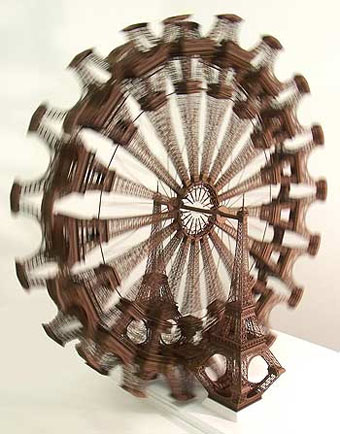
Tours de Revolutions by Peter Eudenbach (2007).

Built to commemorate the French Revolution, the Eiffel Tower inspired Ferris to create a revolving wrought iron marvel to surpass it. Twenty years later Duchamp’s love of Ferris Wheels led to the first readymade and caused a revolution in art. Tours de Revolution is a Ferris wheel made of Eiffel towers, bringing this famous landmark full circle.

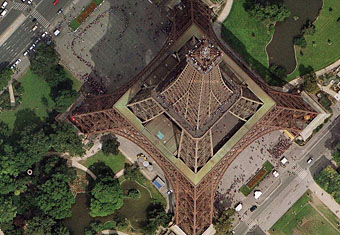
And speaking of Gustave Eiffel’s monument, Google Maps now has very clear views of central Paris. That snaking line of people is the queue to use one of the lifts.

eiffel2.jpg

Previously on { feuilleton }
• City of Light
• Paris V: Details
• Enormous structures II: Tatlin’s Tower

Howard Pyle’s pirates

pirate1.jpg

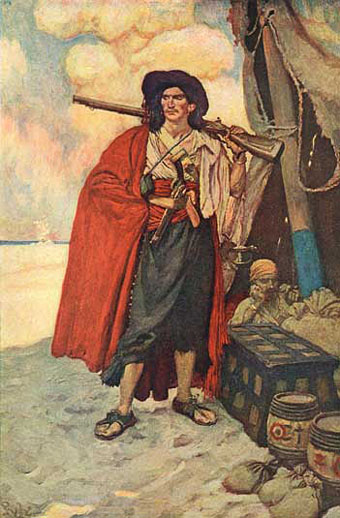
The Buccaneer was a Picturesque Fellow by Howard Pyle (1905).

Seeing as how Johnny Depp and co. are sailing the Spanish Main once more (to mixed reviews, unfortunately), now is perhaps a suitable moment to note the genesis of our popular conception of buccaneers. The famous characters of the Wild West were being mythologised while many of them were still alive and some survived long enough to be consulted by filmmakers such as John Ford when the first of the silent Westerns were being made. Pirates had their exploits recounted in tabloid fashion via books like The Newgate Calendar but our romantic image of the pirate comes primarily from Robert Louis Stevenson and artist/writer Howard Pyle (1853–1911).

pirate2.jpg

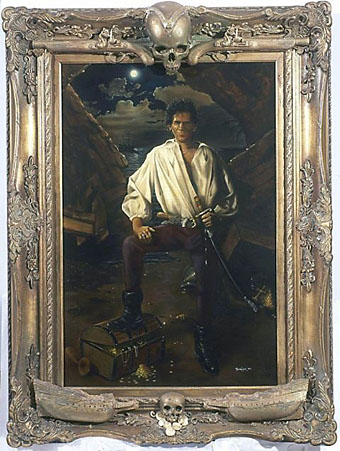
Keith Richards by Paul Karslake (1998).

Pyle’s articles for Harper’s Monthly Magazine in the early 1900s were later collected as the very popular Howard Pyle’s Book of Pirates, “Fiction, Fact & Fancy concerning the Buccaneers & Marooners of the Spanish Main”. The considerable gulf between fact and fiction can be see in early pirate portraits, most of which are crude woodcut renderings. Pyle ignored these for the most part, relying on imagination to exaggerate details of worn-out 18th century clothing in much the same way that Sergio Leone and others exaggerated certain qualities of 19th century garb for their Westerns, turning what would have been a rather sorry reality into something more visually thrilling. Hollywood costume designers have used Pyle’s paintings as source material for pirate characters ever since so it’s perhaps fitting that Johnny Depp’s conception of Jack Sparrow’s character also came from a painting, Paul Karslake’s portrait of Keith Richards posing as a pirate. And now Richards is in the latest film playing Sparrow’s father…

• Howard Pyle at 100 Years of Illustration
• A Pyle pirate gallery

Elsewhere on { feuilleton }
• The illustrators archive

Previously on { feuilleton }
• Coming soon: Sea Monsters and Cannibals!
• Seamen in great distress eat one another
• Druillet meets Hodgson
• Rogue’s Gallery: Pirate Ballads, Sea Songs, and Chanteys
• Davy Jones

Imaginary maps by Francesca Berrini

berrini.jpg

Us and Them (Torn Map Collage on Canvas).

At first glance, from afar, Berrini’s works look like a collection of high-quality maps and atlases with unfamiliar continents and geographic markings. As you examine the details of the maps a bit closer, and try to follow the geographic and geopolitical information displayed, you do a double-take as you realize that the maps themselves are actually constructed from minuscule pieces of other maps, forming new terrain, new geographies, and new names of places in entirely new languages. Berrini maintains the abstract language of maps, yet plays with our notions of their unspoken authority and overall usability.

By recycling different visions of the world, past and present, Berrini hopes to capture her nostalgia for the places that she has not been to. “The creation of maps has historically been a painstaking process, meticulously striving for accuracy. I aim to slowly create a separate world from the scraps of my current fascinations. I am reforming the world that is available to me piece by piece to reflect my imagination of what I do not know. A pointless precision beautifully mirroring nothing.”—Francesca Berrini

Via Design Observer.

• Unusual Cards by Francesca Berrini

Elsewhere on { feuilleton }
• The fantastic art archive

Previously on { feuilleton }
• The Voynich Manuscript
• The Codex Seraphinianus
• 20 Sites n Years by Tom Phillips
• The Atlas Coelestis of Johann Gabriel Doppelmayr