Antonin Mercié’s David

david1.jpg

David (c.1872).

I’d marked out this statue as a suitable addition to the burgeoning men with swords archive some time ago but it took the discovery of a piece of writing to prompt this post. Antonin Mercié’s statue of David resides today in the Musée d’Orsay, Paris, but I managed to miss it on my visit there. Judging by the photos it’s situated at the end of the main hall near Rodin’s enormous Gates of Hell, and it was the Rodin which claimed my attention that day. It’s also the case that the D’Orsay hall (formerly a railway station) is such a cavernous space that free-standing works such as this lose their impact, they’d look far better in smaller rooms.

At the late 1870s, Antonin Mercié incarnated the young generation of French sculptors who, without breaking away from the traditional canons, wanted to make their figures more vibrant. He sought to combine the skilled composition and lively modelling seen in the great models of the Florentine Renaissance: hence the sweeping curves of the arm extended by the movement of the sword, the bent knee, and the graceful movement of this David. A spectator walking round it can appreciate the way the planes gradually modulate the space. Mercié carved himself an original path between modern classicism and explicit realism. (More.)

david2.jpg

You tend to find with many nude sculptures of the 19th century that the original is the naked one while the copies have gained additional items of clothing. This is the case with Mercié’s David whose replicas like the one above from the University of Copenhagen has a wrap around his waist. It’s the nude condition of the Paris statue that lends a frisson to a piece of writing by French author Patrick Drevet which may be fiction or may be reportage. An Angel at Orsay describes an elaborate game of homoerotic voyeurism as the narrator wanders through the museum and stops by Mercié’s David when he spots a student boy sketching the statue. Drevet’s piece is a sustained reverie inspired by his act of studying the student who studies the statue in turn and then becomes engaged by another student boy, the latter deliberately placing himself on view gazing at the statue and hoping (so the narrator surmises) to be sketched himself. A meagre précis like this fails to do Drevet’s piece any justice, it really needs to be read in its entirety. I found it in the Penguin Book of International Gay Writing (1995), and it may well be available in a collection of the author’s work. It’s certainly enough to make me want to read more of Drevet’s writing.

Elsewhere on { feuilleton }
The men with swords archive

Previously on { feuilleton }
Behold the (naked) man

Outer Alliance Pride Day

outer.jpgToday is Outer Alliance Pride Day so let’s begin with a statement:

As a member of the Outer Alliance, I advocate for queer speculative fiction and those who create, publish and support it, whatever their sexual orientation and gender identity. I make sure this is reflected in my actions and my work.

Various members of the Outer Alliance are either posting fiction, or reviewing something or otherwise attempting to fill that declaration of intent. For my part I decided today to do a sketch based on my favourite chapter of The Ticket that Exploded by William Burroughs, the sequence entitled the black fruit which Burroughs wrote with Michael Portman. Ticket was the first Burroughs book I read at the age of 16 or so, having discovered a copy in a local library, and it really felt like something exploding in the head. For a start, the text is some of his least accommodating for an average reader, although I was already familiar enough with literary experiment to cope with that. Far more electrifying was seeing familiar scenarios from science fiction and fantasy infused with a raw and relentless gay sexuality of endless erections and spurting cocks. The black fruit begins with a science fiction scene of lost astronauts encountering alien fishboys intent on having sex; it then progresses through a series of descriptions which read like a pornographic rewriting of similar scenes from HP Lovecraft or Clark Ashton Smith. In the opening pages of Ticket, Burroughs describes his book as “science fiction” but this was like no sf I’d read; I started to wish there was more like it. There are flashes of similar stuff in The Soft Machine (including an idea borrowed from Henry Kuttner) and elsewhere, and Cities of the Red Night is pretty much a full-on fantasy in its second half, but I’d still like to read more about the fishboys…

fishboy

Fishboy and Astronaut (detail).

So here’s an explicitly erotic sketch based on the black fruit (click the picture for the full thing). This should have been a lot better but I’m out of practice drawing at the moment and I didn’t give myself enough time. The scene doesn’t really match the book either, and the astronaut figure is pretty crappy. Feeble excuses aside, Burroughs’ rotting swamp gardens with their marble statues of copulating boys deserve better. And where his fiction leads, I’m still hoping that more writers will follow, not by copying his obsessions but by being as fearless and honest in mining their own.

Previously on { feuilleton }
William S Burroughs: A Man Within
The art of NoBeast

A=P=P=A=R=I=T=I=O=N

apparition.jpg

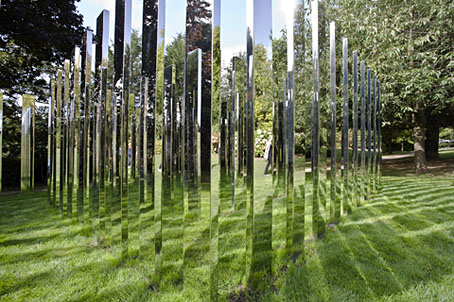
A=P=P=A=R=I=T=I=O=N is a collaboration between artist Cerith Wyn Evans and Throbbing Gristle, the once notorious Industrial music act now enjoying a resurgence of activity and attention. Evans and TG have an earlier connection via Derek Jarman, for whom Evans worked as an assistant. Given how much I enjoy seeing mirrors used in art, I’m very taken with these, and knowing that they function as drifting speakers transmitting specially recorded TG audio makes them doubly interesting. The mirrors-plus-audio aspect is reminiscent of Josiah McElheny’s recent Island Universes with Paul Schütze but that’s not to imply any influence, both artists have been following their individual paths for some time.

The title of this work comes from a poem by Stephan Mallarmé (1842–1898), a poet closely associated with the Symbolists. Looking at an English translation, the piece ends with the line “a snow of white bouquets of perfumed stars”; that final, impossible flourish—perfumed stars—is a very Symbolist touch. Claude Debussy, who took the title of his Prélude à l’après-midi d’un faune from Mallarmé, set Apparition to music in 1884.

A=P=P=A=R=I=T=I=O=N can be seen at Tramway, Glasgow until September 27, 2009.

A=P=P=A=R=I=T=I=O=N test run on Chris Carter’s Flickr pages.

Previously on { feuilleton }
In the Shadow of the Sun by Derek Jarman
The art of Josiah McElheny

The Studio & Studio International

studio1.jpg

Back in February I posted some pictures from a 1971 collection of Art Nouveau illustration and design, some of which were competition entries from The Studio magazine. The Studio, which later became the long-running Studio International, can be seen from issue 11 onwards at the Internet Archive now that they’ve started uploading Google’s book scans. I’ve only looked at one of these so far, Volume 11–13 which runs over 850 pages and so takes some time to go through, as do all these rather unwieldy PDF books. The issues are missing their covers and so aren’t dated but would appear to be from around 1896 to 1898, one of the final entries being a memorial piece for Aubrey Beardsley who died that year; The Studio was the magazine which had introduced Beardsley to the public only five years earlier.

studio2.jpg

The Studio ran regular competitions among its readers and the examples shown here are from some of those. I especially like these type designs; dare we assume that the “Dorian” design below is named after Dorian Gray? As a whole the magazine is an odd mix of very dull Victorian art of the landscapes and artisans type, with occasional flares of interest when they devote a feature to the emerging Art Nouveau style or profile a Symbolist artist such as Giovanni Segantini.

studio3.jpg

A note for anyone wishing to download Google scans from the Internet Archive: some of the PDF links lead you to a Google page where they’re trying to sell you an e-text or get you to buy a book. To see the available files you need to click “All Files: HTTP”.

Previously on { feuilleton }
The Great God Pan
Art Nouveau illustration
Jugend Magazine

Nicoletto Giganti’s naked duellists

fencers.jpg

This is something you don’t generally see in swashbuckling films, a duellist being stabbed through the eye. To judge by the plates in Nicoletto Giganti’s sword-fighting manual it seems to have been a very common form of attack; duels with bare blades were a serious business. For some reason most of the combatants in these pictures also have bare bodies, possibly to better display the positioning of their limbs.

I found this 1644 book by accident last year while searching for something completely unrelated then forgot to bookmark the page. Good job, then, that the indispensable Mr Peacay at BibliOdyssey had come across the same pages. He also found plates from an older book dealing with different forms of hand combat.

Elsewhere on { feuilleton }
The men with swords archive
The etching and engraving archive

Previously on { feuilleton }
Battle of the Naked Men