Dalí’s discography

dalidisc1.jpg

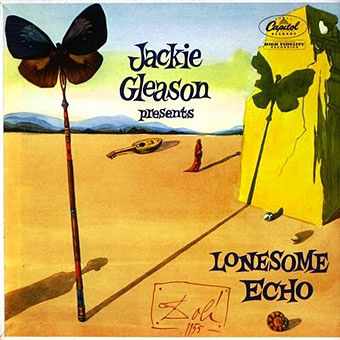
Lonesome Echo (1955) by Jackie Gleason.

Not a definitive list, I was merely browsing Discogs.com out of curiosity. For an artist eager to infiltrate every medium you’d expect there to be more involvement from Dalí with the music world. The Jackie Gleason is included here as the earliest entry for which the artist apparently provided a cover painting and a sleeve note. There’s a nice shot of the back cover on this page with its photo of Salvador and Jackie shaking hands.
dalidisc3.jpg

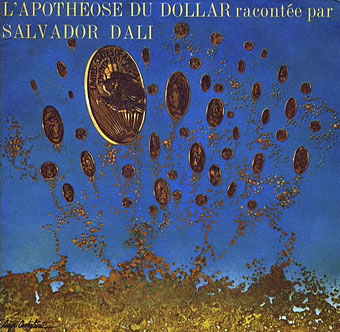
L’Apothéose Du Dollar Racontée Par Salvador Dalí (1971).

Next up is a panegyric to one of the artist’s obsessions—money—recorded on a flexidisc for Crédit Commercial de France. Difficult to imagine any bank today promoting themselves with someone dropping phrases like “divine diahrrée“. A scarce item which can however be found on Ubuweb.
dalidisc2.jpg

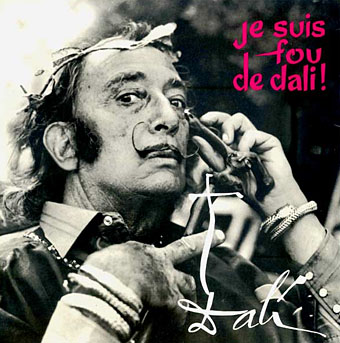
Je Suis Fou De Dalí (1975).

Here the artist extemporises (in French) to a trio of dutiful journalists. Ubuweb again has the entire album, together with a handful of other recordings. This page has some details of the discussion.
dalidisc5.jpg

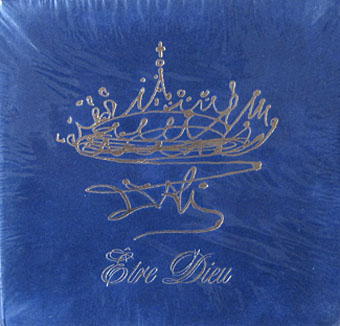
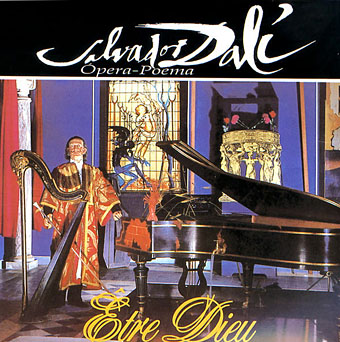
Etre Dieu has been mentioned here before owing to its connection with that cult composer of mine Igor Wakhévitch. Described as an “Opera-Poem: Audiovisual and Catarrah in six parts” it propels Dalí’s megalomania to cosmic proportions with the artist portraying a godlike version of himself. In attendance are an angel and two further Dalís, the male and female halves of an androgynous avatar with the female component being voiced by the great French actress Delphine Seyrig. The libretto is credited to Manuel Vázquez Montalban. The performance was recorded in 1974 but not released on disc until 1989. Not the best of Wakhévitch’s works at all, you’re better off with Logos or Docteur Faust.
dalidisc4.jpg

Elsewhere on { feuilleton }
The album covers archive

Previously on { feuilleton }
Soft Self-Portrait of Salvador Dalí
Mongolian impressions
Hello Dali!
Dalí and the City
Dalí’s Elephant
Dalí in Wonderland
Alejandro Jodorowsky’s Dune
Dirty Dalí
Impressions de la Haute Mongolie revisited
Dalí and Film
Salvador Dalí’s apocalyptic happening
Dalí Atomicus
Impressions de la Haute Mongolie
Weekend links 83

hackett.jpg

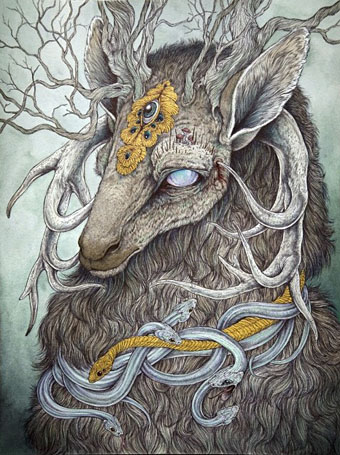
In Memory by Caitlin Hackett who describes her astonishing drawings as “contemporary mythology”.

• David Lynch’s solo album, Crazy Clown Time has just been released so The Guardian last Friday let the artist/director/musician edit their G2 supplement. Xan Brooks tried to get Lynch to open up about his inspirations while elsewhere Lynch had a chat with ZZ Top’s Billy Gibbons. Of more interest to me was news that some of the deleted sequences from Blue Velvet have been discovered. I’ve known about these for years from a feature in Video Watchdog magazine but never thought we might get to see them. Related: a mixtape by David Lynch & musical collaborator/engineer ‘Big’ Dean Hurley.

• “Book jackets these days, for reasons I won’t unpack, seem to revel, overtly, in wit, conceptual deviousness, unusual clever or droll juxtapositions – we, as a professional community, seem to have elevated the visual bon mot above all other virtues.” Peter Mendelsund in a great post about certain problems in book design, starting with the very problematic question of what to do with Nabokov’s Lolita. Related: Covering Lolita, a gallery of covers through the ages which run the gamut of bad decisions.

• “For his sins Pinocchio is not only hanged but robbed, kidnapped, stabbed, whipped, starved, jailed, punched in the head, and has his legs burned off.” Nathaniel Rich goes back to Carlo Collodi’s original Pinocchio. Disney it ain’t.

wolpe.jpg

Some of Berthold Wolpe’s Faber cover designs are now available as prints from wire-frame whose Pelham/Ballard prints were mentioned here recently. Related (and worth another visit): Faber 20th century classics at Flickr.

Technical Vocabularies – Games for May, a small collection of poems by Alan Moore & Steve Moore, is now online with authorial permission. Alan’s Beardsley pastiche on the cover is a bonus.

• Cabaret Voltaire’s Richard H. Kirk says the group’s Virgin albums will be reissued next year by Mute. A new edition of The Crackdown? Yes, please.

• “Homo Riot can only think of six or seven street artists in the world who regularly feature gay themes in their work, and he knows all of them.”

Rub Out The Words: Letters from William Burroughs and Philip K. Dick on the language virus theory of William Burroughs.

L’exilé de Capri: the connections between Jacques d’Adelswärd-Fersen and Roger Peyrefitte explored at Strange Flowers.

• Flying cars and monorails: Soviet Russia in the 1960s also had a Gerry Anderson view of the future.

Are You An Anarchist? The Answer May Surprise You.

Baby’s On Fire (1973) by Brian Eno | Baby’s On Fire (live, 1974) by Eno & The Winkies | Baby’s On Fire (live, 1976) by 801 | Baby’s On Fire (1998) by The Venus In Furs.

Ver Sacrum, 1900

vs-1900-01.jpg

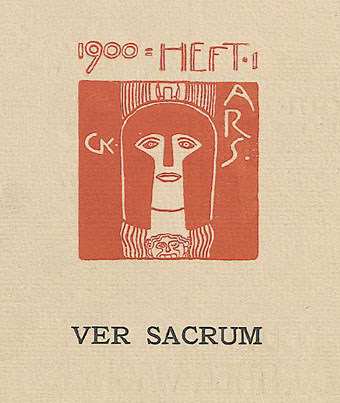
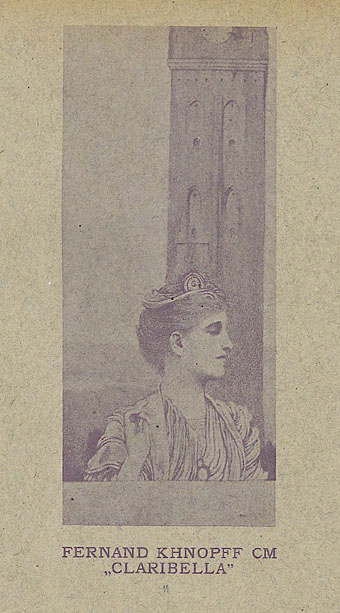
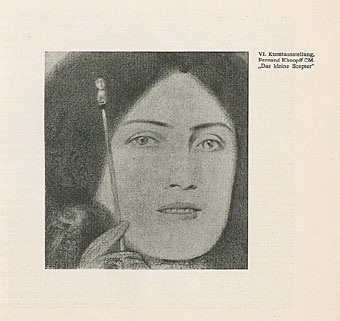
Continuing an occasional series of posts about Ver Sacrum, the art journal of the Viennese Secession. The collected issues for 1900 undergo a change of design, and not necessarily for the better. Gone are the decorative covers of previous years, replaced by small emblem-like vignettes for each issue. The one above is a design by Gustav Klimt whose work is featured throughout this year. Other familiar names include the Belgian Symbolist Fernand Khnopff, Ludwig von Hofmann and Marcus Behmer. The page design is generally less interesting, unfortunately, although the magazine did retain its square format and there are many impressive examples of Art Nouveau graphics. The complete set of pages for this volume can be viewed or downloaded here.

vs-1900-02.jpg

vs-1900-03.jpg

Continue reading “Ver Sacrum, 1900”

The art of Jindřich Štyrský, 1899–1942

styrsky1.jpg

From a late Surrealist to an early one. Jindřich Štyrský is a Czech artist best remembered today for his collages but he was also a painter, a photographer and a publisher of erotic material. He illustrated and published a Czech edition of Lautréamont’s Maldoror, and helped found the Surrealismus review in Prague.

styrsky2.jpg

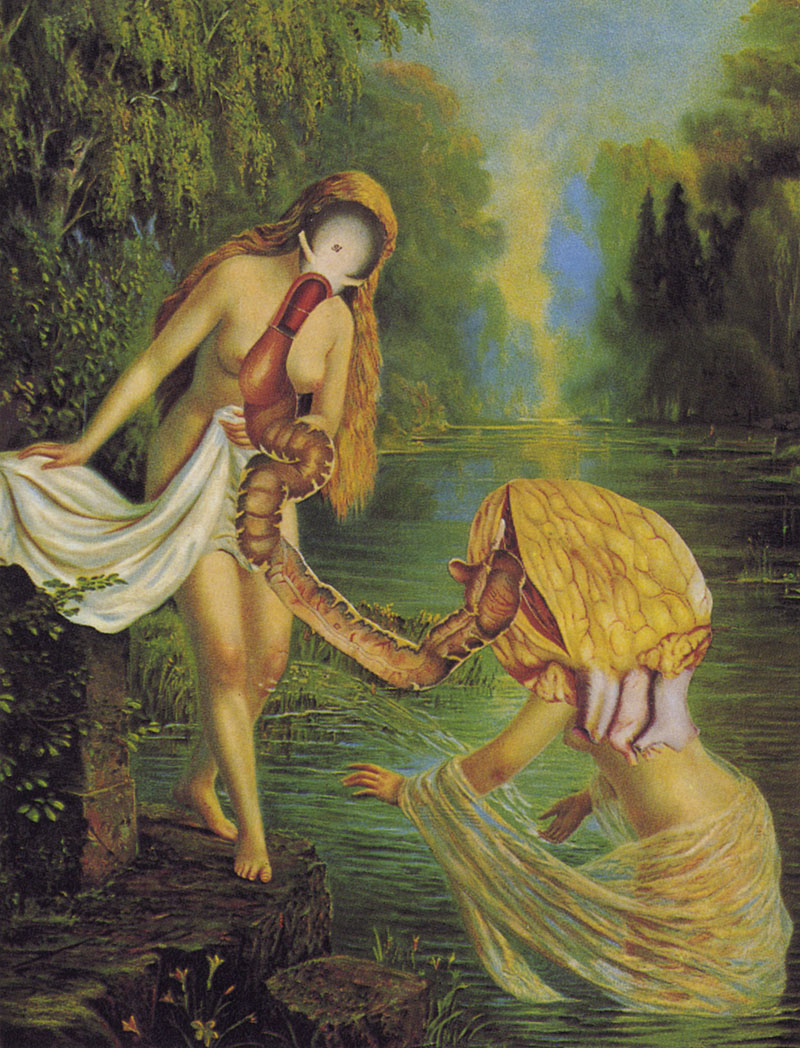
The Bathe (1934).

Regular readers won’t be surprised to hear that I’ve liked Štyrský’s collages for years, many of which subject sentimental Victorian illustration to processes of violent transmutation. Ever since seeing The Bathe I’ve found it impossible to look at one of Renoir’s fleshy nudes without wondering what happened to the exposed viscera. Weimar covered Štyrský’s career in some detail last year so that’s a good place to go for further information. There’s an extract from Štyrský’s dream diary here, and a substantial collection of the collage work and other material at this Flickr set.

styrsky3.jpg

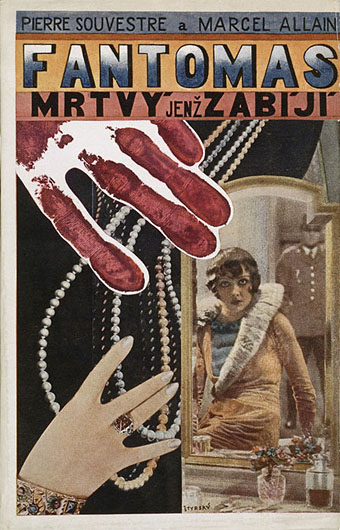
Cover for a Czech edition of Fantômas (1929).

Elsewhere on { feuilleton }
The fantastic art archive

Previously on { feuilleton }
Initiations in the Abyss: A Surrealist Apocalypse
Vultures Await
Wilfried Sätty: Artist of the occult
Illustrating Poe #4: Wilfried Sätty
Metamorphosis Victorianus
Max (The Birdman) Ernst
Gandharva by Beaver & Krause
The art of Stephen Aldrich

Klapheck versus Ballard

klaphek.jpg

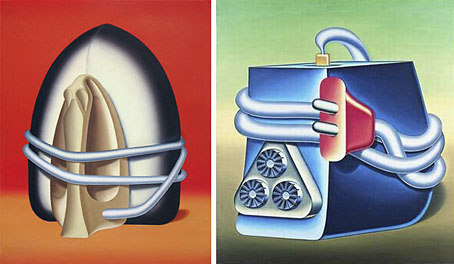
left: The Hostage (1966); right: The Female Terrorist (1971). Both by Konrad Klapheck.

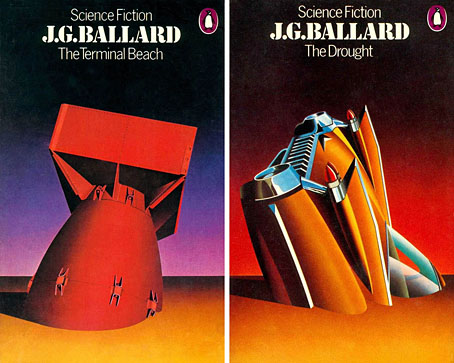
No, I’m not suggesting that David Pelham’s paintings for the Ballard covers he designed in the 1970s are inspired by the earlier work of German artist Konrad Klapheck. But it’s tempting to think of Klapheck’s isolated objects as being intended for Ballard collections that never saw the light of day. Klapheck has connections with late Surrealism, and some of his paintings prefigure the styles and concerns of Pop Art, so I’m sure Ballard would have approved.

pelham.jpg

Three of Pelham’s memorable Ballard paintings were made available as signed and numbered prints earlier this year, together with his design for A Clockwork Orange. For more about the covers see Landscapes From a Dream: How the Art of David Pelham Captured the Essence of JG Ballard’s Early Fiction, an essay at Ballardian. The designer discussed his career at some length in 2007. Then there’s the complete set of covers at the Penguin Science Fiction site, and let’s not forget Konrad Klapheck who’s still painting and who has a website here.

Elsewhere on { feuilleton }
The book covers archive