The Turgot Map of Paris

turgot1.jpg

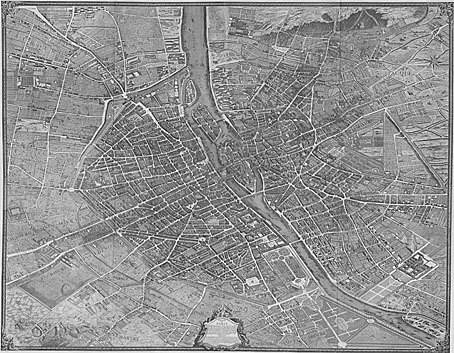
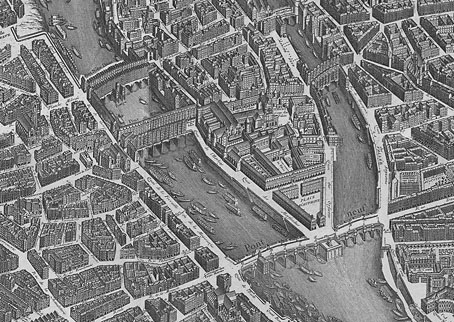
Yesterday’s map of Portmeirion presented a style of mapping I’ve always enjoyed, with the scale of buildings and roads exaggerated in order to give a better impression of the various locations for navigation purposes. The most elaborate example of this kind of isometric projection—indeed, the undoubted nonpareil—is the Turgot Map of Paris, named after its commissioner Michel-Étienne Turgot. The map was issued originally in a series of 20 engraved plates from 1734–1736, and for a long time I only knew of it via the (frustratingly uncredited) details printed on endpapers of the German first edition of Perfume by Patrick Süskind. Once again the web managed to solve another of those nagging artistic riddles.
turgot2.jpg

We’re told that one Louis Bretez was contracted by Monsieur Turgot to draw up the plans of the city which apparently took him two years. Once you start scrutinising the detail it’s surprising it didn’t take a lot longer. Claude Lucas was responsible for the meticulous engravings which show how Paris appeared before Baron Haussmann set to work demolishing many of the medieval streets.
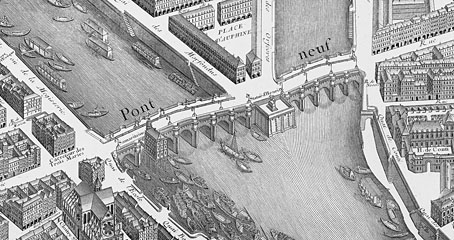
turgot3.jpg

Wikimedia Commons has the entire map in a variety of sizes up to a hefty 6,552 × 5,101 pixels. At the Kyoto University Library it’s possible to view the plates individually with each plate subdivided into detailed views. There’s also a 1908 reprinting of the plates at the Internet Archive. Despite the depredations of Hausmann and co., central Paris has survived a lot better than many other European cities. London suffered so badly during the Second World War it’s a shame we don’t have an equivalent view of the pre-Luftwaffe capital.
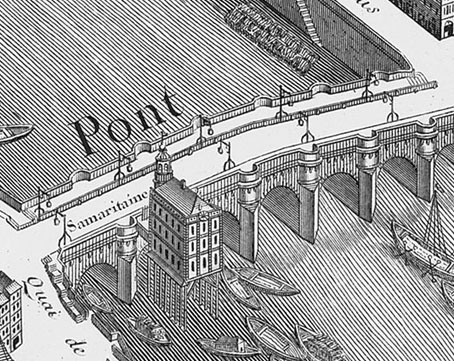
turgot4.jpg

Elsewhere on { feuilleton }
The etching and engraving archive

Previously on { feuilleton }
In the Village
Compass roses
Charles Méryon revisited
The art of Sydney R Jones, 1881–1966
Perfume: the art of scent

Weekend links 92

bmc1.jpg

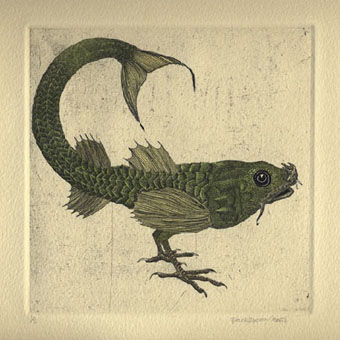
Untitled etching by Briony Morrow-Cribbs.

• An interview with author Paul Russell whose new novel, The Unreal Life of Sergey Nabokov, concerns the gay brother of the celebrated Vladimir.

• Joseph Cornell turns up again in a report at Strange Flowers about Locus Solus, an exhibition in Madrid devoted to the work of Raymond Roussel.

Night of Pan: 42 seconds of occult freakery by Bill Butler featuring Vincent Gallo, Twiggy Ramirez plus (blink and you miss him) Kenneth Anger.

Jan Švankmajer talks (briefly) about his new film Surviving Life. A subtitled trailer is here; the very different Japanese trailer is here.

Cormac McCarthy turns in his first original screenplay. I’d rather he turned in a new novel but any new Cormac is better than none at all.

Barnbrook show off another design for the latest CD from John Foxx & The Maths.

Melanie McDonagh asks “Where have all the book illustrators gone?”

• Congrats to Evan for getting his poetry in the New York Times.

Margaret Atwood on writing The Handmaid’s Tale.

Subliminal Frequencies: An Interview With Pinch.

The (Lucas) Cranach Digital Archive

The M.O.P. Radionic Workshop

• Music promos of the week from the Weird Seventies: All The Years Round (1972) by Amon Düül II, and Supernature (1977) by Cerrone.

Ballet Mécanique

ballet1.jpg

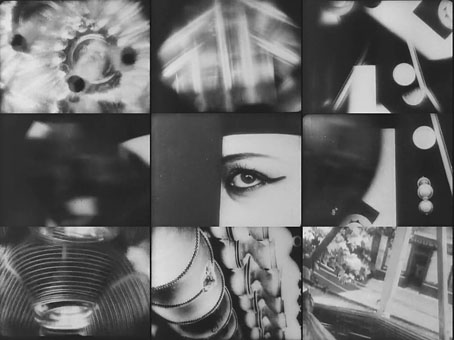
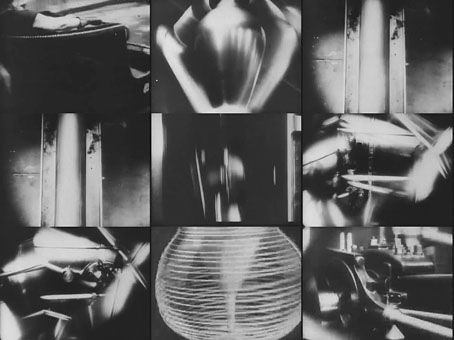
A film to round off a week of connected posts. Ballet Mécanique (1924) is more Dada than Surrealist if you want to get strict about the taxonomy, but the latter movement grew out of the former, and this short experiment by Fernand Léger and Dudley Murphy is a pioneering piece of work however it’s labelled. The film was photographed by Man Ray who used a variety of techniques including animation and kaleidoscope shots to present a “ballet” of machine parts and kitchen utensils. Some of the kaleidoscope images are so close to the opening shots of Fritz Lang’s Metropolis (1927) you have to wonder whether a viewing of this gave Lang ideas.

Ballet Mécanique has been provided with many scores over the years, from player pianos and sirens to more traditional arrangements. The copy at the Internet Archive has a contemporary score but like all silent films this can always be replaced with music of your own choosing.

ballet2.jpg

Previously on { feuilleton }
Dreams That Money Can Buy
La femme 100 têtes by Eric Duvivier
Metropolis!
Entr’acte by René Clair

Joseph Cornell, 1967

cornell1.jpg

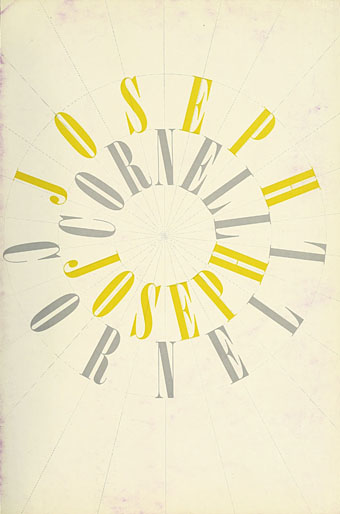
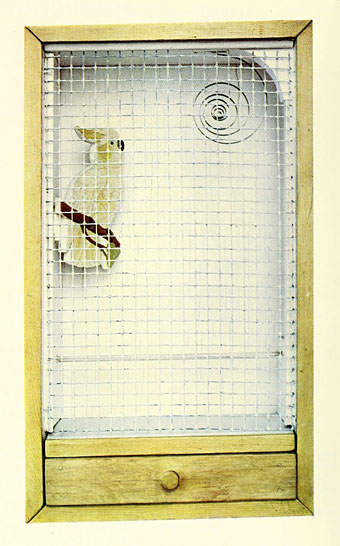
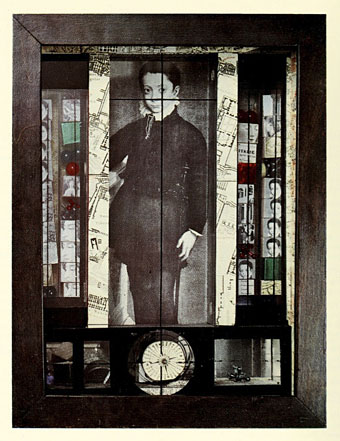
More Surrealism (sort of) from 1967. Joseph Cornell is a catalogue for an exhibition selected and presented by Diane Waldman at the Solomon R. Guggenheim Museum in 1967. The book is one of a number of new and very welcome additions from the Guggenheim Museum to the stock of scanned books at the Internet Archive. Old art books and catalogues often feature black-and-white reproductions but that drawback doesn’t invalidate the usefulness of their textual content. The Museum’s own pages for the archived books may be browsed here.

cornell2.jpg

Cockatoo: Keepsake Parakeet (1949–1953).

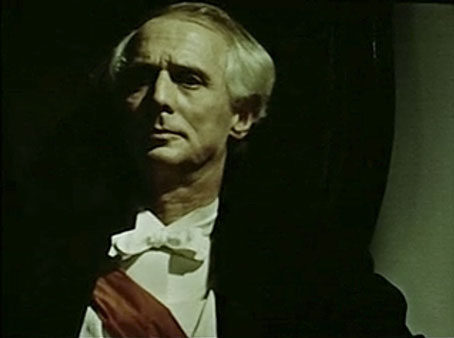
For more on the Magus of Utopia Parkway I’d suggest the BBC’s documentary film Joseph Cornell: Worlds in a Box (1991) but only if you can find a copy since I’ve not seen it online anywhere. That’s a shame because it’s an excellent introduction to Cornell’s life and work, with the added bonus of commentary from Susan Sontag and Cornell’s film collaborators Stan Brakhage and Rudolph Burckhardt. There’s also a surprise appearance from Tony Curtis who was friends with the artist and who reads from his diaries.

cornell3.jpg

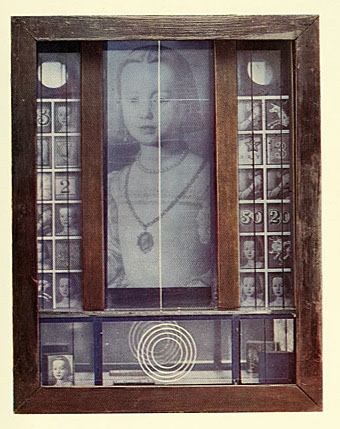
Medici Slot Machine (1942).

Elsewhere, Ubuweb has Cornell’s short films which proceed from the radical re-editing of Rose Hobart (1936) to more lyrical works such as Nymphlight (1957). And I’ve mentioned this before but it’s always worth another look: Americana Fantastica, the edition of Charles Henry Ford’s View magazine edited and illustrated by Cornell in 1943.

cornell4.jpg

Medici Princess (1952).

Previously on { feuilleton }
Rose Hobart by Joseph Cornell
View: The Modern Magazine

Dreams That Money Can Buy

dreams1.jpg

Max Ernst.

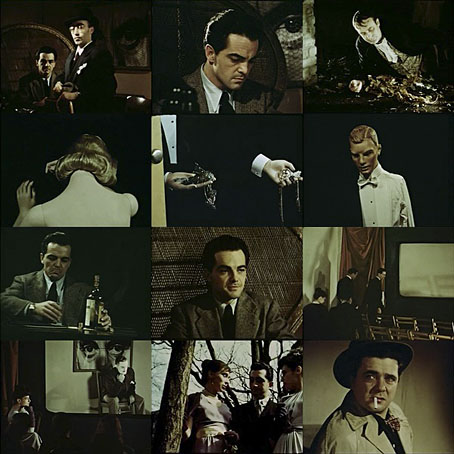
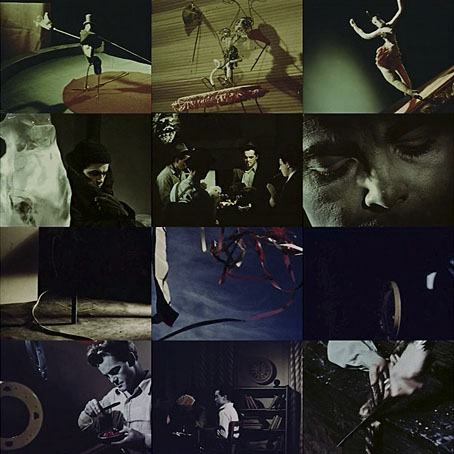
The posts this week have all followed a Surrealist theme so I feel compelled to draw attention to the DVD-quality copy of Hans Richter’s Dreams That Money Can Buy (1947) at the Internet Archive. As mentioned before, Richter’s film is one of the key works of Surrealist cinema, made at the time when the art movement had been overwhelmed by the war in Europe but was finding a brief resurgence of interest in the United States. Hitchcock had drafted Salvador Dalí to design the dream sequences in Spellbound two years earlier which may have helped Richter to raise the funds for a colour feature film. The budget was low but the production values are a lot higher than other experimental films of the time, and Richter was able to find in New York a roster of world-class collaborators including Max Ernst, Paul Bowles, Fernand Léger, Man Ray, Marcel Duchamp, John Cage and Alexander Calder.

dreams2.jpg

The seven artists provide (and in Ernst’s case, perform in) the dreams that lead character Joe is selling to cover his rent. Fernand Léger’s contribution is a song sequence, The Girl with the Prefabricated Heart, about love among the showroom dummies, while Marcel Duchamp’s spinning discs are given another outing accompanied by music from John Cage. Dreams That Money Can Buy is a fascinating film that’s essential viewing for anyone interested in the art of this period. It’s also a film to which Kenneth Anger owes a small debt: the sleeping woman in Ernst’s Desire sequence is seen at one point swallowing a golden ball that hovers above her mouth, a trick that Anger later borrowed for Inauguration of the Pleasure Dome.

dreams3.jpg

Also at the Internet Archive are three further Richter films: two short works, Rhythmus 21 (1921) and Filmstudie (1925), and also Ghosts Before Breakfast (1927), an inventive experimental piece using cut-up imagery, simple animation and trick photography.

Previously on { feuilleton }
La femme 100 têtes by Eric Duvivier
Entr’acte by René Clair