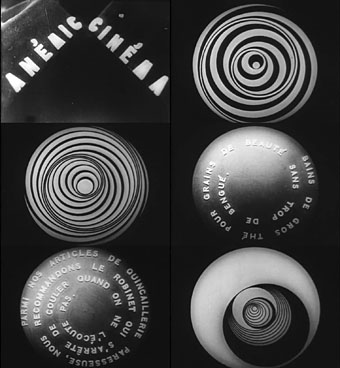
Anémic Cinéma

anemic.jpg

It’s no doubt up to the viewer to decide what constitutes anaemia in Marcel Duchamp’s 7-minute film. Anémic Cinéma was made the same year as Emak-Bakia with the assistance of Man Ray and Marc Allégret. Duchamp’s Rotoreliefs spin hypnotically alternating with punning epithets in French. The spinning artworks later appeared as Duchamp’s contribution to Hans Richter’s Dreams That Money Can Buy (1947).

Previously on { feuilleton }
Emak-Bakia
Un Chien Andalou
Ballet Mécanique
Dreams That Money Can Buy
La femme 100 têtes by Eric Duvivier
Entr’acte by René Clair

Weekend links 105

klikovac.jpg

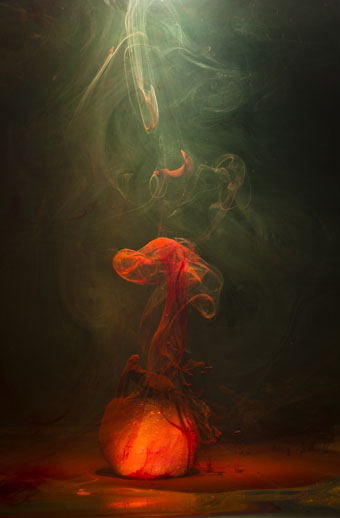
A suspended fluid photograph from Demersal, a series by Luka Klikovac.

• “Soon, Mr. Lachman was writing occult music. His song “(I’m Always Touched by Your) Presence, Dear,” which appeared on Blondie’s 1977 album Plastic Letters, was an example.” Gary Lachman: from Blondie to Swedenborg.

Neil Krug’s cover art for the new Scissor Sisters album, Magic Hour, channels the cloudless skies and photographic surrealism of Storm Thorgerson.

Implicate Explicate, a multiple 16mm film installation by Rose Kallal. Sound by Rose Kallal & Mark Pilkington using modular synthesizers.

Despite conservative queerdom’s best efforts to hide its “otherness” behind a velvet wall of “same as you” Tom and Hank and Jill and Janes, Mattilda and her like will not be ignored. As parades of neo-nuclear same sex families mug for the cameras on courthouse steps, queer body boys parade and flex impossibly taut muscles across our nation’s gym runways and circuit parties, and far, far too many proudly proclaim in knee-jerk defensiveness how “straight-acting” they are across the net, Sycamore blows raspberries at the forced mirage and holds up faded pictures of yesteryear boys and girls whose one claim to fame once was their difference.

Mattilda Bernstein Sycamore is interviewed at Lambda Literary

Paul Oestreicher, an Anglican priest, sets the cat squarely among the pigeons with the question (and answer) “Was Jesus gay? Probably.”

Andromeon, video by Alexander Tucker and Serena Korda for a new song by Alexander Tucker.

• Museums of Melancholy: Iain Sinclair on London’s memorials. An LRB essay from 2005.

FACT mix 325 is by Battles: from Boredoms to Cluster and The Alchemist.

The glass hills of Mars, “a region the size of Europe”.

Labyrinths and clues, an essay by Alan Wall.

The Alchemy of Emptiness.

Drop (1972) by Soft Machine | Drop (2002) by Hope Sandoval & The Warm Inventions | Airdrop (2006) by Kashiwa Daisuke.

David Chestnutt’s psychedelic fairy tales

pretend10.jpg

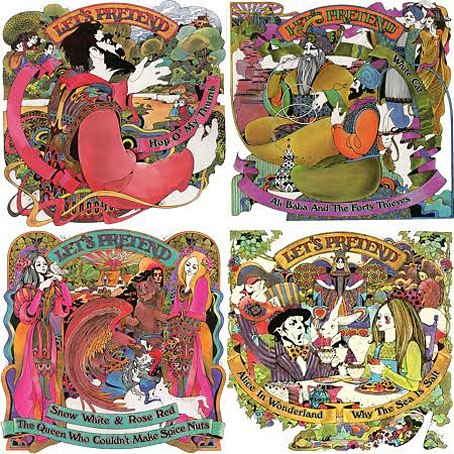
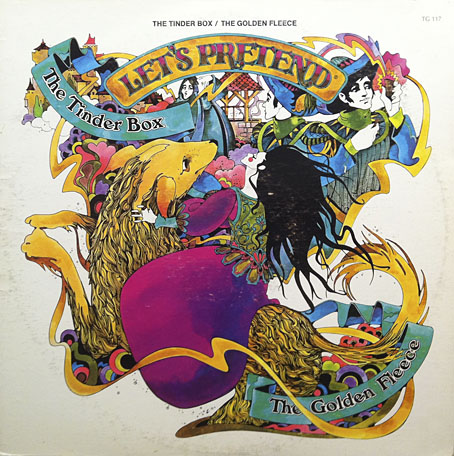
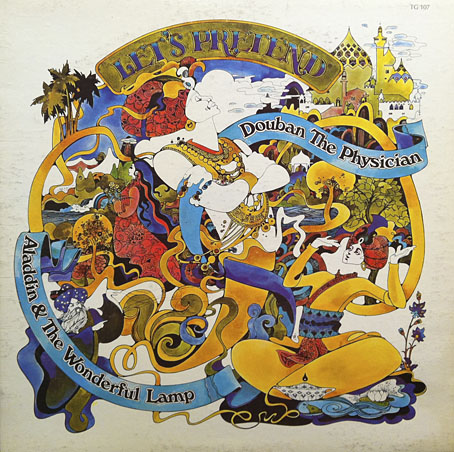
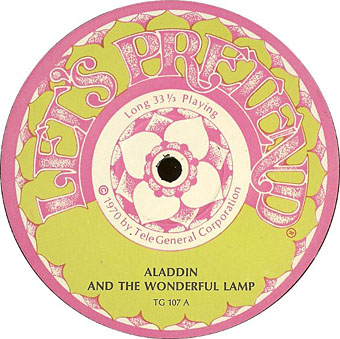
A post for Record Store Day. “Psychedelic” is stretching things here but it’s a word that always grabs the attention. Let’s Pretend was a series of fairy tale recordings released in the US in 1970 on the Stereo Dimension Records label. Each of the 25 recordings employs a radio show format, possibly because these were all radio recordings originally (there’s an older series of Let’s Pretend radio shows at the Internet Archive). Anyone desperate to experience one of them can listen to The Little Mermaid here. The sleeves are all illustrated by David Chestnutt in that post-Heinz Edelmann style that really ought to have a name of its own. Nice to see The Tinderbox turn up again, Chestnutt’s magical hound is a distinctly benevolent creature.

These sleeves were hoovered up from Discogs.com where some of them are only available in small images. If anyone finds a gallery of all 25 designs in decent quality then please leave a comment.

pretend09.jpg

pretend01.jpg

pretend02.jpg

Continue reading “David Chestnutt’s psychedelic fairy tales”

The art of Léon Bonnat, 1833–1922

bonnat1.jpg

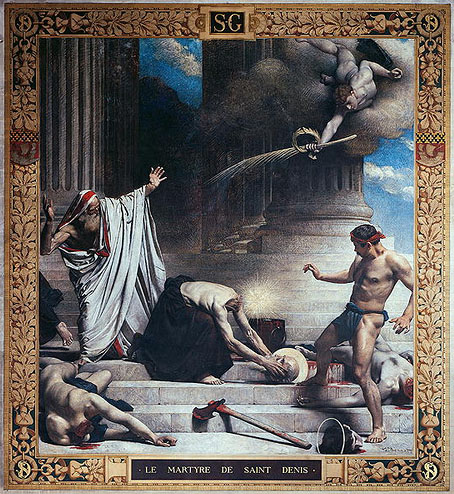
The Martyrdom of St Denis (1885).

Léon Bonnat’s depiction of St Denis reaching for his detached head might be included with St Lucy (always shown with her dish of eyeballs) and St Peter of Verona (seldom without an axe stuck in his skull) in a facetious list of Saints Do The Funniest Things. Bonnat’s gory painting can be found on a wall in the Panthéon in Paris, and is the kind of image I often keep in mind for those moments when someone wants to argue that violent imagery is a very recent thing. Academic painting at the end of the 19th century reached a pitch of photo-realism which demanded that acts of murder be shown with all the relevant blood splashes, hence St Denis and the characteristic excess of Georges Rochegrosse’s Andromaque, painted two years earlier. The 50 Watts Flickr pages have a large monochrome reproduction of Bonnat’s picture.

bonnat2.jpg

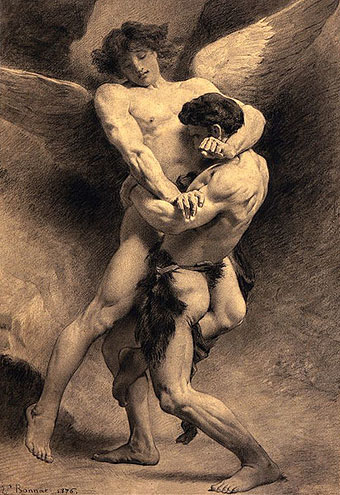
Jacob Wrestling with the Angel (1876).

It was this drawing of Jacob wrestling the angel that set me looking for more of Bonnart’s work. With the exception of a Tarzanesque painting of Samson fighting a lion there isn’t much else like this, a disappointment to those of us who can’t help but notice the Simeon Solomon-like homoerotic quality of the clinch.

Previously on { feuilleton }
Nirvana and The Conquerors

Virgil Finlay’s Tarzan

finlay.jpg

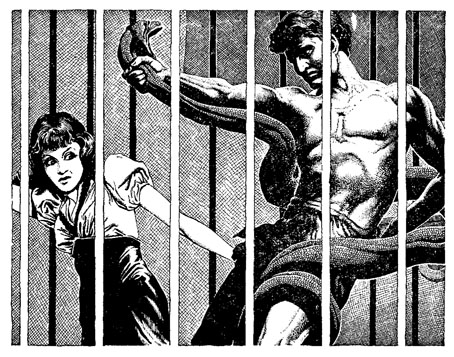
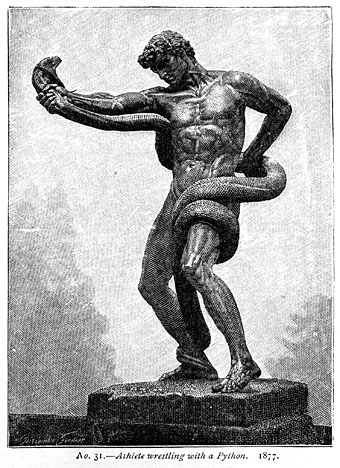
Thanks are due to Ty Reutel for alerting my attention to this one. I’d no idea that the great Virgil Finlay had illustrated Tarzan but here’s the proof, one half of an interior drawing for The Quest of Tarzan in Argosy Weekly for 1941. That’s the first surprise, the second, of course, was that Finlay had copied Frederic Leighton’s Athlete Wrestling with a Python (1877) ( below), a sculpture which has been a subject of discussion here recently. I’ve mentioned before my including Leighton’s work in one of my Lovecraft adaptations; I referred to many other artworks in those stories but never made any direct reference to Virgil Finlay even though he was the original illustrator of Lovecraft’s The Haunter of the Dark when it was first published in Weird Tales in 1936. Finlay’s illustrations for that story later appeared with some of my own in the enormous Centipede Press collection of Lovecraft art so it’s strange to find that we were also led to the same Leighton sculpture.

Tarzan illustration has been in my thoughts for the past few weeks while I’ve been at work (again!) on the collected Reverbstorm, many pages of which played variations on Burne Hogarth’s comic adaptations of the Tarzan stories. Reverbstorm is at long last very close to being finally, absolutely finished, and ready for printing in a single definitive volume. No production schedule just yet but any news will be announced here.

leighton4.jpg

Previously on { feuilleton }
Frederic Leighton’s sculptures
Virgil Finlay’s Salomé
Die Farbe and The Colour Out of Space
Lovecraft’s favourite artists revisited
Angelo Colarossi and son
The monstrous tome
Men with snakes