Hugo Steiner-Prag’s illustrated Poe

prag05.jpg

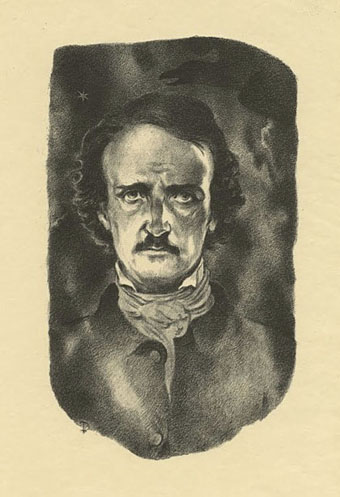
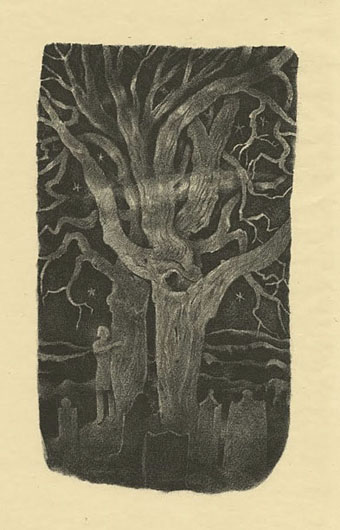
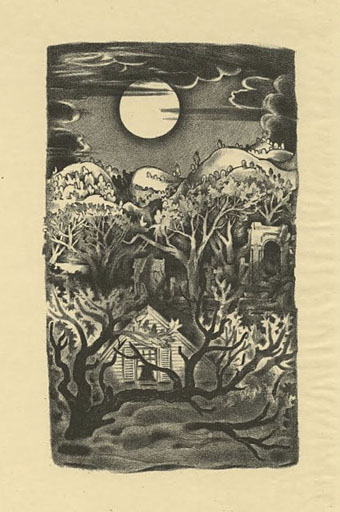
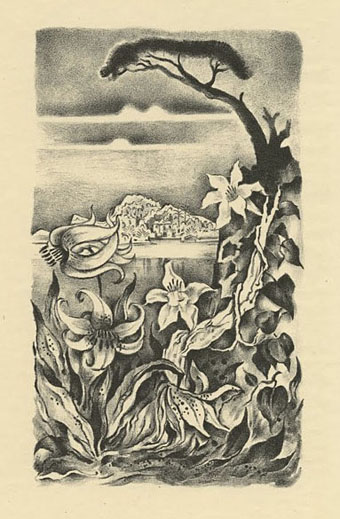
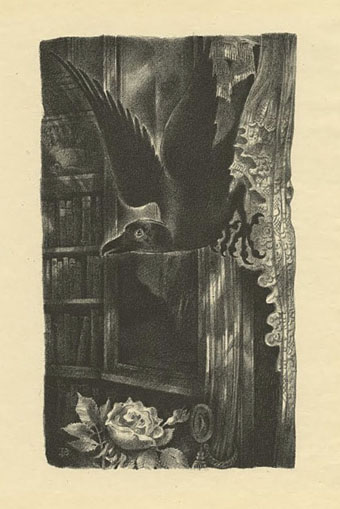
Halloween approaches. Edgar Allan Poe illustrators are legion—some of the better ones appeared here a couple of years ago (see the links below)—but I’d not seen these lithographs by Hugo Steiner-Prag (1880–1945) before. Steiner-Prag was an ideal illustrator for Gustav Meyrink’s The Golem so it’s a pleasure to see him addressing Poe’s poems. All the prints are from a collection at the Google Art Project which includes one of the Golem illustrations plus a set for The Tales of Hoffmann.

prag01.jpg

Spirits of the Dead.

prag02.jpg

The Sleeper.

prag03.jpg

To Zante.

prag04.jpg

The Raven.

Continue reading “Hugo Steiner-Prag’s illustrated Poe”

Ye Sundial Booke

sundial22.jpg

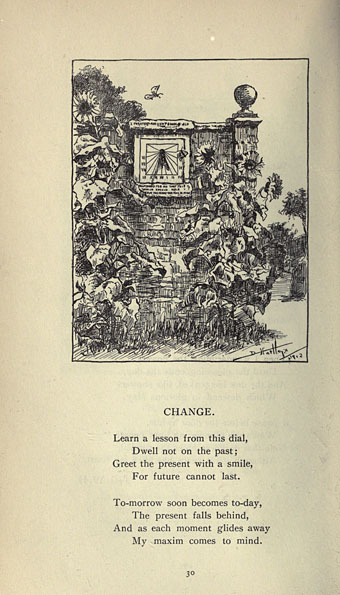
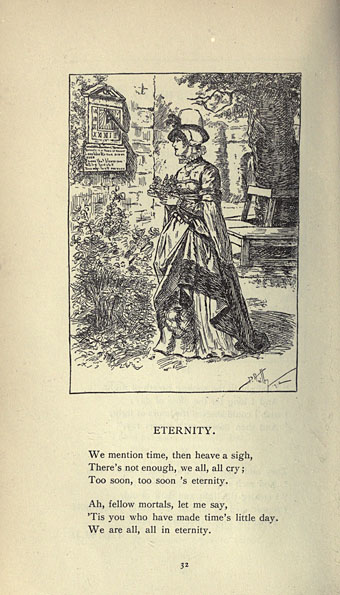
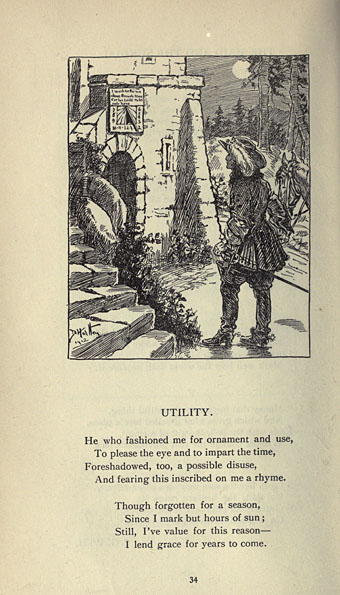
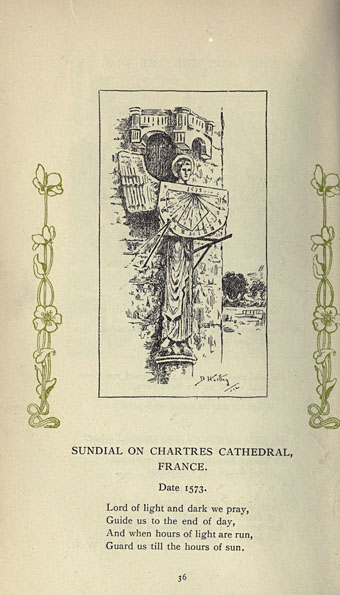
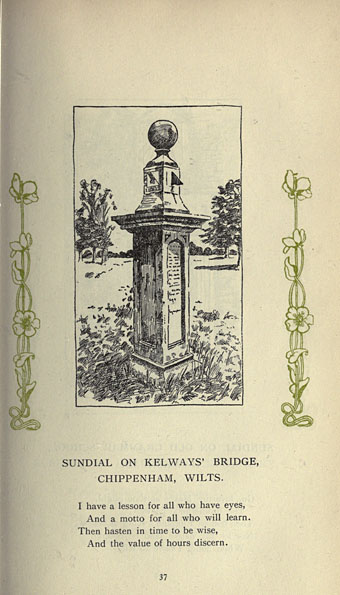
I almost posted this in place of The Book of Old Sundials but to have done so would have made the former volume redundant. This is the same idea—pen drawings of British sundials with accompanying pages of sundial mottos—but a much more comprehensive treatment. The antiquated title is an affectation by its author, T. Geoffrey W. Henslow, the book having been published in 1914. What’s most remarkable about this study is the 370 drawings by Dorothy Hartley (1893–1985), a job of illustration that must have involved considerable labour even if she was working from photographs. Looking for details of Ms Hartley’s career it’s possible she researched the sites herself. In addition to being an illustrator and art teacher she was also a noted social historian and rural archivist, and author of a celebrated book of culinary history, Food in England (1954), which is still in print today.

These page selections do little more than scratch the surface of this extraordinary book. Browse the rest of it here or download it here. For more about Dorothy Hartley and her historical research there’s an hour-long BBC documentary, Food in England: The Lost World of Dorothy Hartley.

sundial23.jpg

sundial24.jpg

sundial25.jpg

sundial26.jpg

Continue reading “Ye Sundial Booke”

Weekend links 182

iwami.jpg

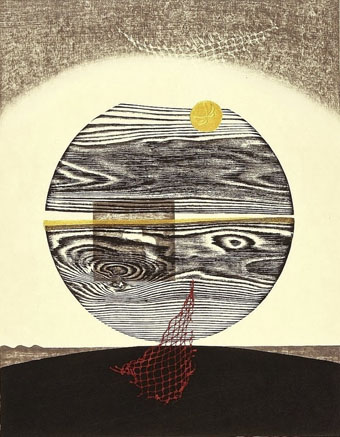
Mirror of Water (1981) by Reika Iwami.

• The week in comics: Paul Gravett interviews Enki Bilal. | Paul Kirchner’s wordless and inventively surreal strip, The Bus, was republished in France last year but it’s been out-of-print for years everywhere else. Read it online here. | Bill Watterson has made the entire run of Calvin and Hobbes available for free.

• “…seek and learn to recognize who and what, in the midst of the inferno, are not inferno, then make them endure, give them space.” Leland de la Durantaye reviews Italo Calvino: Letters 1941–1985.

• Artist Charles Ross says “My interest in science is related to how mysterious it is.” Ross Andersen visited Ross’s Star Axis, “a masterpiece forty years in the making”.

There is a satirical intent at work here, as well as mordant humour, a potent mix that reminds one more of the absurdist fictions of the French jazz musician Boris Vian than of anything in the SF canon. Science fiction is not central in Harrison’s work – not even as a target of his sharp wit – and it is a mistake to regard him as being chiefly interested in demolishing a genre that is only one of several he has mastered.

John Gray on M. John Harrison’s Kefahuchi Tract trilogy. This week Harrison posted a new piece of fiction on his blog.

• Mixes of the week: Secret Thirteen Mix 091 by Sugai Ken, and Bride of the Abominable Marshman, an early Halloween mix by Hackneymarshman.

• Clive Hicks-Jenkins on Schandmasken (masks of shame), and the clay visage of Paul Wegener’s Golem.

• A version of Kraftwerk’s Trans Europe Express by Chicago band Disappears.

Postcards to the Curious: MR James-themed artwork by Alisdair Wood.

Clive Barker: Why I Once Gave Up Horror Movies Entirely.

• Artist Melinda Gebbie at Phantasmaphile.

Fragment, a new video from Emptyset.

38 photos of airships through the ages.

• This Much I Know: Kenneth Anger.

• Trans Europe Express (2000) by Señor Coconut Y Su Conjunto | Trans Europe Express (2007) by Receptors | Trans Europe Express (2012) by Daniel Mantey

Beardsley reviewed

studio1.jpg

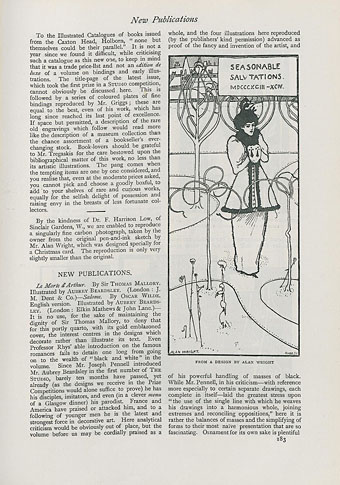
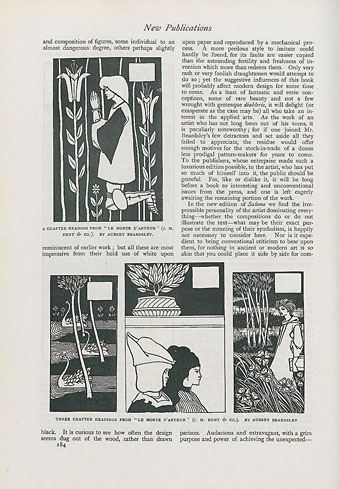
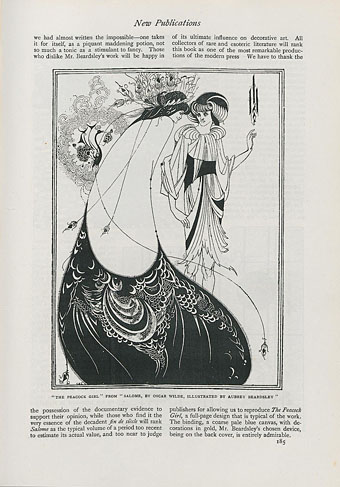
More Aubrey Beardsley ephemera. These pages are from the bound edition of The Studio for 1894, reviews of two of Beardsley’s earliest publications: the first editions of Le Morte d’Arthur (which was published in multiple volumes), and the illustrated edition of Oscar Wilde’s Salomé which sealed Beardsley’s reputation as a major force in the art of the 1890s. The reviews lavish praise on both works, unsurprisingly since Beardsley had received the magazine’s support from the very first issue. It’s interesting to note even at this early stage mention of the rumblings of discontent which would grow increasingly loud in the following years. Also that The Peacock Skirt is here given the name The Peacock Girl.
studio2.jpg

NEW PUBLICATIONS. Le Morte d’Arthur. By Sir Thomas Mallory. Illustrated by Aubrey Beardsley. (London: J. M. Dent & Co.)—Salome. By Oscar Wilde. English version. Illustrated by Aubrey Beardsley. (London: Elkin Mathews & John Lane.)—It is no use, for the sake of maintaining the dignity of Sir Thomas Mallory, to deny that for this portly quarto, with its gold emblazoned cover, the interest centres in the designs which decorate rather than illustrate its text. Even Professor Rhys’ able introduction on the famous romances fails to detain one long from going on to the wealth of “black and white” in the volume. Since Mr. Joseph Pennell introduced Mr. Aubrey Beardsley in the first number of The Studio, barely ten months have passed, yet already (as the designs we receive in the Prize would alone suffice to prove) he has his disciples, imitators, and even (in a clever menu of a Glasgow dinner) his parodist. France and America have praised or attacked him, and to a following of younger men he is the latest and strongest force in decorative art. Here analytical criticism would be obviously out of place, but the volume before us may be cordially praised as a whole, and the four illustrations here reproduced (by the publishers’ kind permission) advanced as proof of the fancy and invention of the artist, and of his powerful handling of masses of black.

While Mr. Pennell, in his criticism—with reference more especially to certain separate drawings each complete in itself—laid the greatest stress upon “the use of the single line with which he weaves his drawings into a harmonious whole, joining extremes and reconciling oppositions,” here it is rather the balances of masses and the simplifying of forms to their most naive presentation that are so fascinating. Ornament for its own sake is plentiful and composition of figures, some individual to an almost dangerous degree, others perhaps slightly reminiscent of earlier work; but all these are most impressive from their bold use of white upon black. It is curious to see how often the design seems dug out of the wood, rather than drawn upon paper and reproduced by a mechanical process. A more perilous style to imitate could hardly be found, for its faults are easier copied than the astounding fertility and freshness of invention which more than redeem them. Only very rash or very foolish draughtsmen would attempt to do so; yet the suggestive influences of this book will probably affect modern design for some time to come.

As a feast of fantastic and eerie conceptions, some of rare beauty and not a few wrought with grotesque diablerie, it will delight (or exasperate as the case may be) all who take an interest in the applied arts. As the work of an artist who has not long been out of his teens, it is peculiarly noteworthy; for if one joined Mr. Beardsley’s few detractors and set aside all they failed to appreciate, the residue would offer enough motives for the stock-in-trade of a dozen less prodigal pattern-makers for years to come. To the publishers, whose enterprise made such a luxurious edition possible, to the artist, who has put so much of himself into it, the public should be grateful. For, like or dislike it, it will be long before a book so interesting and unconventional issues from the press, and one is left eagerly awaiting the remaining portion of the work.
studio3.jpg

In the new edition of Salome we find the irrepressible personality of the artist dominating everything—whether the compositions do or do not illustrate the text—what may be their exact purpose or the meaning of their symbolism, is happily not necessary to consider here. Nor is it expedient to bring conventional criticism to bear upon them for nothing in ancient or modern art is so akin that you could place it side by side for comparison. Audacious and extravagant, with a grim purpose and power of achieving the unexpected—we had almost written the impossible—one takes it for itself, as a piquant maddening potion, not so much a tonic as a stimulant to fancy. Those who dislike Mr. Beardsley’s work will be happy in the possession of the documentary evidence to support their opinion, while those who find it the very essence of the decadent fin de siècle will rank Salome as the typical volume of a period too recent to estimate its actual value, and too near to judge of its ultimate influence on decorative art. All collectors of rare and esoteric literature will rank this book as one of the most remarkable productions of the modern press. We have to thank the publishers for allowing us to reproduce The Peacock Girl, a full-page design that is typical of the work, The binding, a coarse pale blue canvas, with decorations in gold, Mr. Beardsley’s chosen device, being on the back cover, is entirely admirable.

Elsewhere on { feuilleton }
The Aubrey Beardsley archive
A Scholar in his Study

rembrandt1.jpg

A Scholar in his Study (detail, 1650–1654) by Rembrandt van Rijn.

Rembrandt produced many etchings throughout his long career, and if he hadn’t also distinguished himself as a painter his etchings alone would have ensured that his reputation survived. For an example of his mastery of deep shadow see St. Jerome in a Dark Chamber (1642) where the solid masses of shade are created by a virtuoso display of cross-hatching.

rembrandt2.jpg

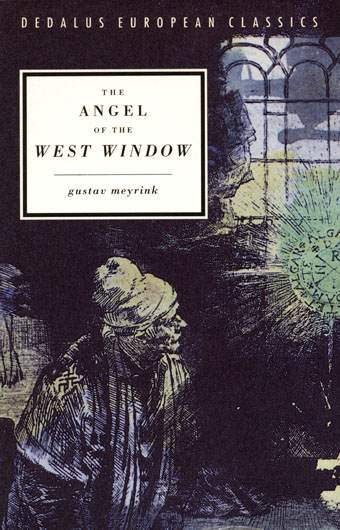
One etching is reproduced far more often than any of the others, the piece known as A Scholar in his Study, which can also be found labelled The Magician, or simply Faust even though it was never intended as an illustration of anyone so specific. The etching is often used as an illustration for Goethe’s play, of course, understandably when it’s one of the few instances in Western art of a first-rate artist depicting a visible occult event. Prior to the 19th century the depiction of magic in paintings or graphic works was generally limited to either mythological or religious tableaux, or to scenes of generic witchery. Rembrandt’s piece is unusual in showing what appears to be a manifestation of some sort, with a disc of Divine Names either partly concealing or forming the head of a spectral figure. The figure is barely visible in smaller reproductions but this large copy reveals the pair of hands below the disc which are drawing the scholar’s attention to what might be a mirror reflecting the glowing disc. Rembrandt produced a number of paintings and etchings on the theme of the scholar or philosopher in his study but none are as curious—or as popular—as this example. If it wasn’t for over-familiarity it’s likely it would seem even stranger today.

rembrandt3.jpg

The Angel of the West Window (1991). Design by Tim Gray.

Elsewhere on { feuilleton }
The etching and engraving archive

Previously on { feuilleton }
Rembrandt’s vision