Weekend links 216

heathen.jpg

Why Do The Heathen Rage? (2014) by The Soft Pink Truth. Cover art by Mavado Charon.

Drew Daniel’s latest release as The Soft Pink Truth is Why Do The Heathen Rage?, a witty electronic riposte to the often reactionary attitudes of black metal music and the people who create it. (The album is dedicated to Magne Andreassen, a gay man stabbed to death by the drummer from Emperor.) Dorian Lynskey talked to Daniel about queering the metal world, as did Angus Finlayson at FACT. Daniel’s project has been receiving press everywhere but you wouldn’t know it to read US/UK gay news sites where the music coverage is relentlessly narrow and insular. To date, only BUTT magazine has mentioned Why Do The Heathen Rage? but then BUTT have always stood apart from their parochial contemporaries. Never mind, here’s another fucking article about “petite pop princess” Kylie Minogue.

• “By the letter of the law, Ulysses was obscene. Obviously, gratuitously, relentlessly obscene.” Josh Cook on censorship and dangerous books. One of my own dangerous publications, the fifth issue of the Lord Horror comics series, Hard Core Horror (declared obscene in a UK court in 1995), received a very belated review at The Comics Journal. More censorship: Judy Bloom on the perennial panics in US school libraries. Lest we feel superior to American prudery, Leena McCall’s painting of a semi-naked woman caused some consternation in a London gallery last week.

• “Over and over, we’re told that nobody buys [compact discs] anymore.” Steven Hyden on the latest obituaries being written for a music format. Ten years ago the death of vinyl was being confidently predicted: “The physical presence of the popular song is gone,” Paul Morley declared. Related: The death of mp3s.

There is nothing quite like Maryanne Amacher’s third ear music. It is alarming. Some of her fellow artists never quite believed that their ears were not being damaged. Third ear music invades you, wraps inside your body, your head, your eyes — just like she says. You can’t be sure, after a while, if the sounds you hear are those created by your ears or Maryanne Amacher.

Stefany Anne Golberg on the music of Maryanne Amacher

• At Dangerous Minds: Nothing Lasts Forever (1984), Bill Murray in a “lost sci-fi comedy set in a totalitarian New York City”.

• More Joyce (there’s always more Joyce): Humument Images to Accompany James Joyce’s Ulysses by Tom Phillips.

• Another celebration of Penda’s Fen by David Rudkin, and another reminder that it’s still not available on DVD.

• Stairway to Heaven: Atlas Obscura on the Gustave Moreau Museum, an essential stop if you visit Paris.

• Mix of the week: Secret Thirteen Mix 121 by Higher Intelligence Agency.

• MetaFilter has a wealth of links to pulp magazine archives.

Yan Nascimbene’s illustrations for Italo Calvino’s stories.

• Rebecca Litchfield’s Orphans of Time and Soviet Ghosts.

• RIP Charlie Haden

Going Home (1972) by Alice Coltrane (Charlie Haden, bass) | Earth (1974) by Joe Henderson Featuring Alice Coltrane (Charlie Haden, bass) | Malkauns (1975) by Don Cherry (Charlie Haden, bass)
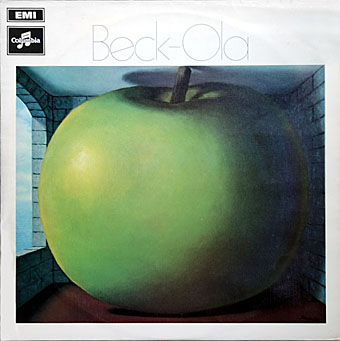
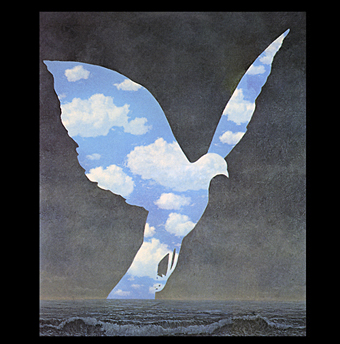
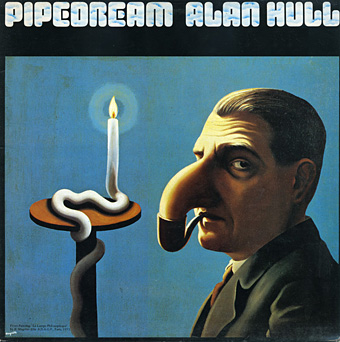
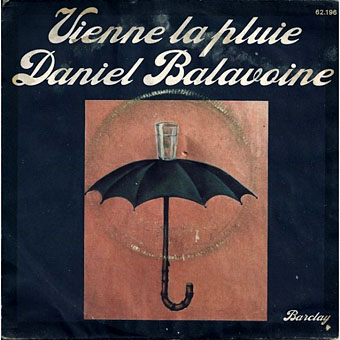
René Magritte album covers

beck.jpg

Beck-Ola (1969) by The Jeff Beck Group. Painting: The Listening Room (second version, 1958).

An inevitable post considering the shape of the week, and also a continuation of an occasional series about paintings used as album cover art. Given Magritte’s continuing popularity I’m sure these can’t be the only examples, especially when his work had such an effect on the cover designs of the 1970s. In addition to the Magritte-like covers created by Hipgnosis for Pink Floyd and others you can find the artist’s influence in the cover by Alton Kelley and Stanley Mouse for The Grand Illusion (1977) by Styx, a hugely successful album whose painting is derived from Magritte’s The Blank Cheque (1965). There are many more examples.

Magritte died in 1967 so he missed out on this explosion of interest which also spread into the advertising world. When it comes to influence, Magritte has probably had more of an effect on the general culture than any of the other Surrealists, Dalí included.

rascals.jpg

See (1969) by The Rascals. Painting: The Big Family (1963).

hull.jpg

Pipedream (1973) by Alan Hull. Painting: Philosopher’s Lamp (1936).

balavoine.jpg

Vienne La Pluie (1975) by Daniel Balavoine. Painting: Hegel’s Holiday (1958).

Continue reading “René Magritte album covers”

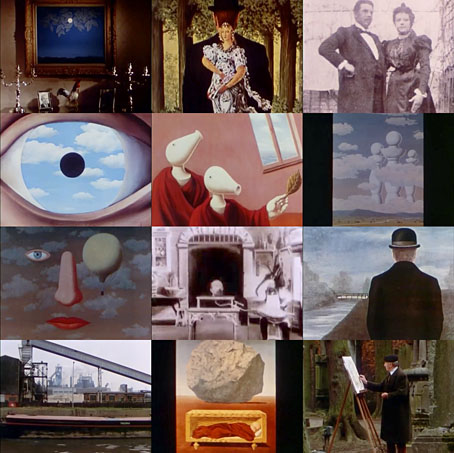
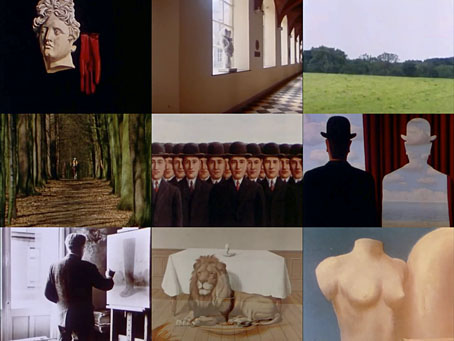
Monsieur René Magritte, a film by Adrian Maben

magritte1.jpg

Until the end of his life, [Magritte] preferred to take the tram.

Now there’s an attitude I approve of. George Melly in his BBC film about Surrealism mentions visiting Magritte at his home in Brussels, and we see Magritte’s house at the beginning of Adrian Maben’s 50-minute film about the artist’s life and work. Maben’s film was made in 1978 as an Franco-German TV production but the narration, by Maben himself, is in English. Surrealism seemed to be back in vogue in 1978: as mentioned yesterday, the Hayward Gallery in London staged an exhibition of Surrealist art that year, the BBC commissioned George Melly’s film as a result of this, while over on rival network ITV there was the marvellous documentary about Surrealist patron Edward James who modelled for one of Magritte’s most famous paintings, La reproduction interdite (1937).

magritte2.jpg

Adrian Maben’s name will be familiar to Pink Floyd obsessives as the director of Pink Floyd: Live at Pompeii (1972), and if you’re familiar with that film you can recognise the same shooting style in his Magritte film which deploys similar slow zooms, tracking shots and images sliding in and out of the frame. The music is credited to a surprising combination of Béla Bartók (mostly piano) and Roger Waters, although some of the pieces from the latter are actually by Pink Floyd, there’s even some of the opening of Obscured By Clouds. In style and content the film is as good as anything the BBC were producing at the time, with extracts from a TV interview with the artist, and also some of Magritte’s high-spirited home movies made with his wife and friends.

Magritte and Pink Floyd are a fitting match, some of the Floyd’s album covers could be Magritte paintings rendered photographically: two men shaking hands, one of whom is on fire; a giant pig adrift over a power station. Storm Thorgerson always acknowledged the debt that Hipgnosis owed Magritte’s example, it’s there in the title of the first Hipgnosis book, Walk Away René, and in this short Tate interview from 2011 where he mentions the Wish You Were Here album as being a very conscious Magritte homage.

Previously on { feuilleton }
George Melly’s Memoirs of a Self-Confessed Surrealist
The Secret Life of Edward James
René Magritte by David Wheatley

George Melly’s Memoirs of a Self-Confessed Surrealist

melly1.jpg

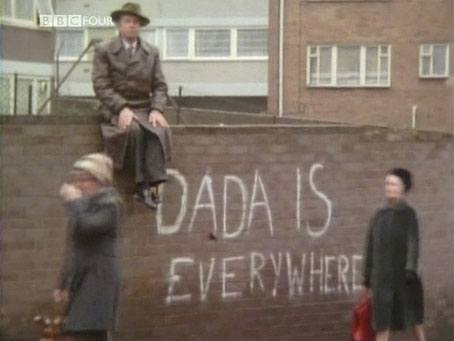
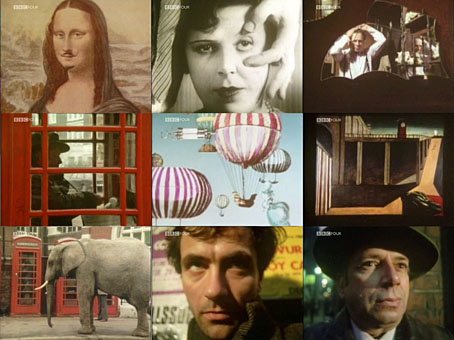
It’s a short step from Dada to Surrealism, and George Melly provides a brief skate through the philosophies of both in this 25-minute BBC film from 1978. Melly, like JG Ballard, was struck by Surrealism at an impressionable age, and the love affair was a lasting one. Both Melly and Ballard championed Surrealism during periods when it was deeply unfashionable, an oppositional stance that Ballard seemed to relish.

melly2.jpg

Melly’s enthusiasm was so well-known that he was often called upon as a token advocate of Surrealism whenever one was required by the TV channels, hence this film whose title implies an admission of something disreputable. A major exhibition of Surrealist art was taking place in 1978 at the Hayward Gallery in London, and it’s to this exhibition that Melly journeys, explaining (and demonstrating) what it means to be a Surrealist along the way. I saw this when it was first broadcast, and the absurd phone calls to strangers inspired myself and a few school-friends to similar activities; teenage pranks seemed less frivolous with an artistic justification. There’s a slight connection to yesterday’s post in Melly’s recounting of an anecdote from the 1950s when he was spared a night-time beating by his reciting of Kurt Schwitters’ Ursonate to a group of belligerent youths. Elsewhere you get to see punk band The Stranglers scowling at the camera—Melly suggests that the punks might be inheritors of the Dadaist attitude—and director Alan Yentob standing at a urinal.

Previously on { feuilleton }
The Secret Life of Edward James
René Magritte by David Wheatley

The original Cabaret Voltaire

cv1.jpg

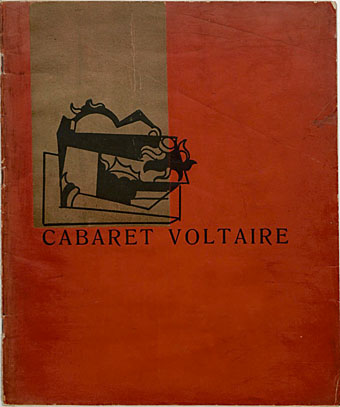
Cabaret Voltaire #1 (1916). Cover by Hans Arp.

Richard H. Kirk’s announcement that he’ll be performing at the Berlin Atonal festival as Cabaret Voltaire caused some raising of eyebrows recently, although if Stephen Mallinder isn’t involved I won’t be getting too excited myself. The last few releases under the Cabaret Voltaire name were credited to Kirk/Mallinder but from Plasticity (1992) on they don’t sound very different to Kirk’s solo releases from the same period. That’s not to say the music suffers but you have to wonder why the group name is being perpetuated if there’s nothing unique attached to it.

cv2.jpg

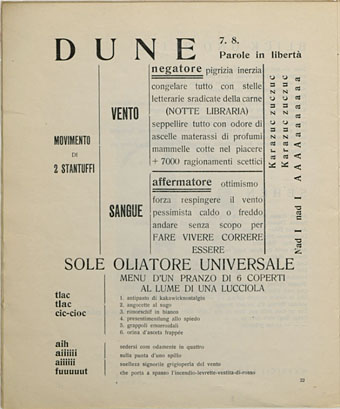
Dune, parole in libertà by Filippo Marinetti.

The group, old or new, will be the first thing that comes to mind for most people when they hear the name Cabaret Voltaire, something that might have surprised Hugo Ball who founded the original Cabaret Voltaire in Zurich almost a century ago. Cabaret Voltaire (the group) named themselves after Ball’s project, their intentions in the mid-1970s being similarly Dadaist. Early Cabs performances were more audience provocations than anything to do with entertainment; the music came later, and only after several years of very uncommercial tape experimentation, some of which can be heard on Methodology ’74–’78: Attic Tapes (2003). Thanks to Switzerland staying out of the war the original Cabaret didn’t get wrecked by bombs or destroyed by the Nazis, and is still active today. Ball also published a Cabaret Voltaire journal, two pages of which can be seen here. If this doesn’t look very dramatic to our eyes it needs to be remembered that everyone who first saw it would have been born in the 19th century so the contents would have seemed a lot more radical. A slim publication but with a formidable list of contributors: Guillaume Apollinaire, Hans Arp, Blaise Cendrars, Wassily Kandinsky, Filippo Marinetti, Amedeo Modigliani, Pablo Picasso, Tristan Tzara and others.

Also at Ubuweb (where else?) there are several recordings of Hugo Ball’s Dada poetry including a recital of Karawane by (of all people) Marie Osmond. Who knew there was a connection between the Osmonds and Cabaret Voltaire?

Previously on { feuilleton }
Cabaret Voltaire on La Edad de Oro, 1983
Doublevision Presents Cabaret Voltaire
Just the ticket: Cabaret Voltaire
TV Wipeout
The Crackdown by Cabaret Voltaire