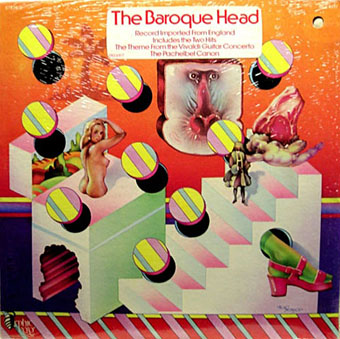
Orphic Egg album covers

orphic12.jpg

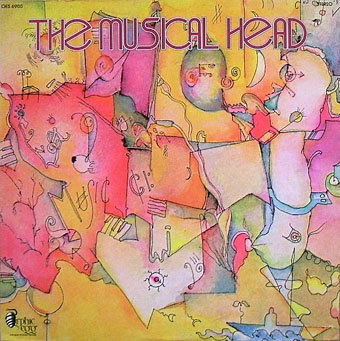
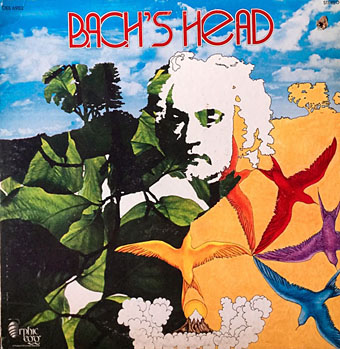
This is a record label I’d not come across before. According to this page Orphic Egg “was a subsidiary label for London Records which was formed in 1972 and lasted about a year. The label was formed to try to capture classical music for the counterculture youth of the time (often called ‘heads’). Liner notes were written by hip rock critics respected by the youth.” According to Discogs the first release, The Baroque Head, was 1971. The covers below follow in chronological order through to 1973. With the exception of the Edgard Varèse album all the releases are compilations of older recordings grouped by composer or theme.
orphic01.jpg

Discogs doesn’t give credits for all the cover art but the series was the work of several different illustrators with George McGinnis being responsible for the design. Jason Roberts’ cover for the Mussorgsky album is a suitably wild piece of late psychedelia for a collection that includes Night On Bald Mountain. There’s a nod there to the Chernobog from Disney’s Fantasia, while the Scriabin cover is an overt swipe from an original piece by Jean Delville. The Mussorgsky album is also notable for the bizarre and unique conjunction of music conducted by Herbert von Karajan and liner notes by Lester Bangs. I have to wonder what the haughty maestro of the Berlin Philharmonic would have made of the sleeve if he ever saw it.
orphic03.jpg

Continue reading “Orphic Egg album covers”

Weekend links 287

hugo.jpg

Cover by Valentine Hugo for Contes Bizarres (1933) by Achim d’Arnim. See Hugo’s interior illustrations here.

• “In spite of the blood-drinking pursuits of Rollin’s protagonists, there’s very little in the way of body horror to be found. His undead are sensual, romantic creatures that are frequently delicate of mind and body. These movies attempt to evoke nuanced emotional responses with their mixture of romance, loss, eroticism, and tragedy.” Tenebrous Kate on Sex, Death, and the Psychedelic Madness of Jean Rollin.

• “Late at night, [Melville] ‘turned flukes’ down Oxford Street as if he were being followed by a great whale, and thought he saw ‘blubber rooms’ in the butcheries of the Fleet Market.” Philip Hoare on Herman Melville’s time in London.

Haunted by Books, a new collection of writings by Mark Valentine, “explores the more curious byways of literature.” Full details at the home of the esoteric, Tartarus Press.

I am completely an elitist, in the cultural but emphatically not the social sense. I prefer the good to the bad, the articulate to the mumbling, the aesthetically developed to the merely primitive, and full to partial consciousness. I love the spectacle of skill, whether it’s an expert gardener at work, or a good carpenter chopping dovetails, or someone tying a Bimini hitch that won’t slip.

Art critic Robert Hughes quoted in a review by Siri Hustvedt of The Spectacle of Skill: Selected Writings of Robert Hughes

• “Art, art – I couldn’t give a crap about art.” Oscar Wilde’s nephew, Arthur Cravan, puts in another appearance at Strange Flowers.

• “The Tarot is utterly fascinating,” says Evan J. Peterson discussing his Tarot-inspired writing with Tarot Poetry.

Manuel Göttsching: “A lot of crazy music happened at the end of the ’60s, very strange, and very curious…”

• Mixes of the week: Secret Thirteen Mix 169 by Chra, and 28th November 2015 by The Séance.

Czech Artists’ Radical Book Designs of the Early 20th Century

• Ten things you might not know about Yayoi Kusama.

• More megaliths: Francis Pryor on ritual landscapes.

Peaches gets wild in the desert: Rub (uncensored).

Irmin Schmidt‘s favourite records (this week)

Mount Etna erupts

Rituals (1981) by Bush Tetras | Ballet For A Blue Whale (1983) by Adrian Belew | Etna (2006) by Boris & Sunn O)))

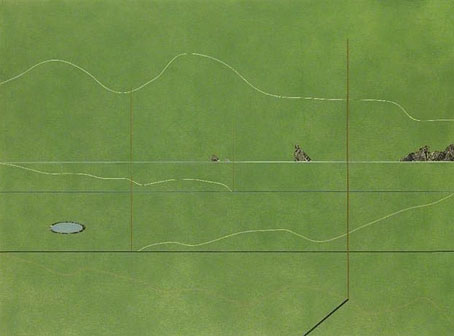
Derek Jarman’s landscapes

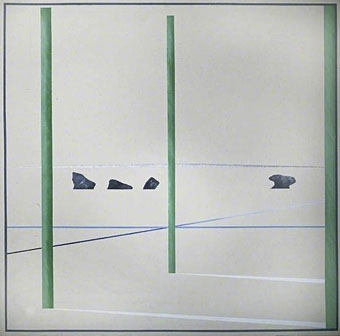
jarman01.jpg

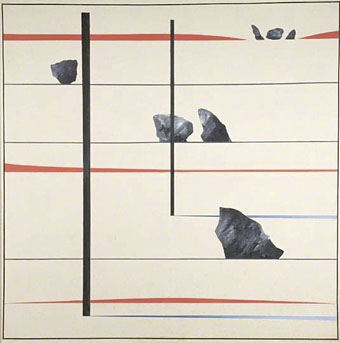
Landscape with Marble Mountain (1967).

1968 – The Lisson Gallery

I have been painting landscapes fairly consistently since I left school, and during that time they’ve changed a great deal. At first they were sparked off by holidays with Aunt Isobel at Kilve in North Somerset. I painted the red-brown earth and dark green of the Quantock Hills, which are at their brightest under the stormy grey skies which blow up over the Bristol Channel. In these paintings there are megaliths and standing stones and clumps of beech trees. By 1965 this has all changed. Oil paint is out. Aquatec, the new acrylic paint, in. The canvas is no longer rough brown flax, but a smooth white cotton duck. The use of rulers and masking tape produces a metrical precision, and replaces improvisation.

I began a series of landscapes which were larger—you have to paint large at the Slade or nobody notices. They have flat red grounds, blue skies, above eye-tricking imagery: Trompe l’oeil water, real taps, classical statues. The largest of these canvases, nine feet by seven, wins the Peter Stuyvesant award for painting at the Young Contemporaries show at the Tate in May 1967.

Since then things have changed again, and at my one-man show, my first one-man show at the Lisson, the canvases have become linear and perfectly balanced. There are no longer any figures or objects, and definitely no jokes. The canvases which are left raw resemble marble through which a grid of lines has been scored.

Derek Jarman, Dancing Ledge (1991)

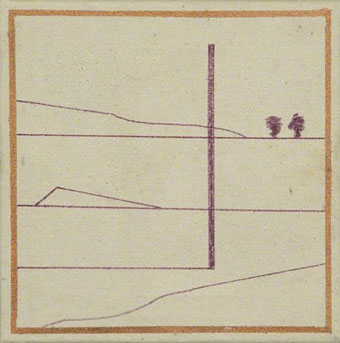
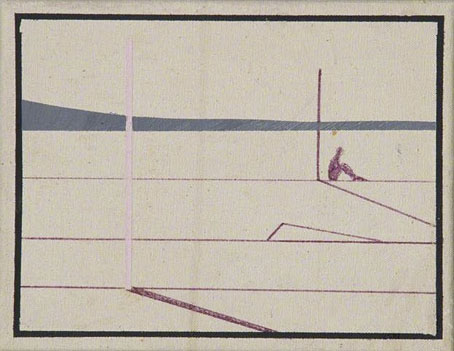
I don’t have a book of Derek Jarman’s paintings so the pictures featured here—taken from the BBC’s collection of public artworks in Britain—are the only examples I’ve seen of his landscapes. These are surprisingly minimal compared to the richly textured Super-8 films he started making in the early 1970s, but then his painting—which is only one facet of his artistic output—went through several distinct periods. It’s notable that he mentions painting standing stones from an early age given their presence in the Avebury series below, and in his beguiling short, A Journey to Avebury (1971).

(Note: Landscape with Marble Mountain is shown on the BBC site as a portrait picture which would appear to be an error. I’ve taken the liberty of rotating the image anti-clockwise.)

jarman02.jpg

Landscape with a Blue Pool (1967).

jarman04.jpg

Landscape (no date).

jarman03.jpg

Landscape II (no date).

jarman05.jpg

Avebury Series No.2 (1973).

jarman06.jpg

Avebury Series No.4 (1973).

Previously on { feuilleton }
Derek Jarman album covers
Ostia, a film by Julian Cole
Derek Jarman In The Key Of Blue
The Dream Machine
Jarman (all this maddening beauty)
Sebastiane by Derek Jarman
A Journey to Avebury by Derek Jarman
Derek Jarman’s music videos
Derek Jarman’s Neutron
Mister Jarman, Mister Moore and Doctor Dee
The Tempest illustrated
In the Shadow of the Sun by Derek Jarman
Derek Jarman at the Serpentine
The Angelic Conversation
The life and work of Derek Jarman

Merman

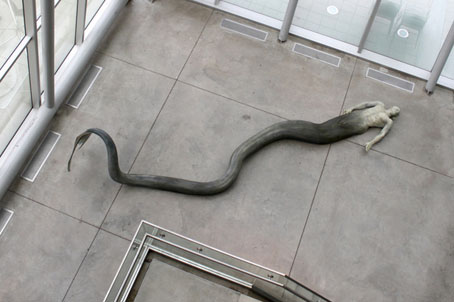
stalheim1.jpg

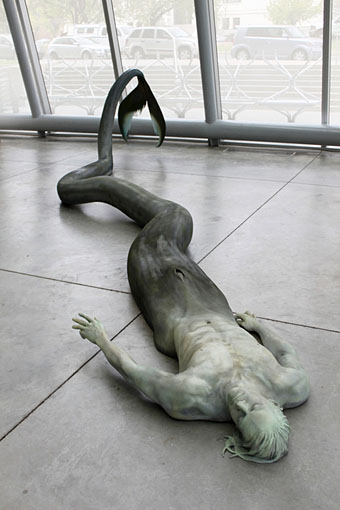
Cameron Stalheim’s artwork is entitled “and then I saw Colby on the Street and my fantasy died”. There’s also a mermaid among his remarkable sculptures but mermen are a less common sight, especially when genitally equipped as this one is. See further details at his website.

stalheim2.jpg

Previously on { feuilleton }
Mermaids