Louis Rhead bookplates

rhead1.jpg

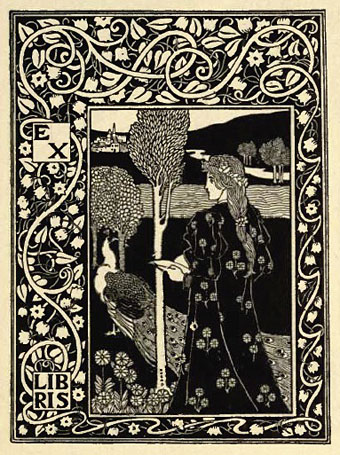
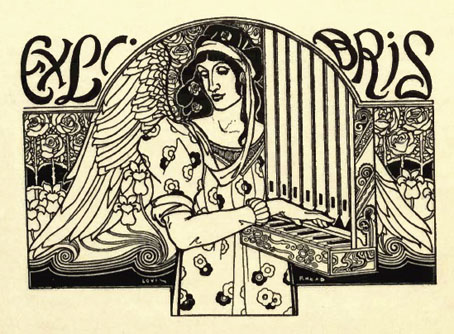
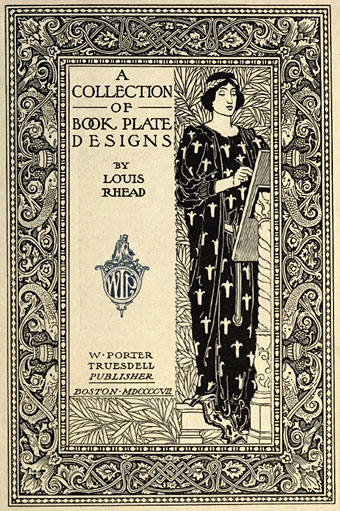
Yet another Internet Archive discovery, examples from a small book collection from 1907 of ex libris plates by Art Nouveau illustrator Louis Rhead (1857–1926). Rhead’s brightly-coloured poster art is often represented in Art Nouveau design books, less visible is his black-and-white work, some of which, like the example below, owes a clear debt to Aubrey Beardsley.

rhead2.jpg

rhead3.jpg

Elsewhere on { feuilleton }
The illustrators archive

Previously on { feuilleton }
Pratt Libraries Ex Libris Collection
The Evil Orchid Bookplate Contest
David Becket’s bookplates
Louis Rhead’s peacocks
More Arabian Nights
Buccaneers #1

Pratt Libraries Ex Libris Collection

pratt.jpg

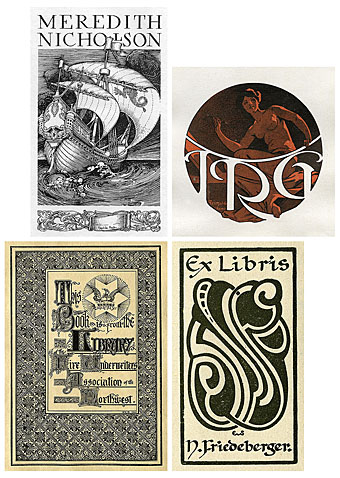
It wouldn’t surprise me if the web’s image-hoarders have already found Pratt Libraries’ huge collection of ex libris plates at Flickr but I hadn’t seen these before. A great variety of different designs from artists known and unknown. The one at the top left is by American illustrator Franklin Booth.

Elsewhere on { feuilleton }
The illustrators archive

Previously on { feuilleton }
The Evil Orchid Bookplate Contest
David Becket’s bookplates
Franklin Booth’s Flying Islands

Engelbrecht lives to fight another day

engelbrecht1.jpg

The beat Engelbrecht had drawn for the early morning rise was a stretch of jet black water between the Jubilee Gasometer and the Municipal Slaughter House. A dank mist lay over the canal. The vampire bats were out in swarms. The bot-fly waltzed in virid clouds. You could hardly have had a better surrealist fishing day.

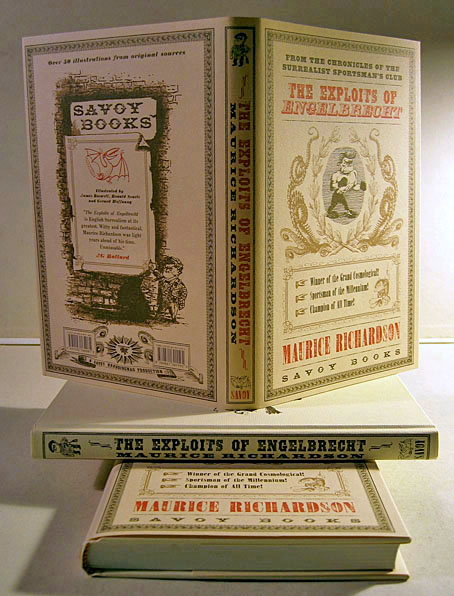
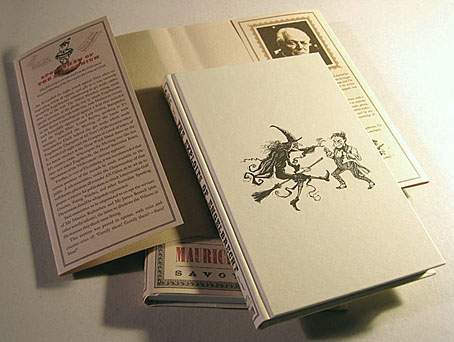
Thus Maurice Richardson in The Exploits of Engelbrecht, newly-printed copies of which I picked up this week from the Savoy Books’ office. This is the reprint of the Savoy edition which was published in 2000 and would have been out two years ago had various problems not intervened. As a result it’s inadvertently become an anniversary edition which is fitting since Engelbrecht was the first title in the line of books from Savoy’s publishing relaunch ten years ago. I’ve mentioned before that I was dissatisfied with my original design so it was a pleasure being able to rework the book slightly in a manner which better suits Richardson’s marvellous stories. The main change is a completely re-designed dust jacket done in three colours printed on textured paper; this has made the book a nice thing to handle as well as look at. A few new illustrations were added courtesy of Savoy artist Kris Guido. Kris is a far better cartoonist than I and his drawing of Engelbrecht facing one of his broomstick-riding foes adorns the front board.

engelbrecht2.jpg

Another cartoonist, Martin Rowson (currently at the Guardian), reviewed the earlier edition for The Independent on Sunday:

Far more obscure, but for my money the best book of the year, is The Exploits of Engelbrecht by Maurice Richardson. Richardson, who died in 1978, was one of the old school of hacks; he later became a stalwart infester of the Colony Rooms and the sordid pubs round Soho that teemed with pissed-up talent in the 1940s and 1950s. The Exploits of Engelbrecht, the dwarf surrealist boxer, and his adventures shooting witches, boxing grandfather clocks, playing football on Mars and games of surrealist golf which last for infinity, originally appeared in Lilliput when it was at its post-war zenith. The stories were illustrated by, among others, Searle and Hoffnung. Ah, God, those were the days.

This edition is lavishly illustrated and comes with endorsements from artist James Cawthorn (who provided some illustrations and an introduction), Michael Moorcock (who provided the afterword), and JG Ballard (who provided a blurb). Since its original publication in 1950 Engelbrecht had been one of Ballard’s favourite books; I wish he could have lived long enough to see this latest edition.

Engelbrecht isn’t on sale yet as I don’t think a price has been decided on but since this is a limited run it’ll be around £25 + p&p. Any queries should be directed to Savoy Books who have a PDF of the first chapter (plus illustrations) available to read. Next up is the enormous Moorcock tome; more about that soon.

Previously on { feuilleton }
Ronald Searle book covers
Engelbrecht again
Mervyn Peake in Lilliput

Mark Twain

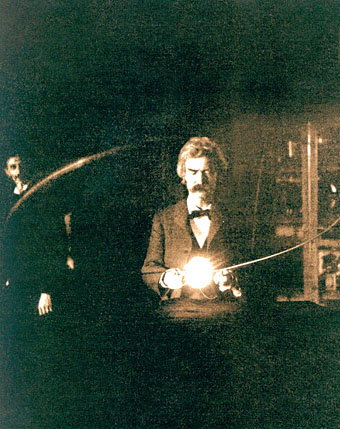
twaintesla.jpg

Nikola Tesla and Mark Twain, 1894.

Mark Twain died 100 years ago today, April 21st, 1910, and the anniversary is being marked in America by a variety of events throughout the year, some of which are listed on this dedicated site. I’ve always been grateful to Twain for cheering a portion of my dismal school days with The Adventures of Huckleberry Finn, one of two books we were forced to read that I actually enjoyed. (The other was Lord of the Flies; both stories, perhaps significantly, concern Wild Boys.) I’ve wanted to re-read Huckleberry Finn for years, perhaps now would be a good time to actually do so.

Unlike many writers of his generation, Twain’s work still seems vital today, and not only his fiction. His broadsides and polemics return continually to basic issues of tolerance and humanity and are often as relevant now as they were a century ago. Twain had little patience for the hypocrisies of his fellows when it came to matters of religion, warfare or the treatment of other human beings; like his contemporary, Oscar Wilde, he’s always been endlessly quotable. Consider these two extracts:

Citizenship? We have none! In place of it we teach patriotism which Samuel Johnson said a hundred and forty or a hundred and fifty years ago was the last refuge of the scoundrel—and I believe that he was right. I remember when I was a boy and I heard repeated time and time again the phrase, ‘My country, right or wrong, my country!’ How absolutely absurd is such an idea. How absolutely absurd to teach this idea to the youth of the country. True Citizenship at the Children’s Theater, 1907

But the truth is, that when a Library expels a book of mine and leaves an unexpurgated Bible lying around where unprotected youth and age can get hold of it, the deep unconscious irony of it delights me and doesn’t anger me. Letter to Mrs FG Whitmore, February 7, 1907

(more)

…then wonder what Twain would have to say about America’s current crop of blustering yahoos with their flags and crosses and misspelled signs.

A copy of the first edition of The Adventures of Huckleberry Finn, illustrated throughout by EW Kemble, can be downloaded at the Internet Archive. For Twain’s dim view of the Bible and its adherents, see his Letters from the Earth. The Tesla Memorial Society has another photograph of Twain in the great inventor’s laboratory.

Manuel Orazi’s Salomé

orazi1.jpg

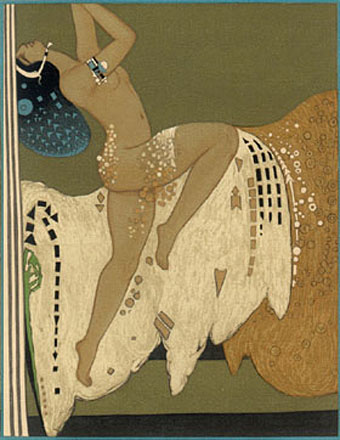
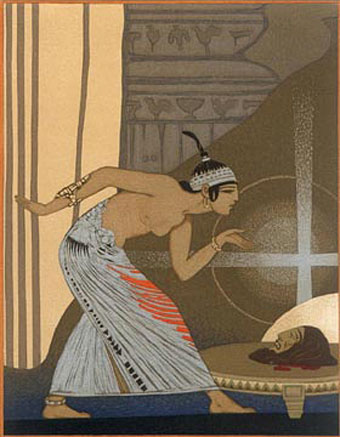
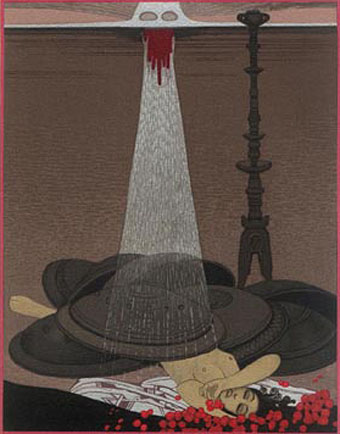
The Biblical bad girl returns in three pictures from an illustrated edition of Oscar Wilde’s play, published as a limited run in 1930. Manuel Orazi (1860–1934) was a French artist whose work has appeared here before, and no doubt will do again very soon since I’ve been finding further examples of his illustrations and designs. These drawings are closer to Gustav Klimt or George Barbier than his earlier illustrations which owed much to the stylisation of Mucha’s Art Nouveau.

orazi2.jpg

orazi3.jpg

Elsewhere on { feuilleton }
The illustrators archive
The Salomé archive