Carl Corley

corley.jpg

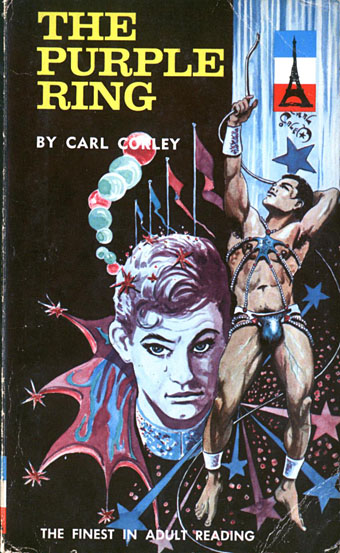
The Purple Ring (1968).

I’ve not read any of Carl Corley’s novels but their covers become familiar once you start searching through archives or articles devoted to the gay pulps of the 1960s. Corley was unusual in this field in authoring his books under his own name (most gay and lesbian pulps are credited to unlikely pseudonyms) as well as providing the cover art for each title. His paintings try for more of a distinctive look than the usual standard of the time— generally two half-dressed guys pouting at each other—but then he was illustrating his own work so could tailor the art for the story. This kind of fiction is a lot more visible now than it used to be, attracting the attention of queer historians and academics, but there’s still no dedicated site for many of these artists and writers beyond Gay on the Range. There’s a couple more Corley covers on Flickr (here and here) but for now The Haunted Lamp seems to have the best collection.

Elsewhere on { feuilleton }
The gay artists archive
The book covers archive

Previously on { feuilleton }
Sherbet and Sodomy
Bugger Boy
Gay book covers

Franz Stassen’s illustrated Hoffmann

stassen01.jpg

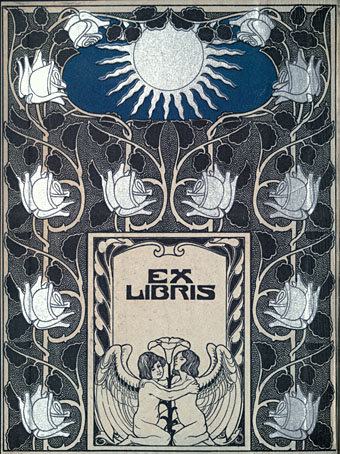
Endpaper design with an ex libris plate by the artist.

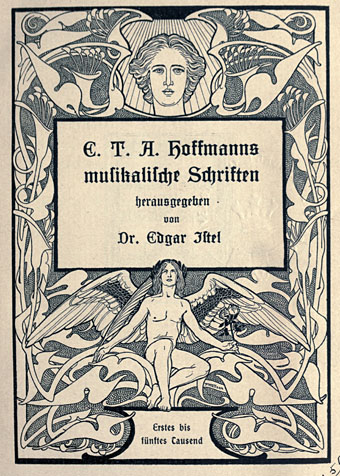
Another prolific illustrator with a clear-line style, Franz Stassen (1869–1949) here decorates the pages of Musikalische Schriften, a book devoted to the musical works of writer ETA Hoffmann. I haven’t checked but I’m fairly sure that Stassen was featured in Jugend magazine a few times, his florid style in this undated volume would certainly complement the work of the other artists there. Like some of those artists, Stassen was enthused by Teutonic nationalism during the First World War, a path that led eventually to work for, and plaudits, from the Nazis. We’re also told (via an unsourced Wikipedia detail) that he ended his days in a gay relationship, something the Third Reich would have either overlooked or conveniently ignored.

stassen02.jpg

stassen03.jpg

Continue reading “Franz Stassen’s illustrated Hoffmann”

Valenti Angelo’s Salomé

angelo.jpg

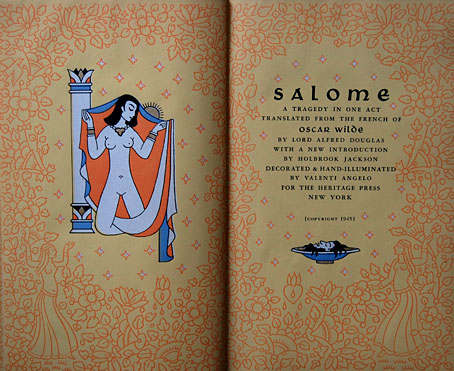
And still they come… Valenti Angelo (1897–1982) was an American printmaker, author of several books for children and the illustrator of an estimated 250 classic works of fiction including this 1945 edition of Wilde’s Salomé for Heritage Press. Angelo has an engagingly simple style in this and other works, reminding me of David Sheridan’s Tarot designs. The Internet Archive has a copy of his illustrated The Imitation of Christ with drawings reminscent of Eric Gill’s woodcuts.

Elsewhere on { feuilleton }
The illustrators archive
The Oscar Wilde archive
The Salomé archive

Bookplates from The Studio

studio01.jpg

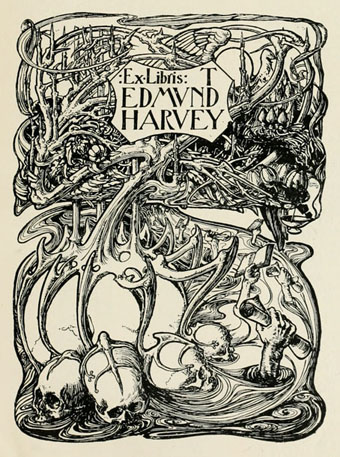
Cyril Goldie.

Selections from Modern Book-plates and their Designers, an overview of British, American and European designs published by The Studio magazine in 1898. These small Studio books are always good to see, not least for the period ads in the opening and closing pages. A couple of the designs are familiar from later reprints, notably Cyril Goldie’s remarkable accumulation of thorns and skulls. Many others are in the swirling and tendrilled style of Art Nouveau which The Studio did much to promote in Britain. Also of interest are a few entries from well-known fine artists who are seldom associated with this kind of design. Among these is Belgian Symbolist Fernand Khnopff who contributes a design of his own and an article about Flemish bookplate design.

studio02.jpg

Charles Robinson.

studio03.jpg

PJ Billinghurst.

Continue reading “Bookplates from The Studio”

Lovecraft’s favourite artists revisited

hpl.jpg

HP Lovecraft (1937) by Virgil Finlay.

I was asked recently to join the bloggers at Tor.com writing about art as it relates to fantasy and science fiction, so for today’s post your attention is directed to this piece, an expanded version of a rather half-hearted list I put together a few years back concerning HP Lovecraft’s favourite artists. Half-hearted or not, people kept linking to that list so it seemed a good idea to make more of it. I’ll be writing these posts a couple of times a month, provided I have the time to do something worthwhile. Watch this space.

Previously on { feuilleton }
The monstrous tome