
Sipping From a Utopian Well in the Desert
Paolo Soleri’s Arcosanti.
Category: {architecture}
Architecture
Les lieux imaginaires d’Erik Desmazières
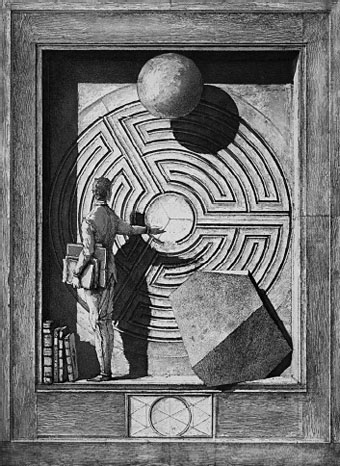
Labyrinthe II (2003).
This is very late notice but I only just discovered that there’s been a major exhibition of etchings by Erik Desmazières running at the Jenisch Gallery in Vevey, Switzerland. The exhibition, which ends on September 9th, includes these more recent works among over 100 other pieces covering the extent of the artist’s career. Sounds like the catalogue for this would certainly be worth ordering. There’s also a 40-minute documentary film being shown there, Le Paris d’Erik by Bertrand Renaudineau and Gérard Emmanuel da Silva.
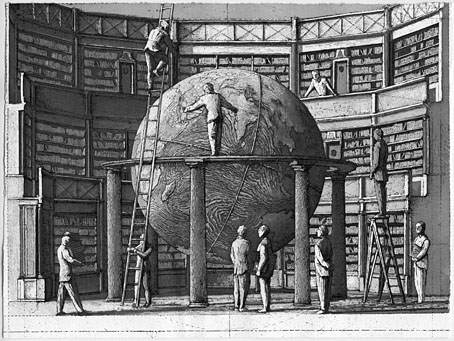
Théâtre de géographie (2007).
Elsewhere on { feuilleton }
• The etching and engraving archive
Previously on { feuilleton }
• The art of Erik Desmazières
Olafur Eliasson’s Serpentine Pavilion
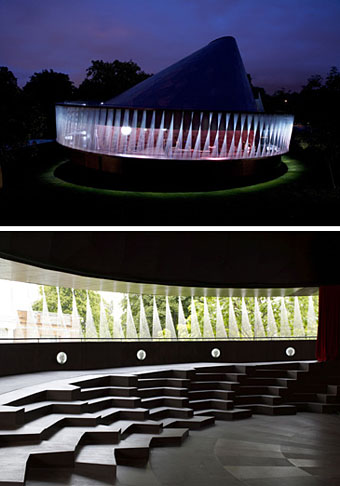
The Serpentine Gallery Pavilion 2007, designed by the internationally acclaimed artist Olafur Eliasson and the award-winning Norwegian architect Kjetil Thorsen, of the architectural practice Snøhetta, is now open to the public and will remain on site until November 2007.
The Pavilion acts as a “laboratory” every Friday night with artists, architects, academics and scientists leading a series of public experiments. The programme, conceived by Eliasson and Thorsen with the Serpentine, will begin in September and culminate in an extraordinary, two-part, 48-hour marathon laboratory event exploring the architecture of the senses.
The Serpentine Pavilion 2007 is a spectacular and dynamic building. The timber-clad structure resembles a spinning top and brings a dramatic vertical dimension to the more usual single level Pavilion. A wide spiralling ramp makes two complete turns, ascending from the Gallery’s lawn to the seating area and continues upwards, culminating at the highest point in a view across Kensington Gardens and down into the chamber below.
Danish-Icelandic artist Olafur Eliasson is based in Berlin where he established Studio Olafur Eliasson, a laboratory for spatial research. His work explores the relationship between individuals and their surroundings, as experienced in his awe-inspiring large-scale installation The weather project, 2003, at Tate Modern. Publisher of a new magazine that melds artistic and architectural experimentation, Eliasson is currently involved in numerous architectural projects such as the Icelandic National Concert and Conference Centre in Reykjavik (design of the building envelope).
He is collaborating with the Hirshhorn Museum and Sculpture Garden, Washington D.C., on a project that reconsiders the Museum’s communicative potential, and he recently won the competition for a large rooftop extension at ARoS Aarhus Kunstmuseum, Denmark.
Kjetil Thorsen is co-founder of Snøhetta, one of Scandinavia’s leading architectural practices, with offices in Oslo and New York. The Bibliotheca Alexandrina, Egypt, 1995–2001, is the commission that brought Snøhetta to international acclaim. Thorsen is responsible for the design of award-winning public buildings globally, and has collaborated with Eliasson several times, including The Opera House, Olso, currently under construction. He is a founder of Galleri Rom, Oslo, which focuses on the intersection of architecture and art, and is a member of the Norwegian Architectural Association (NAL) and the American Institute of Architects (AIA). He is also Professor at the Institute for Experimental Studies in Architecture at the University of Innsbruck, Austria.
Previously on { feuilleton }
• The London Oasis
• New Olafur Eliasson
Steven Soderbergh’s Kafka
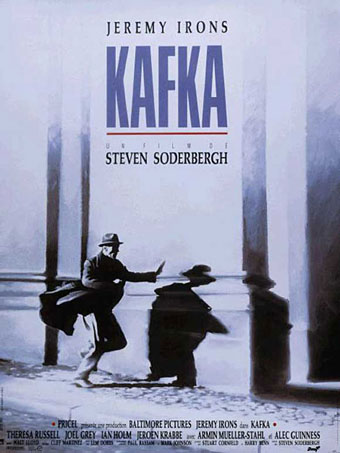
Do you detect a theme this week? The recent Pragueness had me watching this favourite film again. I unfairly dismissed Soderbergh after his debut, Sex, Lies and Videotape (1989), which I found to be two hours of yuppie tedium despite its winning the Palme D’Or at Cannes. The prize did enable him to make Kafka (1991), however, so I shouldn’t complain although I didn’t get to see this until it turned up on TV years after its release. The film was a major flop and put Soderbergh in the wilderness until Out of Sight (1998), his first outing with George Clooney.
Kafka is one of a small group of works wherein well-known writers become embroiled in stories which parallel their fiction. Joe Gores’ Hammett (filmed by Wim Wenders in 1982) did this with Dashiell Hammett while Mark Frost in his novel, The List of Seven, had a pre-Sherlock Holmes Arthur Conan Doyle becoming involved in a Holmesian mystery. The screenplay for Kafka by Lem Dobbs has the author falling in with anarchist revolutionaries in order to solve the death of a co-worker and a bureaucratic conspiracy. This was obviously too clever for a general audience, being littered with references to Kafka’s life and work and also to German Expressionist cinema with names like “Orlac” and “Murnau” comprising key plot elements. Dobbs wrote a couple of other noteworthy screenplays after this, Dark City, a noirish fantasy that does what The Matrix did only with greater imagination, and The Limey (1999), another Soderbergh film with a great performance by Terence Stamp as a vengeful Cockney gangster on the loose in Los Angeles.
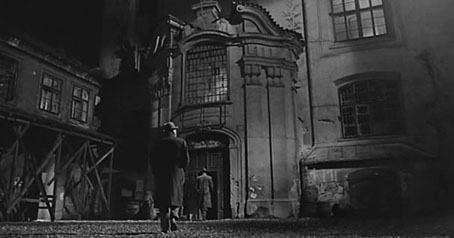
Alan Bennett had already written something similar to Kafka in his 1986 TV film for the BBC, The Insurance Man, which concerns a dye worker becoming enmeshed in the labyrinthine bureaucracy of the Worker’s Accident Insurance Institute where Kafka worked as a clerk. Daniel Day-Lewis made a marvellous Franz Kafka in Bennett’s play, and was much more suited to the role than Jeremy Irons is in Soderbergh’s film. This is a shame since everything else about Kafka is excellent, from Walt Lloyd’s moody photography, and the fabulous cymbalom-inflected score by Cliff Martinez, to the cast which includes the wonderful Theresa Russell, Joel Grey, Ian Holm and, in one of his last performances, Alec Guinness.
Kafka is also the Prague film par excellence, making great use of the city’s Old Town and landmarks such as the Charles Bridge and Prague Castle, a building which dominates the story as well as many of the outdoor scenes. In fact I find myself watching it as much for the settings than anything else. Soderbergh enjoys cinematic pastiche and Kafka owes a great deal to The Third Man (which did for post-war Vienna what Kafka does for Prague) and—inevitably—Orson Welles’ Kafka adaptation, The Trial. Theresa Russell brings Vienna with her via Nicolas Roeg’s Bad Timing, Joel Grey was in Cabaret, of course, and Alec Guinness isn’t so far removed from his role as retired spy George Smiley in the BBC’s John le Carré films. And halfway through the film there’s a great surprise which I won’t spoil here.
Kafka is available on DVD finally, although if you’re in the US you’ll have to import it. Soderbergh has talked about reworking the film in a longer version which I’d like to see if he ever gets round to it. Not an easy film to find but it’s worthy of your attention.
Previously on { feuilleton }
• Kafka and Kupka
• Alexander Hammid
• How to disappear completely
• Karel Plicka’s views of Prague
• Giant mantis invades Prague
• Nosferatu
• Barta’s Golem
Alexander Hammid
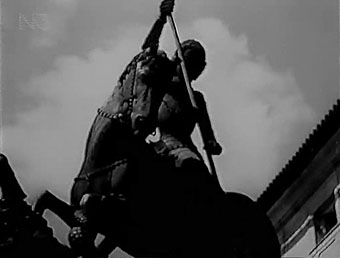
Two short films by Maya Deren’s husband are now available for viewing at Ubuweb. I’ve known about Hammid’s work for years but this is the first time I’ve seen any of it so these additions are very welcome. In a reversal of the usual state of affairs, the works of the wife overshadowed those of the husband even though they collaborated on Deren’s most famous film, Meshes of the Afternoon (which is also at Ubuweb).
Of the pair of films, Na Prazskem Hrade (At Prague Castle) (1931) is the most interesting for this Prague fetishist, a disjointed study of the architecture of the city’s castle which turns the building into an expressionist collage. Two obvious associations arise while watching this; one is Franz Kafka who lived for a time in the castle’s Hradčany district at 22 Golden Lane and whose novel, The Castle (1926), is inspired by the dominating presence of the building. The other is the Nazi invasion which took place a few years after the film was made and caused its maker and his wife to flee to America. The Nazi high command controlled the country from Prague Castle so the brief glimpse of marching soldiers in one shot can be seen as an ominous presentiment of the future. The castle has featured in bigger budget productions more recently, including one of my cult films, Steven Soderbergh’s Kafka (1991), and the underrated The Illusionist (2006) where Prague masqueraded as turn-of-the-century Vienna.
Previously on { feuilleton }
• Jan Švankmajer: The Complete Short Films
• Meshes of the Afternoon by Maya Deren
• How to disappear completely
• Karel Plicka’s views of Prague
• Giant mantis invades Prague
• Barta’s Golem