
Weekend links 8

adur.jpg

Another label design of mine for the Adur Brewery. Much as I like Otto Weisert’s Arnold Böcklin typeface it’s something I’ve been reluctant to use in the past due to its lazy deployment by UK shop sign makers. The ribbon motifs and the hops are adapted from one of my Art Nouveau reference books, however, so it seemed appropriate in this case.

Dead Fingers Talk: The Tape Experiments of William S. Burroughs, a forthcoming exhibition at IMT, London, “presenting two unreleased tape experiments by William Burroughs from the mid 1960s alongside responses by 23 artists, musicians, writers, composers and curators.” Related: get a Naked Lunch t-shirt (or another cover design) at Out of Print clothing.

Ronald Clyne: American folk modernist. Rediscovering the album and book cover designer.

Better Things: The Life and Choices of Jeffrey Jones. A documentary about the work of artist Jeffrey Jones. Related: Mike Kaluta appears in the trailer and Golden Age Comic Book Stories has pages from Kaluta’s illustrated Metropolis (1988), a novel by Thea von Harbou.

• “I imagined myself as a giant penis launching off from earth like a spaceship.” WFMU’s Beware of the Blog explores Cary Grant’s use of LSD. Related: Orange Sunshine – The Brotherhood of Eternal Love and Its Quest to Spread Peace, Love, and Acid to the World, a book by Nicholas Schou.

• Britain’s armed forces have a lesson for the US: “Only 10 years ago, the Army was expelling soldiers for homosexuality. Now gay weddings get the regimental blessing.” A very modern military partnership.

Cassette tapes and their growing curiosity/fetish value. Related: Michael Stipe and Maison Martin Margiela’s sterling silver microcassette charm.

• Another week, another theremin link: Detergent bottles become theremins.

• “Edinburgh is a city built on the production of books”.

The National Archives UK’s photostream at Flickr.

Typographic playing cards.

• A song for Cary Grant: The Trip by Park Avenue Playground, an obscurity from 1967. And These New Puritans have a new video for Attack Music.
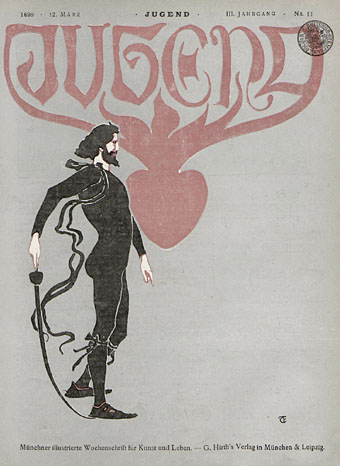
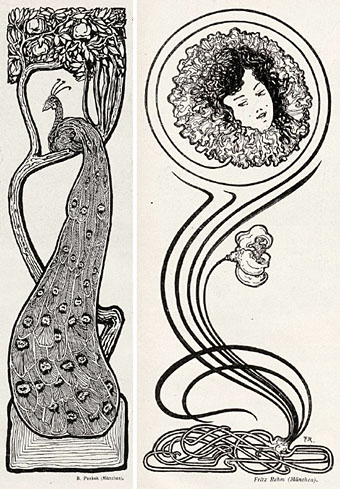
Jugend, 1898

jugend-98-01.jpg

Continuing the delve into back issues of Jugend magazine, the German fin de siècle periodical of “art and life”, this post covers the year 1898. As before, Jugend was so copiously illustrated that the selection here can only scratch the surface. Anyone wanting to see more of these graphics is advised to explore the bound volumes at the Heidelberg University archive. The two books for 1898 can be found here and here.

jugend-98-02.jpg

Continue reading “Jugend, 1898”

Albrecht Dürer’s Triumphal Arch

durer.jpg

Albrecht Dürer’s Triumphal Arch (1515), a wall-sized print produced by 192 separate print blocks. I had a good look at this the last time I was the British Museum. The Museum’s site has some sample details of the work but the size of them isn’t so good, unfortunately. This is one of those pictures you either have to see in situ or find a huge digital copy to scrutinise in order to fully appreciate its incredible detail.

The Triumphal Arch is one of the largest prints ever produced. It was commissioned by the Holy Roman Emperor Maximilian I (1459-1519). The programme was devised by the court historian and mathematician, Johann Stabius, who explains underneath that it was constructed after the model of ‘the ancient triumphal arches of the Roman Emperors’. (More.)

The Triumphal Arch at The American Institute for Conservation | An overview of the prints and some good views of the full scale of the work.
The Triumphal Arch at Backtoclassics.com | A large view and some details.

Elsewhere on { feuilleton }
The etching and engraving archive

Mel Roberts: California Dreaming

roberts1.jpg

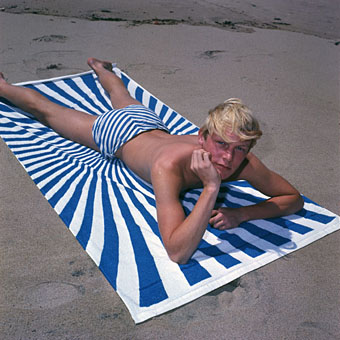
Sean Patrick (1968).

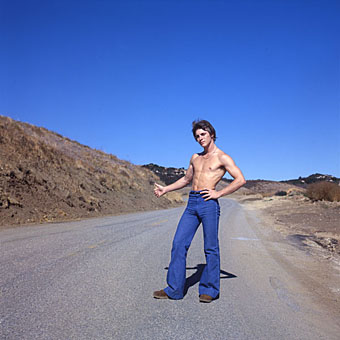
Mel Roberts’ photos have featured here before but it’s doubtful they will do again seeing as the photographer died in 2007 so we won’t see any more of his Californian boys. His complete archive, comprising several thousand prints, is up for sale as part of an auction which begins today. Out.com have the details if you’re wealthy enough to bid for something; the rest of us can admire the pictures. Tip via V-M-P.

Best known for his photos of tanned—often nude—young men basking in the California sun, the iconic photographer first published his work in the popular physique magazines of the early ’60s. By the end of his career, Roberts had taken over 50,000 photographs of nearly 200 models, many of them friends and lovers.

roberts2.jpg

Bobby Kroop (1973).

Previously on { feuilleton }
Sailors
California boys by Mel Roberts