Dorothea Tanning, 1910–2012

tanning.jpg

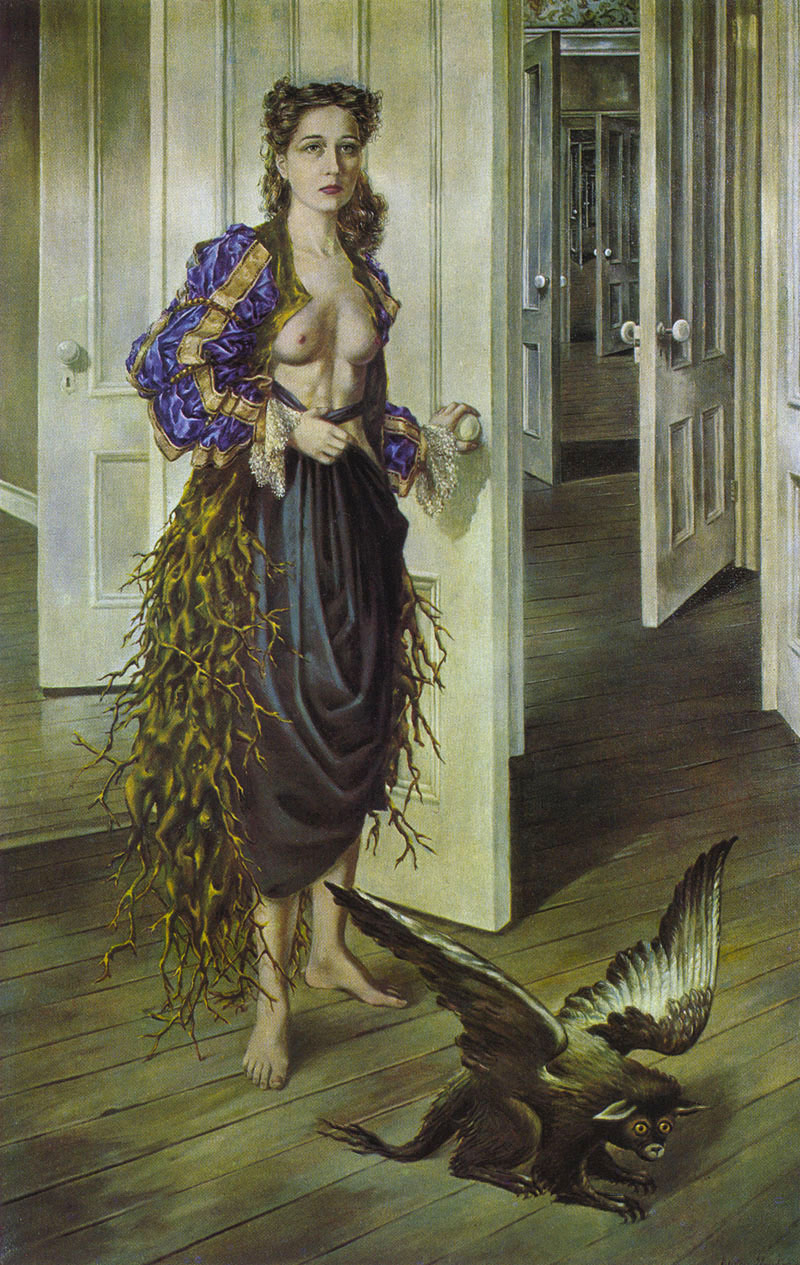
Birthday (1942) by Dorothea Tanning.

In pre-internet days it always used to surprise me to read that Dorothea Tanning was still alive when one seldom heard much about her; Leonora Carrington seemed positively hyperactive by comparison. In the end Dorothea outlasted all her Surrealist contemporaries, and the announcement of her death this week sees the passing of that generation of art revolutionaries. Birthday became an immediate favourite when I first encountered it in art books some thirty-odd years ago, and it remains my favourite among her works. John Glassie interviewed her for Salon ten years ago when she had this to say about the painting:

Well, excuse me for this, but “Birthday” is among other dreamlike things, a topless self-portrait. Is it fair to say that at that time, 1942, people thought you were immodest?

Well, I was aware it was pretty daring, but that’s not why I did it. It was a kind of a statement, wanting the utter truth, and bareness was necessary. My breasts didn’t amount to much. Quite unremarkable. And besides, when you are feeling very solemn and painting very intensively, you think only of what you are trying to communicate.

So what have you tried to communicate as an artist? What were your goals, and have you achieved them?

I’d be satisfied with having suggested that there is more than meets the eye.

She also offered a piece of sound advice:

Keep your eye on your inner world and keep away from ads and idiots and movie stars, except when you need amusement.

New York Times: Dorothea Tanning, Surrealist Painter, Dies at 101
• Coilhouse: “My work is about leaving the door open to the imagination.”
New York magazine: Jerry Saltz on Dorothea Tanning
Guardian obituary | From 2004: “I’ve always been perverse!”

Previously on { feuilleton }
Leonora Carrington, 1917–2011
Marsi Paribatra: the Royal Surrealist
Dorothea Tanning: Early Designs for the Stage
Angels of Anarchy: Women Artists and Surrealism
The art of Leonor Fini, 1907–1996
Surrealist women

Palais Idéal panoramas

cheval1.jpg

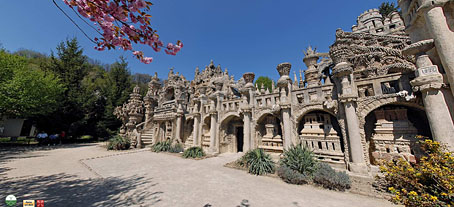
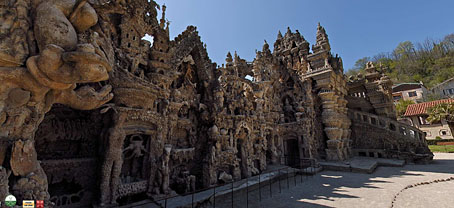
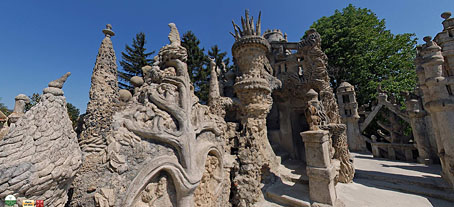
The oft-recounted story behind the extraordinary Palais Idéal in Hauterives, France, is that rural postman Ferdinand Cheval (1836–1924) found an unusually-shaped stone on his route which compelled him to spend the next thirty-three years building an elaborate architectural fantasy from cement and more stones collected on his rounds. The structure is aptly named if you consider it the ideal to which Edward James may have been aspiring with Las Pozas. James could hardly be unaware of Cheval’s work since it was praised as a Surrealist precursor by André Breton, admired by Picasso and inspired a collage by Max Ernst.

cheval2.jpg

These panoramas came via a link at the official Facteur Cheval site. As usual, Flickr is the place to go for detailed views.

cheval3.jpg

Elsewhere on { feuilleton }
The panoramas archive

Previously on { feuilleton }
Las Pozas and Edward James

Las Pozas panoramas

xilitla1.jpg

Photo by Carlos Ernesto Guadarrama Muñoz.

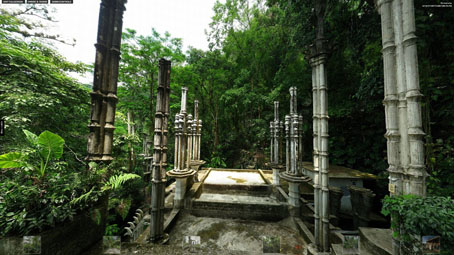
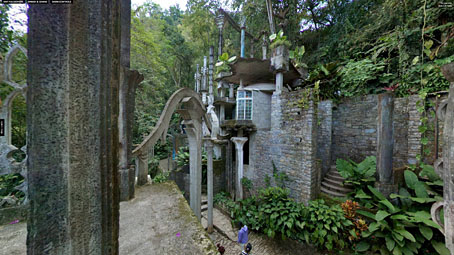
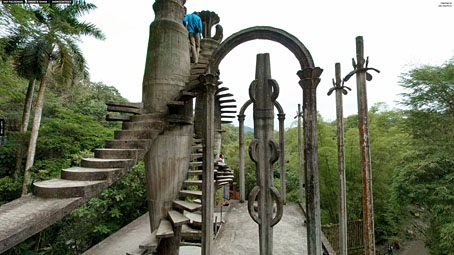
How soon things change. In 2006 when I wrote something about Las Pozas, the unfinished concrete fantasia constructed by Edward James at Xilitla in the Mexican jungle, there was little information about the place on the web. A couple of years later photos had appeared on Flickr and Monty Don had been there with TV cameras for the BBC’s Around the World in 80 Gardens. Now, thanks to 360cities.net, we have a collection of panoramic views inside James’ platforms, plazas and stairways to nowhere. See the complete set of views here.

xilitla2.jpg

Photo by Jose Luis Perez.

Edward James described himself as a poet (and is credited as such on his gravestone), but he’s far better known as one of the primary patrons of Surrealist art and a lifelong proponent of the Surrealist ethos, hence Las Pozas whose construction occupied him up to his death in 1984. In addition to being the model for Magritte’s La reproduction interdite (1937), James also converted Monkton, his home in England, into a Surrealist showcase. It’s a place I’ll be writing about at greater length when I find the time.

xilitla3.jpg

Photo by Jose Luis Perez.

Elsewhere on { feuilleton }
The panoramas archive

Previously on { feuilleton }
Return to Las Pozas
Las Pozas and Edward James

Book talk

shevdon.jpg

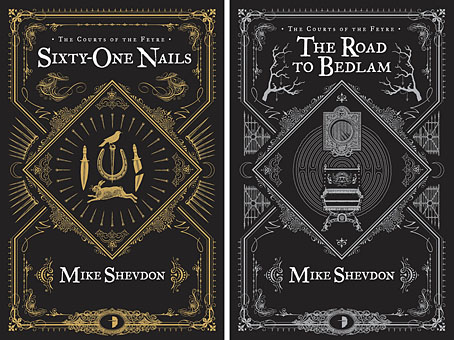
I posted my covers for the Angry Robot editions of Mike Shevdon’s Courts of the Feyre series last month. Last week Mike asked me to answer a few questions about the design process and related matters. The answers are now posted on his blog where I discuss art, book design, favourite reading and a couple of the things I plan to foist on the world in the near future.

Not mentioned there but due on the shelves later this year is The Graphic Canon, a collection of adaptations in comic strip and illustration form of literary works from the Epic of Gilgamesh on. Seven Stories Press is the publisher, Russ Kick is the editor, and my contribution is a condensation of The Picture of Dorian Gray. The first of the three volumes will be out in April. More about that later.

Previously on { feuilleton }
The Courts of the Feyre

Weekend links 93

favre.jpg

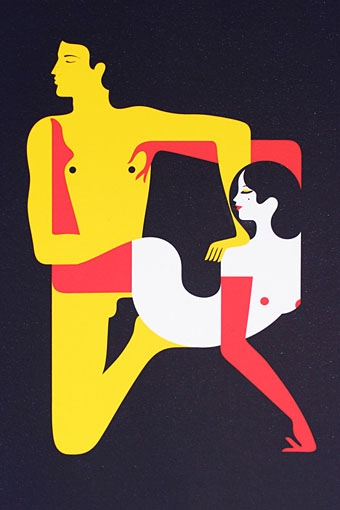
One of a series of tremendous designs by Malika Favre for a new Penguin edition of the Kama Sutra.

• New interviews: “…Americans — mired in individualism — prefer to think in terms of identity than in terms of roles and masks. An American would never have called a novel Confessions of a Mask.” Nicholas Currie, better known via his Momus mask. | “The horror in music comes from the silence,” says John Carpenter. | “It’s dangerous to be an artist. That’s what we talk about in Naked Lunch — and it’s dangerous on many different levels. Politically it can be dangerous, but psychologically it can be quite dangerous too. You make yourself very vulnerable. You put yourself out there and of course you open yourself up to criticism and attack.” David Cronenberg at the Los Angeles Review of Books.

• New books: Dotter of Her Father’s Eyes, a Joycean memoir by Mary M Talbot and Bryan Talbot. | A stack of new works from Strange Attractor including a collection of Savage Pencil‘s Trip or Squeek comic strips. | Robert Irwin’s Visions of the Jinn: Illustrators of the Arabian Nights. A shame about the high price on the latter but I’m sure it looks wonderful.

• The Blu-ray release of Wings (1927), William A. Wellman’s silent drama about air aces during the First World War, has prompted renewed attention for the passionate relationship between its two male leads, especially this deathbed scene which is tagged as the first same-sex kiss in cinema. That’s arguable, of course, but it’s certainly a touching moment.

• From 2009: Searching the Library of Babel, a list of all the stories in all 33 volumes of The Library of Babel, a 1979 Spanish language anthology of fantastic literature edited by Jorge Luis Borges.

• Lots of newpaper attention in the past week for the not-so-fresh news that magic mushrooms could help fight depression. Nature went into the detail of the latest studies.

French group Air have written the score for a rare colour print of Le voyage dans la lune (1902) by Georges Méliès. Air’s YouTube channel has extracts.

• From 1989: The Merchant of Shadows by Angela Carter.

Will Hunt on the Ghost River of Manhattan.

Selected Letters of William S. Burroughs

Sexy Boy (1998) by Air | Surfing On A Rocket (2003) by Air | Mer Du Japon (2007) by Air.