The Flow III

flow.jpg

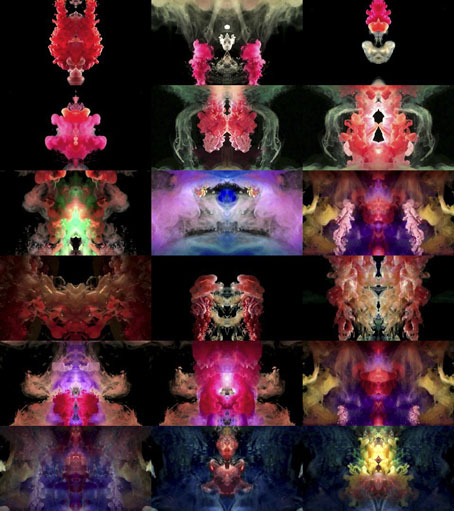
A short motion study by David Vigh for Bose Collins. Sometimes the simplest tricks are the most effective, as with these shots of coloured inks dropped into water and mirrored at their vertical axis. The resulting symmetry effortlessly prompts our pareidolia. Bose Collins has some additional experiments in this series, including one exploring the weirdness of ferrofluids.

Elsewhere on { feuilleton }
The abstract cinema archive

Further echoes of Aubrey

verhagen.jpg

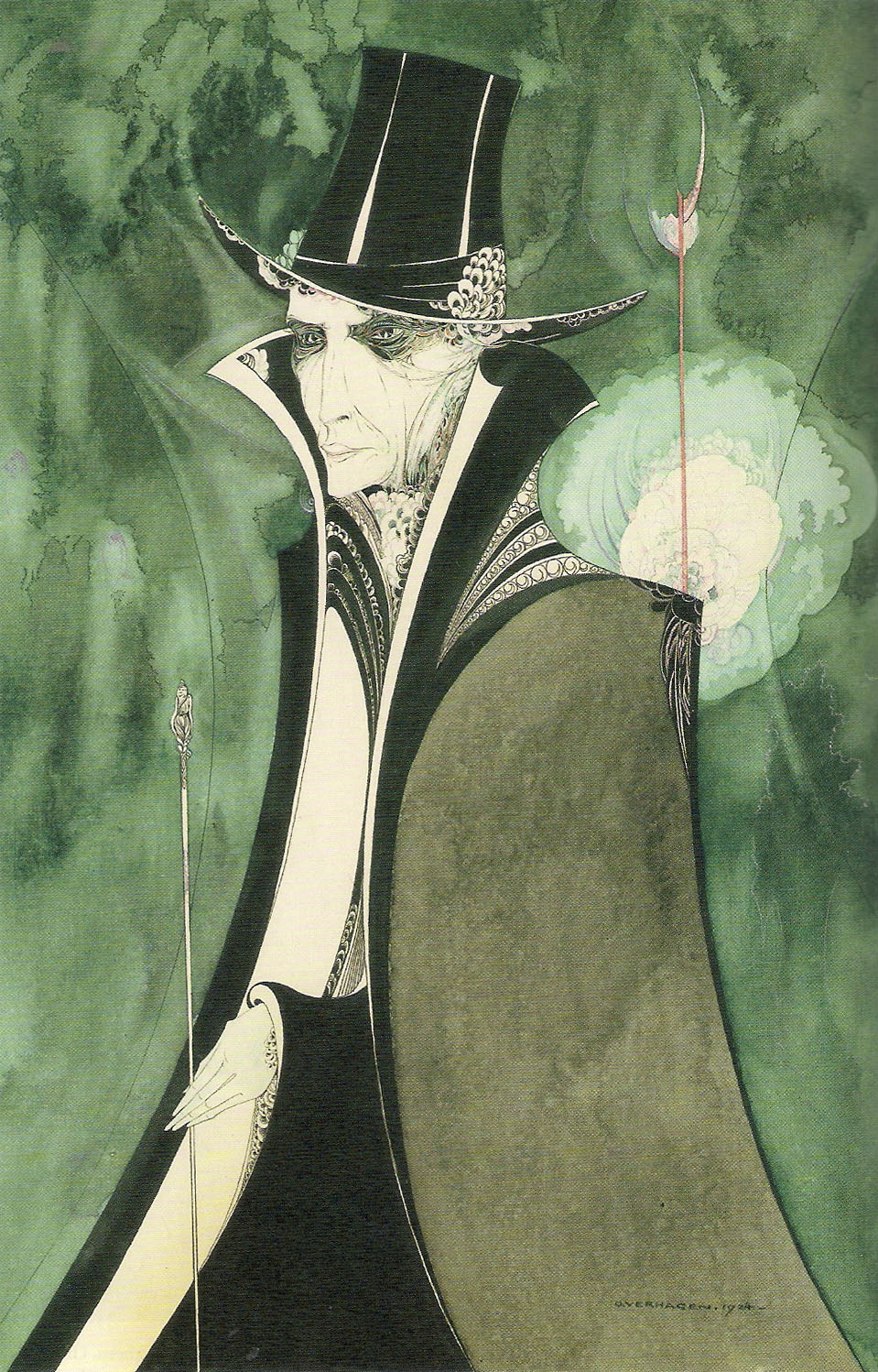
Dorian Gray (1924) by Otto Verhagen (1885–1951).

If you need an idea of the colossal impact Aubrey Beardsley’s drawing had on the art world of the 1890s consider that the entirety of his career—from his first public exposure in The Studio in 1893 to his very untimely death in 1898—lasted a mere five years. Decades afterwards artists around the world were still imitating his style. The later disciples are so numerous and so widespread it’s no surprise if some have yet to be fully acknowledged by subsequent generations. Sander Bink who maintains the Rond1900 site sent copies of these drawings (from Lopende Vuurtjes, Verloren Publishers, 2012) and provided some information about the artists:

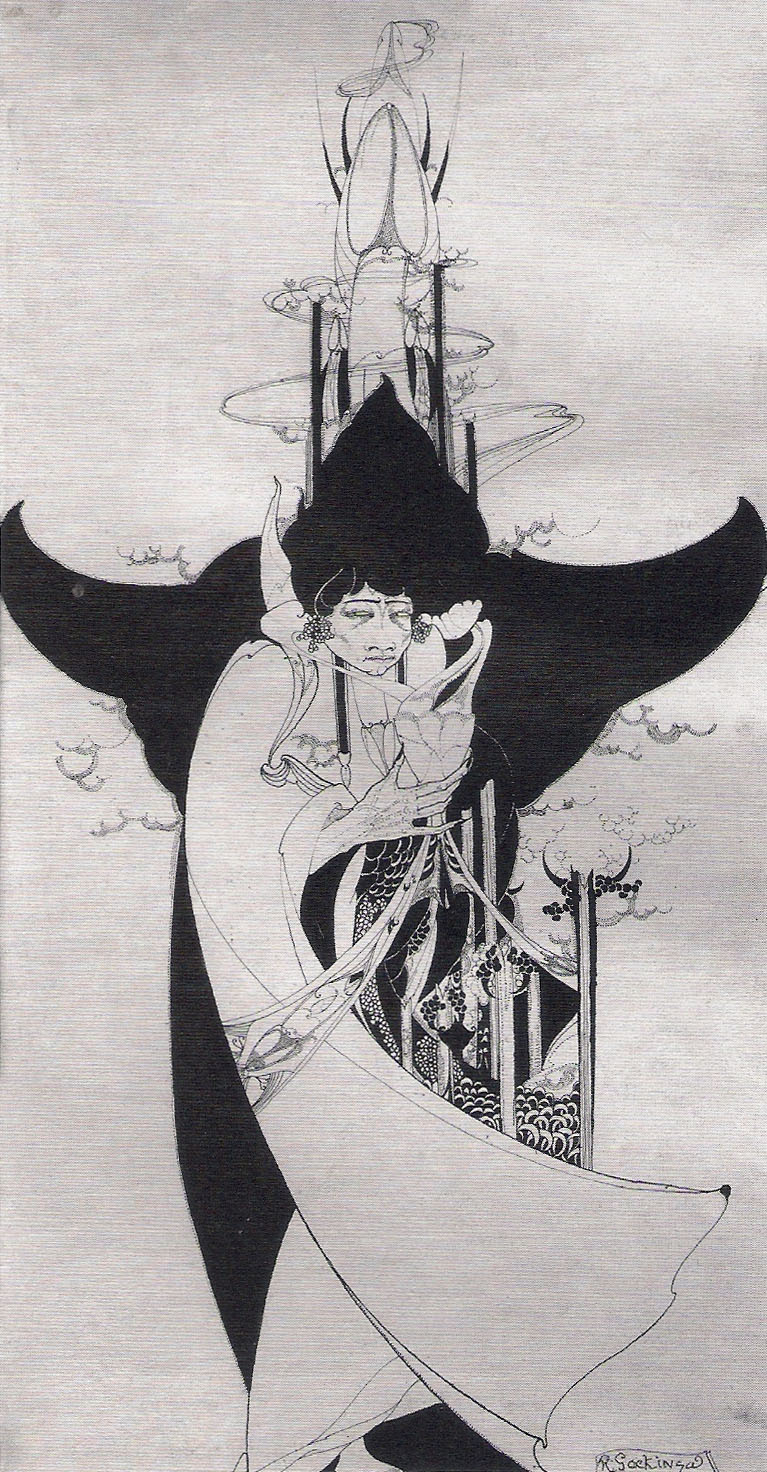
Verhagen was a government official for most of his life and seems to have led a very respected life and made his Beardsley-esque work privately, no expositions as far is I know. Gockinga appears to have led a more interesting life: born in Indonesia, lived in Holland 1908–1922, the Indonesia (Java) again, then New York, and the Indonesia and after wwii Amsterdam, probably homosexual. Had one exposition of his work in 1917.

Sander’s site has further examples of Verhagen’s drawings, and he says that both artists were probably inspired by Carel (or Karel) de Nerée, some of whose work was featured here a while back. Always good to have the dots joined. Verhagen’s Dorian Gray is a curious piece; in style it’s a little like the angular drawings that Beresford Egan was producing in the 1920s, while the subject can’t be Dorian himself unless it’s a rendering of his aged portrait. As for Gockinga’s drawing, it’s a lot more faithful to Beardsley’s early style (complete with phallic extrusions) than the poor Nichols fakes that appeared in 1919. If you want a successful forgery it’s always best to find someone with talent.

(Thanks Sander!)

gockinga.jpg

Old lady with ghost (c.1916) by René Gockinga (1893–1962).

Elsewhere on { feuilleton }
The Aubrey Beardsley archive
The illustrators archive
The Oscar Wilde archive

Books Borges never wrote

borges2.jpg

Design by Hector Haralambous.

The composition of vast books is a laborious and impoverishing extravagance. To go on for five hundred pages developing an idea whose perfect oral exposition is possible in a few minutes! A better course of procedure is to pretend that these books already exist, and then to offer a resume, a commentary… More reasonable, more inept, more indolent, I have preferred to write notes upon imaginary books.

Jorge Luis Borges

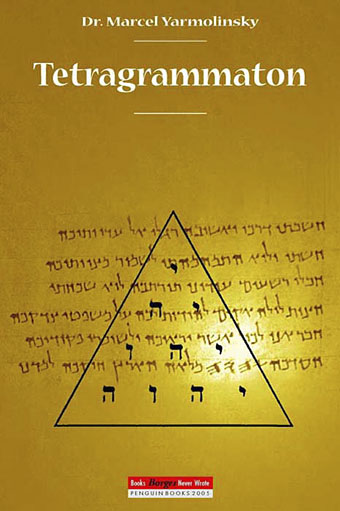
Borges was true to his intention in scattering invented volumes throughout his work, a number of the ficciones either have invented books as their subjects or use them to propel the narrative. Tlön, Uqbar, Orbis Tertius is perhaps the most elaborate example, the story in which Borges invents an encyclopedia which is itself being invented to prove a philosophical point. My favourite Borges site at The Modern Word has a page detailing some of the imaginary volumes. Invented books naturally suggest invented book covers. Several years ago another Borges site took up the challenge for the latter which is where the examples above and below originate. The site is now defunct but its pages can be seen mostly intact thanks to the Internet Archive. The book covers are here and here. The designs for the most part could have been better, although they don’t look any worse than some of the poorly-designed covers for genuine books now flooding the web thanks to print-on-demand and electronic publishing.

borges3.jpg

Design by George Kranitis.

ttl7.jpg

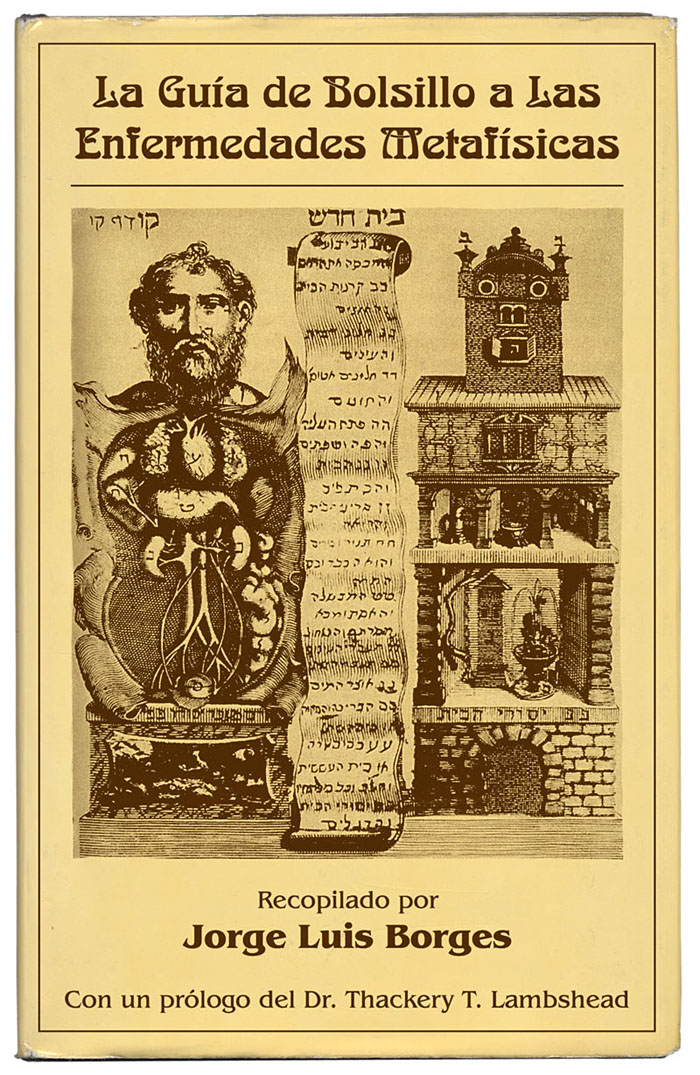
The Spanish language edition of the Thackery T Lambshead Pocket Guide to Invented and Discredited Diseases (1977).

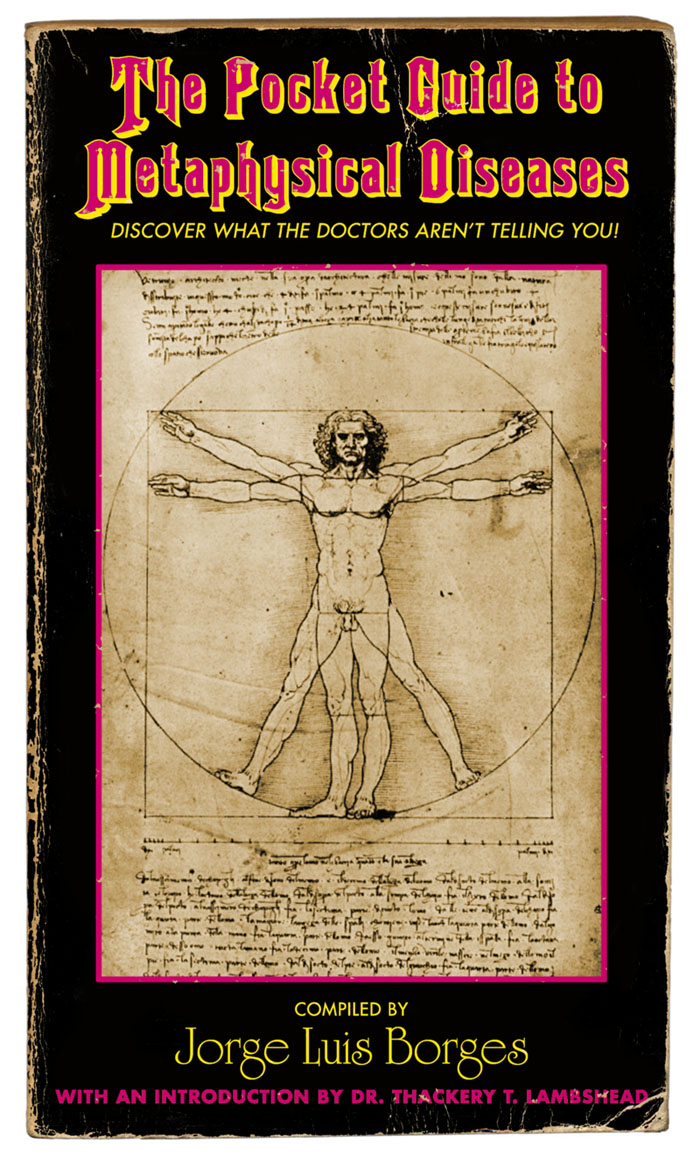
All of which reminded me of my own fake Borges covers from 2003, supposedly Borges’ own compilations of The Thackery T Lambshead Pocket Guide to Invented and Discredited Diseases, the fake disease guide edited by Jeff VanderMeer and Mark Roberts. These were created in colour but printed in black-and-white. Since they’ve appeared here before I’ve included links this time to larger copies. In a detail that Borges might have appreciated the idea for the disease guide came about after Modern Word editor Allen B. Ruch, who often manifests as The Great Quail, remarked to Jeff VanderMeer that “I think I have contracted Mad Quail Disease”. You have to be cautious with casual quips to writers, you never know where they might lead.

ttl8.jpg

An English paperback reprint of the Borges edition (1979).

Update: While we’re on the subject… Remember the Fake Books from The Royal Tenenbaums? Here They Are!

Elsewhere on { feuilleton }
The book covers archive

Previously on { feuilleton }
Borges and I
Recovering Viriconium
Forbidden volumes
Pasticheur’s Addiction

Borges and I

borges.jpg

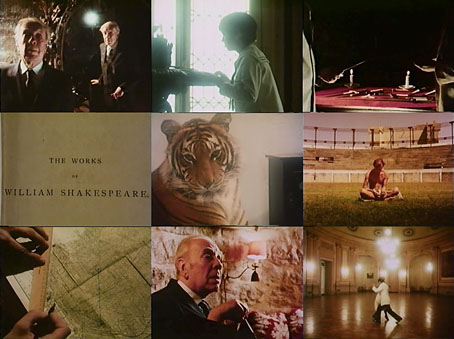
Another piece of revenant television to tick off the “When will I see this?” list. I mentioned David Wheatley’s film Borges and I back in January in a post about the director’s dramatisation of the life and work of René Magritte. Wheatley’s student film secured for him a job as a BBC director at a time when the Arena arts series was one of the best things being produced by the corporation. Borges and I was filmed in 1982 and broadcast a year later, an event I managed to miss to my considerable regret. Once again Ubuweb has turned up the goods with a copy from an American video tape. It’s not ideal—all the Spanish sequences would have been subtitled in the original broadcast—but I’m not going to complain. This 80-minute film is not only the best Anglophone documentary I’ve seen on Borges, it was produced in collaboration with the author who for much of the running time discusses his life and work in English. The tape copy also frustratingly lacks credits but the unseen American interviewer and narrator would appear to be translator and collaborator Norman Thomas di Giovanni, a writer who later found himself and his work marginalised by the Borges estate. Between the interviews and readings there are dramatised sequences from The Meeting, Funes, the Memorious, The South, The Circular Ruins, Death and the Compass, and The Sartorial Revolution, one of the collaborations with Adolfo Bioy Casares. Plus, of course, the expected complement of mirrors, tigers and a duel with knives. The budget must have been generous: scenes were shot in Argentina and Uruguay, and we also see Borges at his favourite lodging in Paris: L’Hôtel in the Rue des Beaux-Arts, a building which now bears plaques celebrating the visits of Borges and another famous literary resident, Oscar Wilde.

Previously on { feuilleton }
René Magritte by David Wheatley
L’Hôtel, Paris
Borges documentary
Borges in Performance

Weekend links 121

lambshead.jpg

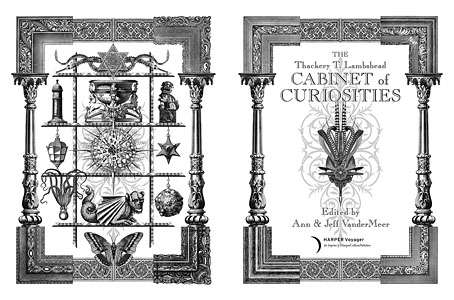
Title spread for The Thackery T. Lambshead Cabinet of Curiosities (2011) edited by Ann & Jeff VanderMeer.

I was surprised this week to find myself nominated as Best Artist in the World Fantasy Awards. The results will be announced at the World Fantasy Convention in November. Among the books nominated for Best Anthology is the Thackery T. Lambshead Cabinet of Curiosities for which I provided title page designs and some illustrations. Editors Ann & Jeff are well-represented (and ought to win for their landmark The Weird anthology), and I’m pleased to see Mark Valentine receive a nod for his excellent Wormwood magazine. Mark and Roger Dobson published my first Lovecraft adaptation, The Haunter of the Dark, in a large-format edition under their Caermaen imprint in 1988.

I remember having a conversation with my father about it. I told him what I’d really have liked to find, in my exhaustive search of the canon, was a gay superhero. You know: fucking dudes, saving the world. Never mind the fact that superheroes, with their notoriously contour-hugging apparel, are usually assumed gay by default. I wanted something that had existed, something from history. My father considered my criteria.

“I think what you want is Gore Vidal.”

Henry Giardina on Gore Vidal’s Bully Republic at the Paris Review.

• Appreciations and memorials for the late Gore Vidal continue to surface: “He was punk rock with a traditional, smooth exterior. But there was nothing traditional about him, not really. He defied singular category,” says Aaron Tilford at Lambda Literary. “Jokes course through Vidal’s entropy-heavy commentaries like a warm, reviving current. They, more than the barbs to which they form a counterpoint, are what make his essays a continuing pleasure to read,” says “J.C.” at the TLS.

• “Winterson’s opposition to strict realism is less an artistic critique than a cultural one. She uses the term ‘realism’ to describe an entrenched way of viewing the world, which it is the writer’s duty to challenge.” Hannah Tennant-Moore on Jeanette Winterson at n+1.

The Ghosts of Bush by Robin The Fog: “A final hauntological perambulation around the hidden corners of Bush House, Aldwych, London, June 2012”.

• “For everything that is not shown, the filmmaker counts on the power of imagination of his viewers.” Lebbeus Woods on Chris Marker and La Jetée.

Joseph Burnett on “Rainbow Ambiguity: Defying conservatism in mainstream LGBT culture”.

• Leigh Brackett book and magazine covers at Golden Age Comic Book Stories.

BLDGBLOG visited the Whitechapel Bell Foundry in London.

Stilled Life: A collection of photography by Thom Ayres.

• Underground subversion: Stickers on the Central Line.

Andrei Codrescu on five favourite Fantastical Tales.

Vangelis performs an analogue synth freakout for Spanish TV in 1982 | Oro Opus Alter, a track from the forthcoming album by Ufomammut | New World, a track from the forthcoming album by The Irrepressibles. Can’t wait.