Nirvana and The Conquerors

nirvana.jpg

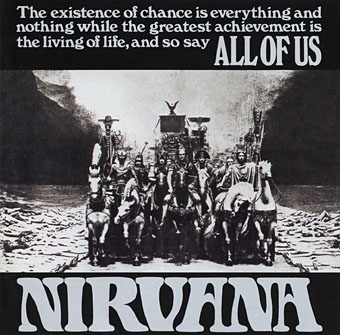
All Of Us by Nirvana (1968).

Every now and then the web’s great proliferation of images serves a useful purpose by solving some minor artistic conundrum. All Of Us is the second album by UK psychedelic band Nirvana (no relation to Kurt and co.) and the striking cover painting—a long line of emperors and warriors from different ages parading down an avenue of corpses—is annoyingly uncredited. The notes for the 2003 CD reissue inform us that “Patrick had found, in an exhibition of Nazi art (in Bremen, Germany), a still shot from a propaganda film directed by Adolf Hitler’s favourite film-maker, Leni Riefenstahl.” Setting aside the bizarre use of such a picture by one of London’s more effete psychedelic groups, I wasn’t convinced that this was a Nazi-era painting. The style is more like a piece of Neoclassical academic art from the late 19th century, and that’s what it turns out to be.
fritel1.jpg

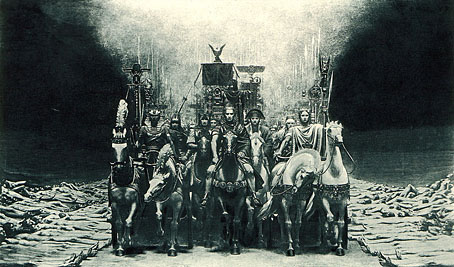
Les Conquérants (1892) by Pierre Fritel. From this Flickr page.

It was a search for works by French academician George Antoine Rochegrosse that turned up a copy of the painting in Google Images. “Aha, it’s Rochegrosse, then!” thought I, only it wasn’t. The picture is entitled Les Conquérants and the artist responsible is one Pierre Fritel (1853–1942) about whom there’s very little information on the web. There is, however, a discussion here which details the painting’s symbolism:

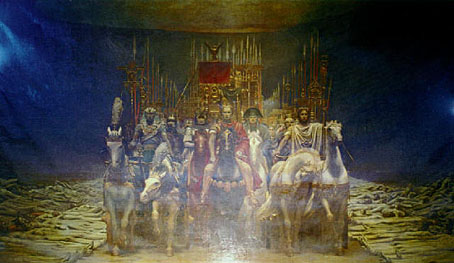
Through the Valley of the Shadow of Death, whose limits are obscured in darkness, advance, hollow-eyed and remorseful, the conquerors of all ages, marching in close ranks between a double row of corpses, stripped and rigid, lying packed close together with their feet toward the procession. In the center of the van rides Julius Caesar, whom Shakespeare has pronounced “the foremost man of all this world.” On his right are the Egyptian called by the Greeks Sesostris, now known to be Rameses II., Attila, “the Scourge of God,” Hannibal the Carthaginian, and Tamerlane the Tartar. On his left march Napoleon, the last world-conqueror, Alexander of Macedon, Nebuchadnezzar of Babylon, that “head of gold” in the great image seen in his vision as interpreted by the prophet Daniel, and Charlemagne, who restored the fallen Roman Empire.

There’s a follow-up discussion on MetaFilter where a commenter makes the Nirvana connection, and the Internet Archive even has the catalogue for the Salon of 1892 which lists the painting’s first public appearance. See a larger monochrome version here. The only mystery now is the whereabouts of the painting itself. Artnet tells us it was sold in 1988, and they have a poor quality colour photo of the picture (below) which looks a lot less dramatic than the moody monochrome reproductions. If anyone knows the current location of Fritel’s canvas, please leave a comment.
fritel2.jpg

Elsewhere on { feuilleton }
The album covers archive

Previously on { feuilleton }
The art of Vasili Vereshchagin, 1842–1904
Robert Anning Bell’s Tempest

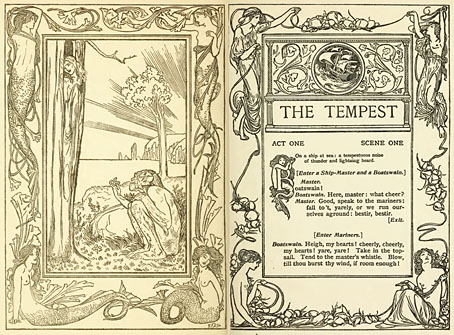
bell1.jpg

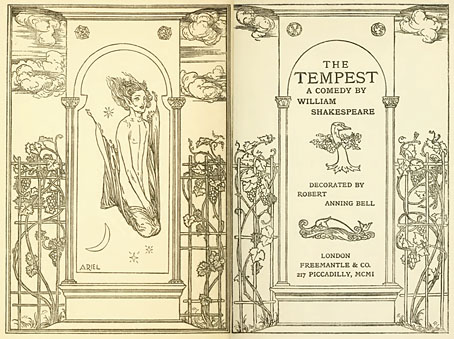
British artist and designer Robert Anning Bell (1863–1933) illustrates Shakespeare in this 1901 edition at the Internet Archive and the work seemed to give him an excuse to embellish many of the pages with writhing mer-folk. His adaptation isn’t as striking as William Heath Robinson’s Midsummer Night’s Dream from 1914 but then few books are. In style Bell is closer to his contemporary Charles Ricketts with very open line work and no heavy black areas. Ricketts produced his own version of Ariel’s Song to Ferdinand for The Magazine of Art in 1895 but doesn’t seem to have illustrated much more of The Tempest as far as I’m aware, although his Vale Press did issue an edition of Shakespeare’s complete works. It hadn’t occurred to me before how few illustrated editions there are of The Tempest; this seems surprising given the fantastic nature of the story. It might be that illustrated plays have never sold so well despite there having been a number of illustrated Midsummer Night’s Dreams. I’d love to have seen Harry Clarke tackling Ariel and Caliban.

bell2.jpg

bell4.jpg

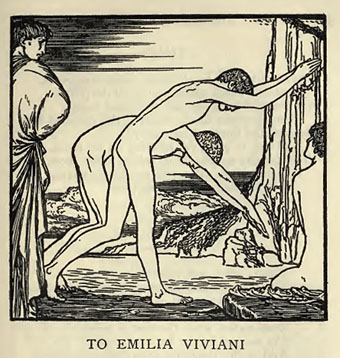
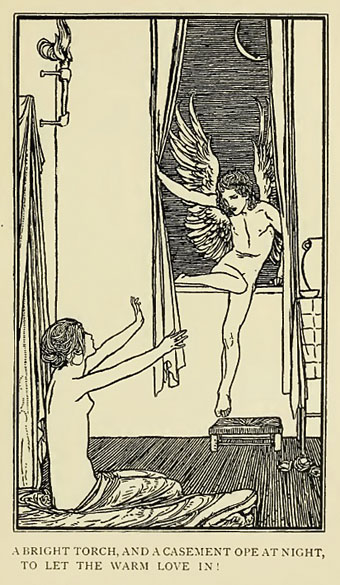
Also at the Internet Archive is a 1902 edition of Shelley’s poems illustrated by Bell (above) and an 1897 edition of Keats in the same series (below). Great poetry doesn’t necessarily lend itself to illustration so it’s no surprise that these books are less interesting than the Shakespeare.

bell3.jpg

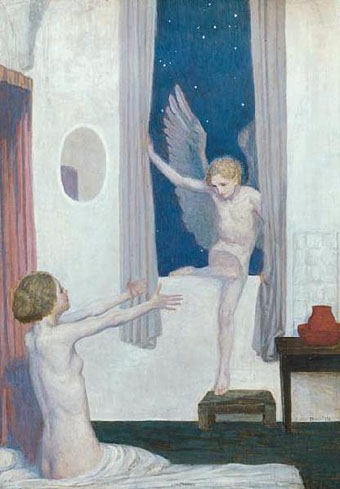
Bell later reworked his illustration for Keats’s Ode to Psyche as a painting which he called Cupid’s Visit. I much prefer the drawing to the painting.

bell5.jpg

Cupid’s Visit (1912).

Elsewhere on { feuilleton }
The illustrators archive

Previously on { feuilleton }
Charles Ricketts’ Hero and Leander
Another Midsummer Night
Arthur Rackham’s Midsummer Night’s Dream
The art of Charles Robinson, 1870–1937
William Heath Robinson’s Midsummer Night’s Dream

Another Midsummer Night

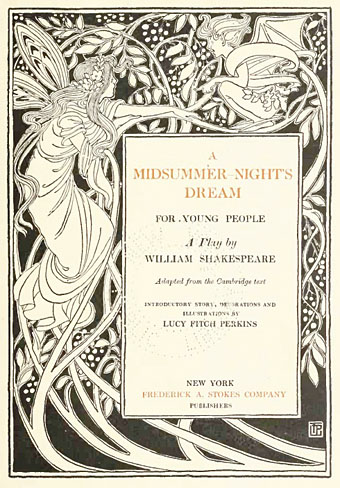
perkins.jpg

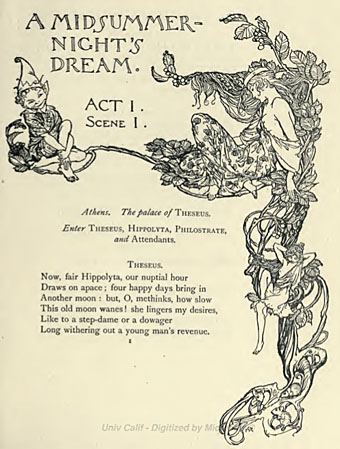
Another illustrated Shakespeare and another Internet Archive scan. Lucy Fitch Perkins’ adaptation dates from 1907 and while her colour work in this volume is distinctly bland, her ink drawings are styled with some tasty Art Nouveau flourishes. Puck with bat wings is an unusual touch.

Elsewhere on { feuilleton }
The illustrators archive

Previously on { feuilleton }
Arthur Rackham’s Midsummer Night’s Dream
A Midsummer Night’s Dadd
William Heath Robinson’s Midsummer Night’s Dream

Arthur Rackham’s Midsummer Night’s Dream

rackham.jpg

Something for the Summer Solstice, the whole of Arthur Rackham’s Shakespeare at the Internet Archive. Rackham’s paintings are classics of the period but for me William Heath Robinson’s black and white drawings are the superior renderings of this story. Happily you can see that book as well.

Elsewhere on { feuilleton }
The illustrators archive

Previously on { feuilleton }
A Midsummer Night’s Dadd
William Heath Robinson’s Midsummer Night’s Dream