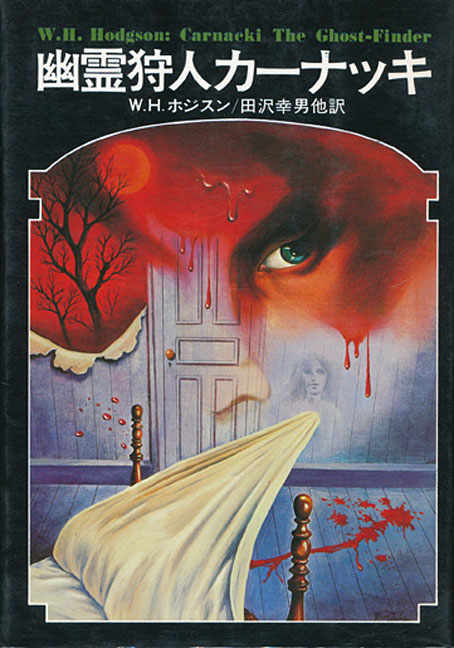
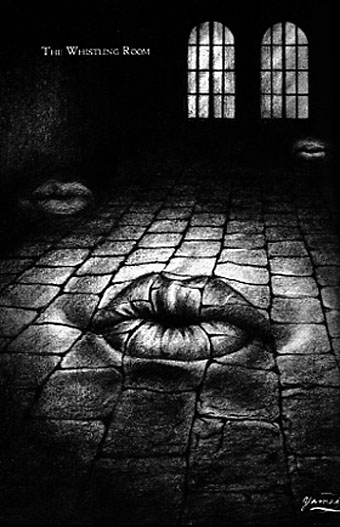
Tadami Yamada’s illustrated Carnacki

carnacki10.jpg

It’s William Hope Hodgson’s occult detective again. Late last year I was looking for Hodgson illustrations after reading Timothy S. Murphy’s William Hope Hodgson and the Rise of the Weird: Possibilities of the Dark but couldn’t find much of interest apart from book covers I’d seen many times before. Tadami Yamada’s illustrations for a Japanese edition of Carnacki, The Ghost-Finder have yet to be catalogued at ISFDB, and don’t seem to have been disseminated much at all. Once again, I’m indebted to 70sscifiart for turning up art that I might not otherwise have seen.

carnacki01.jpg

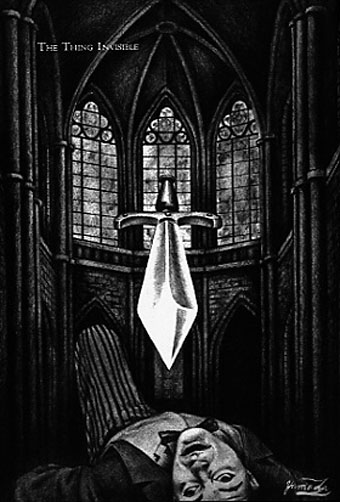
The Thing Invisible.

Information about the Japanese collection was difficult to find in general, a common problem with older Japanese books when most of the online documentation hasn’t been translated. The book was published by Kokusho Kankōkai in 1977 as part of a series of weird fiction reprints along with collections by HP Lovecraft, Algernon Blackwood and others. The Hodgson volume contains the expanded collection of Carnacki stories, with the three posthumously published tales–The Haunted “Jarvee”, The Find and The Hog–appended to the original 1913 edition.

carnacki06.jpg

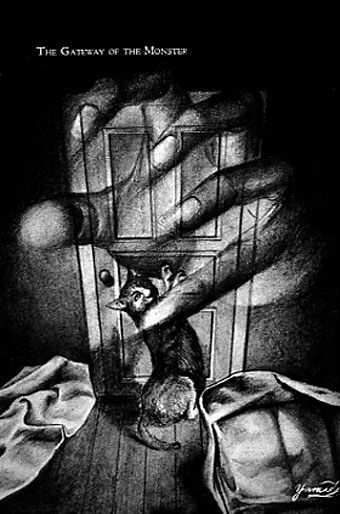
The Gateway of the Monster.

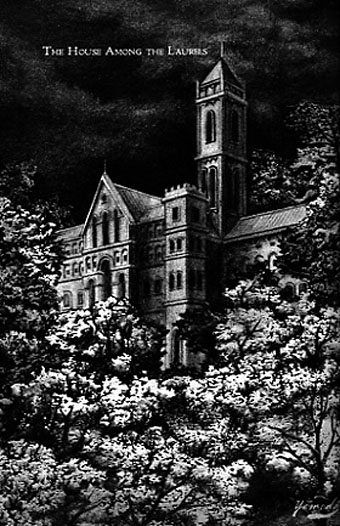
As to the illustrations, these were early works by Tamada, an artist with a lengthy career as an illustrator and painter. The copies of the illustrations don’t reveal much about their medium but they all appear to be paintings; the ones for The Find and The Hog (whose Japanese title translates as The Witch Pig) both show signs of the patterning you get with the decalcomania process, something you can’t easily create in other media. If this book was part of a series then I don’t imagine it was the sole illustrated edition, which raises the possibility that the Lovecraft, Blackwood and other titles were fully illustrated as well. Once again, further research is required.

carnacki08.jpg

The House Among the Laurels.

carnacki02.jpg

The Whistling Room.

Continue reading “Tadami Yamada’s illustrated Carnacki”

Carnacki’s first manifestation

carnacki1.jpg

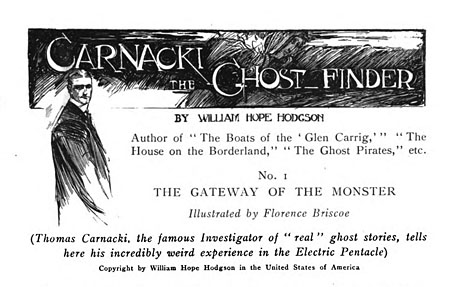
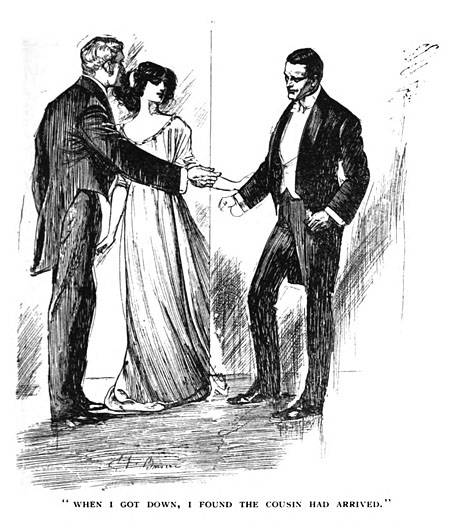
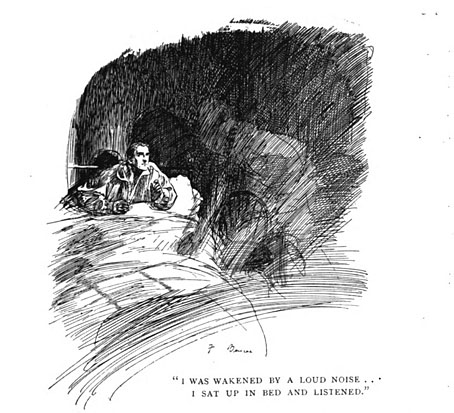
Visual manifestation, that is. The first Carnacki story to see print was The Thing Invisible, published in 1909 as a part of The Ghost Pirates, A Chaunty, and Another Story. The book wasn’t illustrated, nor was the Carnacki collection published by Eveleigh Nash in 1913. The five stories that ran in The Idler, however, were all decorated with sketchy illustrations by Florence Briscoe, all of which may be seen in this collection of extracted pages from the issues for 1910. (For the complete magazines, look here.)

carnacki2.jpg

The House Among the Laurels.

Miss Briscoe (and she does appear to have been a Miss at this point) has the distinction of being one of the first illustrators (possibly the first) of any of Hodgson’s fiction. She was also a friend of the author and may well have used him as a model for many of her illustrations. James Bojaciuk suggests as much in this piece of biographical research that I’d managed to miss when it was posted at Greydogtales. I think we can take Hodgson as a definite model for the portrait of Carnacki that illustrates the magazine header, the similarity between the drawing and one of the author’s photos is beyond doubt even if some of the other Carnacki drawings show less of a resemblance. Carnacki also seems to be quite tall, or at least of average male height, something that the diminutive Hodgson was not.

carnacki4.jpg

The Whistling Room.

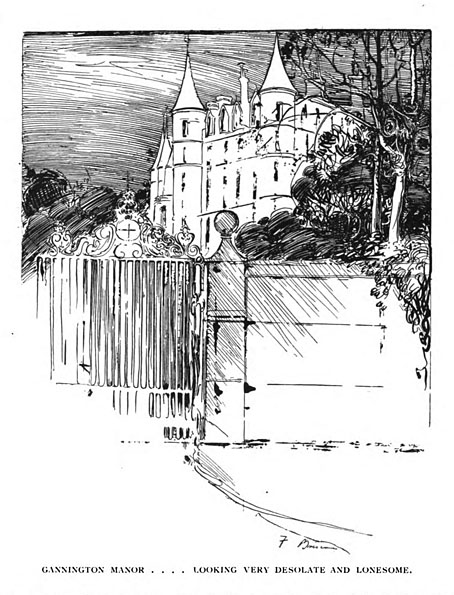
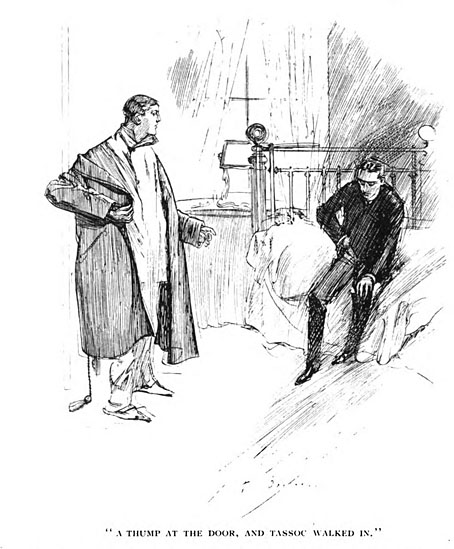
Portraiture aside, Florence Briscoe’s illustrations tend to be of a type that I refer to as “people standing about in rooms”, a common form in the world of magazine illustration. Sidney Paget’s famous drawings of Sherlock Holmes are almost all of this type, stories of cerebral industry and ratiocination being rewarding for the reader, less so for the jobbing illustrator. (The Hound of the Baskervilles is a notable exception, with its dramatic locations and spectral atmosphere.) The most obvious difference between Carnacki and Holmes is that Carnacki encounters genuine manifestations of eldritch horror which he manages to keep at bay with his incantations and electrical devices. Miss Briscoe shows us none of this, unfortunately. But her figures are well-drawn, and as general illustration her work is of a higher standard than the often amateurish renderings you find in the early pulp magazines of the 1920s. The growing sphere of Hodgsonian illustration begins with these few stories.

carnacki3.jpg

The Horse of the Invisible.

carnacki5.jpg

The Searcher of the End House.

Elsewhere on { feuilleton }
The illustrators archive

Previously on { feuilleton }
The Whistling Room, 1952
The art of Jean-Michel Nicollet
Suspicion: The Voice in the Night
Hodgsonian vibrations
The Horse of the Invisible
Tentacles #2: The Lost Continent
Tentacles #1: The Boats of the ‘Glen Carrig’
Hodgson versus Houdini
Weekend links: Hodgson edition
Druillet meets Hodgson

The Whistling Room, 1952

whistling1.jpg

Coincidence time again: this ancient TV drama was posted to YouTube a few days ago just as I was finishing Timothy S. Murphy’s very commendable study of William Hope Hodgson’s fiction, William Hope Hodgson and the Rise of the Weird: Possibilities of the Dark. As drama or even basic entertainment, The Whistling Room is the opposite of commendable but it is notable for being the first screen adaptation of a Hodgson story. Hodgson’s fiction has never been popular with film or television dramatists. His two major weird novels, The Night Land and The House on the Borderland, would require lavish expenditure and special effects to do them justice, while the latter has a narrative shape and a lack of characterisation that would either repel any interest or incur considerable mangling of the story.

More appealing for screen adapters are Hodgson’s tales of Carnacki the Ghost Finder, a collection of short mysteries with a supernatural atmosphere and neat resolutions. The Whistling Room, a US production for Chevron Theatre in 1952, is the first of two Carnacki adaptations, the other appearing almost 20 years later when Thames TV included The Horse of the Invisible in their first series of The Rivals of Sherlock Holmes. The Carnacki character was Hodgson’s take on the occult detective or psychic investigator, a short-lived offshoot of the post-Sherlock Holmes detection boom of the 1890s, and the concurrent interest in Spiritualism (or “Spiritism”, as Aleister Crowley always insisted it should be called). Carnacki is as resourceful and energetic as Hodgson’s other protagonists, and as an investigator he’s happy to use modern technology (electricity, cameras, vacuum tubes) to combat incursions from other dimensions. Hodgson’s descriptions of these encounters are freighted with all the capitalised terminology that recurs throughout The Night Land: “Outer Monstrosities”, “a Force from Outside”, “the Ab-human”. Carnacki’s exploits, however, have often been dismissed as hack-work when compared to the author’s novels or his tales of the Sargasso Sea. (The one Carnacki story that even detractors favour, The Hog, was a longer piece that only turned up many years after Hodgson’s death.) The stories are at their best when the mystery is an authentically supernatural menace, instead of another Scooby-Doo-like fraud being perpetrated by a disgruntled minor character.

whistling2.jpg

The Whistling Room was the third Carnacki tale from an early series of five that ran in The Idler in 1910. The story is one of those that concern genuinely supernatural events, and is essentially a repetition of the first of the Idler episodes, The Gateway of the Monster, in which a room in an old house is haunted by an antique curse that plagues the present owners. The room in question isn’t as deadly as the menace in the first story, the mysterious whistling (or “hooning”) being more of a threat to the nerves of the household than to life or limb. But the whistling soon resolves into a more material manifestation.

whistling3.jpg

Whatever power the original story may possess is thoroughly absent from the TV adaptation, a mere sketch of a narrative that wasn’t very substantial to begin with. Alan Napier—Alfred the butler in the Batman TV series—is hopelessly miscast as Carnacki, being more of a bungling buffoon than any kind of serious investigator. There’s no mention here of Carnacki’s favourite occult tools, the “Saaamaaa Ritual” and the Sigsand Manuscript, while the closest we get to his Electric Pentacle is a ridiculous “Day-Ray”, a raygun-like emitter of captured sunlight that has no effect at all on the cursed room. The room itself and its mysterious whistling is more comical than frightening, with dancing furniture that wouldn’t be out of place in Pee-wee’s Playhouse, while the Irish setting of the story is signalled by terrible attempts at Irish accents from two of the actors. Nobody actually says “begorrah” or mentions leprechauns but much of the dialogue is pure stereotype. The adaptation by Howard J. Green even shunts the resolution into Scooby-Doo territory when one of the local lads is found to be partially responsible for the whistling noises, an explanation that Hodgson’s Carnacki goes to some trouble to rule from his investigation.

whistling4.jpg

I wouldn’t usually write so much about something that scarcely deserves the attention but this film is such an obscure item we’re fortunate to be able to see it at all. I’ve been wondering what prompted the producers to choose this particular story. The Whistling Room was first published in the US in 1947, in the expanded Carnacki collection from Myecroft and Moran, an imprint of Arkham House. If Howard J. Green (or whoever) had taken the story from there then we have to wonder why he favoured this one over the others. I think it’s more likely that Dennis Wheatley’s A Century of Horror Stories (1935) was the source, a British anthology but one which would have had wider distribution than an Arkham House limited edition. The only other option listed at ISFDB is a US magazine, the final (?) issue of The Mysterious Traveler Mystery Reader. But this was published in 1952 which puts it too close to the TV production given the time required to commission and schedule an adaptation, even a poor one such as this. Whatever the answer, I feel that thanks are due to the uploader for making The Whistling Room available. Now that my curiosity has been assuaged I’ll return to hoping that someone eventually gives us a better copy of The Voice in the Night.

Previously on { feuilleton }
The art of Jean-Michel Nicollet
Suspicion: The Voice in the Night
Hodgsonian vibrations
The Horse of the Invisible
Tentacles #2: The Lost Continent
Tentacles #1: The Boats of the ‘Glen Carrig’
Hodgson versus Houdini
Weekend links: Hodgson edition
Druillet meets Hodgson

The art of Jean-Michel Nicollet

nicollet12.jpg

French artist Jean-Michel Nicollet isn’t really known as a comic artist but one of his strips appeared in the Métal Hurlant Lovecraft special in September, 1978, and was reprinted in the Heavy Metal Lovecraft special a year later. Nicollet’s three-page story, H.P.L., is a slight thing which you can read below but his paintings present more of the atmosphere of Lovecraft’s fictional worlds than many of the other strips in those issues, including the equally slight contribution from Moebius. Prior to this, Métal Hurlant had been using some of Nicollet’s paintings for cover art, as a result of which one of the same illustrations appeared on the cover of the very first issue of Heavy Metal magazine in 1977. The winged Lovecraft from his comic strip turned up again on the cover of a Robert Bloch story collection for French publisher Nouvelles Éditions Oswald (NéO) in 1980.

nicollet09.jpg

Nicollet seems to have retired now from cover work but during the 1970s and 80s he was a very prolific illustrator, especially for NéO. NooSFere has a gallery of his covers which are mostly for reprints of early 20th-century horror, fantasy and adventure tales, also a few detective stories. He seems to have enjoyed illustrating classic detective fiction (photos show him posing with a large Holmesian pipe) so there may well be more covers which aren’t included in the NooSFere list.

nicollet11.jpg

The selections I’ve chosen here match my own preferences for cosmic horror and weird fiction, and represent another attempt to look further afield for this type of illustration. French cover design can be unsympathetic to cover illustration, crowding the paintings with poor type choices and purposeless graphics. The uniform layouts of NéO treat the artwork with more respect.

nicollet13.jpg

nicollet14.jpg

Continue reading “The art of Jean-Michel Nicollet”

Weekend links 785

mabuse.jpg

A 1933 poster for the second of Fritz Lang’s Mabuse films.

• Good news for those who missed the original run (from 2002–2013), Arthur Magazine is now available for the first time as a complete set of free PDFs. I was laterally involved with the magazine from the outset, mostly as a remote supporter, but I also did several covers and interior illustrations for the early issues.

• Among the new titles at Standard Ebooks, the home of free, high-quality, public-domain texts: Dr. Mabuse, the Gambler by Norbert Jacques (translated by Lilian A. Clare); and two books by J. Sheridan Le Fanu: Short Fiction, and a novella, The Room in the Dragon Volant.

• New music: Spilla by Ensemble Nist-Nah; and Sea-swallowed Wands by Jolanda Moletta and Karen Vogt.

With his compulsions for systems and architecture, his command of shadows and symbolism-imbued sets and props, Lang is never less than arresting. Yet few of the films make complete statements; Lang’s art, in this period, is seemingly as much a fugitive as are his archetypal characters. That is, until the moment that his long journey to the direct subject matter and cultural framework of the 1950s United States, addressed in the terms and by the means available to him in Hollywood, abruptly comes to superb fruition with The Big Heat.

Jonathan Lethem on Fritz Lang in Hollywood and one of the greatest noir pictures of the 1950s

• This week in the Bumper Book of Magic: an enthusiastic review at The Joey Zone. My thanks to Mr Shea!

• Mixes of the week: A mix for The Wire by Nina Garcia; and Isolated Mix 133 by Pentagrams Of Discordia.

• At Colossal: David Romero’s digital recreations of Frank Lloyd Wright’s unrealised buildings.

• At Smithsonian magazine: John Last investigates the history of the Tarot.

• At Planet Paul: An interview with artist Malcolm Ashman.

• At the Daily Heller: A porno gag mag with attitude.

Hodgsonia

Das Testaments Des Mabuse (1984) by Propaganda | (The Ninth Life Of…) Dr Mabuse (1984) by Propaganda | Abuse (Here) (1985) by Propaganda