Weekend links 576

haberfield.jpg

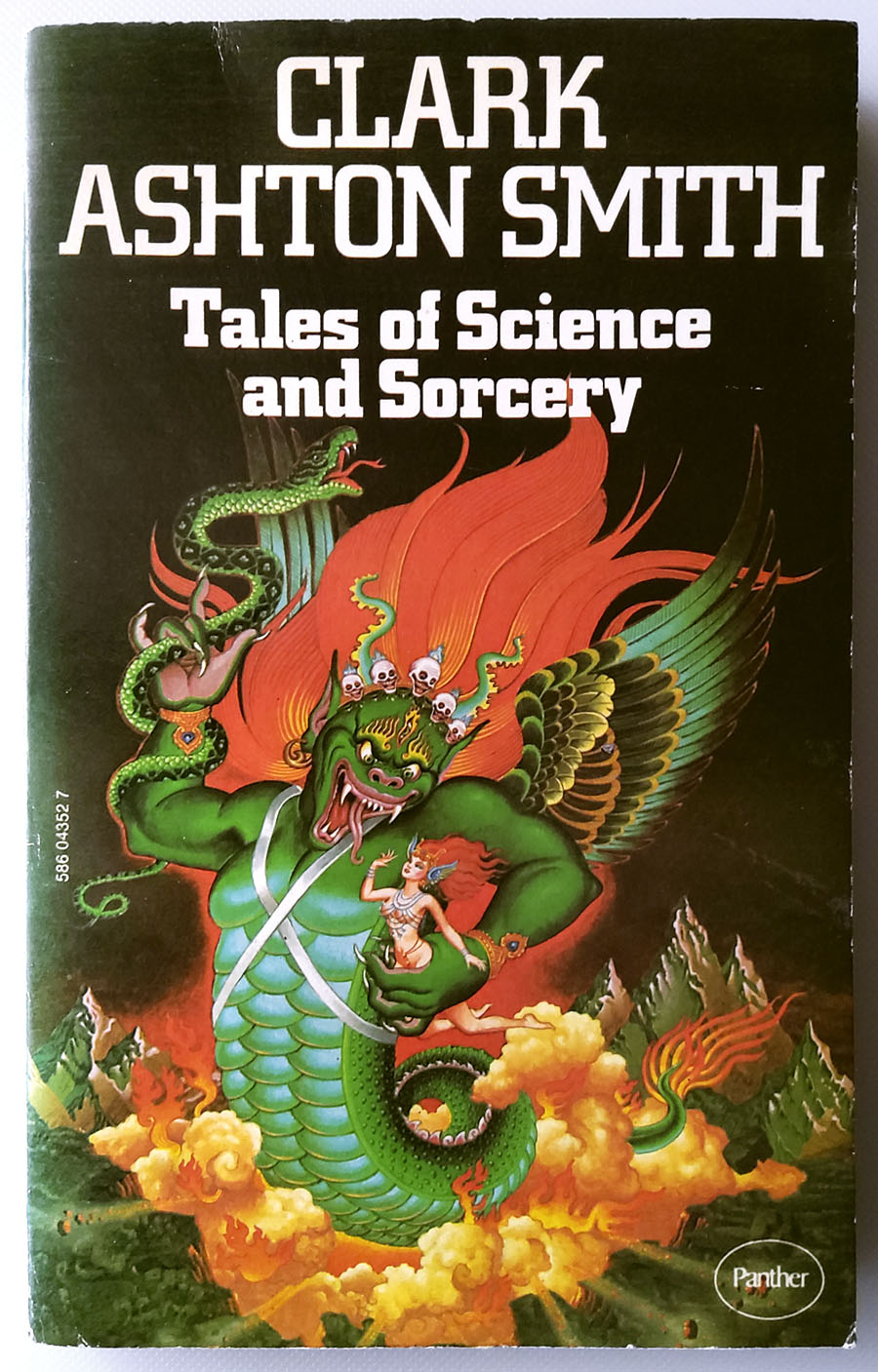
Cover art by Bob Haberfield, 1976.

• I’ve been reliably informed that Australian artist Bob Haberfield died recently but I can’t point to an online confirmation of this so you’ll have to take my word for it. “Science” and “sorcery” might describe the two poles of Haberfield’s career while he was working as a cover artist. His paintings made a big impression on British readers of fantasy and science fiction in the 1970s, especially if you were interested in Michael Moorcock’s books when they appeared en masse as Mayflower paperbacks covered in Haberfield’s art. Haberfield also appeared alongside Bruce Pennington providing covers for Panther paperbacks by HP Lovecraft, Clark Ashton Smith and others, although his work there isn’t always credited. Dangerous Minds collected some of his covers for a feature in 2017. (The US cover for The Iron Dream isn’t a Haberfield, however.)

• “Like Alice, who can only reach the house in Through the Looking-Glass by turning her back to it, Gorey reversed the usual advice to ‘write what you know’ and wrote the apparent opposite of his own situation.” Rosemary Hill reviewing Born to Be Posthumous: The Eccentric Life and Mysterious Genius of Edward Gorey by Mark Dery.

• “Orvil…wanders the countryside, visits churches, rummages in antique shops, and encounters strange men to whom he is no doubt equally strange.” John Self reviewing a new edition of In Youth Is Pleasure by Denton Welch.

• At the Wyrd Daze blog: Q&A sessions with Stephen Buckley (aka Polypores), Gareth Hanrahan, and Kemper Norton.

• “Fellini liked to say that ‘I fall asleep, and the fête begins’.” Matt Hanson on Federico Fellini’s phenomenal films.

• A Beautiful Space: Ned Raggett talks to Mick Harris about the thirty-year history of Scorn.

• Deep in the dial: Lawrence English on the enduring appeal of shortwave radio.

Clive Hicks-Jenkins on making a picture for Annie Darwin (1841–1851).

DJ Food looks at pages from Grunt Free Press circa 1970.

• Mix of the week: Fact Mix 814 by Loraine James.

• New music: Clash (feat. Logan) by The Bug.

• At BLDGBLOG: Terrestrial Astronomy.

LoneLady‘s favourite albums.

• At Dennis Cooper’s: Porn 2.

Tilings Encyclopedia

Betrayal (Sorcerer Theme) (1977) by Tangerine Dream | Science Fiction (1981) by Andy Burnham | Sorceress (2018) by Beautify Junkyards
Weekend links 556

wilson.jpg

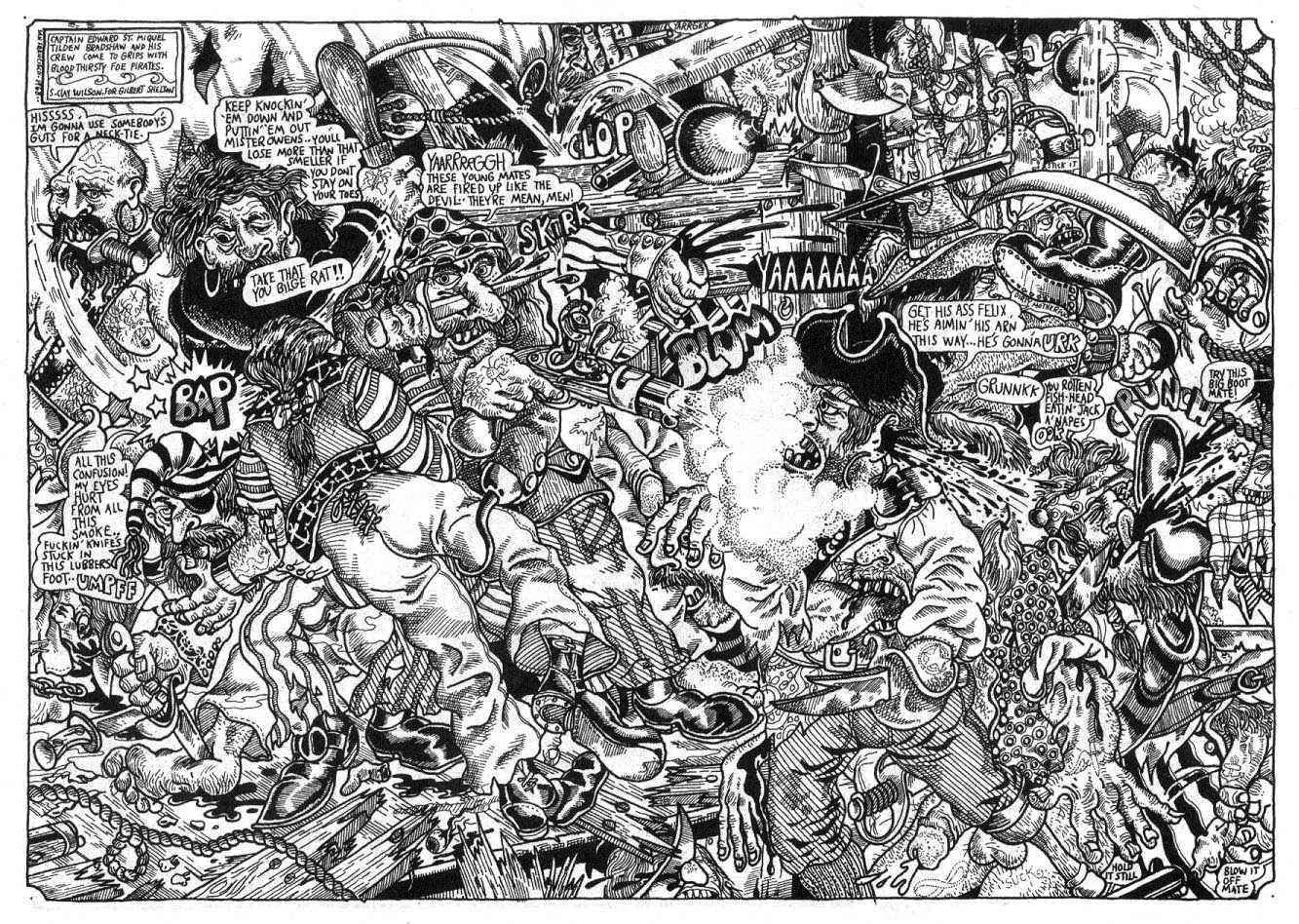
Captain Edward St. Miquel Tilden Bradshaw and his Crew Come to Grips with Bloodthirsty Foe Pirates by S. Clay Wilson, Zap Comix no. 3, 1968.

• RIP S. Clay Wilson, the wild man of American comics. The scene of mayhem above is typical in being barely coherent at a small size; click for a larger view. Patrick Rosenkranz at The Comics Journal describes Wilson as “the most influential artist of his generation…creating an extensive body of work that will defy authority and offend propriety until the end of days”. When Moebius was writing in the 1980s about the founding of Métal Hurlant he had this to say about the American undergrounds: “They were the first in the world to use comics as a means of communication, to express real emotions. Before, comics were used only to do stories, entertainment. They had some great moments but they were all very conventional. The American Underground showed us in Europe how to express true feelings, how to tell something to the reader through the comics. They blew the minds of the few professionals in Europe who saw them.” Also at TCJ, the S. Clay Wilson Interview. Wilson sent me a postcard once. I wish I knew what the hell I’d done with it.

• Michael Hoenig, synthesist for Agitation Free and (briefly) Tangerine Dream, plays one of the pieces from his debut album of electronic music, Departure From The Northern Wasteland, on a radio show in 1977. Hoenig’s album is long overdue a remastering and re-release.

• “My job, which the BBC has tasked me to do, is to provoke people and ask them, ‘Have you thought about looking at the world this way?'” Adam Curtis talks to Michael J. Brooks about his new TV series, Can’t Get You Out Of My Head.

m_chat.jpg

{ feuilleton } celebrates its 15th birthday today. Monsieur Chat, the mascot of this place, is happy about that but then Monsieur Chat is happy about most things.

• At Greydogtales: Opening The Book of Carnacki. A call for contributions to a collection of new stories about William Hope Hodgson’s occult detective. I’d be tempted if I didn’t already have more than enough to keep me occupied.

• “I’m being asked to talk about it a great deal at the moment, with the pandemic.” Roger Corman and Jane Asher on filming The Masque of the Red Death.

• New music: Cygnus Sutra by Mike Shannon, “a soundtrack to a fantasy/sci-fi epic not yet written”.

• A trailer for The Witch of King’s Cross, a documentary about occult artist Rosaleen Norton.

• At Dennis Cooper’s: Spotlight on…Hans Bellmer & Paul Eluard The Games of the Doll (1949).

• RIP also this week to Rowena Morrill, fantasy artist, and to Chick Corea.

• “Computers will never write good novels,” says Angus Fletcher.

• DJ Food on Zodiac posters by Funky Features, 1967.

• Mix of the week: Fact Mix 794 by Lutto Lento.

Annie Nightingale’s favourite music.

Zodiac (1984) by Boogie Boys | From The Zodiacal Light (2014) by Earth | Zodiac Black (2017) by Goldfrapp

Cosmic music and cosmic horror

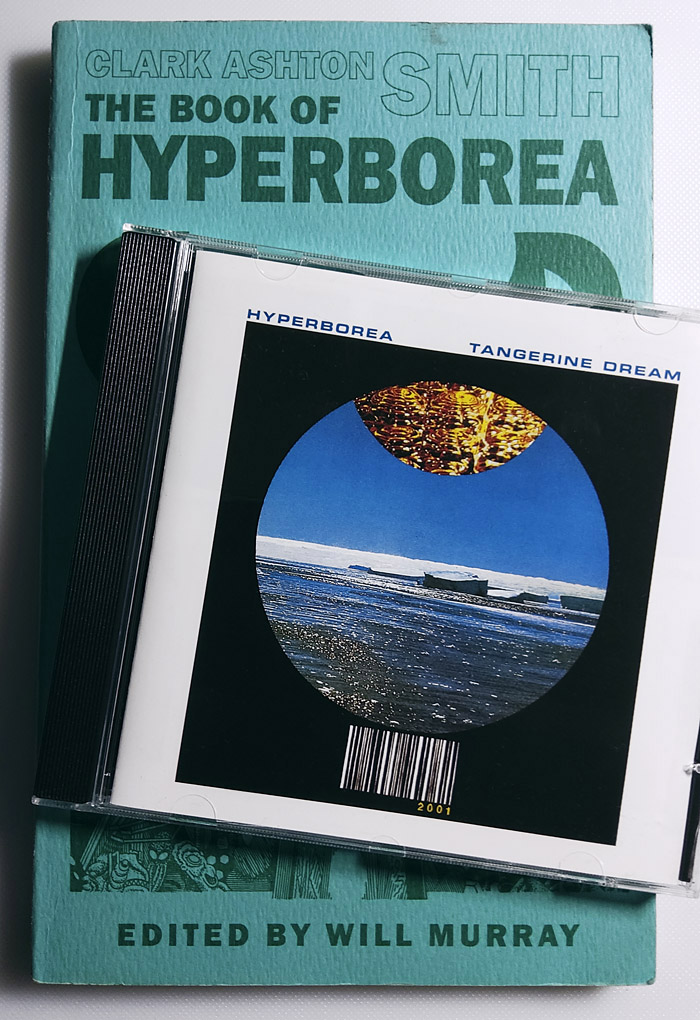
hyperborea.jpg

Track titles by Tangerine Dream (again) if they were stories or chapters in a book of weird fiction:

– Alpha Centauri
– Ultima Thule
– Origin Of Supernatural Probabilities
– Mysterious Semblance At The Strand Of Nightmares
– Sorcerer
– Abyss
– Stratosfear
– Choronzon
– Remote Viewing
– Hyperborea

Clark Ashton Smith’s tales of the northern continent of Hyperborea were Cthulhu Mythos fantasies with a sardonic CAS twist. The connection with Tangerine Dream is most likely coincidental, the name being one that Smith borrowed rather than invented, but I enjoy the intersection all the same. The title of TD’s first single, Ultima Thule, refers to another remote northern realm. If you’re reaching for associations, as I invariably am, then it’s also worth mentioning Haunted Island by an affiliated group, Agitation Free. The last track on their 2nd album features a partial recitation of Dream-Land by Edgar Allan Poe that includes the words “from some ultimate dim Thule”; the keyboard player in Agitation Free was Michael Hoenig who was briefly a member of Tangerine Dream in 1975. As for Choronzon, this was a demon that Aleister Crowley claimed to have tangled with in the Algerian desert in 1909. The malevolent and chaotic nature of the entity, together with its unavoidably Lovecraftian epithet of “the Dweller in the Abyss”, places it close to the Mythos god of “nuclear chaos”, Azathoth, although the music that bears the Dweller’s name doesn’t convey any of these qualities. Tangerine Dream’s Choronzon is an uptempo piece of electro-pop that Virgin optimistically released as a single in 1981. For a group with a long history of eccentric title choices this maybe isn’t so surprising.

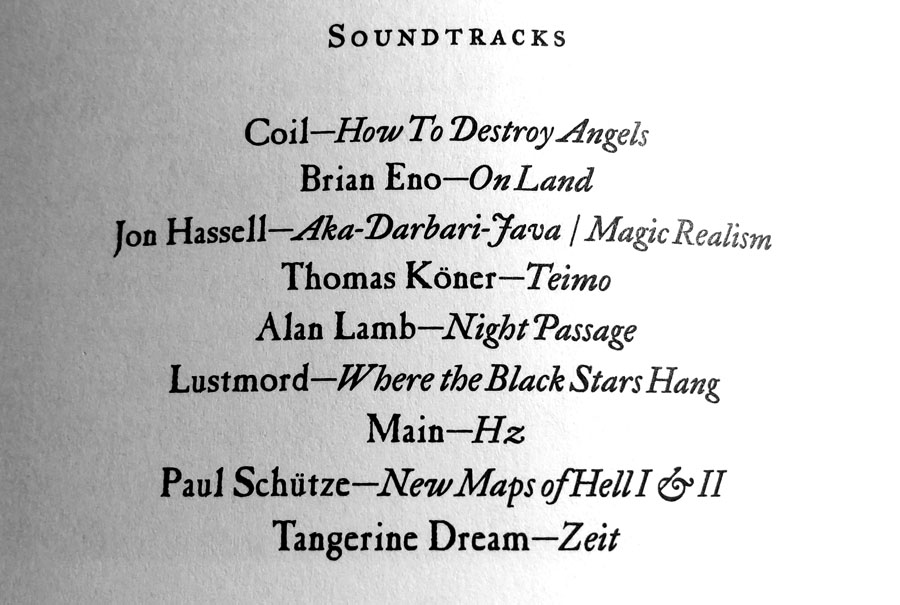
soundtracks.jpg

Tangerine Dream feature on another cosmic-horror music list that I suggested as soundtracks for The Haunter of the Dark in 1999. (The Lustmord somehow lost a couple of words from its title.) Most of these are drone works, and several were released after I’d drawn most of the pages, but I was listening to Zeit and Rubycon during many late-night work sessions, the latter especially while drawing The Call of Cthulhu. Discovering weird fiction and spacey electronica simultaneously caused the two things to become inextricably connected, and besides which there wasn’t much else to be found in the music world of the late 1970s that complemented such stories to the same degree. Rubycon offered satisfying associations, from the liquid green of the cover art (Cthulhu always suggests the colour green), to the predominantly sinister, minor-key music within. When the sequencers in Rubycon: Part 2 give way to the sounds of waves breaking on a shoreline this only reinforces the suitability of the album as a Cthulhoid soundtrack.

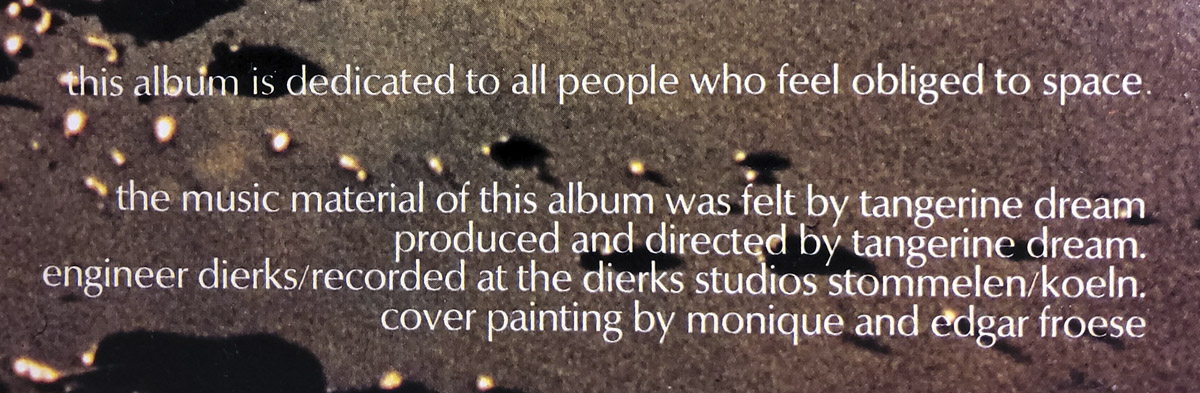
space.jpg

The dedication from Alpha Centauri as printed in the Virgin double-disc reissue with the Atem album. It’s never been clear whether the “space” referred to is a noun or a verb.

If you’re looking for cosmic-horror soundtracks today then you’re spoiled for choice, there are numerous examples, from the general—the occulted universe of Dark Ambience—to the very specific. I enjoy the drones, obviously, but the Berlin School still has something to offer so long as the key remains a minor one and the titles avoid New Age vapidity. See this mix for further examples.

Previously on { feuilleton }
Tangerine Dream in concert
Drone month
Pilots Of Purple Twilight
Synapse: The Electronic Music Magazine, 1976–1979
A mix for Halloween: Analogue Spectres
Edgar Froese, 1944–2015
Synthesizing
Tangerine Dream in Poland
Hodgsonian vibrations
White Noise: Electric Storms, Radiophonics and the Delian Mode

Tangerine Dream in concert

tdc1.jpg

I was going to call this post “Remote Viewing”, after the last track on Tangerine Dream’s Exit album, but the reference is too obscure. Having spent the past week listening to the Pilots Of Purple Twilight box I thought I’d see what concert video might be available from the period covered by the recordings, 1980–83. Thank to some recent YouTube uploads there’s more than I expected. A couple of things are notable about these TV performances: the first is that two of them feature the same annoyingly mismatched audio and video that spoiled Tony Palmer’s record of the group playing in Coventry Cathedral in 1975; the second is that all the footage is from Continental Europe. Tangerine Dream were very popular in the UK throughout the 1970s and 80s—they were on a British record label, after all, and toured here extensively every couple of years—but Palmer’s film is the only record of a British TD concert. These videos aren’t always the highest quality but they make up for the negligence of the BBC and ITV.

tdc2.jpg

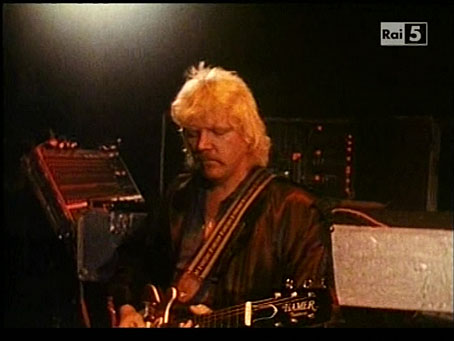
Palasport, Bologna, 20th October, 1980.

Mismatched audio and video in the opening scenes, followed by an interview with the group in Italian and German. The audio and video is in synch after this, and includes rare footage from this period of Edgar Froese playing guitar on Diamond Duster, an uptempo piece that evolved into Diamond Diary for the Thief soundtrack. I’m not always keen on Edgar’s meandering live solos but this is still good to see. Also of note for synth-heads is how much of the group’s equipment was still the analogue modular gear they were using in the 1970s.

tdc3.jpg

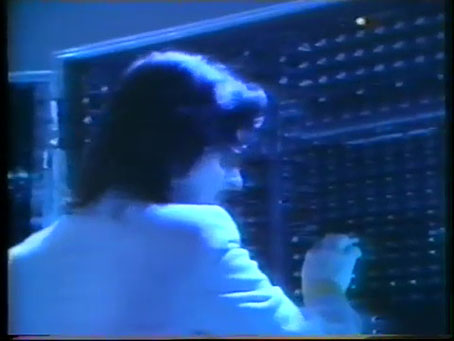
Platz der Republik, West Berlin, 29th August, 1981.

A big concert in the group’s home city. The opening shows them playing Kiew Mission, the first time they did so in concert with a live singer providing the vocals. The audio for this piece, however, is an overdub from the Exit album.

tdc4.jpg

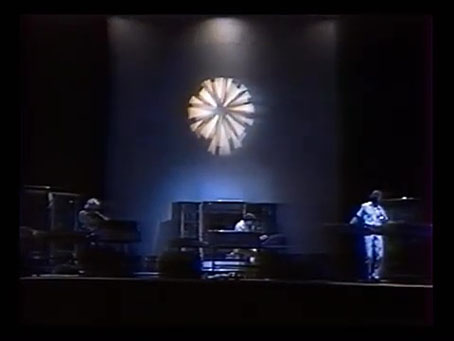
Lycabettus Theatre, Athens, 30th August, 1983.

A shame this isn’t better quality because it’s the best of the lot: 85 minutes of the group performing (with no overdubs) preceded by 10 minutes of an interview in English for Greek TV. The concert itself features a more elaborate light show than usual, while the first half of the show includes new compositions that later turned up on the live Poland album.

tdc5.jpg

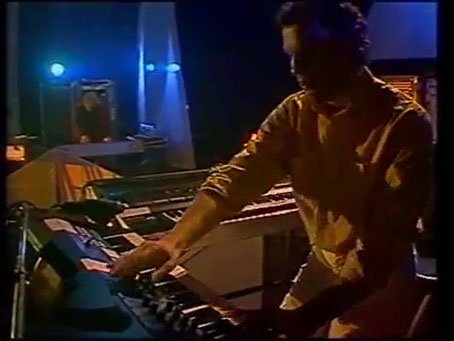
Warsaw Ice Stadium, 10th December, 1983.

And speaking of which (and linked here before), half an hour of the two-hour Warsaw concert. The earlier YouTube copy featured additional footage of a dancer in a studio but this version is sans dancer.

Previously on { feuilleton }
Pilots Of Purple Twilight
Synapse: The Electronic Music Magazine, 1976–1979
German gear
Edgar Froese, 1944–2015
Synthesizing
Tangerine Dream in Poland
Electronic Music Review
Tonto’s expanding frog men
A Clockwork Orange: The Complete Original Score
White Noise: Electric Storms, Radiophonics and the Delian Mode

Weekend links 542

gysbrechts.jpg

The Reverse of a Framed Painting (between 1668 and 1672) by Cornelis Norbertus Gysbrechts.

• New music with a cinematic flavour: Disciples Of The Scorpion (Main Theme) Heavy Mix by The Rowan Amber Mill is a taster for the group’s forthcoming imaginary soundtrack, Disciples Of The Scorpion (also a sequel of sorts to The Book Of The Lost); The Quietened Dream Palace is this year’s final themed compilation from A Year In The Country. The subject this time is abandoned cinemas, past and present.

San Francisco Moog: 1968–72 by Doug McKechnie, a collection of early synthesizer music using a modular instrument that was later bought by Tangerine Dream. “The quiescent, meditative pulse of the music has much more in common with what would come to be known as the Berlin school of German electronic music than anything coming out of the US at the time,” says Geeta Dayal.

• Sarah Davachi released a new album recently, Cantus, Descant, so The Quietus asked her to discuss her favourite albums. Related: XLR8R has a mix of the music that Davachi regards as influences. Kudos for the choice of Why Do I Still Sleep by Popol Vuh, an overlooked piece from the end of the group’s career.

When I use relevance as a filter for determining what books to read, I’m failing to make myself available for an authentic encounter with otherness, something genuine art always offers. I’m presuming that I can guess, from the barest plot summary, whether a book will be useful in my life. But how can I know what I will find relevant about a work before I have submitted myself to the experience? I don’t think we are likely to be transformed by art if we try to determine that encounter in advance. Part of the vulnerability necessary for transformation is the recognition that I am, to a great extent, a mystery to myself. How could I know what I need?

Garth Greenwell on the idea that a novel is only worthwhile if it is somehow “relevant”

• “For a long time I had been encouraged by the world of fine art to remove references to the spiritual from my work,” says Penny Slinger in a piece by Hettie Judah exploring the resurgence of interest in occult art. Good to see S. Elizabeth and her book on the subject receiving a mention.

• Arriving on Region B blu-ray later this month is Spring (2014) by Justin Benson & Aaron Moorhead, which 101 Films describes as Richard Linklater channeling HP Lovecraft. I enjoyed Benson & Moorhead’s Resolution (2012) and The Endless (2017) so this one is on pre-order.

• Topical books dept: The Man in the High Chair and Other Tyrannies by Kurt Fawver, a benefit publication for the California Coalition for Women Prisoners.

• We never know exactly where we’re going in outer space: Caleb Scharf on the difficulties of aiming for distant objects in an ever-changing universe.

• Submissions open soon for the contemporary Dada journal Maintenant 15, with a theme of “Humanity: The Reboot”. Details here.

• At Dennis Cooper’s: Harry Smith, Filmmaker Day.

Pandemonium – Spring (1985) by Peter Principle | Silent Spring (2006) by Massive Attack feat. Elizabeth Fraser | Spring Stars (2009) by Simon Scott