Two films by Clive Barker: The Forbidden and Salome

forbidden1.jpg

The Forbidden.

Clive Barker announced late last month that arrangements were being made for a remake of Hellraiser. This isn’t the first time such an announcement has been made so we’ll have to wait and see what comes of that. I think I’m in a minority of people who’ve always been well-disposed to Barker and his works (the early stories in particular) but have never really enjoyed Hellraiser. I saw it when it was first released, and was disappointed that Barker and co. hadn’t manage to successfully negotiate the pitfalls of making a British film for demanding American producers. The soundtrack that Barker commissioned from Coil was dropped (a serious error); the film’s awkward mid-Atlantic tone makes suspension of disbelief difficult, and considering Barker’s success as a storyteller the narrative is often confused and disjointed. Without all the memorable imagery it’s doubtful it would have had much of a lasting reputation, or birthed so many sequels.
forbidden2.jpg

The Forbidden.

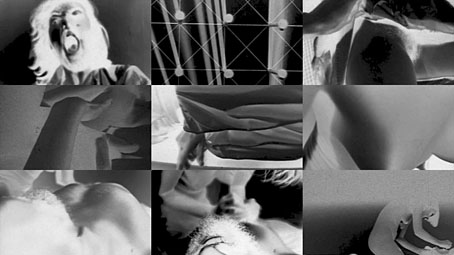
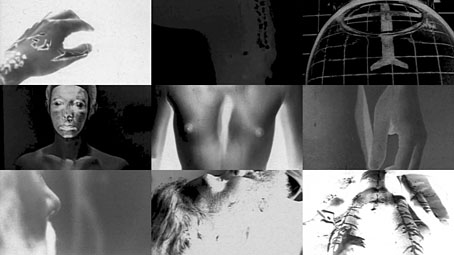
Barker and his theatre colleagues made The Forbidden in 1978, a 35-minute 16mm film of entirely negative images which shows how different Hellraiser might have been if fewer capitulations had been made to the marketplace, and to the clichés of horror cinema. Both films concern an occult ritual, an occult puzzle, and the subsequent consequences of the ritual. Where Hellraiser has to connect its most striking scenes with mundane business such as Julia’s murder spree and screaming teens, The Forbidden presents its imagery as raw data, leaving it to the viewer to piece together its fragments.

Barker’s work since Hellraiser has been almost completely generic so it’s surprising to see something of his that’s this open and abstract. In tone it’s closer to the films of Derek Jarman or Kenneth Anger than anything else, especially the sequence of Barker himself dancing with an erection, something which will ensure this doesn’t get many TV screenings. (Barker has referred to Kenneth Anger when discussing the film.) The final section, featuring a man being lovingly flayed by a number of scalpel-wielding hands, offers the same spectacle as Hellraiser‘s skinless Frank but without any of the accompanying frenzy. This won’t necessarily be on YouTube for very long so watch it while you can. The uploaded version is from the Redemption DVD, music included. Since the film is silent you can watch it with a score of your choice; I’d suggest Coil’s themes for Hellraiser.
salome.jpg

Salome.

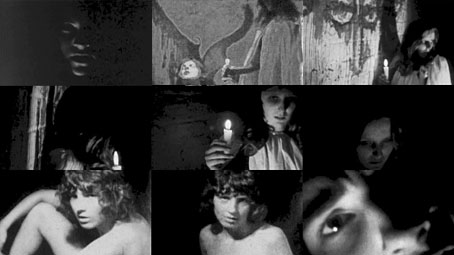
Where The Forbidden is a successful piece of avant-garde cinema, Barker’s 17-minute dramatisation of Salome (1973) is closer to a well-made home movie. This is silent as well, and even has the quality and feel of a very old silent film. For an amateur work it still manages to convey a greater sense of dread than some of the other Salomé-related films which have been featured here, and I believe that’s the director himself playing the femme fatale.

Elsewhere on { feuilleton }
The Salomé archive

Previously on { feuilleton }
Clive Barker, Imaginer

The poster art of Akiko Stehrenberger

stehrenberger1.jpg

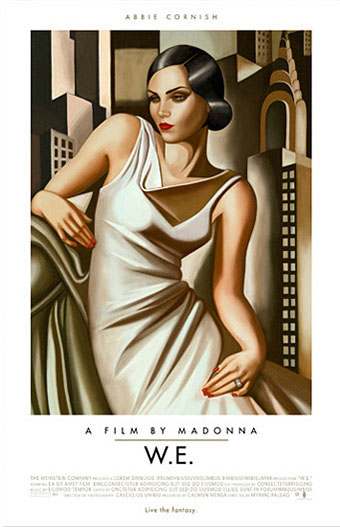
W.E. (2011).

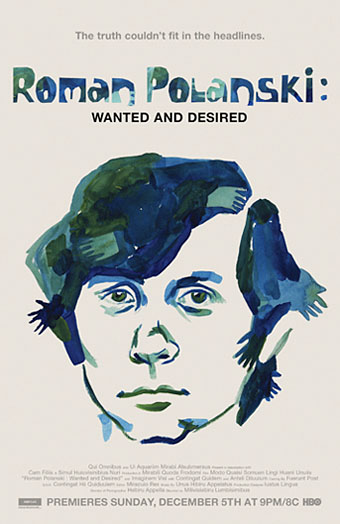
Being someone who enjoys adopting and pastiching different art and design styles for different projects I naturally like to see other people doing the same. American illustrator and designer Akiko Stehrenberger is very adept at using this approach for her film posters. Without knowing the identity of the person responsible you wouldn’t guess that they were all the work of the same person.

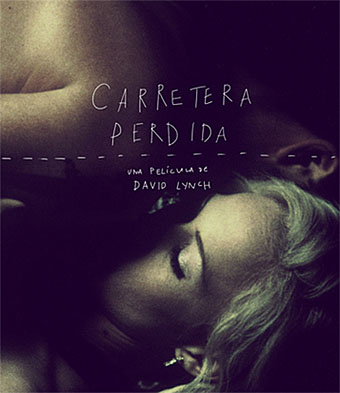
The Madonna and Polanski posters are the two most overt pastiches, being based respectively on the paintings of Tamara de Lempicka, and the posters by Jan Lenica for Polanski’s Repulsion and Cul-de-Sac. Good as the poster for W.E. is, it seems the studio preferred a more cliched “romantic” treatment for their international sales. Stehrenberger’s Mac desktop design for Burn After Reading was dropped in favour of yet another Saul Bass pastiche. (As a sidenote I’d suggest a moratorium on imitating Saul Bass for the time being; it’s getting boring.) The Lost Highway design isn’t a poster but I added it here since it’s a surprising take on David Lynch’s noir piece. I like the way the dotted line can be taken either as road markings or a line signifying the division in the film between the separate storylines and the separated characters.

Akiko Stehrenberger talked to Adrian Curry earlier this year about her favourite film posters.

stehrenberger2.jpg

Burn After Reading (2008).

stehrenberger3.jpg

Roman Polanski: Wanted and Desired (2008).

stehrenberger4.jpg

Lost Highway (Spanish Blu-ray cover).

Previously on { feuilleton }
La Belle et la Bête posters
Dr Mabuse posters
The poster art of Frank McCarthy
Repulsion posters
The poster art of Vic Fair
Petulia film posters
Lucifer Rising posters
Wild Salomés
Druillet’s vampires
Bob Peak revisited
Alice in Acidland
Salomé posters
Polish posters: Freedom on the Fence
Kaleidoscope: the switched-on thriller
The Robing of The Birds
Franciszek Starowieyski, 1930–2009
Dallamano’s Dorian Gray
Czech film posters
The poster art of Richard Amsel
Bollywood posters
Lussuria, Invidia, Superbia
The poster art of Bob Peak
A premonition of Premonition
Metropolis posters
Film noir posters

Beardsley reviewed

studio1.jpg

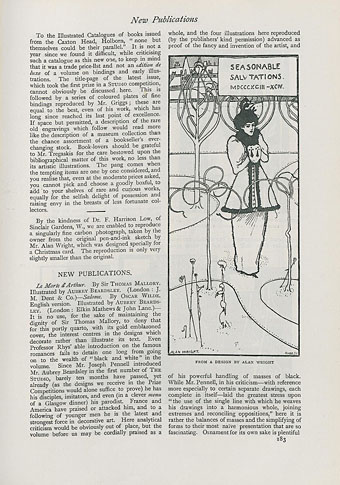
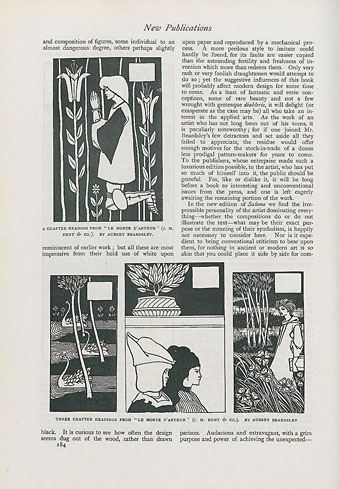
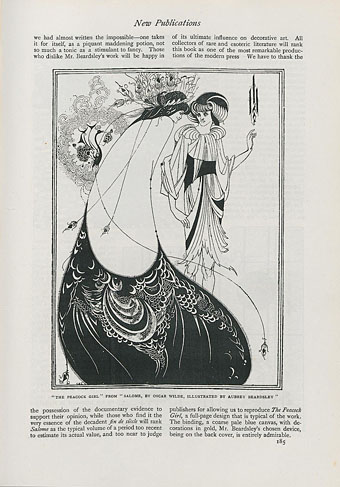
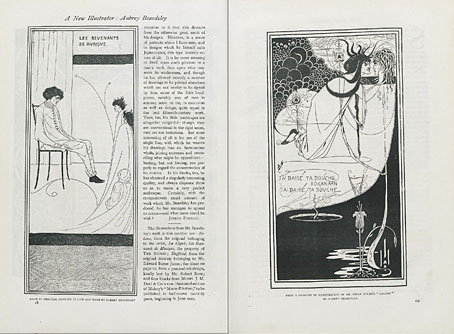
More Aubrey Beardsley ephemera. These pages are from the bound edition of The Studio for 1894, reviews of two of Beardsley’s earliest publications: the first editions of Le Morte d’Arthur (which was published in multiple volumes), and the illustrated edition of Oscar Wilde’s Salomé which sealed Beardsley’s reputation as a major force in the art of the 1890s. The reviews lavish praise on both works, unsurprisingly since Beardsley had received the magazine’s support from the very first issue. It’s interesting to note even at this early stage mention of the rumblings of discontent which would grow increasingly loud in the following years. Also that The Peacock Skirt is here given the name The Peacock Girl.

studio2.jpg

NEW PUBLICATIONS. Le Morte d’Arthur. By Sir Thomas Mallory. Illustrated by Aubrey Beardsley. (London: J. M. Dent & Co.)—Salome. By Oscar Wilde. English version. Illustrated by Aubrey Beardsley. (London: Elkin Mathews & John Lane.)—It is no use, for the sake of maintaining the dignity of Sir Thomas Mallory, to deny that for this portly quarto, with its gold emblazoned cover, the interest centres in the designs which decorate rather than illustrate its text. Even Professor Rhys’ able introduction on the famous romances fails to detain one long from going on to the wealth of “black and white” in the volume. Since Mr. Joseph Pennell introduced Mr. Aubrey Beardsley in the first number of The Studio, barely ten months have passed, yet already (as the designs we receive in the Prize would alone suffice to prove) he has his disciples, imitators, and even (in a clever menu of a Glasgow dinner) his parodist. France and America have praised or attacked him, and to a following of younger men he is the latest and strongest force in decorative art. Here analytical criticism would be obviously out of place, but the volume before us may be cordially praised as a whole, and the four illustrations here reproduced (by the publishers’ kind permission) advanced as proof of the fancy and invention of the artist, and of his powerful handling of masses of black.

While Mr. Pennell, in his criticism—with reference more especially to certain separate drawings each complete in itself—laid the greatest stress upon “the use of the single line with which he weaves his drawings into a harmonious whole, joining extremes and reconciling oppositions,” here it is rather the balances of masses and the simplifying of forms to their most naive presentation that are so fascinating. Ornament for its own sake is plentiful and composition of figures, some individual to an almost dangerous degree, others perhaps slightly reminiscent of earlier work; but all these are most impressive from their bold use of white upon black. It is curious to see how often the design seems dug out of the wood, rather than drawn upon paper and reproduced by a mechanical process. A more perilous style to imitate could hardly be found, for its faults are easier copied than the astounding fertility and freshness of invention which more than redeem them. Only very rash or very foolish draughtsmen would attempt to do so; yet the suggestive influences of this book will probably affect modern design for some time to come.

As a feast of fantastic and eerie conceptions, some of rare beauty and not a few wrought with grotesque diablerie, it will delight (or exasperate as the case may be) all who take an interest in the applied arts. As the work of an artist who has not long been out of his teens, it is peculiarly noteworthy; for if one joined Mr. Beardsley’s few detractors and set aside all they failed to appreciate, the residue would offer enough motives for the stock-in-trade of a dozen less prodigal pattern-makers for years to come. To the publishers, whose enterprise made such a luxurious edition possible, to the artist, who has put so much of himself into it, the public should be grateful. For, like or dislike it, it will be long before a book so interesting and unconventional issues from the press, and one is left eagerly awaiting the remaining portion of the work.

studio3.jpg

In the new edition of Salome we find the irrepressible personality of the artist dominating everything—whether the compositions do or do not illustrate the text—what may be their exact purpose or the meaning of their symbolism, is happily not necessary to consider here. Nor is it expedient to bring conventional criticism to bear upon them for nothing in ancient or modern art is so akin that you could place it side by side for comparison. Audacious and extravagant, with a grim purpose and power of achieving the unexpected—we had almost written the impossible—one takes it for itself, as a piquant maddening potion, not so much a tonic as a stimulant to fancy. Those who dislike Mr. Beardsley’s work will be happy in the possession of the documentary evidence to support their opinion, while those who find it the very essence of the decadent fin de siècle will rank Salome as the typical volume of a period too recent to estimate its actual value, and too near to judge of its ultimate influence on decorative art. All collectors of rare and esoteric literature will rank this book as one of the most remarkable productions of the modern press. We have to thank the publishers for allowing us to reproduce The Peacock Girl, a full-page design that is typical of the work, The binding, a coarse pale blue canvas, with decorations in gold, Mr. Beardsley’s chosen device, being on the back cover, is entirely admirable.

Elsewhere on { feuilleton }
The Aubrey Beardsley archive

More Salomés

salome1.jpg

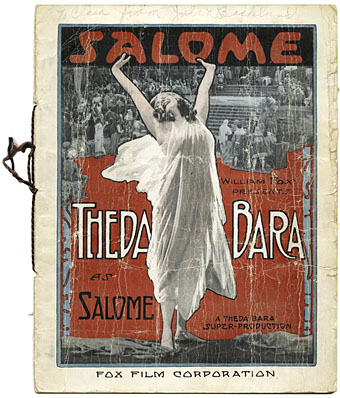
Salome (1918) souvenir book.

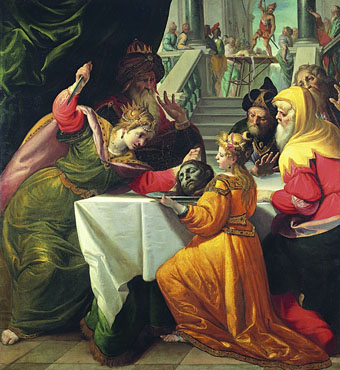
A few of the Salomés recently added to the Google Art Project. The painting by Andrea Ansaldo shows a head that looks distinctly unwell, something that’s not so common in the world of glow-in-the-dark saints. Ansaldo’s Salomé, meanwhile, is so young and diminutive that she hardly seems capable of holding the platter. One way in which this particular theme has survived for so long is that the narrative thread is the sole thing that connects the many variations, all other details are open to interpretation.

Below there’s a more recent painting by Izabella Gustowska that makes the inevitable connection between Salomé and her Biblical sister, Judith.

salome2.jpg

Herodias Presented with the Head of the Baptist by Salomé (c. 1630) by Andrea Ansaldo.

salome3.jpg

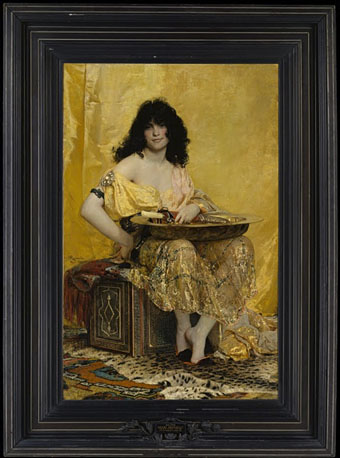
Salomé (1870) by Henri Regnault.

Continue reading “More Salomés”

Aubrey Beardsley in The Studio

ab1.jpg

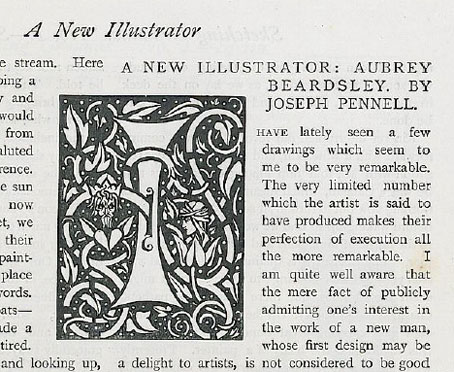
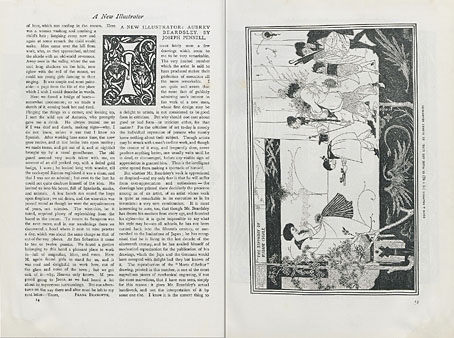
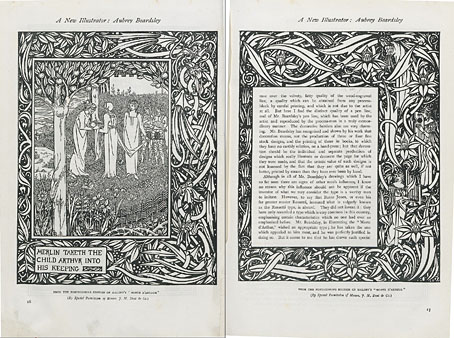
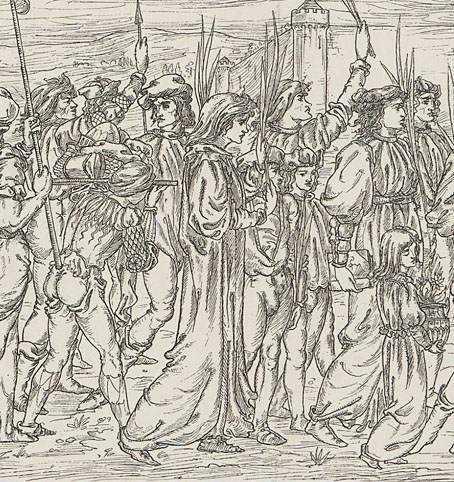
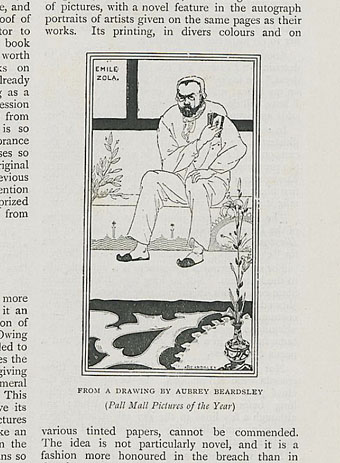
Aubrey Beardsley in the year 1893 was 21, and on the threshold of being catapulted to fame (and notoriety) via his illustrations for Oscar Wilde’s Salomé. Some of Beardsley’s drawings in the distinctive style he called “Japanesque” had already appeared in The Pall Mall Magazine, and he was hard at work on some 600 illustrations and embellishments for Dent’s Le Morte D’Arthur which began publication in 1894. Some of those illustrations are featured in the glowing introduction by Joseph Pennell which appeared in the first issue of The Studio magazine in April 1893 (when Beardsley was still only 20), a title that became the leading showcase for the British end of the Art Nouveau movement in the 1890s. Pennell’s appreciation also included Beardsley’s Joan of Arc’s Entry into Orleans, a piece which showed how much the artist’s early work owed to Mantegna, and the first drawing of Salomé which later helped secure the Wilde commission. The Joan of Arc picture was reproduced as a fold-out supplement in the magazine’s second issue.

ab2.jpg

All the major Beardsley books refer to Pennell’s article but I’ve never had the opportunity to see it in full until now, thanks to the excellent online archives at the University of Heidelberg. There are many volumes of the international editions of The Studio at the Internet Archive but for some reason these don’t include the early numbers; at Heidelberg we can now browse the missing issues. In the first volume in addition to Beardsley there’s a piece about Frederic Leighton’s clay studies for paintings and sculptures, illustrations by Walter Crane and Robert Anning Bell, and an article on whether nude photography can be considered art. In this last piece several of the examples happen to be provided by Frederick Rolfe aka Baron Corvo, and Wilhelm von Gloeden, two men who we now know had other things on their mind when they were photographing Italian youths.

The collected volumes of The Studio from 1893 to 1898 may be browsed or downloaded here. I’ve not had time to go through the rest of these so I’m looking forward to discovering what else they may contain.

ab3.jpg

ab4.jpg

ab5.jpg

Detail from Joan of Arc’s Entry into Orleans.

ab6.jpg

Elsewhere on { feuilleton }
The Aubrey Beardsley archive