Aubrey Beardsley in The Studio

ab1.jpg

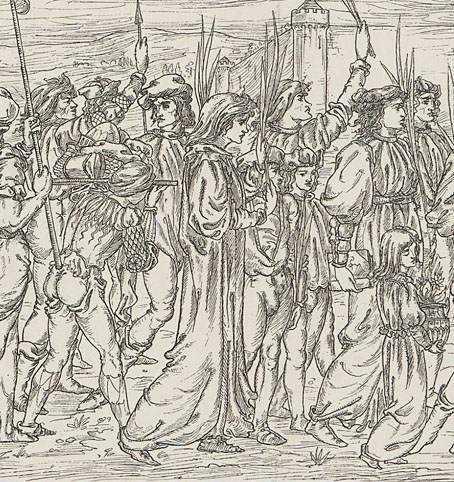
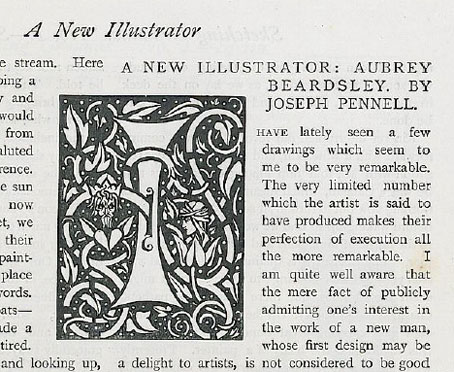
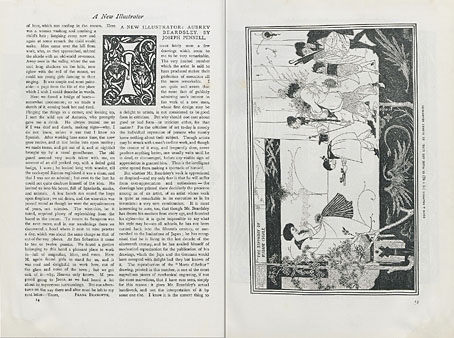
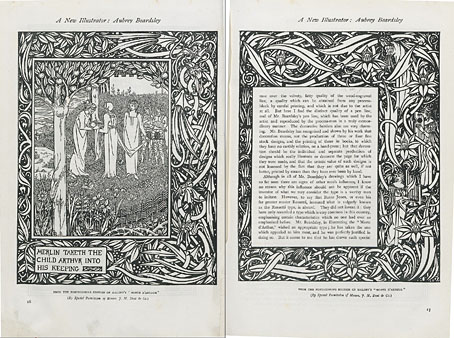
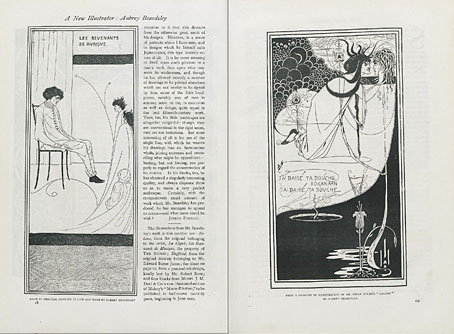
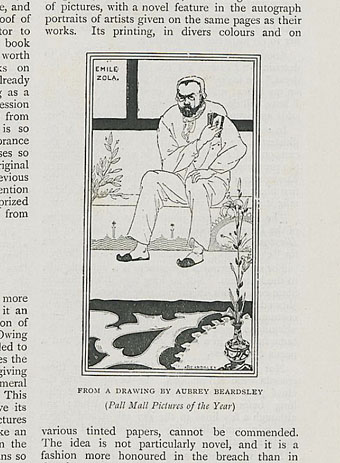
Aubrey Beardsley in the year 1893 was 21, and on the threshold of being catapulted to fame (and notoriety) via his illustrations for Oscar Wilde’s Salomé. Some of Beardsley’s drawings in the distinctive style he called “Japanesque” had already appeared in The Pall Mall Magazine, and he was hard at work on some 600 illustrations and embellishments for Dent’s Le Morte D’Arthur which began publication in 1894. Some of those illustrations are featured in the glowing introduction by Joseph Pennell which appeared in the first issue of The Studio magazine in April 1893 (when Beardsley was still only 20), a title that became the leading showcase for the British end of the Art Nouveau movement in the 1890s. Pennell’s appreciation also included Beardsley’s Joan of Arc’s Entry into Orleans, a piece which showed how much the artist’s early work owed to Mantegna, and the first drawing of Salomé which later helped secure the Wilde commission. The Joan of Arc picture was reproduced as a fold-out supplement in the magazine’s second issue.
ab2.jpg

All the major Beardsley books refer to Pennell’s article but I’ve never had the opportunity to see it in full until now, thanks to the excellent online archives at the University of Heidelberg. There are many volumes of the international editions of The Studio at the Internet Archive but for some reason these don’t include the early numbers; at Heidelberg we can now browse the missing issues. In the first volume in addition to Beardsley there’s a piece about Frederic Leighton’s clay studies for paintings and sculptures, illustrations by Walter Crane and Robert Anning Bell, and an article on whether nude photography can be considered art. In this last piece several of the examples happen to be provided by Frederick Rolfe aka Baron Corvo, and Wilhelm von Gloeden, two men who we now know had other things on their mind when they were photographing Italian youths.

The collected volumes of The Studio from 1893 to 1898 may be browsed or downloaded here. I’ve not had time to go through the rest of these so I’m looking forward to discovering what else they may contain.
ab3.jpg

ab4.jpg

ab5.jpg

Detail from Joan of Arc’s Entry into Orleans.
ab6.jpg

Elsewhere on { feuilleton }
The Aubrey Beardsley archive
Wildeana 10

wilde.jpg

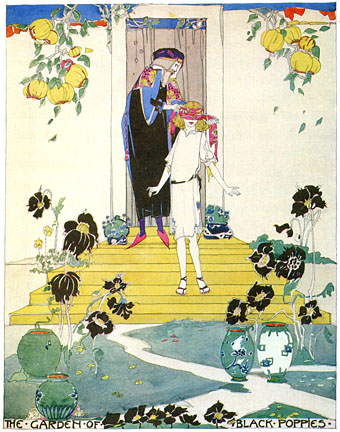
Illustration from The House of Pomegranates (1914) by Jessie M. King.

Continuing an occasional series. Recent Wildean links.

• It’s a measure of a writer’s success if the characters or stories they create resonate sufficiently with future generations to be subject to new interpretations. Among Oscar Wilde’s contemporaries this has happened to Arthur Conan Doyle and Bram Stoker, both of whom Wilde knew. Increasingly it’s been happening to Wilde’s own fiction, especially in the case of Dorian Gray whose tragedy assumes the status of a modern myth. At Cannes this year, Clio Barnard premiered a contemporary retelling of Wilde’s The Selfish Giant. Bleeding Cool has some clips. The social realism is a long way from Wilde’s tale but that shows how flexible these fables can be.

• Jessie M. King’s illustrations for Wilde’s The House of Pomegranates have appeared here before but the copies posted at The Golden Age are the usual quality scans.

Rick Gekoski: “Visiting the US, I am reminded of Oscar Wilde’s tour there in 1881, which allowed him to become an orator and a celebrity.”

Paper Dolls by David Claudon based on the characters from The Importance of Being Earnest. (Thanks to Gabe for the tip.)

Elsewhere on { feuilleton }
The Oscar Wilde archive

Weekend links 174

ikuma.jpg

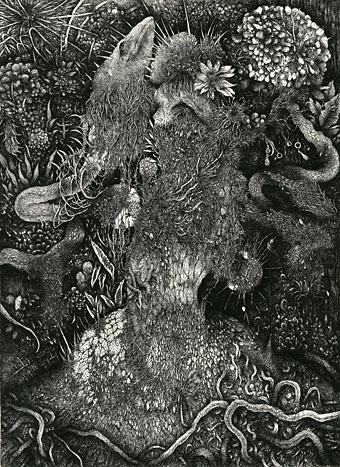
Dress (2012) by Nao Ikuma.

• Two of my Cthulhu artworks can currently be seen in the Ars Necronomica exhibition at the Cohen Gallery, Brown University, Providence, RI. The exhibition is part of NecronomiCon, and runs to September 13th. In related news, my steampunk illustration has been nominated in the Visual category of this year’s Airship Awards. Winners will be announced at Steamcon V in October.

• “…the story of how a small cabal of British jazz obsessives conducting a besotted affair with the style arcana of Europe and America somehow became an army of scooter-borne rock fans…” Ian Penman looks back at the culture of Mod for the LRB.

• “What is it about the writer in the First World that wants the Third World writer to be nakedly political, a blunt instrument bludgeoning his world’s ills?” Gina Apostol on Borges, Politics, and the Postcolonial.

If someone had designed a work regime perfectly suited to maintaining the power of finance capital, it’s hard to see how they could have done a better job. Real, productive workers are relentlessly squeezed and exploited. The remainder are divided between a terrorised stratum of the, universally reviled, unemployed and a larger stratum who are basically paid to do nothing, in positions designed to make them identify with the perspectives and sensibilities of the ruling class (managers, administrators, etc) – and particularly its financial avatars – but, at the same time, foster a simmering resentment against anyone whose work has clear and undeniable social value. Clearly, the system was never consciously designed. It emerged from almost a century of trial and error. But it is the only explanation for why, despite our technological capacities, we are not all working 3–4 hour days.

On the Phenomenon of Bullshit Jobs by David Graeber

Ron Rosenbaum talks to Al Pacino about all the usual stuff, and reveals some detail about the actor’s obsessive interest in Oscar Wilde’s Salomé.

• More queer history: The Brixton Fairies and the South London Gay Community Centre, Brixton 1974–6.

• At Dangerous Minds: Anthony Burgess and the Top Secret Code in A Clockwork Orange

• Every day for 100 days, Jessica Svendsen redesigned a Josef Müller-Brockmann poster.

LondonTypographica: Mapping the typographic landscape of London.

• Mix of the week: Secret Thirteen Mix 083 by Demdike Stare.

• At Strange Flowers: Alfred Kubin the writer.

Derek Jarman’s sketchbooks.

Rick Poynor on Collage Now.

• Thomas Leer: Private Plane (1978) | Tight As A Drum (1981) | Heartbeat (1985)

Ads for The Yellow Book

yb1.jpg

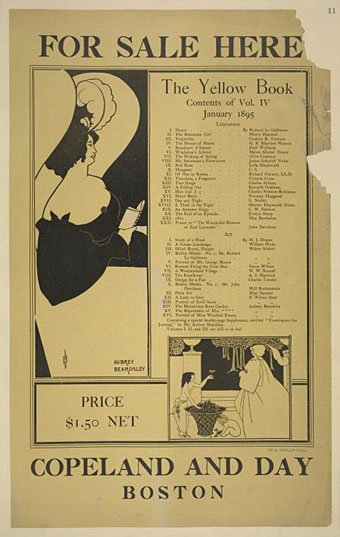
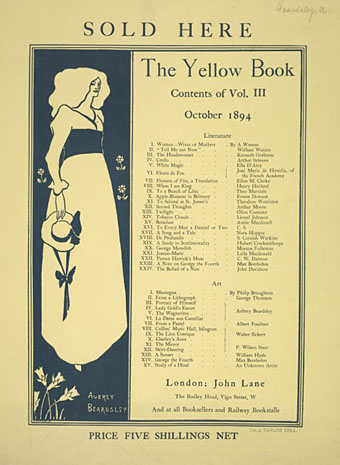
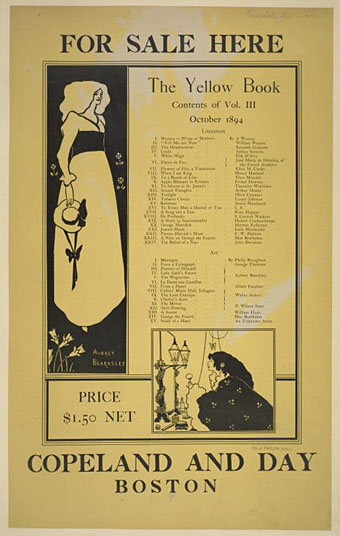
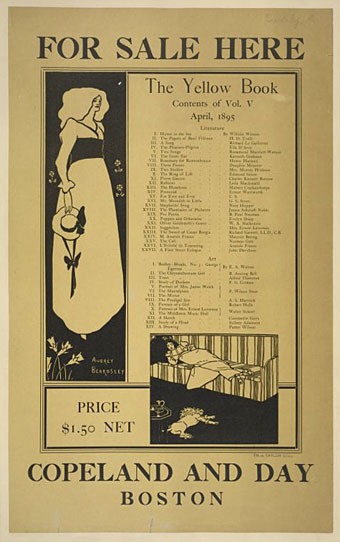
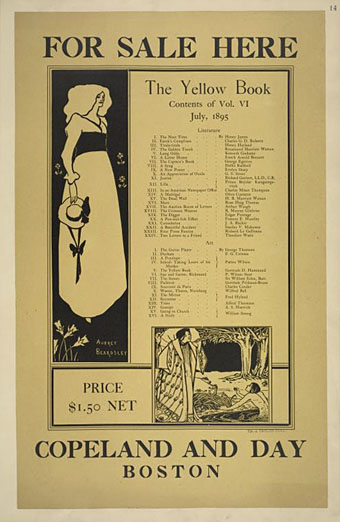
More Beardsley ephemera, and more from the recently upgraded NYPL Digital Collections. These US ads for The Yellow Book date from late 1894 to early 1895, a couple of months before Oscar Wilde was arrested and Aubrey Beardsley had to leave the magazine despite having no connection with Wilde’s activities.

What’s most interesting for me about these ads is the small vignettes, two of which I’m sure I haven’t seen before. This suggests that there’s still material in the pages of The Yellow Book which has been overlooked despite the many books which collect Beardsley’s art. The Internet Archive has several volumes of the magazine but I’ve been daunted in the past by its thousands of pages of not-so-interesting Victorian prose. (The Savoy was the superior publication where quality of writing was concerned.) Maybe it’s time to take a deep breath and dive in.

yb2.jpg

yb3.jpg

yb4.jpg

yb5.jpg

Elsewhere on { feuilleton }
The Aubrey Beardsley archive
Atget’s corners

seine1.jpg

Un coin, rue de Seine (1924).

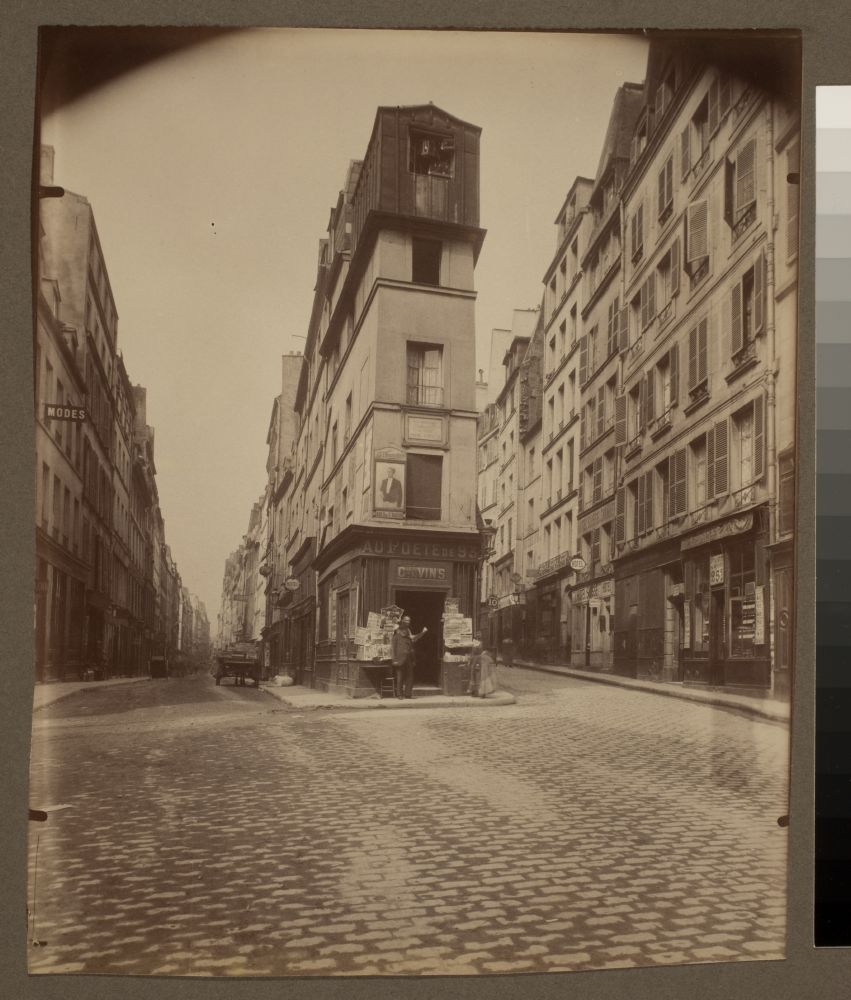
Photographer Eugène Atget had a thing for the architectural promontory, as do I for that matter, and this photo of a street corner in the rue de Seine, Paris, has always been a favourite. Atget liked the location enough to photograph it at least twice from different angles. The long exposures bleach the sky and turn passing figures into ghostly blurs.

seine2.jpg

Coin rue de Seine (1924).

seine3.jpg

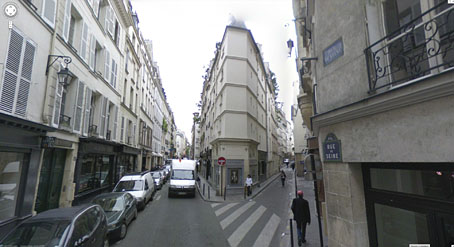
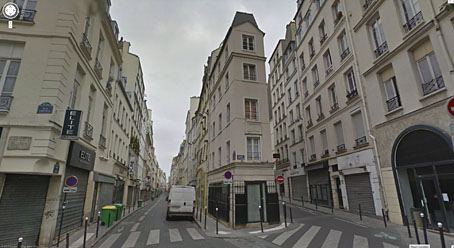
Opening up Google Maps to see how the street looks today left me astonished when I realised I’d walked past this very corner without realising it was the location of Atget’s photos. The rue de Seine is one of two streets giving access to the rue des Beaux-Arts, the location of L’Hôtel where Oscar Wilde died. Matters weren’t helped by my walking in the opposite direction to this view so I didn’t notice the narrow corner. In any case the street looks very different today from Atget’s gloomy intersection.

clery1.jpg

Maison d’Andre Chenier en 1793–97, rue de Cléry (1907).

Equally as clean and unremarkable is another narrow building in the rue de Cléry which in 1907 was sporting some kind of wooden structure on its upper floor. Google’s cameras tend to diminish whatever space they photograph but the streets seem smaller today when cluttered with bollards, cars, bikes and the ubiquitous green bins of Paris.

clery2.jpg

Previously on { feuilleton }
Rue St. Augustin, then and now
Brion Gysin’s walk, 1966
L’Hôtel, Paris