In A Silent Way

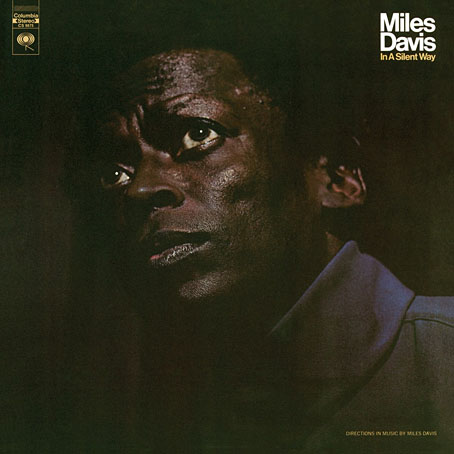
In A Silent Way (1969) by Miles Davis
miles.jpg

In A Silent Way (YT)

In a Silent Way was assembled from various takes from a three-hour session on February 18, 1969, at CBS 30th Street Studio’s Studio B in Manhattan. “Shhh / Peaceful” was composed solely by Davis, while the opening and closing section to “In a Silent Way / It’s About That Time” is based on [Joe] Zawinul’s “In a Silent Way”, which he would record in its original form in 1970 for his third solo album, Zawinul (1971). After Zawinul presented the tune to the group, it was rehearsed as it was originally written, but Davis wished for it to sound more rock-oriented and stripped the various chord changes to leave a more basic melody built around a pedal point. [John] McLaughlin had some difficulty playing in the manner Davis wished of him, but found his way after the trumpeter suggested he play the guitar as if he were a novice. Davis believed that Zawinul was never happy with his adaptation of “In a Silent Way”, but felt that the album would have been less successful had its original arrangement been kept. Zawinul had expressed some dislike of Davis’ arrangement, in particular of two chords that he believed that Davis was wrong to remove. Zawinul claimed that he was responsible for the melodic bass line and descending melody of “It’s About That Time” but was not credited; he blamed [Teo] Macero for this, as he “always put things together so that it came out as if Miles had written it.” (more)


Zawinul (1971) by Joe Zawinul

In A Silent Way (YT)


Celebration (1972) by El Chicano

In A Silent Way (YT)


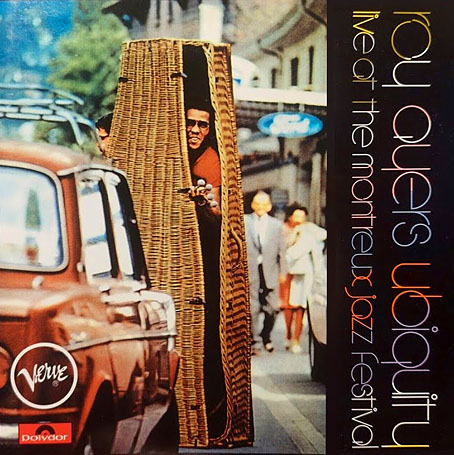
Live At The Montreux Jazz Festival (1972) by Roy Ayers Ubiquity
ayers.jpg

In A Silent Way (Should really be titled It’s About That Time since Ayers is playing the second part of the Davis piece) (YT)


Filmore – The Last Days (1972) by Various Artists

In A Silent Way by Santana (YT)


Double Exposure (1975) by Nat Adderley

In A Silent Way (YT)


Concerto Retitled (1976) by Joe Zawinul

In A Silent Way (YT)


Babel (1978) by Max

D’Una Manera Silenciosa (YT)


Continue reading “In A Silent Way”

Weekend links 729

demorgan.jpg

Phosphorus and Hesperus (1881) by Evelyn De Morgan.

• Mix of the week, or possibly the entire year: The Deep Ark, 167 tracks (over 8 hours of music), most of which are from the electronic deluge of the early 1990s. The download link may not work for all browsers—it didn’t for one of mine—but it is active. Via Simon Reynolds who has more about the Deep Ark project.

• At Nautilus: Betsy Mason on the use of stage magic to investigate animal behaviour. “By performing tricks for birds, monkeys, and other creatures, researchers hope to learn how they perceive and think about their world.”

• At The Daily Heller: Mad and the Usual Gang of Idiots. Meanwhile, Mr Heller’s font of the month may prove useful for this election season, a Jonathan Barnbrook design named Moron.

Looking back, you can see a pattern in those eras in which interest in telepathy boomed. Coined by Myers and his fellow psychical researchers in the 1880s, telepathy gained traction because it was formulated inside a moment of scientific and technological revolution, where uncanny transmissions proliferated across the visible and invisible spectrum, seeming to collapse the natural and the supernatural together. In the 1970s, telepathy returned, if under different names, as part of another moment of crisis. The Cold War arms race was an essential part of this, feeding a strange supplemental world of fantasy technologies, from mind control to brainwashing, and playing on an all-too-widespread psychological paranoia around being seen, infiltrated and manipulated by invisible agents.

Roger Luckhurst looks back at a century of psychic research

• New music: Portable Reality Generator by Field Lines Cartographer, and Sublime Eternal Love by Chrystabell and David Lynch.

• Coffee and Chocolates for Two Guitars: Robert Fripp interviewing John McLaughlin in July, 1982.

• Paintings by Ithell Colquhoun currently showing at the Ben Hunter gallery, London.

• At Public Domain Review: Eye Miniatures (ca. 1790–1810).

ESP (1965) by Miles Davis | ESP (1990) by Deee-lite | ESP (2002) by Comets On Fire

Weekend links 727

maar.jpg

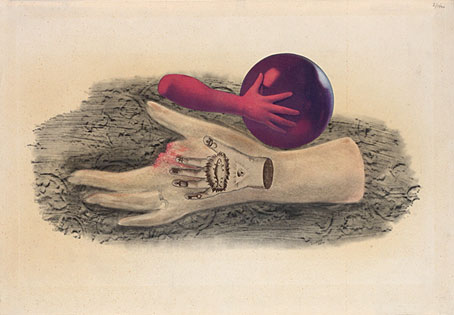
Untitled (Hand-Shell) (1934) by Dora Maar.

• “The Secret Public…reads like the book he was born to write…and speaks to the taboo around homosexuality which the bravest pop stars did their best to dispel.” Alex Needham reviewing The Secret Public: How LGBTQ Resistance Shaped Popular Culture (1955–1979) by Jon Savage. Anyone buying the book should also find themselves a copy of Savage’s Queer Noises compilation.

• At Dangerous Minds: Richard Metzger advises everyone to seek out Sion Sono’s 237-minute Love Exposure (2008), “Japan’s eroto-theosophical answer to the allegorical journeys of Alejandro Jodorowsky”.

Prince – Sign O’ The Times (Live at Paisley Park 12/31/87). Pro-shot video of the last performance of the Sign O’ The Times tour, with a unique contribution from Miles Davis.

• Old music: Camembert Electrique by Gong. A rocking riposte to the stereotype of the group as a bunch of whimsical hippies.

• New music: Lambda by ZULI. This is another release on the Subtext label which I designed.

• The Devil in the Flesh: Patrick Clarke on David Sylvian’s Red Guitar at 40.

Milky Way photographer of the year 2024.

The Strange World of…Gastr del Sol.

Jungle Guitar (1961) by The Palatons | Lunatic Guitar (1980) by Ippu-Do | Naive Guitar (1982) by Adrian Belew

Weekend links 625

styrsky.jpg

Hand (1940) by Jindřich Štyrský.

• “I love very much Symbolist painters like Odilon Redon, Ferdinand Knopf or Léon Spilliaert. Or Nordic European painters such as Munch or Gallen-Kallela. I like the way they often mix nature and mythology. Some Surrealist painters are very inspiring too: De Chirico, Tanguy, Toyen, Styrsky, or Dorothea Tanning, for instance.” Lucile Hadžihalilović talking to Mark Cousins about her new film, Earwig, and her approach to cinema.

• “It was no accident that Mishima chose to experiment with science fiction. It was a genre he had long admired. He adored Arthur C. Clarke, and lavished praise on Godzilla…” Alexander Lee on Yukio Mishima’s sole venture into science fiction, Beautiful Star.

• Old music: Roforofo Fight by Fela Kuti, a great favourite round here, is receiving a 50th anniversary reissue.

Readers of Berlin’s Third Sex were confronted with a whole fête galante of misfits, deviants, and sexual mutineers cavorting on the legal edgelands of society. There’s the “gathering of obviously homosexual princes, counts and barons” discussing Wagner, the women-only ball where a “dark-eyed Carmen sets a jockey aflame”, the drag act burlesquing Isadora Duncan, a café in the city’s north where Jewish lesbians play chess, gaggles of gay labourers meeting up to gossip before tending to their needlework, the Russian baron distributing alms to hustlers in the Tiergarten, a canal-side tavern where soldiers from the nearby barracks find gay men only too willing to pick up their tab, and the encrypted classified ads with which the lonesome and horny sought to make the vast metropolis just a little smaller.

James Conway on the pioneering sexology of Magnus Hirschfeld

• At Aquarium Drunkard: The Miles Davis Septet playing live at Chateau Neuf, Oslo, in 1971.

Industrial Symphony No. 1 by David Lynch & Angelo Badalamenti featuring Julee Cruise.

• Mix of the week: Ghosts & Goblins 1 by The Ephemeral Man.

• New music: The Homeland Of Electricity by Scanner.

• Steven Heller’s font of the month is Pufff.

• Galerie Dennis Cooper presents Ilse Bing.

• RIP Paula Rego and Julee Cruise.

Teacher Of Electricity (1970) by Old Gold | Electricity (1980) by Orchestral Manoeuvres In The Dark | Night Electricity Theme (2017) by Dean Hurley

Weekend links 603

weird.jpg

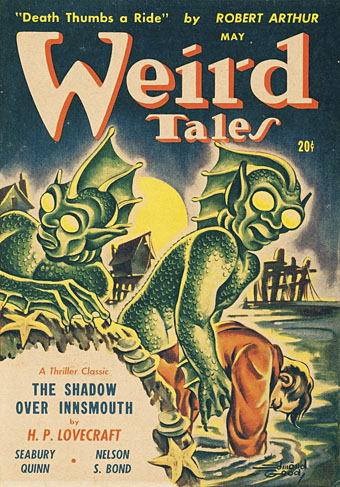
Weird Tales (Canada), May 1942. Cover art by Edmond Good.

• “…in 1968, seven years after the MOMA retrospective, Orson Welles appreciatively got in touch and suggested that Bogdanovich do a book-length set of interviews with him like the one that Bogdanovich had just done with Ford. The resulting book, This Is Orson Welles (which took a winding path to publication, in 1992, seven years after Welles’s death), is a classic of the literature of movies.” Richard Brody on the late Peter Bogdanovich. The book of Welles interviews is one of my favourite film books, as good in its way as Hitchcock/Truffaut, and like Truffaut’s book you wish it was twice as long.

• At Public Domain Review: Paloma Ruiz and Hunter Dukes on Johann Caspar Lavater’s frog-to-human physiognomies. If you reverse the sequence, as I did for one of the illustrations in Lovecraft’s Monsters, you approach The Shadow Over Innsmouth.

• The week in virtual exploration (via MetaFilter): Mini Tokyo 3D and Explore the Soane Museum, London.

• Submissions are open for the 16th issue of Dada journal Maintenant which will have the theme “Nyet Zero”.

• At Spoon & Tamago: Artists and artisans collaborate on exhibition of 144 maekake aprons.

• DJ Food unearths flyers and posters for the Million Volt Light & Sound Rave, 1967.

• Mix of the week: Isolatedmix 116 by Chris SSG.

• At Dennis Cooper’s: Stephen Dwoskin Day.

The Little Blue Frog (1970) by Miles Davis | Jail-House Frog (1972) by Amon Düül II | Tree Frog (1995) by Facil