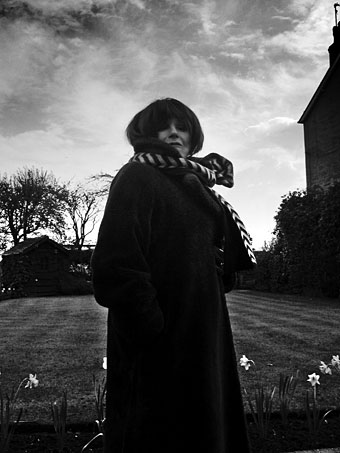
Fenella Fielding, May 2005.
A few things of interest in the Coulthart world this month.
• The Independent on Sunday this weekend ran a feature by Robert Chalmers on film and stage actress Fenella Fielding which included some discussion with my Savoy colleague Dave Britton about the recordings Savoy has been making with Fenella for the past few years. I was fortunate to meet Ms Fielding myself a couple of years ago, during one of the sessions at Lisa Stansfield’s studio in darkest Rochdale, north of Manchester. As well as having the opportunity to chat to La Fielding (as Kenneth Williams used to call her), I got to take a few photos outside the studio, the best of which can be seen above. The IoS interview is an interesting one, revealing some details about Ms Fielding’s mysterious past and confirming what we knew already, that she’s not overly enamoured of her work with the ruffians from the North.
• Also in the Savoy orbit, Michael Butterworth and I were interviewed for the second number of Trespass magazine before Christmas and I’m told the issue featuring that interview has now been published although I’ve yet to see a copy. Considering I spent most of my portion of the piece ranting intemperately about the art world, that may turn out to be a good thing.
Trespass–Issue 2: January–February 2008
Alasdair Gray tells us why Lanark took so long to write and what he thinks of Gordon Brown. Savoy: a look at the obscenity trials and establishment outrage that mark this infamous publisher’s history. ‘Transgender Adventures’: a frank account of life in the sexual margins featuring Pia. ‘Not a Pursuit for a Lady’: a modern take on Tennyson’s The Lady of Shalott. ‘Stop Talking and Move’: Nottingham’s parkour crew—a growing subculture. Sarah Maple: vote for her or you’re an islamaphobasexistracialist. Also the best of poetry, art and short fiction, including Catherine Smith, A. F. Harrold, Sascha Akhtar, Bernadette Cremin, David Gaffney and Anthony Cantons.
• And finally, the Savoy boys and myself receive a note of thanks in Elric: The Stealer of Souls by Michael Moorcock, one of a new series of reprints from Del Rey. Elric was and is Moorcock’s greatest fantasy character, not so much a hero as an anti-hero, and for me the early stories, which this first volume features, have always been the best. The books in this new series collect a lot of ephemeral material along with the stories (I helped source the picture of Zenith the Albino, the old pulp character Elric is based on) and all have new introductions. The intro for this volume is by Alan Moore and it’s a tremendous piece of writing. You couldn’t ask for better company.