Borges and I

borges.jpg

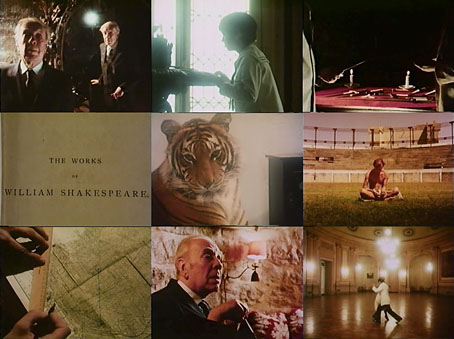
Another piece of revenant television to tick off the “When will I see this?” list. I mentioned David Wheatley’s film Borges and I back in January in a post about the director’s dramatisation of the life and work of René Magritte. Wheatley’s student film secured for him a job as a BBC director at a time when the Arena arts series was one of the best things being produced by the corporation. Borges and I was filmed in 1982 and broadcast a year later, an event I managed to miss to my considerable regret. Once again Ubuweb has turned up the goods with a copy from an American video tape. It’s not ideal—all the Spanish sequences would have been subtitled in the original broadcast—but I’m not going to complain. This 80-minute film is not only the best Anglophone documentary I’ve seen on Borges, it was produced in collaboration with the author who for much of the running time discusses his life and work in English. The tape copy also frustratingly lacks credits but the unseen American interviewer and narrator would appear to be translator and collaborator Norman Thomas di Giovanni, a writer who later found himself and his work marginalised by the Borges estate. Between the interviews and readings there are dramatised sequences from The Meeting, Funes, the Memorious, The South, The Circular Ruins, Death and the Compass, and The Sartorial Revolution, one of the collaborations with Adolfo Bioy Casares. Plus, of course, the expected complement of mirrors, tigers and a duel with knives. The budget must have been generous: scenes were shot in Argentina and Uruguay, and we also see Borges at his favourite lodging in Paris: L’Hôtel in the Rue des Beaux-Arts, a building which now bears plaques celebrating the visits of Borges and another famous literary resident, Oscar Wilde.

Previously on { feuilleton }
René Magritte by David Wheatley
L’Hôtel, Paris
Borges documentary
Borges in Performance

Weekend links 118

owczarek.jpg

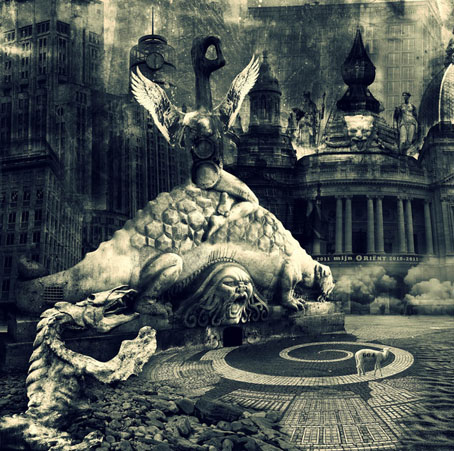
The Garden of Urban Delights (2010) by Marcin Owczarek.

His protagonists are misfits: alienated, implicitly gay, longing for love, frequently hard to be around, always fixated on small pleasures that compensate for an essential feeling of not belonging. […] His patroness Edith Sitwell termed him “that rare being, a born writer.” William Burroughs dedicated The Place of Dead Roads to him, declaring Welch “certainly the writer who most directly influenced my work.” John Waters has called In Youth is Pleasure “so precious, so beyond gay, so deliciously subversive, [it] is enough to make illiteracy a worse social crime than hunger.”

Sadie Stein on Denton Welch, a writer I’m embarrassed about still not having read. Edith Sitwell and William Burroughs had a famously disputatious correspondence in the pages of the TLS over The Naked Lunch. An appreciation of Welch’s work was one of the few things they had in common.

• Don’t mention guitars: Robert Hampson on acousmatic music, the curse of Loop and the rebirth of Main.

• No Straight Lines: A Collection Of Queer Comics part one, part two, part three. A history by Justin Hall.

Pieces Of Gold by The Aikiu: shots from gay porn videos repurposed via some smart editing.

• RIP İlhan Mimaroğlu, electroacoustic composer. Ubuweb has a selection of his recordings.

“A good ground rule for writing in any genre is: start with a form, then undermine its confidence in itself,” he says. “Ask what it’s afraid of, what it’s trying to hide – then write that.” For Harrison, the most satisfying writers are “at odds with their cultural context. They’re trying to fit in and failing, or they’re trying to remove themselves and failing. The attempt to resolve the conflict is an angle – a frame or a context – in itself.”

The Guardian’s A Life in Writing profiles M. John Harrison. His new novel, Empty Space, was published on Thursday. There’s also this recent video interview with Arc magazine.

• Stephen Usery interviews editor Russ Kick about The Graphic Canon: Volume One.

At home with Prince Zaleski, the “most decadent and imperial detective in fiction”.

• A Visit with Magritte: photographs by Duane Michals.

Loitering airships could dispense drones on demand.

• Creating a Forever Object: Ian Schon’s Pen Project.

• A Tumblr for the late, lamented Arthur Magazine.

• “Few cities can boast a railway line for the dead.”

The Lost Tapes by Can: An Oral History.

Space Reflex (1963) by Dick Hyman & Mary Mayo | Space Is Deep (1972) by Hawkwind | Space Is The Place (1973) by Sun Ra | Space Moment (1995) by Stereolab | Space Pong (2006) by T++

Dalí in New York

dali.jpg

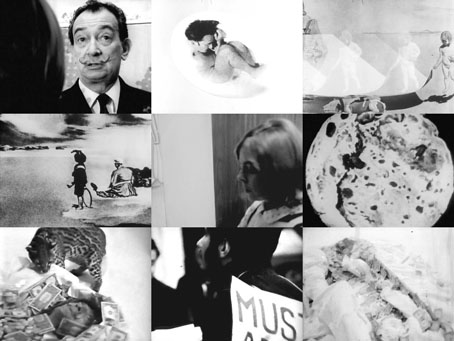
Another Dalínean gem surfaces at Ubuweb. Dalí in New York is a fascinating 50-minute account of the artist’s antics in New York City at the end of 1965. Unlike the reverential documentaries of the 1970s this film isn’t out to flatter its subject: scenes of the usual Dalí happenings are intercut with some combative verbal sparring from the equally remarkable Jane Arden who does her best to try and make sense of the painter’s pronouncements. The director was Arden’s collaborator, Jack Bond, most of whose work was for television although he’s also notable for having directed the Pet Shop Boys’ It Couldn’t Happen Here (1988), a film with some not entirely successful “surrealist” moments of its own.

Previously on { feuilleton }
The Secret Life of Edward James
René Magritte by David Wheatley
Soft Self-Portrait of Salvador Dalí
Mongolian impressions
Hello Dali!
Dirty Dalí
Impressions de la Haute Mongolie revisited

Weekend links 109

magritte.jpg

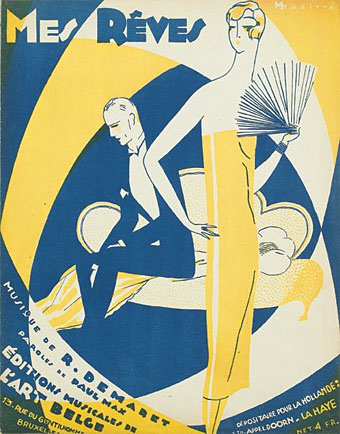
Dreams before Surrealism: a sheet music cover from 1926 by René Magritte.

• The week in music: Listen to compositions by Annea Lockwood. | At the Free Music Archive: Uncomfortable Music, a tribute to David Lynch’s Eraserhead (and, it should be said, to Alan Splet’s unique soundtrack). | Alan Licht plays a track from Trout Mask Replica then loops some Donna Summer and improvises guitar noise over it. | Music Experiments with Terror: The Spooky Isles presents Joseph Stannard‘s list of recent eldritch sounds from British musicians.

Great art, or, let’s just say, more modestly, original art is never created in the safe middle ground, but always at the edge. Originality is dangerous. It challenges, questions, overturns assumptions, unsettles moral codes, disrespects sacred cows or other such entities. It can be shocking, or ugly, or, to use the catch-all term so beloved of the tabloid press, controversial. And if we believe in liberty, if we want the air we breathe to remain plentiful and breathable, this is the art whose right to exist we must not only defend, but celebrate. Art is not entertainment. At its very best, it’s a revolution.

Salman Rushdie on the censorship of art

• All Diamond, No Rough” says the School Library Journal about the first volume of The Graphic Canon. Volume two should be out in August.

Scientific American asks: Do Psychedelics Expand the Mind by Reducing Brain Activity?

• From 2010: A Dandy in Aspic – A letter from Derek Marlowe.

Tom Phillips and A Humument: how a novel became an oracle.

Timeline Maps at the David Rumsey Map Collection.

• Happy 50th birthday, A Clockwork Orange.

Jim Dandy (1956) by LaVern Baker | Larks’ Tongues in Aspic, part one (1972) by King Crimson, live on Beat Club.

The Secret Life of Edward James

james1.jpg

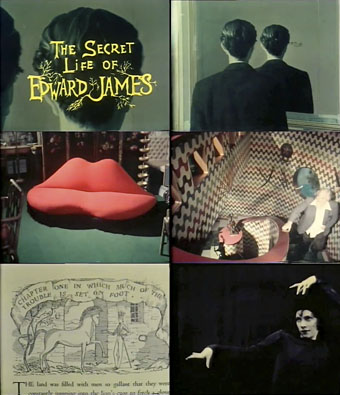
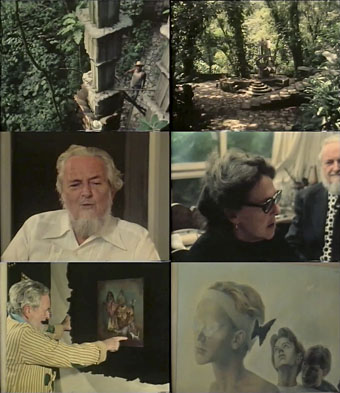
From the earliest days of YouTube there were two films about Surrealist art that I’d been hoping would one day be posted somewhere so I could watch them again. One was José Montes-Baquer’s collaboration with Salvador Dalí, Impressions de la Haute Mongolie – Hommage á Raymond Roussel (1976), which eventually turned up at Ubuweb; the other was Patrick Boyle’s The Secret Life of Edward James, a 50-minute documentary about the wealthy poet and Surrealist art patron that was screened once, and once only, on the UK’s ITV network in 1978. Boyle’s film, which was narrated by James’ friend and fellow Surrealism enthusiast, George Melly, was my first introduction to a fascinating figure who was one of the last—if not the last—of the many eccentric aristocrats that these islands have produced. I knew James’ name from Surrealist art books where the Edward James Foundation was credited as the owner of paintings by Magritte and Dalí, but had no idea that James was the model for three of Magritte’s paintings, including La reproduction interdite (1937); or that he’d abandoned his huge ancestral home to create a Surrealist house at nearby Monkton, and had also commenced the construction of a concrete fantasia, Las Pozas, in the heart of the Mexican jungle at Xilitla. Boyle’s film explores all of this in the calm and uncondescending manner that used to be a staple of UK TV documentaries. I’ve been telling people about this film for years, hoping that somebody might have taped it (unlikely in 1978) but no-one ever seemed to have seen it.

james2.jpg

In 1986, two years after James’ death, Monkton was up for sale so Central TV sent George Melly and director Patrick Boyle to revisit the place. Monkton, A Surrealist Dream, was the result, a 26-minute documentary which relied heavily on the earlier film to fill out the details of James’ life. The original resurfaced for me again, albeit briefly, in Brighton in 1998. A Surreal Life: Edward James (1907–1984) was an exhibition at the Brighton Museum & Art Gallery that featured many works from the James art collection, including major pieces by Leonora Carrington (who appears in Boyle’s film), Dalí, Leonor Fini, Magritte, Picasso, Dorothea Tanning, Pavel Tchelitchew and others. A tape of the 1978 documentary was showing on a TV in one part of the exhibition but the people I was with were reluctant to stand around for an hour so all I got to see was a minute or so of Edward in his jungle paradise. Happily we’re all now able to watch this gem of a film since it was uploaded to YouTube earlier this month (my thanks to James at Strange Flowers for finding it!).

james3.jpg

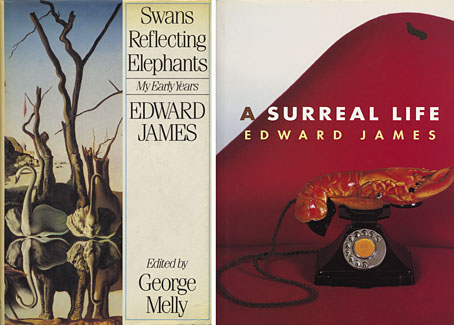
For anyone whose interest is piqued by all of this, two books are worth searching for: Swans Reflecting Elephants, My Early Years (1982) is an autobiography which George Melly compiled from conversations with its subject (and which apparently finished their friendship). James’ propensity for invention means it can’t always be trusted but then that’s the case with many memoirs. A Surreal Life: Edward James (1998) is the 160-page exhibition catalogue which explores James’ life and aesthetic obsessions in a series of copiously-illustrated essays. Both books can be found relatively cheaply via used book dealers.

Previously on { feuilleton }
Las Pozas panoramas
René Magritte by David Wheatley
Soft Self-Portrait of Salvador Dalí
Mongolian impressions
Hello Dali!
Return to Las Pozas
Dirty Dalí
Impressions de la Haute Mongolie revisited
Las Pozas and Edward James