Marsi Paribatra: the Royal Surrealist

marsi1.jpg

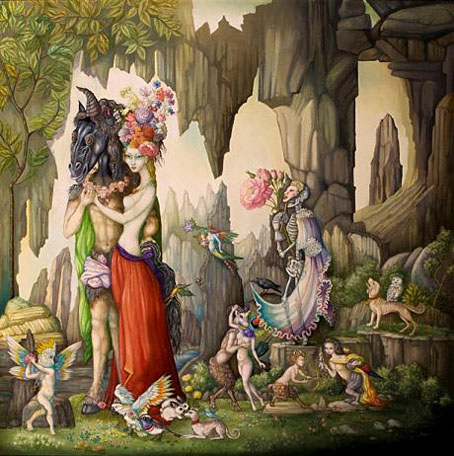
La Menace (1994).

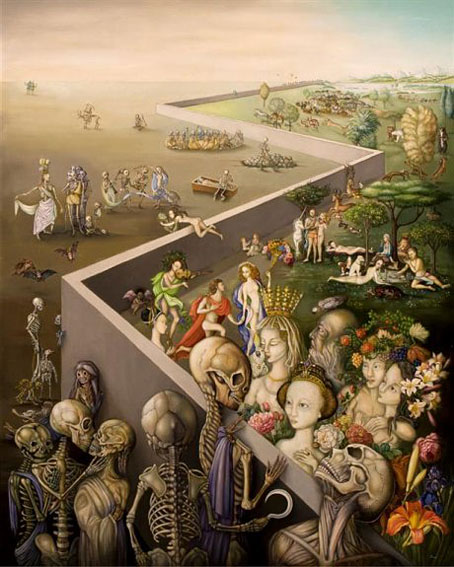
Two paintings by Princess Marsi Paribatra, a member of the royal family of Thailand who lists Dalí, Arcimboldo and Titian among her artistic influences. If it seems surprising that a princess should not only be an accomplished painter but also be possessed of a distinctly vivid imagination we might ask why this is the case. There’s no reason why a member of a royal family shouldn’t be as good a painter as anyone else although it’s the case that here in Britain our views of royalty are inevitably tainted by the uninspiring members of the current House of Windsor. Prince Charles in particular is a singularly dreary and frequently philistine figure, and also a painter whose daubs would never have received any attention at all were it not for his being born into the right family.

This hasn’t always been the case. It used to be that being an aristocrat gave you the free time and the wealth to indulge no end of manias and eccentricities. The British Isles are littered with architectural follies of various kinds built to appease the whims of rich landowners; William Beckford (1760–1844) is renowned for having written the Gothic melodrama Vathek and also for having built the lavish (and unfortunately short-lived) pile of Fonthill Abbey. In the 20th century we had Edward James (1907–1984), a lifelong champion of Surrealism who spent much of his later life building Las Pozas in the Mexican jungle at Xilitla, a concrete fantasia which looks like something dreamed up by Antonio Gaudí and JG Ballard. James collected the work of Leonora Carrington and Dorothea Tanning and I’d imagine him being equally entranced by some of Marsi Paribatra’s paintings. The recurrence of skeletal figures in her work invokes the Mexican Day of the Dead traditions which always excited the Surrealists.
marsi2.jpg

No title or date available.

Dali House has more about Marsi Paribatra’s life and art while further examples of her paintings can be found here and here. Thanks again to Monsieur Thombeau for pointing the way!

Elsewhere on { feuilleton }
The fantastic art archive

Previously on { feuilleton }
Angels of Anarchy: Women Artists and Surrealism
Return to Las Pozas
The art of Leonor Fini, 1907–1996
Surrealist women
Las Pozas and Edward James

Weekend links 19

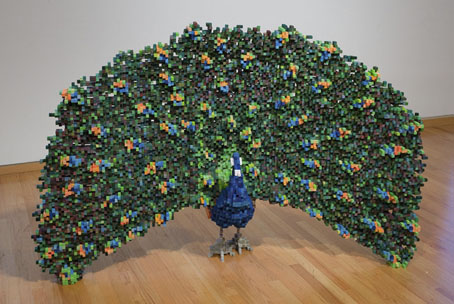
smith.jpg

Peafile (2006) by Shawn Smith; plywood, ink, acrylic paint.

Surreal Friends, an exhibition of work by Leonora Carrington, Remedios Varo and Kati Horna at the Pallant House Gallery, Chichester, UK. Related: The surrealist muses who roared, Leonora Carrington and other women Surrealists profiled.

Landscapes From a Dream: How the Art of David Pelham Captured the Essence of JG Ballard’s Early Fiction. A graphic design essay at Ballardian.

• “(T)he significant thing is not the behaviour of the players but the attitude of the spectators: and, behind the spectators, of the nations who work themselves into furies over these absurd contests, and seriously believe — at any rate for short periods — that running, jumping and kicking a ball are tests of national virtue. (…) It is the most violently combative sports, football and boxing, that have spread the widest. There cannot be much doubt that the whole thing is bound up with the rise of nationalism — that is, with the lunatic modern habit of identifying oneself with large power units and seeing everything in terms of competitive prestige.” The Sporting Spirit by George Orwell, December 1945.

• One of my cult pop albums from the 1980s, A Secret Wish by Propaganda, is reissued in a 25th anniversary edition next month. I no doubt have most of the bonus tracks already but the prospect is still irresistible.

Tangier Cut-Up, an uncollected piece by William Burroughs from Esquire, September 1964.

Ghostwriter —  The Continuing Adventures Of The Strange Sound Association.

Faust And Last And Always: Germany’s Most Radical Rock Group Talk.

Hollingsville at Resonance FM. Related: Graphic Design on the Radio.

iPad Publishing No Savior for Small Press, LGBT Comics Creators.

The Largest Oil Spills in History, 1901 to Present.

1948 Buick Streamliner by Norman E Timbs.

Neville Brody’s work on display in Tokyo.

Dr Mabuse (1984) by Propaganda; Vladek Sheybal, cowled monks, Fritz Lang references and Anton Corbijn directing.

Angels of Anarchy: Women Artists and Surrealism

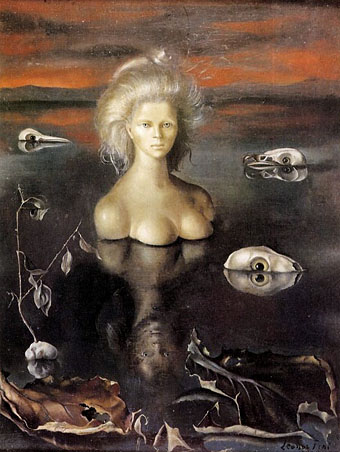
fini.jpg

Le Bout du monde by Leonor Fini (1948).

Yes, I’ll definitely be going to see this one.

The first major exhibition of women artists and Surrealism to be held in Europe, Angels of Anarchy, opens this autumn at Manchester Art Gallery.

Featuring over 150 artworks by 32 women artists, the exhibition is a celebration of the crucial, but at the time not fully recognised, role that women artists have played within Surrealism. Paintings, prints, photographs, surreal objects and sculptures by well-known international artists including Frida Kahlo, Meret Oppenheim, Leonora Carrington and Lee Miller will be exhibited alongside works by artists less well-known in the UK, such as Emila Medková, Jane Graverol, Mimi Parent, Kay Sage and Francesca Woodman. Manchester Art Gallery is the only venue for this exhibition, making it a once-in-a-lifetime opportunity to see the works of so many significant women artists displayed together, with many of the works on loan from international public and private collections.

Angels of Anarchy runs from 26 September 2009–10 January 2010 at Manchester Art Gallery, and it’s a paying event with tickets at £6 (concessions £4, free entry for under 18s and Manchester Art Gallery Friends).

Elsewhere on { feuilleton }
The fantastic art archive

Previously on { feuilleton }
The art of Leonor Fini, 1907–1996
Surrealist women

The art of Harold Hitchcock

hitchcock.jpg

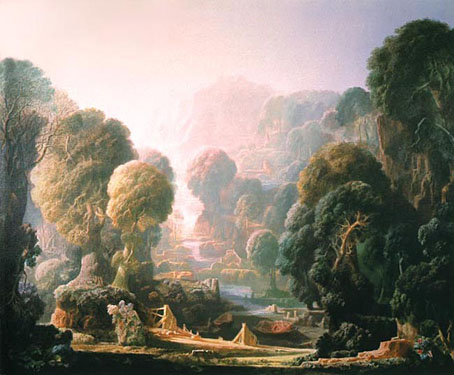
Sunrise in a Valley (1974).

It’s difficult to say whether the work of Harold Hitchcock (born 1914) is rarely seen in his native country because of those British art critics who’ve often regarded fantastic or sacred themes with suspicion—or whether it’s merely because people find his work to be bad. Sometimes the latter accusation appears to be a disguise for the former belief, especially among those who follow the pack rather than drawing their own conclusions. At times the English Channel has acted as an aesthetic as well as a physical barrier. British art never quite got to grips with Surrealism, despite the best efforts of Roland Penrose and others, while Symbolism was almost exclusively a Continental movement whose existence was largely expunged from later art histories; the 1959 Penguin Dictionary of Art and Artists, for instance, has entries for minor groupings such as the Hudson River School and the Nazarenes, but no entry at all for Symbolism. Fantasy was allowable in illustration but not elsewhere; no wonder Mervyn Peake took up writing.

So much for polemic. Hitchcock’s work comprises very detailed landscapes that present a Claude Lorraine-like approach to light with more Modernist forays reminiscent of Expressionist painters such as Franz Marc. His fanciful works remind me of his Surrealist contemporary Leonora Carrington, with their creation of a self-contained, often naive, private world. Hitchcock lives in South Devon and was still active three years ago when the BBC reported his 90th birthday. The American exhibition mentioned in that news story took place at the Phillips Gallery, Carmel, CA and their site has three pages of (rather blurred) examples of his luminous work.

Update: The official Harold Hitchcock site

Harold Hitchcock by Leonard Hitchcock
Catching the Light by Emmanuel Williams

Elsewhere on { feuilleton }
The fantastic art archive

Surrealist women

Was the Surrealist movement the first art grouping to give female creators more of an equivalent status to their male counterparts? The recent posting about Leonora Carrington had me considering this question again (yes, this is what taxes my brain while it’s awake). The answer isn’t so easy to find since women artists had been emerging gradually since the late 19th century, from Berthe Morisot onwards. Women certainly played a greater role in the development of Surrealism than they were allowed to do in earlier art movements, and their work is continually featured in histories of the period. The men were still accorded all the glory, of course, and many of the women were only given an opportunity by virtue of being wives or lovers of the male artists, but they still managed to map out their own imaginative territory. The following are some of the more notable examples.

tanning.jpg

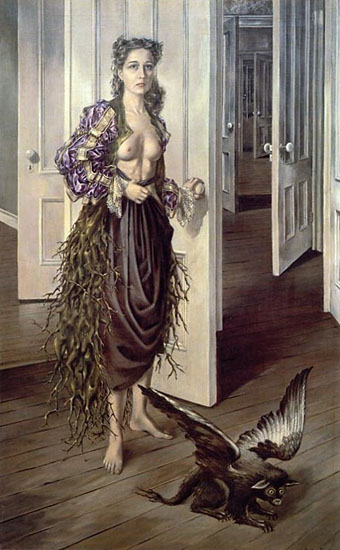
Birthday by Dorothea Tanning (b.1910).
My personal favourite, a very accomplished painter who married Max Ernst.

Continue reading “Surrealist women”