Home of the Brave

hotb1.jpg

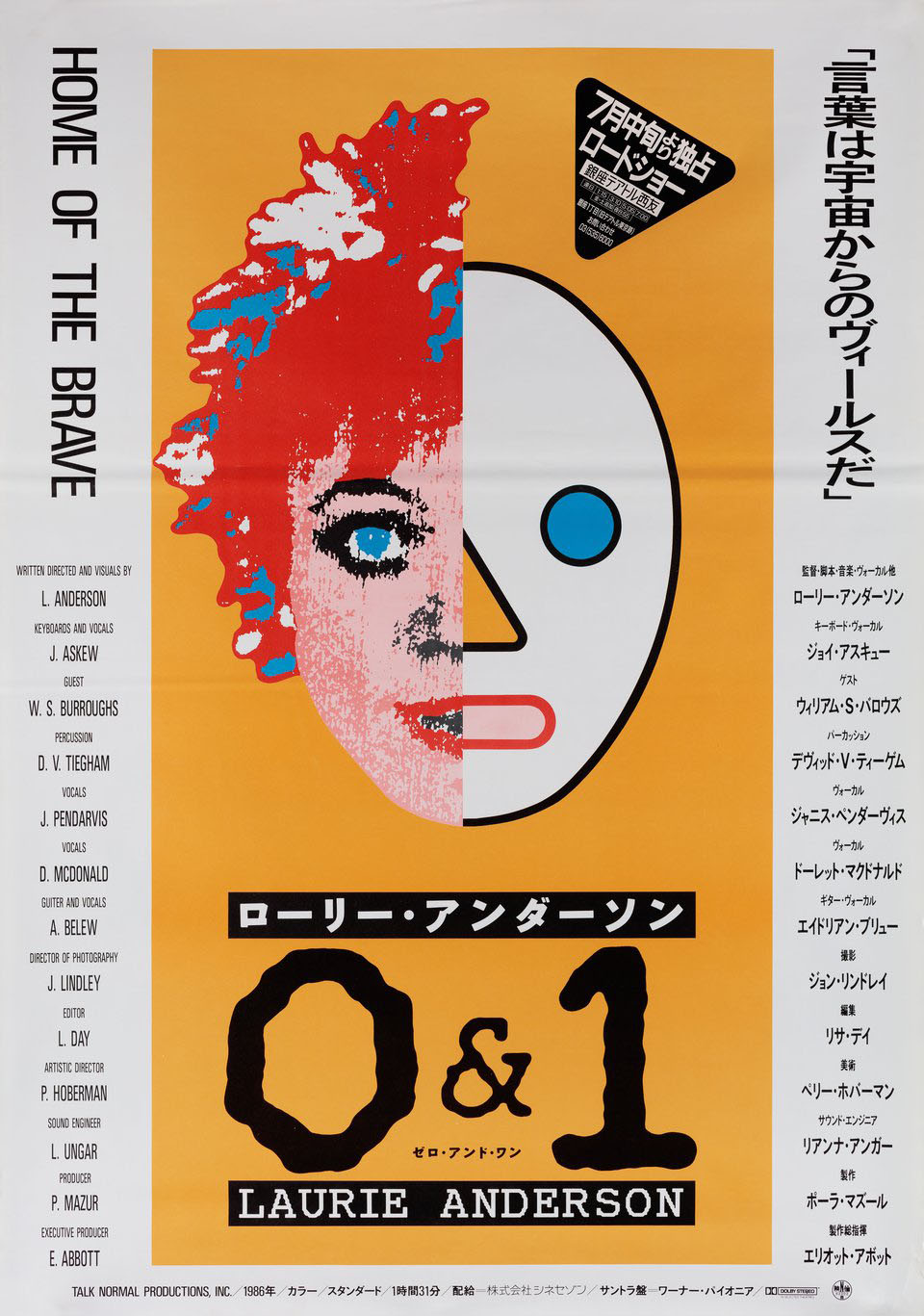
A Japanese poster.

Home of the Brave is a Laurie Anderson concert film from 1986 that more people might know about if it hadn’t been out of circulation for the past thirty years. The reason for the unavailability remains a mystery; Anderson announced a DVD release in 2007 but so far nothing has materialised. Whatever the explanation may be, this copy (which appears to be a Laserdisc rip) is better than the VHS transfers that circulate elsewhere.

hotb2.jpg

The concert itself is a 90-minute multimedia stage show built around the songs from Anderson’s second album, Mister Heartbreak. Between the album songs there are quirky, sketch-like interludes together with a reworked version of Language Is A Virus from her United States show, which was later reworked again for a single release. The album transcription extends to the projected visuals which incorporates graphics from Anderson’s design for the album cover, elements which show her to have been an early user of Macintosh computers. The Chicago font which was the default for the original Mac OS is a recurrent presence here, even being used for the title of the film on the posters and the cover of the soundtrack album. Another recurrent presence is William Burroughs, a friend of Anderson’s whose inimitable voice turns up on the last song on Mister Heartbreak, Sharkey’s Night. Burroughs’ first appearance in the film occurs when he and Laurie Anderson waltz across the stage, probably the first and last time that Burroughs was ever persuaded to dance in public.

hotb3.jpg

As for the music, if you’re as familiar as I am with Mister Heartbreak it’s good to see the songs from the album presented in live versions by some of the album’s musicians: Adrian Belew (playing guitar between stints in King Crimson), David Van Tieghem (percussion), and Dolette McDonald (backing vocals). This was Laurie Anderson’s first overtly pop-oriented outing (if you can call something “pop” that features William Burroughs and a song dedicated to Thomas Pynchon), but the stage show is filled with moments that aren’t so different to her earlier performances: solo keyboard spots, textual projections (one of which has her handwritten musings about the title of the show), unusual instruments (the tape-loop violin, body percussion, a keyboard tie), processed voices, and so on. The overall effect is simultaneously weird and playful, with the songs and general activity preventing the show from coming across like a low-key comedy act, the way United States often does. A proper reissue would be preferable but for now this is about the best you can get.

Previously on { feuilleton }
Going beyond the zero
Ear to the Ground

Weekend links 792

caroff.jpg

West Side Story (1961) poster designed by Joe Caroff.

• “From the very moment of its inception, the Wound Man was an image intimately tied to actual practice. He was in fact many, many things at once: epistemic diagram, medical tool, affective muse, technical spur, international artwork.” Jack Hartnell explores the tortured paths of book illustration known as the Wound Man.

• At The Daily Heller: The late Joe Caroff, who Steven Heller calls “the most prolific designer you’ve never heard of”.

• From V to Vineland and Inherent Vice: John Keenan ranks Thomas Pynchon’s books.

• Sometimes Easy, Sometimes Hard: Toby Manning on Harmonia’s Deluxe at 50.

• At Unquiet Things: The infinite cosmos of Martina Hoffmann.

• Mix of the week: A mix for The Wire by Sanam.

• The Strange World of…Joe McPhee.

• RIP Terence Stamp.

Gravity’s Angel (1984) by Laurie Anderson | Wounder (2006) by Burial | Melodie Is A Wound (2025) by Stereolab

Weekend links 756

crane.jpg

A Diver (no date) by Walter Crane.

• At Worldbuilding Agency: The first part of a long interview with Bruce Sterling concerning “the pursuit of deliberate oxymorons as a creative strategy, worldbuilding in the context of history and futurity, Berlusconi on the moon and more”. With questions from Paul Graham Raven, and my cover art for Bruce’s Robot Artists and Black Swans.

• “With its focus on the 1970s career of Leonard Rossiter and its mordant metaphysics of the moist, Sophie-Sleigh Johnson’s Code: Damp might just be the most original book yet to emerge from Repeater publishing,” says Tim Burrows.

• “A definitive guide to the work of William S Burroughs’ on screen.” It’s a guide but it’s hardly definitive when there’s no mention of the four films Burroughs made with Anthony Balch.

• A catalogue of lots at the forthcoming After Dark: Gay Art and Culture online auction. Homoerotic art, photos, etc, also historic porn and a few garments worn by Divine.

• New music: Jay recommends the high-grade motorik en espanol dance-rock of Sgt Papers; Topology Of A Quantum City by Paul Schütze; Overtones by Everyday Dust.

• This week’s obligatory Bumper Book of Magic entry: Ben Wickey at Alan Moore World talks about his work on the book’s Great Enchanters comic strips.

• At Dennis Cooper’s it’s Malcolm Le Grice’s Day. Le Grice’s death was announced earlier this month.

• At The Wire: The magazine’s contributors’ charts showing their favourite music of the past year.

• A new website for the Sanborn Fire Maps and their decorated title pages.

• Mix of the week: DreamScenes – December 2024 at Ambientblog.

• At Public Domain Review: Albert Kahn’s autochromes.

Burroughs Called The Law (1960s) by William S. Burroughs | Language Is A Virus From Outer Space (Live) (1984) by Laurie Anderson | Burroughs Don’t Play Guitar (1996) by Islamic Diggers

Weekend links 753

brewer.jpg

Grow (1970) by Linda Brewer.Via.

• The week in work-related reviews: Raymond Tyler reviewed the Bumper Book of Magic at Religious Socialism, while James Palmer did the same at Foreign Policy. Meanwhile, Rob Latham at the Los Angeles Review of Books examined the legacy of the New Wave of science fiction with reviews of New Worlds 224, and The Last Dangerous Visions, Harlan Ellison’s long-delayed story collection.

• “Incline Press is a private fine press publisher in the UK, stubbornly printing with hand set, metal type on a collection of vintage machines, working with poets and artists to make limited edition books and ephemera.”

• New music: Horses In Your Blood, another dose of unhinged weirdness from Moon Wiring Club; The Source by Jon Palmer; and Ekkorääg by Tarotplane.

• At Dennis Cooper’s: Spotlight on…Rikki Ducornet The Fan-Maker’s Inquisition: A Novel of the Marquis de Sade (1999).

• At Smithsonian Magazine: “Rare atlas of astronomy from the Dutch Golden Age goes on display in England“.

• Old music: Jon Savage’s Space, a space-themed compilation on Caroline True Records.

• At The Daily Heller: Berman’s Book Boom is a boon to graphic design’s legacy.

• At Public Domain Review: Christoph Jamnitzer’s Neuw Grotteßken Buch (1610).

• Mix of the week: A Dungeon Synth mix by Flickers From The Fen for The Wire.

• At Heavy Metal Magazine: The HP Lovecraft Art of John Holmes.

• At The Quietus: The Strange World of…Laurie Anderson.

I Can Hear The Grass Grow (1967) by The Move | Grow Fins (1972) by Captain Beefheart | The Growing (2011) by The Haxan Cloak

Weekend links 731

electrical.jpg

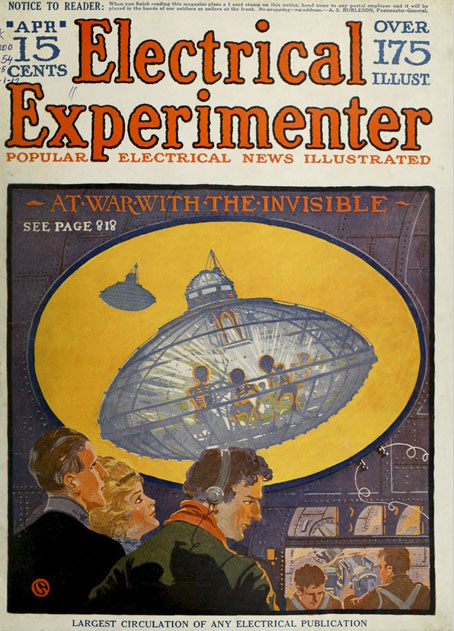
The Electrical Experimenter, Vol. 5, no. 1. April, 1918. Electrical cover art by Vincent Lynch.

• Coming soon from Rocket 88 Books: Electricity and Ghosts, a collection of art and graphic design by John Foxx/Dennis Leigh. The book itself has been designed with a regular Foxx collaborator, Jonathan Barnbrook. Last year I put together a post collecting Dennis Leigh’s book covers.

• At Strange Flowers: Lavinia Schulz and Walter Holdt, their Expressionist dance costumes, and their short, tempestuous lives. There’s more about the couple’s costumes and dances here.

• New music: Road to Mandalay by Laurie Anderson; Panorama (French Soundtracks & Rarities) by Various Artists; The Passage Of Time by Cosmos In Collision.

• At Public Domain Review: Raffaele Mainella’s illustrations for Nos Invisibles (1907), a Spiritualist text by Clotilde Briatte (writing as Charles d’Orinio).

Dennis Cooper’s favourite fiction, poetry, non-fiction, film, art, and internet of 2024 so far. Thanks again for the link here!

John Cale’s favourite music. Also The Records That Made Me by Carsten Nicolai/Alva Noto.

The mysterious mirrored monolith returns.

• RIP Donald Sutherland.

BBC Sound Effects.

Electricity (1967) by Captain Beefheart & His Magic Band | Electricity (1980) by Orchestral Manoeuvres In The Dark | Electricity (1995) by Pet Shop Boys