Weekend links 814

dameron.jpg

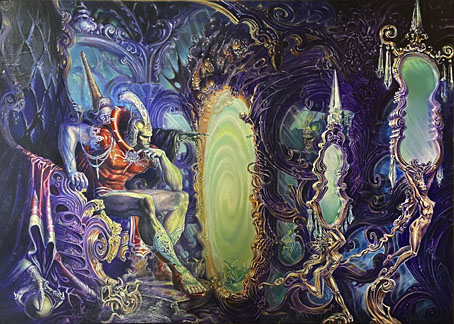
Kull of Atlantis—The Mirrors of Tuzun Thune by Ned Dameron for Kull (1985) by Robert E. Howard. Via.

Jeremy Allen reviews the latest reissue of The New Worlds Fair by Michael Moorcock and The Deep Fix, describing the album as “a fascinating and quixotic document from the time it was made, deserving to be taken seriously in its own right”.

• Among the new titles at Standard Ebooks, the home of free, high-quality, public-domain texts: Short Fiction, a small collection of early stories by Clark Ashton Smith.

• New music: Geometry of Murder: Extra Capsular Extraction Inversions by Earth x Black Noi$e; Live At Nonseq by WNDFRM.

The book is not just loaded with words or tongues. Its also loaded with genres, or more accurately, different modes of literature. And one of the modes I particularly enjoyed this time around is, appropriately, the Weird. In ways long noted on forlorn and unspeakable subreddits, there is a decidedly Lovecraftian dimension to Melville’s Whale, which the Master of Providence did read and enjoy months before writing his game-changing “Call of Cthulhu.” We begin the novel with a sick soul, who may or may not be named after an Old Testament outcast, wandering through a macabre and fetid New England whale-town, following grim portents that lead him on towards a cursed ship doomed to confront a monster who sleeps or at least feeds, and presumably dreams, at the bottom of the sea. And that’s just the first couple of chapters.

Erik Davis on the pleasures of re-reading Moby-Dick, in a piece which makes me want to read the novel again

• At the BFI: Phil Hoad on David Lynch’s efforts to keep making films in an industry resistant to his kind of art.

• Exploration Log 12: Adam Rowe on the best retro science fiction art collections.

• At Public Domain Review: The Nine Birds of Jacques de Fornazeris (1594).

Winners and finalists for the 2025 Ocean Art Contest.

• Mix of the week: A mix for The Wire by Hilary Woods.

The Whale (1977) by Electric Light Orchestra | Don’t Kill The Whale (1978) by Yes | School For Whales (1980) by Marc Barreca

Weekend links 770

finlay.jpg

Abstraction #51 (1965) by Virgil Finlay.

• “I think the world venerates him as this deeply religious composer who tackles eternal themes in his music, but I think it’s also good to remember that he also has a playful experimental side.” Maria Juur discussing Estonian composer Arvo Pärt in a review by Geeta Dayal of a new recording of four Pärt compositions.

• “Rubycon feels like an epic soundtrack to a great lost film…” Jeremy Allen on the 50th anniversary of a Tangerine Dream album that’s always been a favourite of mine.

• At the Internet Archive: Browse the catalogue for a forthcoming auction of rare books and artworks from The Library of Barry Humphries.

• At Public Domain Review: Through a Glass Lushly: Michalina Janoszanka’s reverse paintings (ca. 1920s).

• At Colossal: “Vintage postcard paintings by David Opdyke demonstrate an ecological future in peril“.

• At the BFI: Michael Brooke offers suggestions for ten great Slovak New Wave films.

• DJ Food unearthed four sheets of Dave Roe wrapping paper from 1968.

• New music: Doppelgänger by Ian Boddy & Harald Grosskopf.

Ten minutes of Sun Ra and the Arkestra on French TV in 1969.

Depictions of Atlantis in retro science fiction art.

• Old music: Flora (1987) by Hiroshi Yoshimura has been reissued.

Atlantis (1961) by The Blue Bells | Atlantis (1969) by Donovan | Atlantis (1971) by Deuter

Weekend links 668

escher.jpg

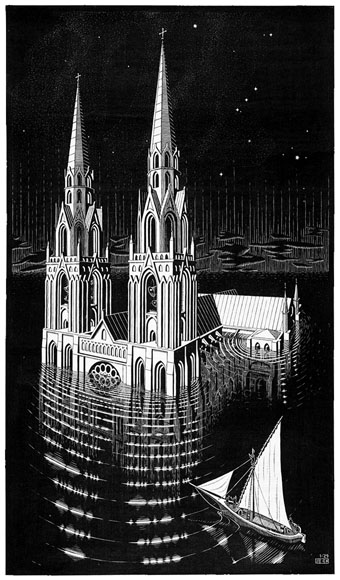
The Drowned Cathedral (1929) by MC Escher.

• “All Saints’ was the last of the seven parish churches to fall headlong into the waves. The drowned church was doomed to lie in a gulley not far out to sea, a habitat for sponges and crabs, and yet it lives on, unvanquishable; for—as the story of Britain’s lost cities, ghost towns, and vanished villages tells us—what has disappeared beneath the sea can rebuild itself in the mind.” Matthew Green explores the history of Dunwich, Suffolk.

• “Why do certain artists endure and become (dread word) ‘iconic’, while some are forgotten or sidelined or only grudgingly acknowledged?” Ian Penman talking to Jeremy Allen about his new book, Fassbinder Thousands of Mirrors.

• Coming soon from Strange Attractor: A new edition of England’s Hidden Reverse, David Keenan’s study of the lives and music of Coil, Nurse With Wound and Current 93.

• “What is electronic music?” Daphne Oram, Desmond Briscoe and David Cain of the BBC Radiophonic Workshop are here to explain.

• “Direct evidence of the use of multiple drugs in Bronze Age Menorca (Western Mediterranean) from human hair analysis.”

• New music: Timespan by Majeure, and Microdosing by African Head Charge.

• “Future of Borges estate in limbo as widow doesn’t leave will.”

Arooj Aftab’s favourite albums.

Paperback Covers on Tumblr.

The Engulfed Cathedral (1974) by Tomita | Engulfed Cathedral (1981) by John Carpenter | La Cathédrale Engloutie (2003) by Sora

Weekend links 612

remps.jpg

Cabinet of Curiosities (c. 1690s) by Domenico Remps.

• “…the human voice is an astonishing landscape”. Jeremy Allen on Desert Equations: Azax Attra (1986) by Sussan Deyhim & Richard Horowitz, an album which is being reissued by Crammed Discs with bonus tracks and an inexplicably rearranged track list. Good as it is, their follow-up release from 1996, Majoun, is even better, and might be better known if it hadn’t been so thoroughly abandoned by Sony Classical.

• “On view through May 29, By Her Hand: Artemisia Gentileschi and Women Artists in Italy, 1500–1800 showcases masterpieces done by 17 Italian women to make the case for a broader view of women’s participation in the Italian Renaissance.” Nora McGreevy reports.

• “We had a far more profound effect on society than we really understood, and some of us paid for that”: Jane Lapiner and David Simpson of the San Francisco Diggers talking to Jay Babcock in another installment of Jay’s verbal history of the hippie anarchists.

• “Close your eyes and you could almost imagine it’s the muffled screams of a ghost trapped in a bottle.” Daryl Worthington on 25 years of The Ballasted Orchestra by Stars Of The Lid.

• More Dangerous Visions and New Worlds: Mike Stax talks with Michael Moorcock about music, science fiction, politics, and their intersections in the 1960s.

• “Cormac McCarthy to publish two new novels.” Oboy oboy.

• At Dennis Cooper’s: Larry Gottheim Day.

Metal Machine Music For Airports

Marginalia Search

Music For Meditation I (1973) by Eberhard Schoener | Music For Evenings (1980) by Young Marble Giants | Music for Twin Peaks Episode #30 (Part I) (1996) by Stars Of The Lid

Weekend links 590

santesson.jpg

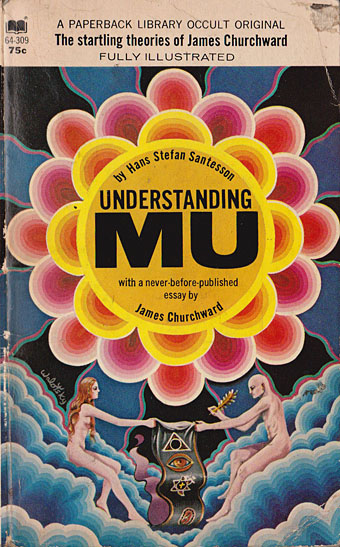
Understanding Mu (1970) by Hans Stefan Santesson. Cover art by Ron Walotsky. Via.

• “I have never believed Chariots of the Gods?—it takes faith, so what I mean is that I’ve never believed in it—but it has still held my affection for decades.” Patrick Allington on ancient aliens, unidentified aerial phenomena, and the unhinged pleasures of speculative nonfiction. I still have a stash of paperbacks in what I call “The Crank Box”, a collection of the more far-out titles that proliferated in the 1970s in the wake of the bestselling (and very egregious) Erich von Däniken. There aren’t many books about ancient astronauts or flying saucers in the box because they were so plentiful, I was always on the lookout for more outlandish volumes: lost continents, yes, but not the all-too-common Atlantis; Lemuria or Mu were more like it. So too with Hollow Earths and mysterious realms as detailed in Shambhala: Oasis of Light by Andrew Tomas, or The Lost World of Agharti: The Mystery of Vril Power by Alec MacLellan. The attraction wasn’t that any of this speculation might be true, more that these books operate as bargain-basement equivalents of the Borges conceit in which metaphysics is regarded as a branch of fantastic literature. Weird fiction by other means.

Collecting these books was a fun thing to do in the 1980s when the crank publications of the previous decade had washed up on the shelves of secondhand bookshops. The shine began to wear off in the 1990s when the emergence of the internet empowered a new breed of hucksters (and worse) pushing all of this stuff as though it was “hidden knowledge”. It’s hard to get excited about a battered paperback brimming with pseudo-science and pseudo-archaeology when similar ideas proliferate on YouTube channels catering to credulous hordes.

• Absolutely elsewhere (and linked here on a regular basis): An archive of the endlessly fascinating Absolute Elsewhere, a website created by the late RT Gault in order to present “a bibliography of visionary, occult, new age, fringe science, strange and even crackpot works published between 1945 and 1988”. The listings are accompanied by an informed, sceptical and often enlightening commentary, and also include a fair amount of weird fiction. Mr Gault had the right attitude.

• New music: Raum by Tangerine Dream, a preview of the new album, Probe 6–8, which will be released next year; new/old music: a reissue of Marine Flowers (Science Fantasy) by Akira Ito.

• “He had been honest about himself, and shockingly honest about his parents, but about his work he had spun me a tale.” Carole Angier on the elusive WG Sebald.

• At The New Criterion: Two stray notes on Moby-Dick by William Logan; on contemporary reviews of Moby-Dick and Melville’s journey on the Acushnet.

• “Perhaps what’s most extraordinary about Kollaps is that it was made at all.” Jeremy Allen on Einstürzende Neubauten’s thrilling debut album.

• At Culture.pl: a podcast about Czech film director Vera Chytilová and her masterpiece of Surrealist anarchy, Daisies.

• At Perfect Sound Forever: Part 2 of a Jon Hassell tribute which talks to friends and musical collaborators.

• At Dennis Cooper’s: Spotlight on…William S. Burroughs The Ticket That Exploded (1962).

• At Wormwoodiana: Mark Valentine unearths a medieval recipe for gingerbread.

• Mix of the week: Death’s Other Dominion by The Ephemeral Man.

MU-UR (2000) by Coil | Mu (2005) by Jah Wobble | Mu 1 (2015) by Acronym