The Gable Window

gable.jpg

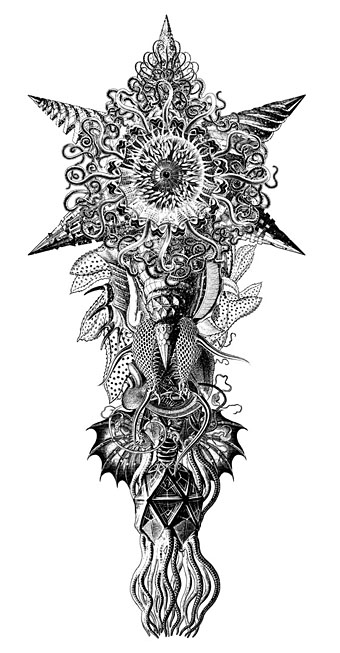
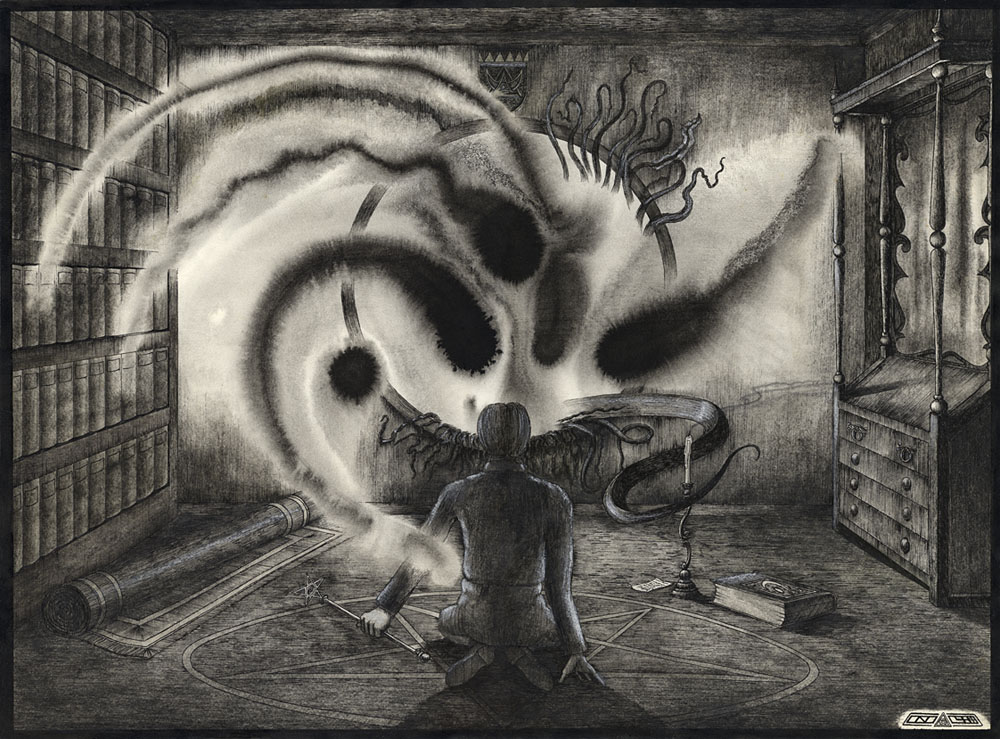
The Gable Window (1984) by John Coulthart.

Presenting some of my first Lovecraftian illustrations, neither of which have been made public before. This drawing, and the one below, are as much Derlethian as they are Lovecraftian, depicting scenes from a short story and a short novel written by August Derleth from fragments and notes found in Lovecraft’s papers. The Gable Window was collected in The Survivor and Others (1957) which happens to be the only Lovecraft-related title I own in its original Arkham House printing. Derleth’s posthumous collaborations are often more Derleth than Lovecraft but I liked the central idea of The Gable Window which, like The Music of Erich Zann, concerns a window that also serves as a portal to other dimensions.

lurker.jpg

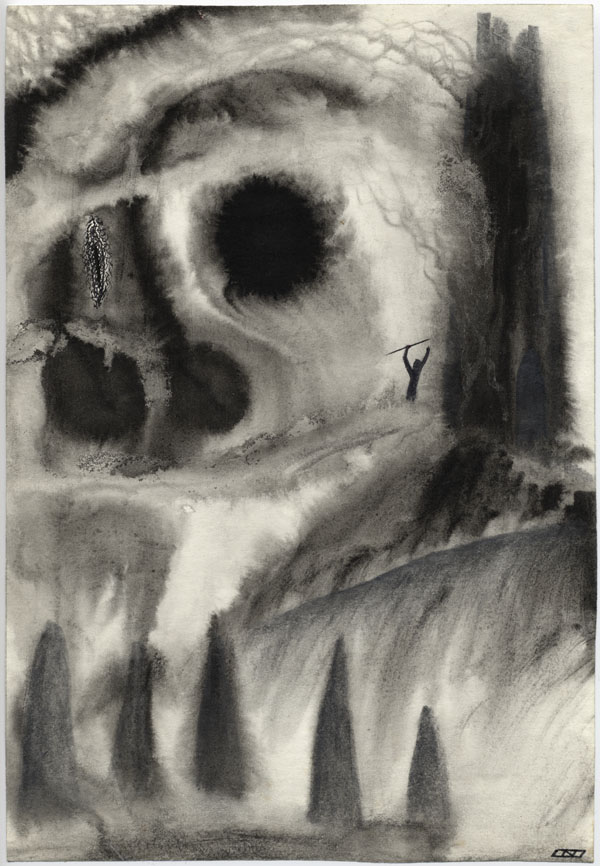
The Lurker at the Threshold (1982) by John Coulthart.

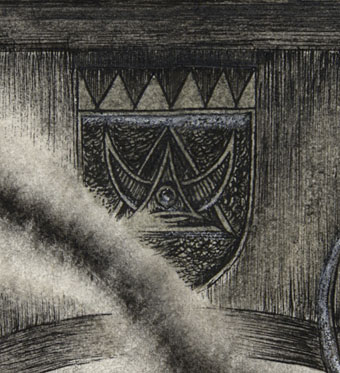
Before I began adapting The Haunter of the Dark in 1986 I hadn’t made much of an attempt to illustrate Lovecraft seriously. These drawings and a handful of other pieces were more like experimental sketches, although The Gable Window is obviously a very polished piece of work. Rather than depict anything overtly monstrous, each piece began as an arrangement of ink splotches and washes applied to cartridge paper soaked with water. The Lurker at the Threshold is one of several small pictures made with this technique in 1982, none of which are very successful. This one doesn’t look too bad but the best one, depicting the climax of The Dunwich Horror, I sent to the late Roger Dobson for possible use in an issue of Aklo, and haven’t seen it since. The Gable Window refined the technique by using fewer splotches and a more detailed drawing applied afterwards. I’ve never been happy with the figure, and the books on the left are lazily done, but it’s one of the better things I was doing in 1984. The biggest surprise looking at the drawing again was noticing the crest over the window which features a triangle/crescent motif that’s very similar to the one I designed a year later for Hawkwind’s Chronicle of the Black Sword album. This wasnt intentional.

gable-detail.jpg

Today The Gable Window seems like an indicator of where my head was at during this time. I was tired of doing Hawkwind-related things, and eager to immerse myself in something different; a series of Ballard illustrations was one potential way forward, Lovecraft was another. A year later I’d made a decision and, as it were, stepped through the window.

Elsewhere on { feuilleton }
The Lovecraft archive

Occult gestures

dunwich1.jpg

Dean Stockwell freaks out: The Dunwich Horror (1970).

I’m off to the NecronomiCon later this month so HP Lovecraft and all his works will be a predominant theme for the next couple of weeks. I’m also extremely busy right now so posts may tend to be brief.

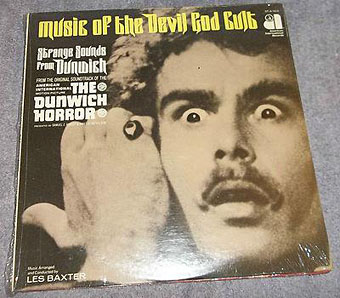
One of the films showing in Providence for the convention is Daniel Haller’s 1970 production of The Dunwich Horror. I have a low tolerance for bad horror films, and this is a bad one despite being closer to its source than other AIP quickies. Dean Stockwell plays Wilbur Whateley whose goatish qualities are here reduced to a gesture which even the filmmakers may not have known as “the Horns of Pan”, a borrowing from the famous photo of Aleister Crowley in his magician’s robes. I noted an earlier borrowing of this gesture some time ago after stumbling upon an obscure silent film serial, The Mysteries of Myra. The use in The Dunwich Horror provides another odd link between Lovecraft and Crowley, and makes me wonder whether any other films have nodded to Crowley in this way.

crowley.jpg

Aleister Crowley in 1912.

Another stray connection worth noting: Dean Stockwell was good friends with Dennis Hopper, and the pair are described in a number of sources as living for a while in a house run by Marjorie Cameron, an artist with a direct connection to Crowley via her husband, Jack Parsons. This may be rumour but Hopper and Cameron did appear together in Curtis Harrington’s beguiling Night Tide in 1961.

dunwich2.jpg

Finally, the gesture appears again on the cover of the soundtrack album which AIP smartly titled Music of the Devil God Cult: Strange Sounds from Dunwich. The title was too much for easy-listening maestro Les Baxter to live up to but he does have the distinction of being the first composer to record a piece of music entitled Necronomicon.

Previously on { feuilleton }
NecronomiCon Providence 2015
The horror
Die Farbe and The Colour Out of Space
The Mysteries of Myra

NecronomiCon Providence 2015

necro.jpg

Next month I’ll be in Providence, Rhode Island, where I’m the Artist Guest of Honour for NecronomiCon Providence 2015. This is an honour for me in more ways than one: the city of Providence, or its representation in the spectral prose of HP Lovecraft, has occupied a fair amount of my creative life, especially in the comic-strip adaptations I was drawing in the 1980s. I just hope the citizens of Providence can forgive the liberties I took with the city’s architecture in The Haunter of the Dark where the buildings owe far more to the architecture of Scotland than they do to New England.

lm19.jpg

A nameless entity from Lovecraft’s Monsters (2014).

The main event where I’m concerned will be the Ars Necronomica art show at the Providence Art Club on Thomas Street. This is a few doors away from the beautiful Fleur-De-Lys Studios, a building that Lovecraft mentions in The Call of Cthulhu, and which (having done some research this time) filled a panel in my adaptation. In the story the building is the home of eccentric artist Henry Wilcox so it’s a dizzying prospect to find my own art being exhibited a few doors away. Among my works there will be print enlargements of some of the illustrations from last year’s Lovecraft’s Monsters, Ellen Datlow’s expertly edited collection of recent Lovecraftiana; and the piece I created in 2007 for the Exhibition of Unspeakable Things at Maison d’Ailleurs, Switzerland, has been refashioned especially for this show. My work isn’t the only art on display, there’ll be contributions from 50 other artists which I think must make the event one of the largest Lovecraftian art shows staged anywhere. The show opens on August 11th but the official opening will be on the 20th which happens to be Lovecraft’s 125th birthday. Big thanks to Joe Shea, Niels Hobbs et al for arranging everything.

The convention begins on the 21st, and rather than attempt to summarise the astonishing range of events it’s easier to provide links to the main schedule and the additional programming. For anyone interested in attending, there are still day passes available, while many of the additional events are open to the public. Oh, and I’ve also designed the cover for the convention booklet so attendees will be able to get their copy defaced by my signature. (I’m probably making work for myself here, aren’t I?) And I’ve just noticed that there’s a preview of the booklet cover on the convention Facebook page.

Elsewhere on { feuilleton }
The Lovecraft archive

The Plutonian Drug

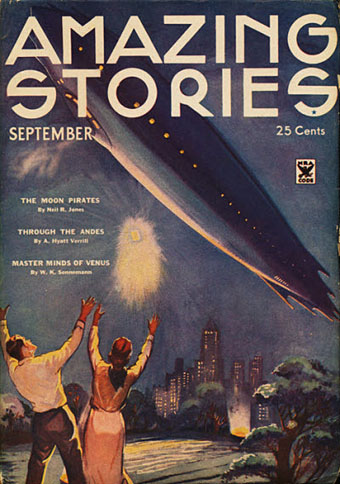
amazing.jpg

Cover art by Leo Morey.

To HP Lovecraft, Pluto was the planet Yuggoth, home to the fungoid, brain-harvesting Mi-go whose exploits are detailed in The Whisperer in Darkness (1931). Clark Ashton Smith wasn’t averse to imagining the planets of the Solar System as exotic worlds, but in The Plutonian Drug, a short story published in Amazing Stories for September 1934, he stayed closer to what was known of Pluto at the time, albeit with an exception or two:

“There are some other drugs, comparatively little known, whose effects, if possible, are even more curious than those of mnophka. I don’t suppose you have ever heard of plutonium?”

“No, I haven’t,” admitted Balcoth. “Tell me about it.”

“I can do even better than that — I can show you some of the stuff, though it isn’t much to look at — merely a fine white powder.”

Dr. Manners rose from the pneumatic-cushioned chair in which he sat facing his guest, and went to a large cabinet of synthetic ebony, whose shelves were crowded with flasks, bottles, tubes, and cartons of various sizes and forms. Returning, he handed to Balcoth a squat and tiny vial, two-thirds filled with a starchy substance.

“Plutonium,” explained Manners, “as its name would indicate, comes from forlorn, frozen Pluto, which only one terrestrial expedition has so far visited — the expedition led by the Cornell brothers, John and Augustine, which started in 1990 and did not return to earth till 1996, when nearly everyone had given it up as lost. John, as you may have heard, died during the returning voyage, together with half the personnel of the expedition: and the others reached earth with only one reserve oxygen-tank remaining.

This vial contains about a tenth of the existing supply of plutonium. Augustine Cornell, who is an old school friend of mine gave it to me three years ago, just before he embarked with the Allan Farquar crowd. I count myself pretty lucky to own anything so rare.

“The geologists of the party found the stuff when they began prying beneath the solidified gases that cover the surface of that dim, starlit planet, in an effort to learn a little about its composition and history. They couldn’t do much under the circumstances, with limited time and equipment; but they made some curious discoveries — of which plutonium was far from being the least.

“Like selenine, the stuff is a bi-product of vegetable fossilization. Doubtless it is many billion years old, and dates back to the time when Pluto possessed enough internal heat to make possible the development of certain rudimentary plant-forms on its blind surface. It must have had an atmosphere then; though no evidence of former animal-life was found by the Cornells.

“Plutonium, in addition to carbon, hydrogen, nitrogen, and oxygen, contains minute quantities of several unclassified elements. It was discovered in a crystalloid condition, but turned immediately to the fine powder that you see, as soon as it was exposed to air in the rocketship. It is readily soluble in water, forming a permanent colloid, without the least sign of deposit, no matter how long it remains in suspension.”

“You say it is a drug?” queried Balcoth. “What does it do to you?”

“I”ll come to that in a minute — though the effect is pretty hard to describe. The properties of the stuff were discovered by chance: on the return journey from Pluto, a member of the expedition, half delirious with space-fever, got hold of the unmarked jar containing it and took a small dose, imagining that it was bromide of potassium. It served to complicate his delirium for a while — since it gave him some brand-new ideas about space and time.

“Other people have experimented with it since then. The effects are quite brief (the influence never lasts more than half an hour) and they vary considerably with the individual. There is no bad aftermath, either neural, mental, or physical, as far as anyone has been able to determine. I”ve taken it myself, once or twice, and can testify to that.

“Just what it does to one, I am not sure. Perhaps it merely produces a derangement or metamorphosis of sensations, like hashish; or perhaps it serves to stimulate some rudimentary organ, some dormant sense of the human brain. At any rate there is, as clearly as I can put it, an altering of the perception of time — of actual duration — into a sort of space-perception. One sees the past, and also the future, in relation to one’s own physical self, like a landscape stretching away on either hand. You don’t see very far, it is true — merely the events of a few hours in each direction; but it’s a very curious experience; and it helps to give you a new slant on the mystery of time and space. It is altogether different from the delusions of mnophka.”

The most immediately notable detail here is the word “plutonium” which Smith was using as his own six years before the radioactive element was officially named. (By coincidence, transuranic plutonium was discovered the year Smith’s story was published.) Also of note is yet more discussion in a Smith story of real drugs such as opium and hashish. I’ve never seen any evidence that Smith was a drug user but he was happy to exploit the visionary potential of these substances. The time-viewing effects of Smith’s plutonium might have made for an effective weird tale but the piece runs out of steam fairly quickly; this is one of those stories with a promising idea that needs someone like HG Wells to do it justice. Many of Smith’s stories were written in haste so this isn’t too surprising but The Plutonian Drug lacks the imaginative scope of a piece of psychedelic science fiction like The City of the Singing Flame. Nevertheless, it was druggy enough to open Michel Parry’s Strange Ecstasies which is how I came to revisit it recently.

I was hoping the story might have been illustrated for its early printings but it seems not. The best I can find is this card design; there’s also a metal song by a band named Innsmouth that was released as a double-bill single in 2012. Smith’s story may be read in full at Eldritch Dark.

Previously on { feuilleton }
More trip texts
Yuggoth details
The Garden of Adompha
The City of the Singing Flame
Haschisch Hallucinations by HE Gowers
Odes and Sonnets by Clark Ashton Smith
Clark Ashton Smith book covers

More Esteban Maroto

maroto05.jpg

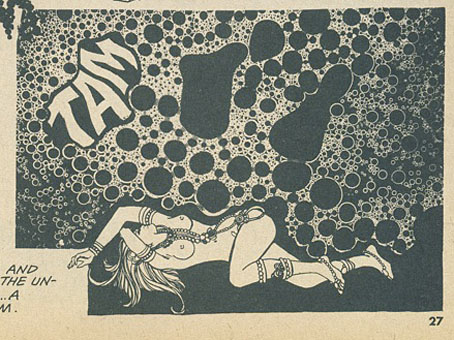
Psychedelic Kali from Vampirella 18.

Copies of the Dracula comics may be scarce these days but two of the artists who appeared in the title—Esteban Maroto and José Beá—were also appearing regularly in Vampirella around the same time. The Internet Archive has a large collection of Warren titles including an almost complete run of Vampirella. Esteban Maroto’s work stands out for me for his draughtsmanship, his page layouts, the atmosphere of heady eroticism, and the frequent touches of psychedelia of which the panel above is one of the more striking examples. The best strips are the ones he wrote himself; when he works with American writers the results tend to be more restrained. It’s a shame Vampirella was mostly a black-and-white title, so many of these pages would benefit from the same colour treatment as Wolff.

maroto01.jpg

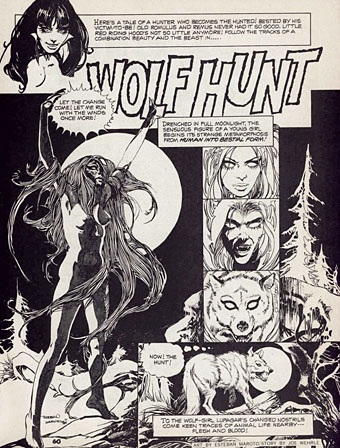
Wolf Hunt from Vampirella 14.

And speaking of wolves, there’s a similar collection of witches and lycanthropes in these stories.

maroto02.jpg

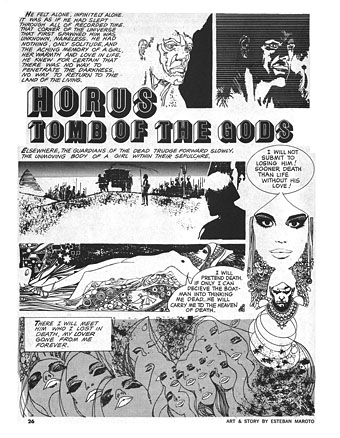
Tomb of the Gods: Horus from Vampirella 17.

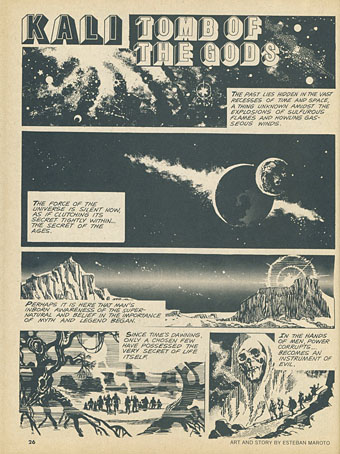
Tomb of the Gods is a short series in which mythological stories are explored Maroto-style. The exception is Gender Bender, a piece of science fiction with masculine and feminine psyches pitted against each other in a virtual arena. The story title is a surprise for anyone thinks that phrase originated in the 1980s.

maroto03.jpg

Tomb of the Gods: Kali from Vampirella 18.

Continue reading “More Esteban Maroto”