Audio Albion

audioalbion.jpg

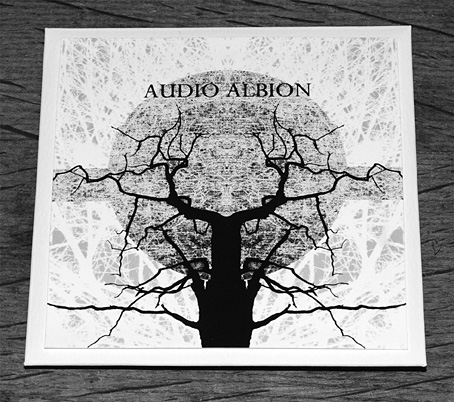
Last year saw a series of themed compilation albums from A Year In The Country, each of which was released a few months at a time. This year follows suit with Audio Albion, a collection of 15 new pieces of music from regular contributors such as David Colohan, Howlround, Keith Seatman, Sproatly Smith and others. The theme this time is “the sounds found and heard when wandering down pathways, over fields, through marshes, alongside rivers, down into caves and caverns, climbing hills, along coastlands, through remote mountain forestland, amongst the signs of industry and infrastructure and its discarded debris.”

Track list:
1) Bare Bones—Marshland Improvisation
2) David Colohan—On Stormy Point
3) Grey Frequency—Stapleford Hill
4) Field Lines Cartographer—Coldbarrow
5) Howlround—Cold Kissing
6) A Year In The Country—The Fields of Tumbling Ideas
7) Keith Seatman—Winter Sands
8) Magpahi—Shepsters in the Yessins
9) Sproatly Smith—Ethelbert & Mary
10) Widow’s Weeds—The Unquiet Grave
11) Time Attendant—Holloway
12) Spaceship—The Roding in Spate
13) Pulselovers—Thieves’ Cant
14) The Heartwood Institute—Hvin-lettir
15) Vic Mars—Dinedor Hill

As with previous A Year In The Country collections, the approaches are diverse, ranging here from the banjo-plus-location-recordings of Bare Bones to abstract electronic treatments by Howlround and Time Attendant. The accompanying texts are useful for contextualising the recordings; so David Colohan informs us that his piece, On Stormy Point, contains a whistle recording made in one of the caves at Alderley Edge in Cheshire, an important location in the Rural Wyrd via the popularisation of its myths in the novels of Alan Garner. Not everything here aims for a sinister atmosphere but the The Unquiet Grave by Widow’s Weeds certainly achieves this, a marvellous interpretation of one of the spookiest English folk songs, and the standout piece in an excellent collection.

Audio Albion will be released on 29th May but is available for pre-order now.

Previously on { feuilleton }
A Year In The Country: the book
All The Merry Year Round
The Quietened Cosmologists
Undercurrents
From The Furthest Signals
The Restless Field
The Marks Upon The Land
The Forest / The Wald
The Quietened Bunker
Fractures
Folk Horror Revival: Field Studies

The Quietened Cosmologists

quietened.jpg

It was a coincidence, but the destruction last week of the Cassini probe in the atmosphere of Saturn parallels the theme of the latest music collection from A Year In The Country:

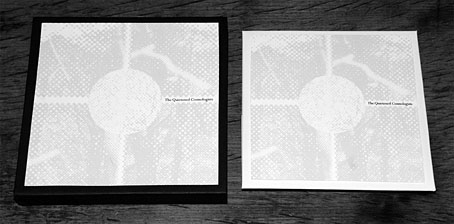
The Quietened Cosmologists is a reflection on space exploration projects that have been abandoned and/or that were never realised, of connected lost or imagined futures and dreams, the intrigue and sometimes melancholia of related derelict sites and technological remnants that lie scattered and forgotten.

It takes as its initial starting points the shape of the future’s past via the discarded British space program of the 1950s to 1970s; the sometimes statuesque and startling derelict artefacts and infrastructure from the Soviet Union’s once far reaching space projects; the way in which manned spaceflight beyond Earth’s orbit/to the moon and the associated sense of a coming space age came to be largely put to one side after the 1969 to 1972 US Apollo flights.

Track list:
1) Field Lines Cartographer — OPS-4
2) Pulselovers — Lonely Puck
3) Magpahi — Chayka
4) Howlround — Night Call, Collect
5) Vic Mars — X-3
6) Unit One — Voyages Of The Moon
7) A Year In The Country — The March Of Progress/Frontier Dreams
8) Keith Seatman — 093A-Prospero
9) Grey Frequency — Phantom Cosmonauts
10) Time Attendant — Adrift
11) Listening Center — Mlécný Perihelion Weekend
12) Polypores — The Amateur Astronomer
13) David Colohan — Landfall At William Creek

The Cassini expedition wasn’t a failed one, of course, but the destruction of the probe (planned from the outset to avoid space-junk wandering the Solar System) is a reminder of the realities of the Space Age, that this is a frontier with the same casualties and ruins as any other. The ruins of Britain’s own contribution to the Space Race—especially those like the abandoned launch-pad at High Down on the Isle of Wight—are all the more poignant for the gulf between their past ambition and present state of decay.

As you might expect, the entries on this collection tend towards the electronic, and there’s even an uptempo synth piece from Keith Seatman whose title—093A-Prospero—is a nod to one of the old British rockets. By way of contrast, David Colohan’s Landfall At William Creek sounds more pastoral unless you know that his title refers to the region of Australia where Britain’s rockets and nuclear missiles were tested during the 1950s and 1960s.

The Quietened Cosmologists will be released on 3rd October, and is available for pre-order now.

Previously on { feuilleton }
Undercurrents
From The Furthest Signals
The Restless Field
The Marks Upon The Land
The Forest / The Wald
The Quietened Bunker
Fractures

From The Furthest Signals

signals.jpg

It’s been a busy year so far for A Year In The Country with two themed compilation albums being followed this month by a third, From The Furthest Signals. The latest theme is an intriguing one, taking as its starting point the erasing of broadcast tapes by British TV companies in the 1960s and early 1970s which destroyed hundreds of hours of dramas, concerts and other programmes. This was done as a money-saving measure (tape being expensive and reusable) at a time when the output of the BBC and the independent stations was regarded as mostly ephemeral and of little value. There was also a patronising class aspect to the practice: John Peel used to bitterly remind people that the BBC had saved its tapes of gardening shows while wiping concerts by the likes of Captain Beefheart.

Track list:
1) Circle/Temple – The Séance/Search for Muspel-Light
2) David Colohan – Brass Rubbings Club (Opening Titles)
3) A Year In The Country – A Multitude Of Tumblings
4) Sharron Kraus – Asterope
5) Time Attendant – The Dreaming Green
6) Depatterning – Aurora In Andromeda
7) Sproatly Smith – The Thistle Doll
8) Field Lines Cartographer – The Radio Window
9) Grey Frequency – Ident (IV)
10) Keith Seatman – Curious Noises & Distant Voices
11) Polypores – Signals Caught Off The Coast
12) The Hare And The Moon – Man Of Double Deed
13) Pulselovers – Endless Repeats/Eternal Return
14) Listening Center – Only The Credits Remain

All those wiped broadcasts may be lost down on Earth but they still exist somewhere in the halo of television and radio signals which is expanding into space. From The Furthest Signals is a speculation about the content of these remote signals, a tuning in to decayed transmissions and imagined broadcasts (that word—”broadcast”—being examined here in its widest possible sense). Some of the entries nod to fictional analogues: The Séance/Search For The Muspel Light by Circle/Temple is a reference to A Voyage to Arcturus, David Lindsay’s unique and remarkable science-fiction novel. Other entries like Brass Rubbings Club (Opening Titles) by David Colohan are suggestions for imaginary theme tunes. This is an excellent collection, one of the best to date from A Year In The Country with pieces ranging from the folk-oriented balladry of Sproatly Smith to the deteriorating electronics of Grey Frequency. The album ends with a number by Listening Center, Only The Credits Remain, whose weightless harmonies wouldn’t be out of place on Apollo by Brian Eno & Daniel Lanois.

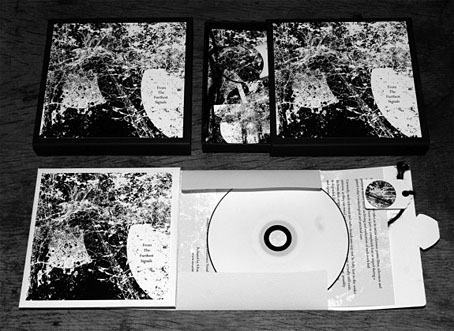
From The Furthest Signals is out now in the familiar range of hand-crafted monochrome formats.

Previously on { feuilleton }
The Restless Field
The Marks Upon The Land
The Forest / The Wald
The Quietened Bunker
Fractures

The Restless Field

restless.jpg

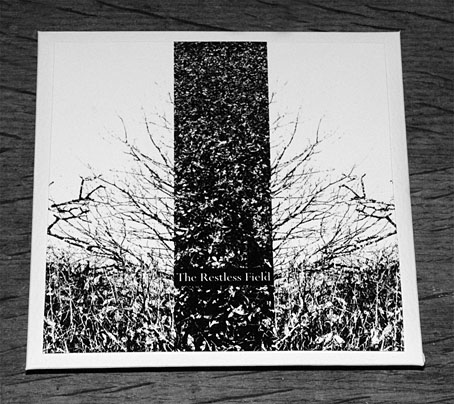
The advent of Spring brings a new CD release from A Year In The Country. The Restless Field is another themed compilation, and one of their best to date, the theme this time being the British landscape as a site for political resistance:

The Restless Field is a study of the land as a place of conflict and protest as well as beauty and escape; an exploration and acknowledgment of the history and possibility of protest, resistance and struggle in the landscape/rural areas, in contrast with sometimes more often referred to urban events. It takes inspiration from flashpoints in history while also interweaving personal and societal myth, memory, the lost and hidden tales of the land.

References and starting points include: The British Miners Strike of 1984 and the Battle Of Orgreave. Gerrard Winstanley & the Diggers/True Levellers in the 17th century. The first battle of the English Civil War in 1642. The burying of The Rotherwas Ribbon. The Mass Trespass of Kinder Scout in 1932. Graveney Marsh/the last battle fought on English soil. The Congested Districts Board/the 19th century land war in Ireland. The Battle Of The Beanfield in 1985.

Track list:
1) Ghosts Of Blood & Iron — Field Lines Cartographer
2) Mortimer’s Cross — Vic Mars
3) [ fears ] avaunt! upon “the” hill — Bare Bones
4) 3am M5 Field Raid — Assembled Minds
5) Agrarian Lament — Grey Frequency
6) Beneath The Cherry Trees — Endurance
7) Congested District — Listening Center
8) Badby 80 — Pulselovers
9) Ribbons — Sproatly Smith
10) Graveney Marsh — Polypores
11) Last Best West (circ. 1896) — Depatterning
12) Black Slab — Time Attendant
13) A Mutable History Under A Bright June Sky — A Year In The Country
14) Beyond Jack’s Gate — David Colohan

All of the compositions this time are instrumentals so the degree to which the music relates to the theme depends upon the interpretation of the listener; some pieces, such as 3am M5 Field Raid, offer an overt clue in the title. The success of the collection as a whole is also open to question; it may be that the artists are becoming more confident—many of the people here have appeared on previous AYITC releases—or that the theme this time was more stimulating than others have been.

For the past week or so I’ve been listening to Coil almost exclusively so I hear a lot of Coil echoes in these pieces. I doubt that these are intentional—although given shared concerns, some of them may be—but by 2000 Coil’s music had moved away from the urban orientation of the 1980s to a pastoral mysticism that also had a political impetus: “The forest is a college / Each tree a university”. Late Coil also involved the construction of fields of sound, the products of fields of another kind: electrical and (possibly) psychical. I can’t speak for the latter quality but there’s plenty of the former in this collection of restless fields.

The album will be released on 2nd May, and is available for pre-order now.

Previously on { feuilleton }
The Marks Upon The Land
The Forest / The Wald
The Quietened Bunker
Fractures

The Quietened Bunker

bunker.jpg

Bunkers were a recurrent feature in the media of the 1980s, a consequence of increasing Cold War tensions following the election of Ronald Reagan and the Soviet invasion of Afghanistan. The decade birthed new horrors of the body-mutating variety, and also reanimated some older ones in the figure of the knife-wielding psychopath, but the omnipresent spectre of nuclear war posed a threat not only to characters in films and TV serials but to the audiences who watched them. That threat manifests most strikingly in the middle of the decade with the TV film Threads (1984), the TV serial Edge of Darkness (1985), and the comic-book serial/graphic novel Watchmen (1986–87). To these you could add feature films such as WarGames (1983) and James Cameron’s The Terminator (1984) and its sequel. Not all of these works feature bunkers but nuclear warfare by its very nature implies the existence of subterranean control centres with all their latent mythological resonances. Some of those resonances are played with in David Rudkin’s Penda’s Fen (1974) and Artemis 81 (1981), the latter featuring an extended sequence in a sinister subterranean complex. Troy Kennedy Martin’s superb nuclear thriller, Edge of Darkness, runs the gamut of underground enclaves, from labyrinthine cave systems and abandoned nuclear shelters to a dusty Cold War command centre with a telephone link to Downing Street.

Bunkers of the abandoned variety provide the theme for the latest compilation album from A Year In The Country:

The Quietened Bunker is an exploration of the abandoned and/or decommissioned Cold War installations which lie under the land and that would have acted as selectively populated refuges/control centres if the button was ever pushed; a study and reflection on these chimeric bulwarks and the faded but still present memory of associated Cold War dread, of which they are stalwart, mouldering symbols.

Track list:
1) Lower Level Clock Room – Keith Seatman
2) Drakelow Tunnels – Grey Frequency
3) The Filter’s Gone / The Last Man Plays The Last Piano – A Year In The Country
4) Aggregates II – Panabrite
5) Bunker 4: Decommissioned – Polypores
6) Comms: Seen Through The Grey – Listening Center
7) Crafty Mechanics – Time Attendant
8) Crush Depth – Unknown Heretic
9) Waiting For The Blazing Skies – David Colohan

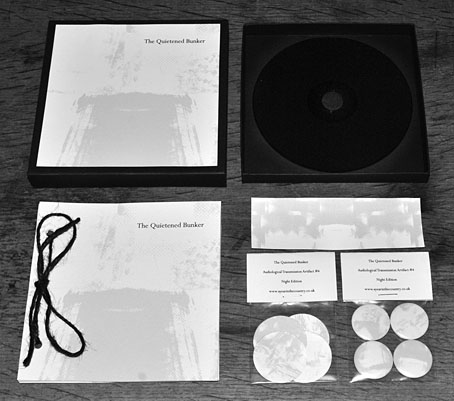
This is another quality collection in distinctive black-and-white packaging that will be of immediate interest to anyone who enjoys the releases on the Ghost Box label (Listening Center are already Ghost Box artists): spectral pianos, shortwave radios, ambient chords. The bunker theme connects to shared concerns among related artists with the old Civil Defence films, samples of which have been used on releases by The Advisory Circle and Mordant Music. The Cold War bunker is more than another empty space, it joins the bio-weapons lab (see The Satan Bug) as a source of contemporary horror that doesn’t require any supernatural component to chill the blood.

Previously on { feuilleton }
Fractures