The Avant Garde Project

electronic.jpg

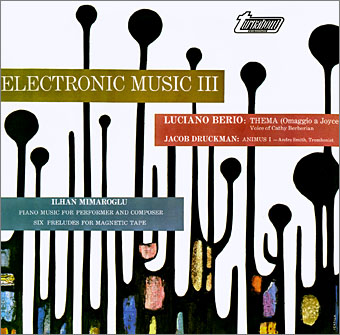
One of the great electroacoustic compilations, Electronic Music III: Berio/Druckman/Mimaroğlu, Turnabout Records (1967).

I’ve spent the past week or so immersed in the world of electroacoustic composition courtesy of torrents provided by the Avant Garde Project. Wikipedia attempts a definition of electroacoustic music and thus saves me the trouble:

While all electroacoustic music is made with electronic technology, the most successful works in the field are usually concerned with those aspects of sonic design which remain inaccessible to either traditional or electronic musical instruments played live. In particular, most electroacoustic compositions make use of sounds not available to, say, the traditional orchestra; these sounds might include pre-recorded sounds from nature or from the studio, synthesized sounds, processed sounds, and so forth.

Much of it is early electronic music, in other words, produced either with tape machines or rudimentary synth modules or a combination of the two. The Avant Garde Project is devoted to making available 20th century classical-experimental-electroacoustic recordings that are unavailable on CD. I’m less interested in the orchestral end of the project, unless it’s work by favourites such as Penderecki or Iannis Xenakis, but it’s good to know that they’re making the effort especially when much of this work remains on vinyl albums that are forty years old. The releases are listed as AGP1 onwards up to the most recent, AGP99, which happens to be music by Xenakis.

To say this stuff is challenging is something of an understatement, most people have little patience for lengthy compositions of artificial shrieks, squawks and blips, trombones fed through ring modulators or trained singers burbling extracts from Finnegans Wake. Despite the fact that many of these experiments form the foundation of today’s electronic music culture, the popular conception of the electroacoustic composer has been that he must be either a psycho rapist, like Chris Sarandon’s character in Lipstick, or a loveless neurotic, like John Hurt’s character in The Shout; decent people dig the Beatles and play guitars like, er…Charles Manson. Stereotypes aside, not all of it is necessarily alienating. Most people wouldn’t realise it but much of the early music for Doctor Who was electroacoustic, including Delia Derbyshire‘s rendering of the famous theme tune.
songmy.jpgSome of this work offers little today beyond curiosity value since a great deal of it was the product of a particular moment in the development of recording and electronic technology, a moment that passed as technology and tastes changed and many of the experiments became absorbed by pop music. Some of the composers were mere doodlers compared to later electronic artists but among the better practitioners in the AGP haul there’s Turkish composer İlhan Mimaroğlu, an expert audio collagist whose rare work is collected in three sets covering the years 1964–1983 (AGP30–32).

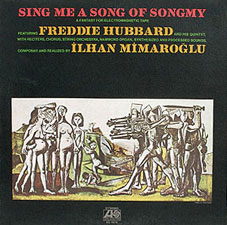
Mimaroğlu stands with one foot in the academic world and the other in the more popular areas of jazz and soundtrack composition. Together with another electroacoustic composer, Tod Dockstadter, he provided music for the score of my favourite Fellini film, Satyricon, and his position at Atlantic Records enabled him to collaborate with trumpet player Freddie Hubbard on one of the more bizarre jazz albums of a decade full of bizarre jazz works, Sing Me a Song of Songmy from 1971. Subtitled “A Fantasy for Electromagnetic Tape”, this anti-Vietnam war polemic mixes electroacoustic passages combining spoken word and musical quotes, poetry and sound effects with Hubbard’s Quintet grooving away as though they’d wandered in from the studio next door. The opening piece is always a good conversation stopper, “Threnody for Sharon Tate”, which features two women reading quotes about murder from associates of the aforementioned Mr Manson while electronic shrieks build unnervingly in the background.

Nothing on the AGP releases is this dramatic, unfortunately, but if you want a taste of Mimaroğlu’s lighter side, his Prelude for Magnetic Tape XI on AGP30 is three minutes of processed sounds from plucked rubber bands. And if the human music is too much, you could always try the cetaceans; AGP28 is the original collection of whale recordings, Songs of the Humpback Whale. The AGP page says they had to remove a few tracks that are now back in print but the copy I found on a torrent site was the complete album.

Previously on { feuilleton }
Electric Seance by Pram
White Noise: Electric Storms, Radiophonics and the Delian Mode
Ghost Box
The Photophonic Experiment
The music of Igor Wakhévitch

Electric Seance by Pram

electric_seance.jpg

The (Electric Seance) concept was inspired by the discovery that many early pioneers and inventors of electrical apparatus and radiophonic equipment believed that they could use their inventions to contact ‘the other side’.

Scott Johnston

This month’s issue of The Wire has Birmingham group Pram on the cover. Inside they discuss working with filmmaker Scott Johnston whose Electric Seance production was used as part of the group’s Photophonic Experiment shows last year. I have to admit I was never much taken with Pram’s early work, preferring their Too Pure stablemates Laika and Mouse on Mars circa 1997. (Having said that, I’m listening to their Helium album now and it sounds better than I remembered.) I did appreciate the references, however, which encompassed a range of interests including White Noise, Maya Deren and the films of Karel Zeman, all of whom have been the subjects of previous posts here. The band were keen to produce an alternative soundtrack for Zeman’s Invention of Destruction but the Czech Film Archive refused their offer.

electric_seance2.jpg

Pram seem to have become more interesting in the intervening years, unlike their compatriots. Laika lost me when they got too poppy while Mouse on Mars abandoned melody for a blizzard of increasingly tiresome electronic abstraction. Electric Seance gives some idea of where Pram are at now which isn’t too far removed from the same world of retro-electronica and English spookiness being explored by the Ghost Box artists. The Wire has the soundtrack to Electric Seance as a free download.

And following from yesterday’s reference to Last Year in Marienbad, another film in Scott Johnston’s YouTube collection, The Arranged Time, is a tale of sinister recursion which he says is indebted to Resnais’s classic enigma.

Previously on { feuilleton }
White Noise: Electric Storms, Radiophonics and the Delian Mode
The Séance at Hobs Lane
New Delia Derbyshire
A playlist for Halloween
Ghost Box
The Photophonic Experiment

Another playlist for Halloween

bauhaus.jpg

A follow-up to last year’s list. Seeing as Joy Division are very much in the news at the moment with the release of Control and the re-issue of the albums, I thought a post-punk theme would be appropriate. The period which immediately followed punk in the late Seventies saw a lot of doom being imported into what was then still a proper alternative to the mainstream of popular music. This trend quickly ossified into the distinct and far less adventurous genres of goth and post Throbbing Gristle/Cabaret Voltaire industrial but between 1978 and 1982 everything was in a state of fascinating flux.

Hamburger Lady (1978) by Throbbing Gristle.
TG’s heart-warming ode to a burns victim.

6am (1979) by Thomas Leer & Robert Rental.
Leer and Rental’s The Bridge album was originally one of the few none-Throbbing Gristle releases on TG’s Industrial label, one half songs, the other moody electronic instrumentals. 6am perfectly conjures a picture of empty streets at dawn and sounds like a precursor of Ennio Morricone’s score for The Thing.

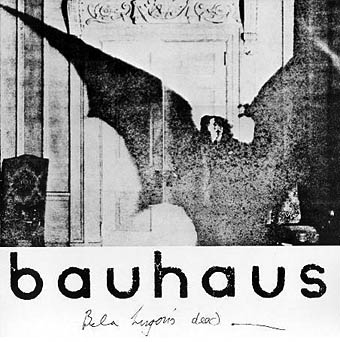
Bela Lugosi’s Dead (1979) by Bauhaus.
The first Bauhaus single and the only song of theirs I liked. Put to great use at the beginning of the otherwise pretty risible The Hunger.

Day Of The Lords (1979) by Joy Division.
If anything shows that Ian Curtis was a Romantic in the 19th century sense, it’s this grandiose wallow in the atrocities of history. “Where will it end?”

James Whale (1980) by Tuxedomoon.
Church bells toll and a lonely violin shrieks for the director of the Universal Frankenstein films.

Halloween (1981) by Siouxsie & the Banshees.
With a title like that, how could it not be included here?

Goo Goo Muck (1981) by The Cramps.
Always superior collagists of rockabilly weirdness and early garage riffs, The Cramps started out in the horror camp (“camp” being a big part of their act) with the Gravest Hits EP. Goo Goo Muck was a cover of a great single by (I kid not) Ronnie Cook & the Gaylads. “When the sun goes down and the moon comes up / I turn into a teenage goo goo muck.”

Raising The Count (1981) by Cabaret Voltaire.
An obscure moment of resurrection originally on the Rough Trade C81 cassette compilation from the NME.

Gregouka (1982) by 23 Skidoo.
Gregorian monks meet Moroccan pipes and drums with the result sounding like a voodoo ceremony taking place in cathedral catacombs.

The Litanies Of Satan (1982) by Diamanda Galás.
The formidable Ms Galás was part of last year’s list and her first album is just as hair-raising as her later works. The second part is the marvellously titled Wild Women With Steak-knives (The Homicidal Love Song For Solo Scream).

Happy Halloween!

Previously on { feuilleton }
White Noise: Electric Storms, Radiophonics and the Delian Mode
The Séance at Hobs Lane
A playlist for Halloween
Ghost Box

White Noise: Electric Storms, Radiophonics and the Delian Mode

white_noise.jpg

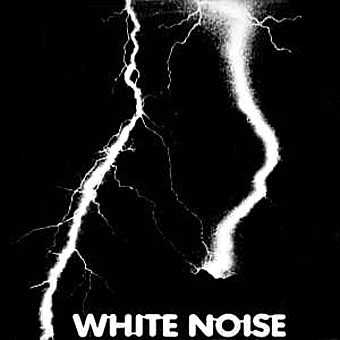
Many sounds have never been heard—by humans: some sound waves you don’t hear—but they reach you. “Storm-stereo” techniques combine singers, instrumentalists and complex electronic sound. The emotional intensity is at a maximum. Sleeve note for An Electric Storm, Island Records, 1969.

An Electric Storm by White Noise is reissued in a remastered edition this week. It’s a work of musical genius and I’m going to tell you why.

Hanging around with metalheads and bikers in the late Seventies meant mostly sitting in smoke-filled bedrooms listening to music while getting stoned. Among the Zeppelin and Sabbath albums in friends’ vinyl collections you’d often find a small selection of records intended to be played when drug-saturation had reached critical mass. These were usually something by Pink Floyd or Virgin-era Tangerine Dream but there were occasionally diamonds hiding in the rough. I first heard The Faust Tapes under these circumstances, introduced facetiously as “the weirdest record ever made” and still a good contender for that description thirty-four years after it was created. One evening someone put on the White Noise album.

It should be noted that I was no stranger to electronic music at this time, I’d been a Kraftwerk fan since I heard the first strains of Autobahn in 1974 and regarded the work of Wendy Carlos, Tangerine Dream, Brian Eno and Isao Tomita as perfectly natural and encouraging musical developments. But An Electric Storm was altogether different. It was strange, very strange; it was weird and creepy and sexy and funny and utterly frightening; in places it could be many of these things all at once. Electronic music in the Seventies was for the most part made by long-hairs with banks of equipment, photographed on their album sleeves preening among stacks of keyboards, Moog modules and Roland systems. You pretty much knew what they were doing and, if you listened to enough records, you eventually began to spot which instruments they were using. There were no pictures on the White Noise sleeve apart from the aggressive lightning flashes on the front. There was no information about the creators beyond their names and that curious line about “the emotional intensity is at a maximum”. And the sounds these people were making was like nothing on earth.

Continue reading “White Noise: Electric Storms, Radiophonics and the Delian Mode”

Wanna see something really scary?

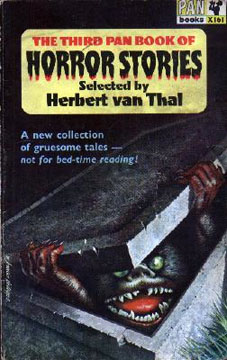
pan_horror.jpgXeni Jardin and Boing Boing readers reminisce today about the childhood traumas inspired by Sesame Street characters. Wimps, say I, although in fairness I was too old to be frightened of Muppetry by the time that stuff appeared on British TV screens.

Scariest thing in the Coulthart household, easily out-classing anything on children’s television (Doctor Who monsters included), was the cover of the third Pan Book of Horror Stories. My parents had a small collection of paperbacks from the early Sixties which included some horror and occult fiction. My sister and I found this book one day while rooting in an old suitcase and were both mortified by it. I seem to remember there being dares to go and look at it again and also have vague recollections of at least one nightmare occurring as a result. A shame there isn’t a larger scan available since I’m curious to know who the artist was.

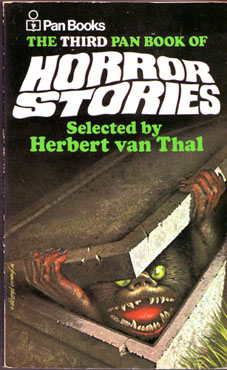
pan_horror2.jpgA few years later I was reading the Pan series myself although I never went back to this particular one. Herbert van Thal’s selections got off to a good start, reprinting old horror classics with newer fiction, but soon degenerated into detailed and repetitive tales of dismemberment and blood-letting, the kind of stuff that makes you think “cool” when you’re a teenage boy but which is otherwise worthless. Most of the writers in the later books are unheard of elsewhere which makes me suspect they were probably hacks earning a quick couple of quid writing under pseudonyms. The strangest thing about volume three now is looking at the contents list and seeing that we had stories by William Hope Hodgson and Algernon Blackwood in the house all that time and I never knew it.

Update: The cover artist was W Francis Phillips.

Elsewhere on { feuilleton }
The book covers archive

Previously on { feuilleton }
Druillet meets Hodgson
A playlist for Halloween
Ghost Box
Le horreur cosmique