Strange Attractions

squid.jpg

Giant Squid of the Newfoundland Banks. From a painting by Herbert B Judy.

Today’s Giant Squid comes to you courtesy of the University of Washington’s Digital Collection and their Freshwater and Marine Image Bank. This book plate is from Sea-shore Life; The Invertebrates of the New York Coast and the Adjacent Coast Region (1905) by Alfred Goldsborough Mayor, and the Internet Archive happens to have copies of the entire book.

sasalon.jpg

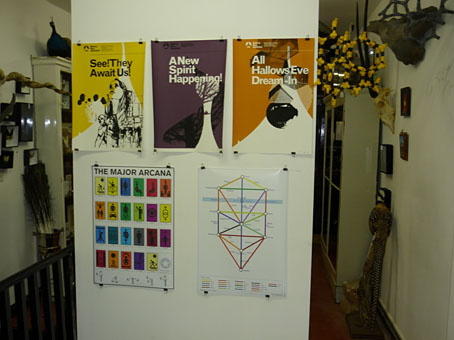
Which facts have nothing whatsoever to do with Ken Hollings’ photos of the Strange Attractor Salon which is in its final week at Viktor Wynd Fine Art, London. I was pleased to see the picture above which shows my pieces on the same wall as work by Julian House whose covers for the Ghost Box CDs I’ve enthused over in the past. Strange Attractor curator Mark Pilkington has posted further photos on his Flickr pages as has artist Ali Hutchinson whose beautiful work is also featured there.

Previously on { feuilleton }
Strange Attractor Salon
Readouts
Welcome to Mars
The Séance at Hobs Lane
SAJ again
Strange Attractor Journal Three
Ghost Box
The Major Arcana

A playlist for Halloween: Voodoo!

voodoo1.jpg

It’s become a tradition here to post a playlist for Halloween so here’s the one for this year, a collection of favourite “voodoo” music. Most are these pieces have as much to do with real voodoo as Bewitched does with real witchcraft but I like the atmospheres of Voodoo Exotica they evoke.

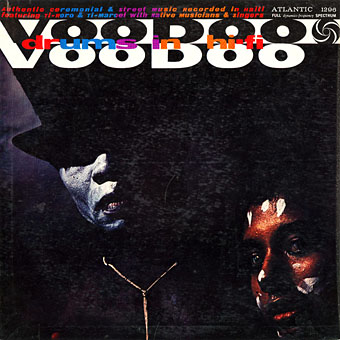
Voodoo Drums in Hi-Fi (1958).
Beginning with some ethnographic authenticity, this is one of many recordings of genuine (so they claim) voodoo drummers from Haiti, and was probably released to cash-in on the Exotica boom of the late Fifties. For the genuine article, the drums here sound less dramatic than the pounding rhythms familiar from Hollywood rituals, but that’s still a great cover. Voodoo Drums in Hi-Fi has been deleted for years but a worn copy of the vinyl release can be found on various mp3 blogs. For a more recent recording of voodoo rhythms, there’s Spirits Of Life: Haitian Vodou on the Soul Jazz label.

Voodoo Dreams (1959) by Martin Denny.
This, meanwhile, is the genuine kitsch from Denny’s Hypnotique album, a slow arrangement of a syrupy Les Baxter tune. More drums and bongos than usual for a Denny piece, and a suitably spectral chorus.

Voodoo (1959) by Robert Drasnin.
When composer Drasnin was asked by the Tops company to get hip to the Exotica craze the result was an album entitled Voodoo (with unconvincingly exotic white people on the cover), from which they released a single, Chant of the Moon, and this track as the B-side, one of the best pieces on the album.
voodoo2.jpg

I Walk on Gilded Splinters (1968) by Dr John.
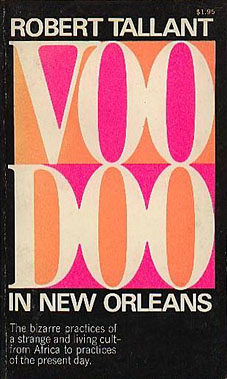
Mac Rebennack was working as a session musician in Los Angeles when he recorded his debut album in an atmosphere far removed from the swampy New Orleans miasma which the music conjures. Gris-Gris owes a great deal to Robert Tallant’s book, Voodoo in New Orleans (1946), a popular recounting of the city’s occult legends from which Rebennack borrowed not only his new persona (chapter 5 concerns the history of the real Dr John, a 19th century voodoo practitioner) but also many of the transcribed chants which he set to music. In chapter 3 we read this:

A song given to a reporter of the New Orleans Times-Picayune was printed in that newspaper on March 16, 1924. Probably a very old one, it reflects the dominance of the queens in New Orleans Voodoo and boasts of their tremendous power. Originally sung in the patois known as Creole, it is given here in English:

They think they frighten me,
Those people must be crazy.
They don’t see their misfortune
Or else they must be drunk.

I—the Voodoo Queen,
With my lovely headkerchief
Am not afraid of tomcat shrieks,
I drink serpent venom!

I walk on pins
I walk on needles,
I walk on gilded splinters,
I want to see what they can do!

They think they have pride
With their big malice,
But when they see a coffin
They’re as frightened as prairie birds.

I’m going to put gris-gris
All over their front steps
And make them shake
Until they stutter!

Anyone familiar with Gris-Gris will recognise the lyrics of I Walk on Gilded Splinters (misspelled “Guilded” on the sleeve) which Dr John did a great job of fashioning into a classic voodoo song. The entire album might be ersatz, then, but it remains one of my favourites by anyone, and for me it’s still the best Dr John album.

Mama Loi, Papa Loi (1970) by Exuma.
Gris-Gris was too weird to be a success when it first appeared but Dr John’s music and extravagant stage presence were very distinctive and helped Blues Magoos manager Bob Wyld recast singer Tony McKay as “Obeah man” Exuma for Mercury Records. Exuma’s self-titled debut album is ersatz stuff again but manages to sound even more deliriously swampy and sorcerous than Gris-Gris, with jungle sounds, zombie gurgles and a clutch of enthusiastic voodoo-inflected songs. “Mama Loi, Papa Loi / I see fire in the dead man’s eye” he sings here, and for the duration of the album Tony McKay is Exuma.

Zu Zu Mamou (1971) by Dr. John.
After Gris-Gris Dr John gradually pared away the voodoo songs but saved one of the best until his final occult outing, The Sun, Moon & Herbs, which includes contributions from Eric Clapton and, somewhere in the bayou distance, Mick Jagger and PP Arnold on backing vocals. Zu Zu Mamou is the spooky highlight which made a fleeting appearance in Alan Parker’s 1987 Satanic noir, Angel Heart.

Voo Doo (1989) by the Neville Brothers.
Of all the songs I’ve heard which equate falling in love with a voodoo spell, this one from New Orleans’ Neville Brothers is the most evocative, a track from their marvellous Yellow Moon album.

Invocation To Papa Legba (1989) by Deborah Harry.
Yes, it’s Blondie’s Debbie Harry singing a very authentic-sounding voodoo chant, arranged by Chris Stein. This was a one-off which appeared on a Giorno Poetry Systems collection, Like A Girl, I Want You To Keep Coming, along with a William Burroughs reading (a staple of GPS albums), New Order playing Sister Ray live, and other pieces.

Litanie Des Saints (1992) by Dr. John.
Goin’ Back to New Orleans, like Gumbo before it, saw Dr John revisiting the musical history of his native city. Most of the songs are old jazz and blues covers with the notable exception of this opening number, another voodoo invocation. A great string arrangement and vocals from the Neville Brothers; I’d love to hear a whole album like this.
voodoo3.jpg

Zombie’ites (1993) by Transglobal Underground.
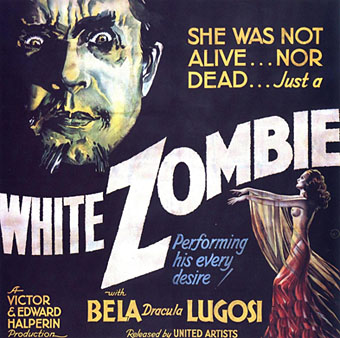
Zombies are a voodoo staple despite their current degraded status as the cuddly monster du jour, a development which has made me tire of seeing the word “zombie” in almost any context. A shame because I used to have a lot of time for films such as White Zombie (1932), I Walked With a Zombie (1943), and the later George Romero movies. White Zombie was the first zombie film and stars Bela Lugosi in a weirder and more effective piece of horror cinema than the stagey Dracula which made his name; I Walked With a Zombie was one of Val Lewton’s superb noirish collaborations with Jacques Tourneur; both films have their voodoo chants sampled on this track by Transglobal Underground from Dream of 100 Nations, with the opening chant from White Zombie forming the pulse that drives the piece. Along the way there’s another invocation from Voodoo in New Orleans—”L’Appé vini, le Grand Zombi / L’Appé vini, pou fe gris-gris!”—samples of Criswell from Plan 9 from Outer Space, and a moment of pure bliss at the midpoint when singer Natacha Atlas rides in on a magic carpet made of Bollywood strings.

Happy Halloween! And don’t forget to feed the loas…

Vampire-hunting in New Orleans

Previously on { feuilleton }
Voo-doo: Hoochie Coochie and the Creative Spirit
Dead on the Dancefloor
Another playlist for Halloween
Exotica!
White Noise: Electric Storms, Radiophonics and the Delian Mode
The Séance at Hobs Lane
Exuma: Obeah men and the voodoo groove
A playlist for Halloween
Ghost Box
Voodoo Macbeth

Readouts

hal9000.jpg

The HAL Project.

January flew by in a blizzard of work so posting here tended to rely more on pictures than words. As usual the things I’ve been designing will be unveiled when they’re closer to being published or released but for now here’s some new or not-so-new items worthy of note.

The HAL Project screensaver. I’ve never had much time for gaudy screensavers, I prefer something which doesn’t get annoying when I’m otherwise engaged. For a while now I’ve been using the Mac-only Lotsawater which turns your monitor into a vertical water tank with slow motion ripples. I replaced that this week with Joe Mackenzie’s HAL Project screensaver (for Mac and Windows) which throws up random samplings of the HAL 9000 monitor animations from 2001: A Space Odyssey. Sounds a bit dull until you see it in action, very crisp and detailed graphics, many of which mimic the animations of those in the film. I’ve belatedly realised how similar these fields of colour and their lines of white type are to the opening titles of A Clockwork Orange, yet another connection between the two films. Now I can sit trying to figure out some of the less obvious 3-letter codes for the spacecraft’s systems; Stanley Kubrick was so thorough you just know they all mean something.

Via the Kubrick obsessives at Coudal.

A pair of new blogs. Designer Barney Bubbles should need little introduction here but if you require one then read this. Paul Gorman has been in touch to inform me of a new online companion to his BB book, Reasons To Be Cheerful, which already looks like a treat with displays of Bubbles creations that didn’t make the book.

Writer Russ Kick was also in touch this week with news of his books and book culture blog, Books Are People, Too. Russ is the author of several books for Disinformation and his Memory Hole website notoriously caused a headache for the Bush regime when he forced photos of flag-draped coffins returning from Iraq onto the front pages of American newspapers.

Songs of the Black Würm Gism. And speaking of books, the much delayed sequel to DM Mitchell’s landmark Lovecraft anthology, The Starry Wisdom comes shambling into the light of day at last. The Creation Oneiros website describes it thus:

The Black Würm Gism Cult – oceanic insect porn – a vortex of cosmic mayhem stalked by ravening lysergic entities – a post-human psychedelic seizure of Lovecraftian text, art and fragments. SONGS OF THE BLACK WÜRM GISM picks up where the acclaimed anthology THE STARRY WISDOM left off and goes beyond – way beyond! – what H.P. Lovecraft dared to show. Editor D.M. Mitchell presents an illustrated brainstorm of visceral deep-sea dream currents, aberrant trans-species sex visions, and frenzied ophidian entropy.

Contributors include: alan moore (cover illustration), john coulthart (introduction), grant morrison, david britton, ian miller, john beal, david conway, kenji siratori, herzan chimera, james havoc, reza negarestani, & many others

Yes, the rather pompous introduction for this volume is mine and the cover is Alan Moore’s psychedelic arachnoid rendering of the demon Asmodeus, the same picture I used to create my little hidden film on the Mindscape of Alan Moore DVD. The Starry Wisdom roused a vaporous fury among the more staid Lovecraft readers so I look forward to seeing what squeaks of outrage this new book inspires. Publication is set for September 2009 but you can order it now from Amazon and other outlets.

ghost_box.jpg

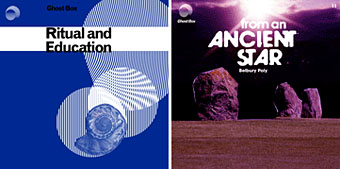
Ghost Box haunts again. And if anything was going to provide a suitable soundtrack to “aberrant trans-species sex visions, and frenzied ophidian entropy” you could do worse than some of the works of the Ghost Box collective, especially the spooky and abrasive Ouroborindra by Eric Zann. Ritual and Education is a new download-only sampler of Ghost Box tracks and probably an ideal place to start if your curiosity is piqued by my recurrent raves about these releases. From An Ancient Star is the latest CD from Belbury Poly which swaps the Pelican Books graphics of earlier works for a convincing piece of crank lit. cover art which wouldn’t look out of place in the RT Gault archives.

Previously on { feuilleton }
The Demon Regent Asmodeus
The Séance at Hobs Lane
Ghost Box
2001: A Space Odyssey program

Dead on the Dancefloor

suspiria.jpg

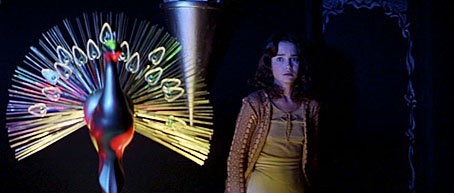
Suspiria: Jessica Harper and a bird with crystal plumage.

For this year’s Halloween playlist I’ve let Mark Pilkington from Strange Attractor make the selection. The following is from a CD-R collection of Italian horror soundtracks that Mark sent me some time ago. Not everything here is easy to find but the superbly nerve-jangling racket created by Goblin to accompany Dario Argento’s equally superb Suspiria (1977) is widely available and ideal Halloween listening.

If one hasn’t been written already, there’s probably a thesis to be found in the influence of progressive rock on Italian cinema. Many of these pieces represent a curious blending of the kind of Italian prog-rock exemplified by bands such as PFM together with the scores of (inevitably) Ennio Morricone. William Friedkin’s use of the opening of Mike Oldfield’s Tubular Bells in The Exorcist inspired legions of imitative themes in subsequent horror films, not least Suspiria. Dario Argento later brought in ELP’s Keith Emerson for the sequel, Inferno (1980), whose main theme—a kind of disco version of Jerry Goldsmith’s Latin chants from The Omen—I’ve always been rather partial to. The best of this music manages to be groovy and scary at the same time, Goblin being the masters in that department, and is often better than the films it was written for. The perfect thing for zombies in satin flares.

Cannibal Holocaust (Main theme) by Riz Ortolani
Death Dies (Profondo Rosso) by Goblin
Zombie Flesh Eaters (theme) by Fabio Frizzi
Sighs (Suspiria) by Goblin
Suoni Dissonanti (City of the Living Dead) by Fabio Frizzi
Flashing (Tenebrae) by Goblin
Adulteress’ Punishment (Cannibal Holocaust) by Riz Ortolani
Suspiria by Goblin
Voci Dal Nulla (The Beyond) by Fabio Frizzi
Deep Shadows (Profondo Rosso) by Giorgio Gaslini & Goblin
L’alba Dei Morti Viventi (Dawn of the Dead) by Goblin
Suono Aperto (The Beyond) by Fabio Frizzi
Markos (Suspiria) by Goblin
The Dead On Main St/Voodoo Rising (Zombie Flesh Eaters) by Fabio Frizzi
Escape From The Flesh Eaters (Zombie Flesh Eaters) by Fabio Frizzi
Roller (Non-soundtrack album) by Goblin

dead.jpg

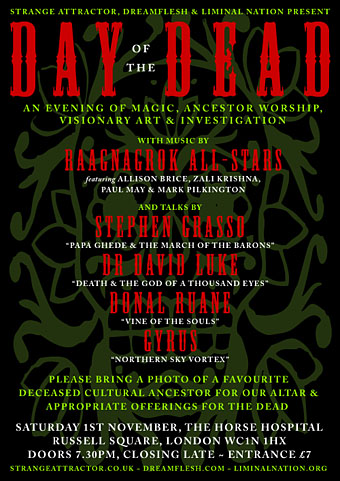
And while we’re on the subject of music and Halloween, Mark Pilkington is playing as part of the Raagnagrok All-Stars on November 1st at the Horse Hospital, London, as part of a Day of the Dead event. More about that here.

Happy Halloween!

Previously on { feuilleton }
Another playlist for Halloween
White Noise: Electric Storms, Radiophonics and the Delian Mode
The Séance at Hobs Lane
A playlist for Halloween
Ghost Box

The Willows by Algernon Blackwood

willows.jpg

Light play on the river Thame by net_efekt.

…the major products of Mr. Blackwood attain a genuinely classic level, and evoke as does nothing else in literature an awed convinced sense of the imminence of strange spiritual spheres of entities.

The well-nigh endless array of Mr. Blackwood’s fiction includes both novels and shorter tales, the latter sometimes independent and sometimes arrayed in series. Foremost of all must be reckoned The Willows, in which the nameless presences on a desolate Danube island are horribly felt and recognised by a pair of idle voyagers. Here art and restraint in narrative reach their very highest development, and an impression of lasting poignancy is produced without a single strained passage or a single false note.

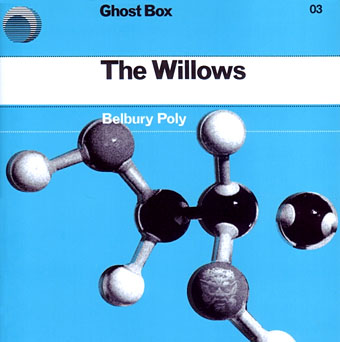
Thus HP Lovecraft in 1927 from his lengthy overview of horror fiction, Supernatural Horror in Literature. Lovecraft was enthusiastic about many of Blackwood’s weird tales, rating him as one of the contemporary masters along with Arthur Machen. A year before his essay he prefaced The Call of Cthulhu with a Blackwood quote and regularly referred to The Willows as one of his favourite stories. Blackwood’s tale continues to find enthusiasts today, among them the Ghost Box music collective whose Belbury Poly CD titled after the story manages to reference in the space of 44 minutes Blackwood, Machen, CS Lewis and The Morning of the Magicians.

belbury.jpg

If your curiosity is sufficiently piqued by this point, you can read the story online at Wikisource or Project Gutenberg. Or you can listen to a reading in a new posting at LibriVox. The perfect thing for autumn and the month of Halloween.

Previously on { feuilleton }
Horror in the shadows
Wanna see something really scary?
Ghost Box
The Absolute Elsewhere