H.P.L.

hpl.jpg

It’s that man again. Presenting the latest reworked page from the ongoing reconstruction/improvement of my Haunter of the Dark book. The picture will illustrate “Abdul Alhazred”, the final section of Alan Moore’s text for The Great Old Ones in which HP Lovecraft is positioned at Malkuth, the “Kingdom” in Alan’s eldritch Kabbalah. This makes Lovecraft himself the receptive vessel of the energies descending from the spheres above, while paradoxically being the source of those energies. Or some of them at least… The Great Old Ones is a Mythos Kabbalah which features Dagon, Hastur, Tsathoggua and Yig as well as Cthulhu and the rest. Alan doesn’t subscribe to Kenneth Grant’s baseless theory that Lovecraft really was a receptacle for transmissions from interdimensional entities, but the incorporation of the writer into his own pantheon isn’t unprecedented. Abdul Alhazred was a childhood persona of Lovecraft’s before he assigned the name to the author of Al Azif, or the Necronomicon; further personas may be found in Through the Gates of the Silver Key (“Ward Phillips”), Robert Bloch’s The Suicide in the Study (“Luveh-Keraph, priest of Bast”), and other fictions.
hpl.jpg

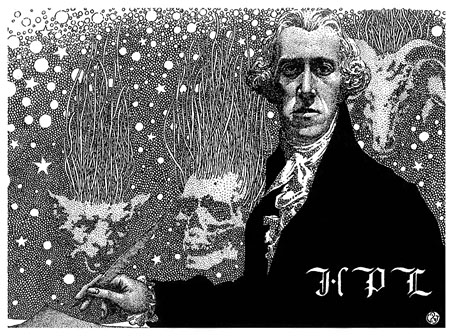
HPL (1937) by Virgil Finlay.

Whether this literary sport warrants the apparently limitless production of Lovecraftian art featuring the man himself, usually sprouting or festooned with tentacles, is a debatable matter. Virgil Finlay began the fantastic portrait trend in 1937 with his memorial depiction of the author writing with a quill pen while dressed in 18th-century garb. The earliest example that I can think of showing Lovecraft paired with the ubiquitous tentacles was the Moebius cover for Lettres d’Arkham in 1975, although there may well be other drawings prior to this. I’ve often wondered what Lovecraft would have made of the deluge of publications and images derived from his work, especially those that place him inside the products of his imagination.

moebius.jpg

Cover art by Moebius, 1975.

And speaking of which… I was at a loss at first with how to approach a new Lovecraft portrait, all I knew was that one was necessary. The original Malkuth picture from 1999 is another poor Photoshop job which has nevertheless been reused elsewhere on a few occasions, even appearing in 2007 on the cover of an issue of FATE magazine. For the new version I started with the portrait itself, using white lines on black to copy the same portrait photograph that formed the centre of the older picture. This was then duplicated and flipped horizontally to create a kind of Janus head which gives the portrait a suitably weird quality without wreathing it in tentacles. The mirrored head harks back to a sequence of treated photos by JK Potter which I first saw in the Heavy Metal Lovecraft special in 1979. Potter had used the same portrait photo to create effects that were somewhat compromised by poor reproduction, leading me to be believe that I’d created something slightly different to the first panel in his sequence. While researching this post I turned up an earlier version of the artwork which appeared on the back of the first issue of a US fanzine, Fantasy Mongers, also in 1979. The clearer reproduction revealed that the first head in Potter’s sequence is almost identical to my own. Ah well…

jkpotter.jpg

Photo art by JK Potter from the back cover of Fantasy Mongers #1, 1979.

The rest of the picture was improvised around this central image. Having drawn the portrait in white-on-black I decided to use a similar technique for the other elements. The Cthulhoid pillars are based on those in my Red-Night Rites painting from 1997, one of which appeared in the 1999 picture. The smaller figure on the right is from one of the photos that Wilfred Talman took while wandering the streets of New York with Lovecraft and Frank Belknap Long. This also appeared in the 1999 picture but for the new version I’ve emphasised what appears to be a book that Lovecraft is carrying in his right hand. Searching around for a complementary figure that might represent Abdul Alhazred turned up a 19th-century photo of a character who not only looked the part but is also standing in a manner similar to the Talman Lovecraft. If you look closely he’s also carrying a book, an addition of my own which turns him into the author of Al Azif. The polyhedra supporting the pair aren’t as arbitrary as they may seem. The spheres serve a dual purpose, preventing the figures from floating in space (or standing in water) while also relating to the Sephiroth of Malkuth which is identified with the Earth in the Kabbalistic scheme of planetary associations.

The next reworked picture will be Tsathoggua which is being polished rather than completely overhauled. I’m hoping I might have this done by the end of the month but I’m still chipping away at The Dunwich Horror while doing all this, as well as working on things which pay the bills. (I’ve just finished designing and illustrating another book.) Further progress will be announced in due course.

Elsewhere on { feuilleton }
The Lovecraft archive

Previously on { feuilleton }
The Return of the Crawling Chaos
Lettering Lovecraft
Weird ekphrasis and the Dunwich Horrors
Kadath and Yog-Sothoth
Another view over Yuggoth

Intégrale Howard Phillips Lovecraft

mnemos1.jpg

More Lovecraft book covers. Blame the season for this although depictions of Lovecraft’s cosmos have been occupying my thoughts for a while now, as I explain below.

A couple of years ago I wrote about the weird-fiction collections that Mnémos had been publishing in France, all of which used for their cover art paintings by the Polish “anti-symbolist” Zdzisław Beksiński. I like Beksiński’s paintings very much, and thought they were a good match for most of the covers that Mnémos had produced, being sufficiently weird and evocative without being directly illustrative. (The sole exception was the peculiar dog-like creature on the cover of a Frank Belknap Long collection, The Hounds of Tindalos. Long’s “hounds” are malevolent extra-dimensional entities whose name shouldn’t be taken literally.) I mentioned that Mnémos had also announced a seven-volume collection of HP Lovecraft’s fiction and non-fiction, but at the time of writing there were no pictures of the books available, and I’d forgotten all about the collection until a few days ago. All the books in the set, which are translated by David Camus, have since been reprinted as standalone volumes.

mnemos2.jpg

Intégrale Howard Phillips Lovecraft is a little deceptive as a title for a Lovecraft collection when the word “intégrale” is often applied to complete editions of something. The Mnémos set looks like it contains all of the fiction in the first few volumes plus a quantity of essays, but Lovecraft famously wrote more letters than he did stories; the letters here are a small selection inside volume 6. In addition to the books, the collection also contains a map of the Dreamlands, together with cards and bookmarks embellished with details from Beksiński’s paintings.

mnemos3.jpg

As with the Mnémos covers for Frank Belknap Long and Clark Ashton Smith, you could use many different Beksiński paintings for these editions, all of which would work to some degree. Even if some of them seem mismatched they offer a change of direction away from those varieties of fantasy art which have become very mannered in recent years when applied to weird fiction in general and Lovecraft’s stories in particular. This is partly a result of over-production: the huge success of the Call of Cthulhu role-playing game drove a demand for more and more Lovecraftian artwork, with the result that clichés emerged sooner than they would have done if the available imagery was limited to book illustrations and comic strips. I’ve contributed to the situation as much as most although I’ve also kept trying to find directions away from the stereotypes; my Cthulhoid picture was one such attempt even it still leans on the tentacular. I’ve been thinking recently of following the King in Yellow portrait with more poster-size art that explores other possibilities in this area. I’d encourage other artists to do the same when they can (commercial constraints often force your hand). Beksiński’s paintings show one route out of the mannerist cul-de-sac.

mnemos4.jpg

mnemos5.jpg

mnemos6.jpg

mnemos7.jpg

mnemos8.jpg

Elsewhere on { feuilleton }
The book covers archive
The fantastic art archive
The Lovecraft archive

Previously on { feuilleton }
Beksiński on film
Beksiński at Mnémos

Weekend links 750

long.jpg

Cover art by Edward Gorey, 1964.

• Plenty of Halloween fallout as usual this week, but then Halloween here is a state of mind rather than a single day’s celebration. Leading off with an article by Smoky Man for Italian readers (and for auto-translators) at (Quasi), the first in what will be a series of reviews of each section of the Moon and Serpent Bumper Book of Magic. I’ve been helping with this, answering questions about the book’s production. I may post my answers here at a later date but for the moment I’m happy to keep them exclusive. In other Moon and Serpent news, the Bumper Book was reviewed by Sam Thielman in the New York Times last weekend, and also subjected to a deeper exploration by Joe McCullough for The Comics Journal.

Michael Atkinson explores the psychosocial dread at the heart of Japanese horror. One of the films I watched for Halloween was Kiyoshi Kurosawa’s brilliantly unnerving Pulse, a film which turns up again in Anne Billson’s evolution of horror in ten revolutionary films.

• Among the new titles at Standard Ebooks, the home of free, high-quality, public-domain texts: Short Fiction by Frank Belknap Long, a collection of science fiction and horror stories which opens with Long’s contribution to the Cthulhu Mythos, The Hounds of Tindalos.

Paracelsus’ quasi-scientific, quasi-magical worldview would profoundly influence scientists for centuries to follow. As historian Violet Moller puts it in her new book Inside the Stargazer’s Palace, “To our rational, orderly, 21st-century minds the 16th-century map of knowledge appears messy, a paradoxical and confusing place where magic was studied alongside geometry, people searched obsessively for the philosopher’s stone and astrology was fundamental to many areas of life.” But in this mixed-up cauldron of magic and nature, real science was forged.

Dale Markowitz on how the occult gave birth to science

• New music: Of Nature & Electricity by Teleplasmiste, and Tristitiam Et Metus Tradam Portare Ventis by Philippe Blache (Day Before Us).

Adam Scovell dares to look inside Dario Argento’s dungeon-like museum of horror memorabilia, Profondo Rosso.

• At Little White Lies: Tyler Thier on Stan Brakhage’s autopsy film, The Act of Seeing With One’s Own Eyes.

• At Spoon & Tamago: Keisuke Oka’s Arimaston Building in Tokyo, made entirely by hand.

• At Bandcamp: George Grella on the pioneers of musique concrète.

• At Unquiet Things: Marci Washington’s midnight revelations.

Typo 8: The International Journal of Prototypes.

• RIP Teri Garr.

Pulse (1972) by Agitation Free | Pulse State (1991) by The Future Sound Of London | Pulse Detected (2021) by The Grid/Fripp

Richard Taylor’s Lovecraftiana

taylor1.jpg

The Mask of Cthulhu (1958) by August Derleth.

To look at any of the cartoons drawn for the New Yorker by Richard Taylor (1902–1970) you wouldn’t suspect that the Canadian artist had spent a few years at the end of the 1950s creating a handful of book covers for Arkham House. I’ve never read much about the history of August Derleth’s publishing endeavours so I can’t say how Taylor came to be offered this work. An unlikely choice he may have been but he did a better job with his five covers than many of the artists in the 60s and 70 who attempted to illustrate the eldritch horrors of Lovecraft, Derleth and co. The hand-drawn titles and monochrome colours make the quintet an attractive series within the Arkham House catalogue as a whole.

taylor2.jpg

The Shuttered Room and Other Pieces (1959) edited by August Derleth.

A collection of Lovecraft’s fiction fragments, some of which have been expanded by Derleth. Also remembrances of the writer by Lovecraft’s friends, plus essays and other material.

taylor3.jpg

Dreams and Fancies (1962) by HP Lovecraft.

A cover I’ve known for years as a result of its being featured in that cult volume of mine, The Fantasy Book by Franz Rottensteiner. (Previously.) I used to wonder about the contents of this book, Dreams and Fancies being an unfamiliar title that was absent from the paperback reprints of Lovecraft’s fiction. The title piece is another Derleth fabulation, a collage of Lovecraft’s transcribed dreams as they were recounted in letters to various friends. This is followed by some of the short fiction and poetry that reworked these dreams. The collection ends with the aeon-spanning novella, The Shadow Out of Time, which Tayor has taken as his subject for the cover art.

taylor4.jpg

The Trail of Cthulhu (1962) by August Derleth.

taylor5.jpg

The Horror from the Hills (1963) by Frank Belknap Long.


Note: I’m a little sceptical that the Richard Taylor responsible for these covers is the same one who was drawing cartoons for the New Yorker. The only source for this is isfdb.org, a site whose artist attributions are sometimes erroneous. If anyone can confirm or deny the accuracy of this information then please leave a comment.

Elsewhere on { feuilleton }
The book covers archive
The Lovecraft archive

Howard/Seward

hpl.jpg
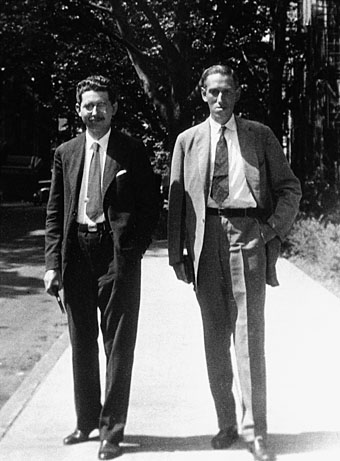
Frank Belknap Long and HP Lovecraft, New York, 1931. Photo by WB Talman.

Two friends—HP Lovecraft and Frank Belknap Long—visit the Egyptian antiquities in New York’s Metropolitan Museum of Art in the 1920s:

Tom Collins (for The Twilight Zone Magazine): I seem to recall a visit to the Metropolitan Museum of Art that you two made together.

Frank Belknap Long: You mean the time we visited the Egyptian tomb? Well, the Metropolitan apparently still has it. This was way back in the 1920s. The tomb was on the main floor in the Hall of Egyptian Antiquities, and we both went inside to the inner burial chamber. Howard was fascinated by the somberness of the whole thing. He put his hand against the corrugated stone wall, just casually, and the next day he developed a pronounced but not too serious inflammation. There was no great pain involved, and the swelling went down in two or three days. But it seems as if some malign, supernatural influence still lingered in the burial chamber—The Curse of the Pharaohs—as if they resented the fact that Howard had entered this tomb and touched the wall. Perhaps they had singled him out because of his stories and feared he was getting too close to the Ancient Mysteries.

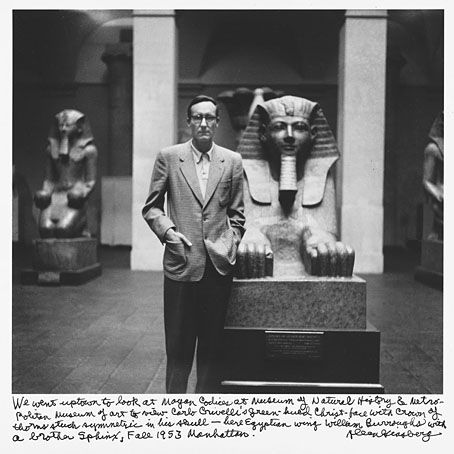
burroughssphinx.jpg

William Burroughs, New York, 1953. Photo by Allen Ginsberg.

Two friends—William Burroughs and Allen Ginsberg—visit the Egyptian antiquities in New York’s Metropolitan Museum of Art in the 1950s:

Allen Ginsberg: We went uptown to look at Mayan Codices at Museum of Natural History & Metropolitan Museum of Art to view Carlo Crivelli’s green-hued Christ-face with crown of thorns stuck symmetric in his skull — here Egyptian wing William Burroughs with a brother Sphinx, Fall 1953 Manhattan.

When I last wrote about the parallels between Lovecraft and Burroughs in a post from 2014 I wasn’t aware of Lovecraft and Long’s visit to the same museum exhibits that Burroughs and Ginsberg visited some 30 years later. I did, however, use the same photos which are posted here, a curious coincidence when Long wasn’t mentioned in the earlier post. This minor revelation is a result of reading the features in back issues of The Twilight Zone Magazine, one of which is an interview with an 81-year-old Frank Belknap Long. The coincidence is a trivial thing but it adds to the small number of connections between the two writers.

cthulhu.jpg

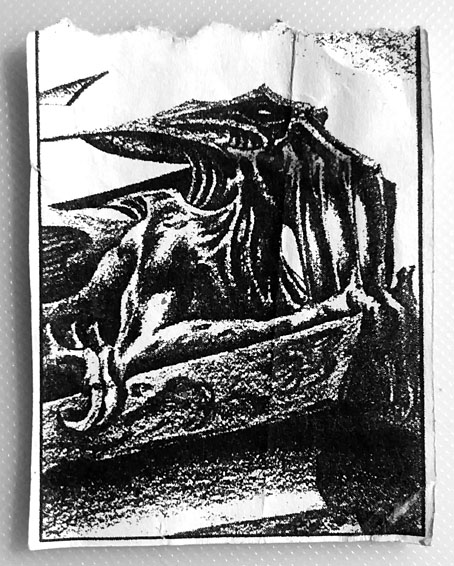
A Cthulhu Sphinx from The Call of Cthulhu, 1988.

Lovecraft and Burroughs were both living in New York City at the time of their excursions, and both touched on Egyptian mythology in their writings, so their having viewed the same museum exhibits seems inevitable rather than surprising. A more tangible connection between the pair is alluded to in Ginsberg’s photograph note when he mentions the Mayan codices. A few years before the museum visit, Burroughs had been studying the Mayan language and the Mexican codices in Mexico City under the tutelage of Robert H. Barlow, the former literary executor of HP Lovecraft. Burroughs’ studies subsequently fueled the references to Mayan mythology that turn up repeatedly in his fiction, and he was still at Mexico City College in 1951 when Barlow killed himself with a barbiturate overdose, afraid that his homosexuality was about to be exposed by one of his students. Burroughs mentioned the suicide in a letter to Ginsberg. The connections don’t end there, however. After Barlow’s death the rights to Lovecraft’s writings passed, somewhat controversially, to August Derleth and Donald Wandrei at Arkham House, and in another curious coincidence Derleth happened to be one of the complainants against a literary journal, Big Table, in 1959, when the magazine ran Ten Episodes from Naked Lunch, and was subsequently prosecuted for sending obscene material through the US mail. Derleth and Arkham House are both mentioned in the court papers.

I’ve never seen any indication that Burroughs was aware of these connections but if he was I doubt he would have paid them much attention, he always seemed rather blasé about his intersections with popular culture. He did think well enough of Lovecraft (or at least the version of Lovecraft’s fiction as presented by the Simon Necronomicon) to invoke “Kutulu” along with the Great God Pan and the usual complement of Mayan deities in Cities of the Red Night. Years later I remember seeing something in a newspaper about him retiring to Lawrence, Kansas, where he was described as passing the time “reading HP Lovecraft”. (I wish I could give a reference for this but I don’t recall the source.) If so then I like to think he might have given Creation Books’ Starry Wisdom collection more than a passing glance when it turned up at his door.

Elsewhere on { feuilleton }
The Lovecraft archive
The William Burroughs archive