Modern Pen Drawings, 1901

drawings08.jpg

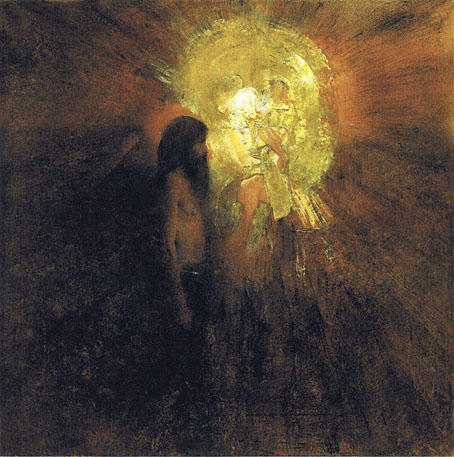
Rustum and the Simoorg (1897) by Patten Wilson.

A new arrival at the Internet Archive. Modern Pen Drawings: European and American is a special number of The Studio magazine, one of several such numbers which they published in book form. The magazine’s editor, Charles Holme, edited the volume which maintains the high quality typical of all these publications, with excellent reproductions and informative notes about the artists and their works. Holme’s choices in collections such as this are always varied, mixing imaginative illustrations with comic drawings and nature studies. For a reader, the books are still useful today for showing you drawings that you might not see anywhere else, even when the artist is a familiar name. When the works themselves are familiar the reproductions are invariably better than you’ll find elsewhere. Such is the case with Patten Wilson’s “Rustum and the Simoorg”, an illustration of a Persian folk tale whose fine lines and details are often spoiled by poor printing. Elsewhere there are two pages of Théophile Steinlen’s inevitable cats, a drawing by Fernand Khnopff that I don’t think I’ve seen before, and Edmund J. Sullivan’s rose-bedecked skeleton which Alton Kelley later “repurposed” (or swiped) for the cover of the Grateful Dead’s second live album.

drawings01.jpg

drawings02.jpg

drawings03.jpg

drawings04.jpg

Continue reading “Modern Pen Drawings, 1901”

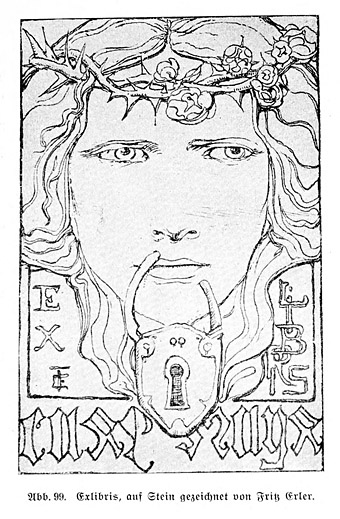
Exlibris (Bucheignerzeichen)

bookplates04.jpg

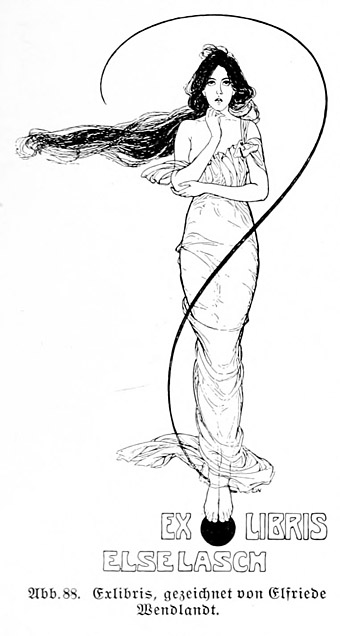
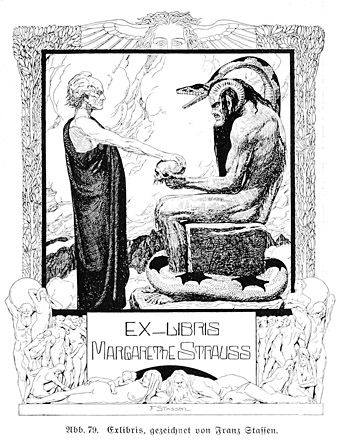
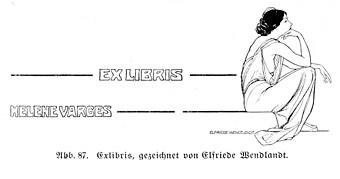
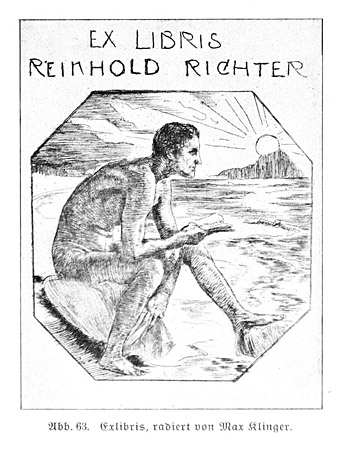
I don’t use bookplates, and don’t know anyone who does, but the conjunction between art and literature is a fascinating one. Exlibris (Bucheignerzeichen) (1909) by Walter von Zur Westen explores the history of the bookplate, and would no doubt answer some of my questions about the form if it wasn’t in German throughout, and also typeset in the semi-legible Fraktur style that used to be de rigueur for all German texts.

bookplates02.jpg

We still have the illustrations, however, and these range from woodcut engravings to contemporary works in pencil and ink, with many of the later contributions being from established artists whose names are familiar today; among the examples below are works by Symbolists Max Klinger, Fernand Khnopff and Felicien Rops. There’s also an especially fine example by Charles Ricketts. The latter are a reminder that bookplate commissions were a common thing for 19th-century artists, although their efforts are seldom seen outside collections such as this. Much of Zur Westen’s history is devoted to the German regions but later chapters cover other European countries and the United States.

bookplates03.jpg

bookplates01.jpg

bookplates05.jpg

Continue reading “Exlibris (Bucheignerzeichen)”

The art of Simon Moulijn, 1866–1948

moulijn5.jpg

Landscape, Drenthe (1896). Collection Hein Klaver.

Sander Bink’s previous guest posts here concerned some of the forgotten artists of the Dutch fin de siècle, in particular the Beardsley-inspired work of René Gockinga. This new post from Sander is more Symbolist-oriented, with a look at the work of another Dutch artist.

* * *

Simon Moulijn was a Dutch painter and graphic artist whose work shows a striking affinity with European Symbolism, in particular his prints and paintings made in the 1890s which would appear to provide a link between Dutch Realism and mystical Symbolism. Beyond their historical context, these are simply beautiful pictures which is, of course, the most important thing.

moulijn6.jpg

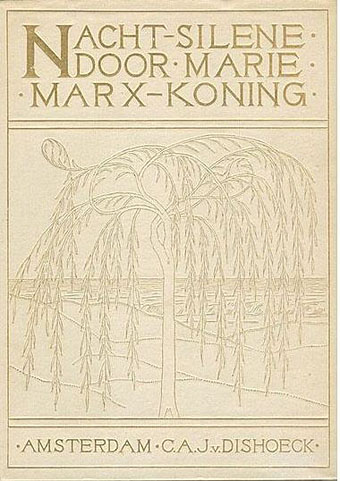
Cover design for Nachtsilene, 1902.

Landscapes were Moulijn’s main theme; some bring to mind the land- and cityscapes of Fernand Khnopff in which the world has become silent: a serene, quiet world, free from the noise and misery of modern life. “Anywhere out of this world”, but within the world we already know. Although not “Decadent” like Khnopff—there are no femmes fatales in his landscapes—Moulijn must certainly have been inspired by Khnopff and similar artists. Van Gogh and Jan Toorop were important for Moulijn as well. That Moulijn was well-versed in Symbolism and other new art forms at the time such as Art Nouveau is evidenced by his exhibition at Siegfried Bing’s Paris Gallery in 1895. Like many of the artists of his generation, he was greatly inspired by the mystical writing of Maeterlinck. No wonder, then, that he designed book covers and illustrations for Marie Marx-Koning, a Dutch writer unjustly neglected today, whose novels and stories also show a strong affinity with European mystical Symbolism.

moulijn1.jpg

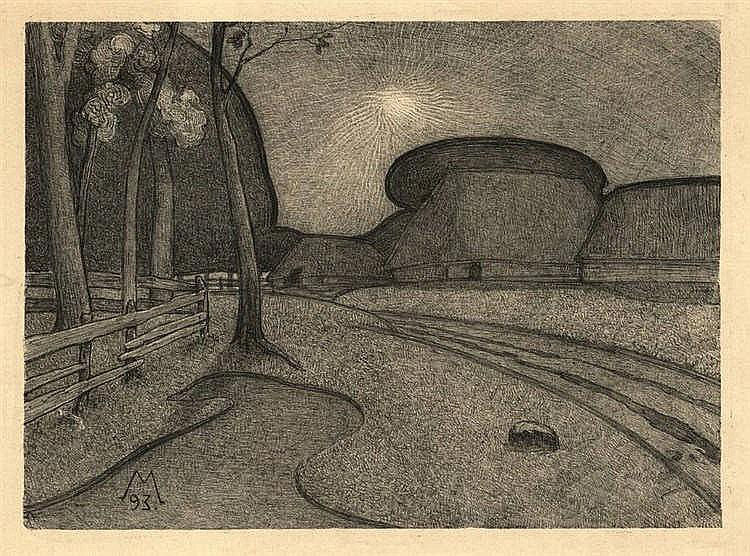
Night (1893). Lithograph.

These qualities are already exemplified by Moulijn’s first printed work, the lithograph Night from 1893 which depicts a traditional Dutch subject, a farm; but there are no peasants, and the nightly tones and silence make it look more like a farm from an Ingmar Bergman film than a landscape by his painter contemporaries from The Hague School.

moulijn2.jpg

Farm at Diphorn (1896). Gemeentemuseum Den Haag.

moulijn4.jpg

Spring (1896). Drents Museum.

moulijn3.jpg

Autumn (1895). Drents Museum.

An 1896 painting with the same subject, Farm at Diphorn, brings to mind the imaginary landscapes of Félix Vallotton, as do, more or less, two pastels which I personally feel to be his best: Spring and Autumn. Once again, the coloured areas in these Symbolist landscapes are reminiscent of a Vallotton or Franz Melchers. But where Vallotton’s landscapes might be characterised as psychological landscapes, these two by Moulijn are almost abstract experiments in colour.

moulijn7.jpg

Vampire (1916). Collection Van Wezel.

Finally mention must be made, for curiosity’s sake and to satisfy the reader’s Decadent needs, of the 1916 coloured lithograph Vampire. This demonstrates Moulijn’s affinity with a more Decadent Symbolism, although by this time the style was increasingly outmoded.

Sander Bink

Previously on { feuilleton }
René Gockinga revisited
Gockinga’s Bacchanal and an unknown portrait of Fritz Klein
More from the Decadent Dutch

Symbolist Temptations

khnopff.jpg

The Temptation of St Anthony (1883) by Fernand Khnopff.

This should really be more Symbolist Temptations since Odilon Redon belongs among these artists. Redon may have devoted more of his time than anyone else to the saint’s travails but other artists also took up the theme. Fernand Khnopff seldom depicted religious subjects but his painting—an early work—is remarkable for the way it reduces the phantasmagoric pageants of previous centuries to a simple face-to-face confrontation.

rops.jpg

The Temptation of St Anthony (1878) by Félicien Rops.

Félicien Rops, on the other hand, can always be relied upon to be vulgar and blasphemous in equal measure. The Devil lurking behind the cross was probably added to balance the composition but that silly expression makes the picture seem more comical than shocking. Similar skull-faced cherubs may be found in other Rops prints.

Continue reading “Symbolist Temptations”

New Life for the Decadents by Philippe Jullian

jullian1.jpg

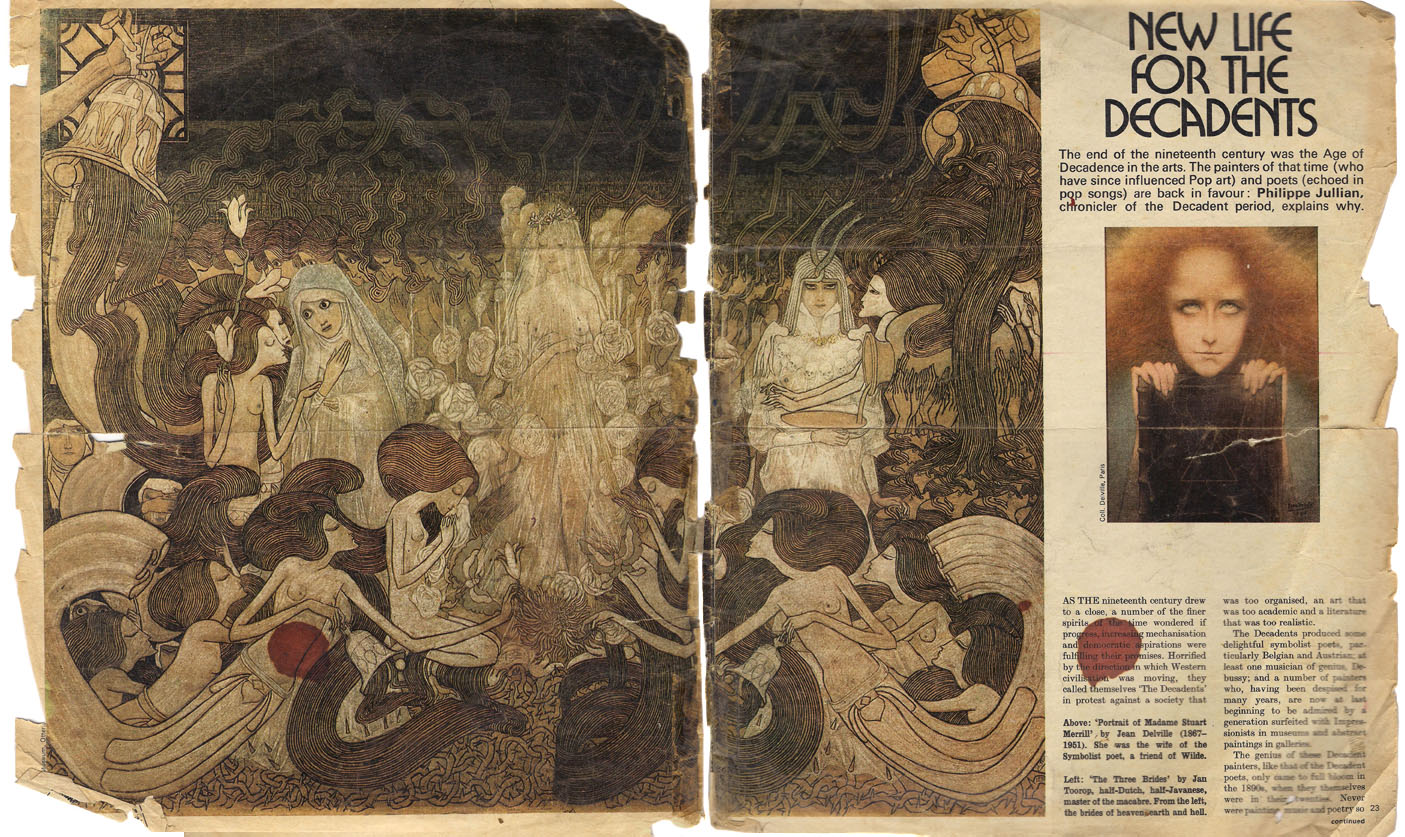
This essay by cult writer Philippe Jullian appeared in an edition of the Observer colour supplement in 1971, shortly after Jullian’s chef d’oeuvre, Dreamers of Decadence, had been published in Britain. Esthètes et Magiciens (1969), as Jullian’s study was titled in France, was instrumental in raising the profile of the many Symbolist artists whose work had been either disparaged or ignored since the First World War. A year after the Observer piece, the Hayward Gallery in London staged a major exhibition of Symbolist art with an emphasis on the paintings of Gustave Moreau; Jullian alludes to the exhibition in his article, and also wrote the foreword to the catalogue. His Observer article is necessarily shorter and less detailed than his introductory essay, emphasising the reader-friendly “Decadence” over the more evasive “Symbolist”. But as a primer to a mysterious and neglected area of art the piece would have served its purpose for a general reader.

Many thanks to Nick for the recommendation, and to Alistair who went to the trouble of providing high-res scans that I could run through the OCR. The translators of the article, Francis King and John Haylock, had previously translated Jullian’s biography of Robert de Montesquiou.

*

New Life for the Decadents

The end of the nineteenth century was the Age of Decadence in the arts. The painters of that time (who have since influenced Pop art) and poets (echoed in pop songs) are back in favour: Philippe Jullian, chronicler of the Decadent period, explains why.

AS THE nineteenth century drew to a close, a number of the finer spirits of the time wondered if progress, increasing mechanisation and democratic aspirations were fulfilling their promises. Horrified by the direction in which Western civilisation was moving, they called themselves “The Decadents” in protest against a society that was too organised, an art that was too academic and a literature that was too realistic.

The Decadents produced some delightful symbolist poets, particularly Belgian and Austrian; at least one musician of genius, Debussy; and a number of painters who, having been despised for many years, are now at last beginning to be admired by a generation surfeited with Impressionists in museums and abstract paintings in galleries.

The genius of these Decadent painters, like that of the Decadent poets, only came to full bloom in the 1890s, when they themselves were in their twenties. Never were painting, music and poetry so close to one another. The gods of the Decadents were primarily Wagner and Baudelaire, then Swinburne and Poe. The Decadent movement, so active all over Europe, turned towards two great sources of inspiration: the Pre-Raphaelites, and a French painter whose glory was for a while eclipsed by the Impressionists but who is now once again accorded his place among the great—Gustave Moreau.

The women whom the Decadents loved and of whom they dreamt resembled the women created 30 years previously by Rossetti, Burne-Jones and Moreau.

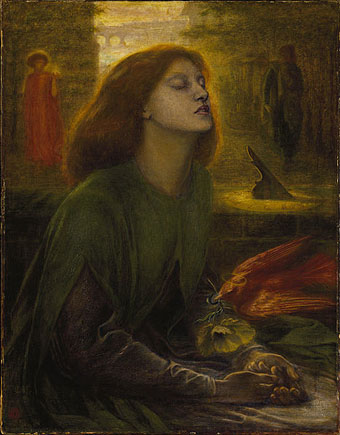
Nothing could be more naturalistic than the artistic style elaborated by the Pre-Raphaelites in the middle of the nineteenth century. Dante Gabriel Rossetti’s model, inspiration, mistress and finally wife was the sweet and sad Elizabeth Siddal, on whom so many fin-de-siècle ladies had to model themselves on the Continent as did all the aesthetic ladies of England in the 1880s. She posed for Rossetti as Beatrix and as the Belle Dame sans Merci.

She was a rare spirit, about whom everything was nebulous and evanescent: the thick, wild hair; the tunic of a simplicity to challenge the elaboration of the crinolines then in vogue; the frail hands burdened with lilies; the gaze turned towards eternity. She also posed, fully dressed and lying in a bath, her hair outspread around her bloodless face, as Ophelia for another Pre-Raphaelite, Millais. Elizabeth died of pulmonary tuberculosis in 1862.

A macabre episode, which might have been imagined by Poe, was the exhumation of a sheaf of Rossetti’s poems that had been buried in Elizabeth Siddal’s coffin. When this symbol of the New Woman died, the grief-stricken poet had insisted on placing the poems inspired by her under her long hair before the coffin was sealed.
jullian4.jpg

Beata Beatrix (1864–1870) by Dante Gabriel Rossetti.

Continue reading “New Life for the Decadents by Philippe Jullian”