Weekend links 808

kometen.jpg

Comets from Meyers Konversationslexikon (1885–90).

• At The Daily Heller: Steven Heller reviews A Life in Ink, a new monograph about the art of Ralph Steadman. Heller is full of praise for Steadman, and discusses commissioning his work for The New York Times. But in his bewilderment at Steadman’s lack of a knighthood he seems unaware of the degree to which state honours are frequently refused by Britons, especially those who position themselves in opposition to the established order. Americans are obsessed with awards and “halls of fame”, and appear to regard Britain’s state honours as something like the Oscars with a royal seal, rather than what JG Ballard once described as “a Ruritanian charade that helps to prop up the top-heavy monarchy.” If Steadman has deliberately shunned the honours list he’d be joining a venerable company.

• “In mid-19th century Italy, two eccentric aristocrats set forth on parallel projects: constructing ostentatious castles in a Moorish Revival style. Iván Moure Pazos tours the psychedelic chambers of Rochetta Mattei, optimised for electrohomeopathic healing, and Castello di Sammezzano, an immersive, orientalist fever dream.”

• New music: Ithaqua by Cryo Chamber Collaboration is this year’s installment in the Lovecraft-themed album series (previously) from Cryo Chamber. Also this week: Analog 2025 by Various Artists; and Flux (music for a performance by still still / Marta & Kim) by Rutger Zuydervelt and Lucija Gregov.

For all their bravura and maximalism, Powell and Pressburger understood the power of leaving things out, building into their films chasms that the mind must leap, gaps that the imagination must fill. Like Joan Webster, we discover that we don’t want things to be made too easy. We want to catch our own fish rather than have them delivered, to swim in the ocean rather than in a pool.

Imogen Sara Smith on I Know Where I’m Going, one of the films from Michael Powell and Emeric Pressburger’s golden decade, the 1940s

• Among the new titles at Standard Ebooks, the home of free, high-quality, public-domain texts: In the Days of the Comet by HG Wells.

• At the BFI: David Parkinson selects 10 great Sherlock Holmes films and TV adaptations.

• Winning entries for the Capture The Atlas Northern Lights Photographer of the Year.

• Books and original drawings by Austin Osman Spare on sale at Gerrish Fine Art.

• At Unquiet Things: The art of Chie Yoshii.

Kohoutek-Kometenmelodie (1973) by Kraftwerk | Cometary Wailing (1981) by Bernard Xolotl | Kometenmelodie Part 1 (1994) by 300,000 VK
Weekend links 714

agar.jpg

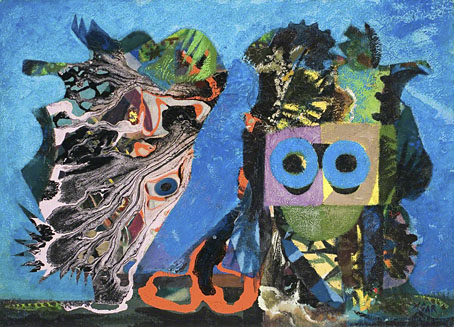
An Exceptional Occurrence (1950) by Eileen Agar.

• New music: The Endless Echo by Pye Corner Audio, coming soon from Ghost Box. PCA continue to fly the flag for the original Ghost Box mission of bringing various forms of weirdness to electronic music. The new album “draws inspiration from scientific and science-fictional notions about the nature of time and the idea that it may be entirely unreal”. Over at Bandcamp there’s Here by Stefano Guzzetti and Ian Hawgood.

• “Powell and Pressburger emerge from this film, more than ever, as sui generis: inventors of their own kind of film, gentleman amateurs of cinema in some ways…” Peter Bradshaw reviewing Martin Scorsese’s Made in England: The Films of Powell and Pressburger.

Velocity and Creation, a pair of short films by Vadim Sherbakov made with magnets, glitter and inks. The scores are too bombastic but I like the visuals.

Art is for increasing life. That, I believe, after all the other purposes receive their due, is really what it’s for—why we revere it, why we give our hearts to it. What do I mean by increasing life? How can we live more, given that we can’t live longer? Through attention and intensity. Being fully present to the world, and feeling without reservation: the two things that making art requires and that experiencing it involves.

William Deresiewicz on thirteen ways of looking at art

Modern Illustration is a project by illustrator Zara Picken, featuring print artefacts from her extensive personal collection.

• Mix of the week: Aquarium Drunkard presents Pulp Jazz: Twenty-First Century Groove Music. Great stuff.

• At Public Domain Review: Tales of the Catfish God: Earthquakes in Japanese Woodblock Prints.

• At The Quietus: Jonathan Meades interviews Saint Leonard. And vice versa.

• At Dennis Cooper’s: Michelangelo Antonioni Day.

• The Strange World of…Bill Laswell.

Creation (1971) by Arthur Brown’s Kingdom Come | Création Du Monde (1971) by Vangelis | Creation (1977) by Tangerine Dream

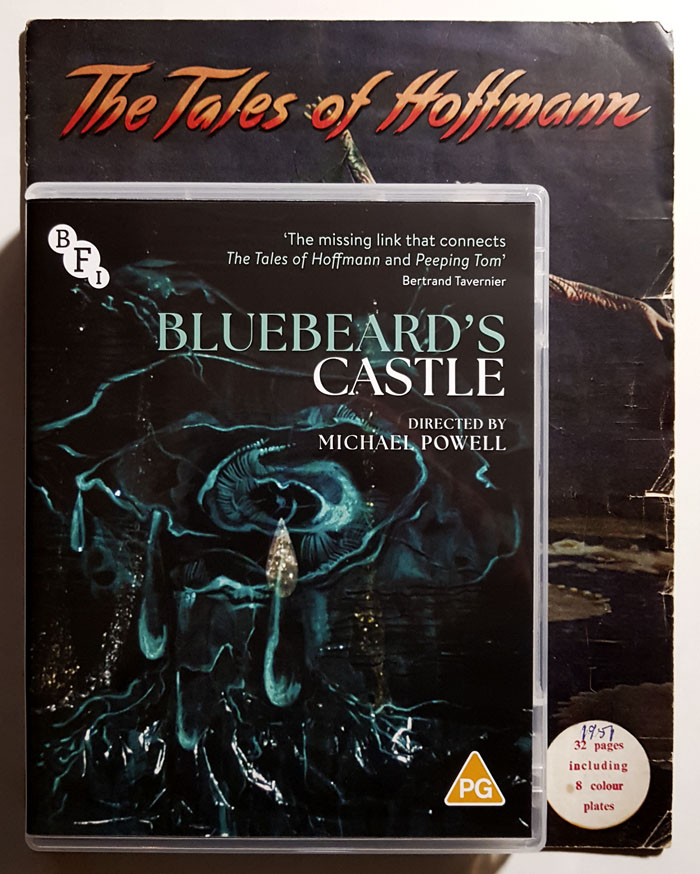
Powell’s Bluebeard on blu-ray

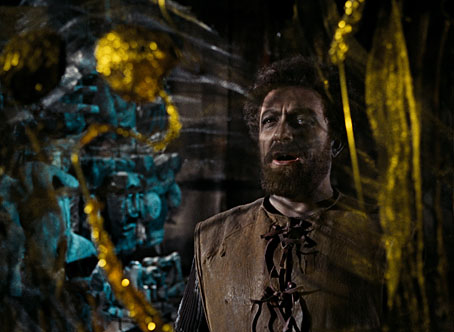
bluebeard1.jpg

My film viewing at the weekend included a return visit to Michael Powell and Emeric Pressburger’s opéra fantastique, The Tales of Hoffmann, followed by the new blu-ray restoration of Powell’s Bluebeard’s Castle. This is the third time I’ve written about Powell’s film of the Bartók opera, the first occasion being a “When will I get to see this?” post, the second a review of a VHS copy which had turned up on YouTube. The new release, which is the film’s debut appearance on disc, is a restoration by the BFI under the supervision of Thelma Schoonmaker and Martin Scorsese.

bluebeard2.jpg

Norman Foster (Bluebeard).

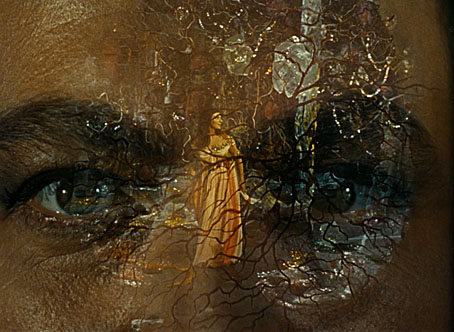
Powell directed the hour-long dramatisation for the German TV channel Süddeutscher Rundfunk in 1963, at a time when his career was in the doldrums following the critical outrage provoked by the release of Peeping Tom. The production was a smaller one than he was used to but it was still shot on 35mm which has now been polished to a breathtaking degree, revealing rich shadows, deep colours and a profusion of glittering detail. (See this clip.) The audio track remains monophonic but the sound is a great improvement on the VHS version. Seeing the latter was gratifying after so long a wait but was also an underwhelming experience. The restoration proves once again how unfair it is to judge filmmakers from a low-grade copy of their work that’s been thrown onto the internet.

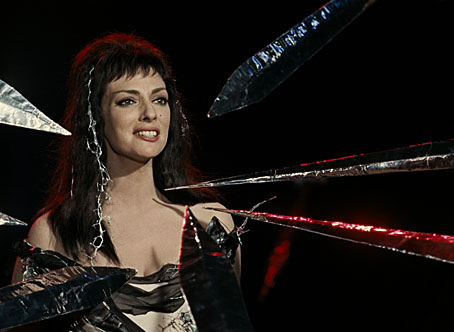
bluebeard3.jpg

Ana Raquel Satre (Judith).

Bluebeard’s Castle (or Herzog Blaubarts Burg, to use the film’s German title) wasn’t a project that Powell inaugurated. Hein Heckroth, the production designer on many of Powell and Pressburger’s colour features, had been working for German TV since the late 1950s, and suggested to singer/producer Norman Foster that Powell might be interested in directing the film. The presence of Heckroth’s weirdly Expressionist designs give Bluebeard’s Castle a continuity with the extended ballet sequence in The Red Shoes and the “Giulietta” episode of The Tales of Hoffmann; all three stories share a dream-like atmosphere whose grading to nightmare is enhanced by Heckroth’s decors. I’ve often wondered whether the strangeness of some of Heckroth’s set designs, whose aesthetics extend to Dalínean Surrealism, were a factor in the frequent grumblings of distaste expressed by British critics for Powell and Pressburger’s films even before Powell made Peeping Tom. The first film that Powell worked on was The Magician in 1926, Rex Ingram’s adaptation of the Somerset Maugham novel, and a film which is at its best in its moments of visual excess. Powell’s films are valued today for their own visual excess but this quality hasn’t always been encouraged in British cinema, as Ken Russell later discovered. Favourable critics like Ian Christie often point to this as part of the “European” sensibility of Powell and Pressburger’s oeuvre, something which is present even when the subject matter is very English. Pressburger was a Hungarian emigré, while Powell met Ingram when he was living in the south of France; the production designers on all the major P&P films, Alfred Junge and Hein Heckroth, were both German, and the films themselves, especially The Red Shoes and The Tales of Hoffmann, feature a host of different nationalities. Watching Bluebeard’s Castle again I was reminded of Italian horror cinema, especially the films of Mario Bava. When you combine the artificiality of Heckroth’s sets with the Gothic story of a woman imperilled by a powerful aristocrat, plus the resemblance of Ana Raquel Satre to Barbara Steele, the whole thing assumes a very Bavaesque flavour.

bluebeard4.jpg

On a musical level I much prefer Bartók to Offenbach, (although Offenbach’s famous Barcarolle is always worth hearing) so I’m pleased that this minor work has been treated to the same restorative care as The Tales of Hoffmann. The 1988 version of Bartók’s opera directed for the BBC by the late Leslie Megahey remains my favourite filmed Bluebeard even though it lacks Powell’s flamboyance; Megahey’s film has more gravitas, and the direction, performances and musical recording are better. But seeing Powell’s film again revealed nuances I’d missed before, like the sustained shot near the end when Judith seals her fate by asking for the key to the forbidden room. It also makes a change hearing the whole thing sung in German, a language I can understand in parts. Bluebeard’s Castle is a further example of Powell’s idea of a “composed film”, a work that would combine all the dramatic arts. (Or almost all—this one lacks dance.) As I said ten years ago, it may be minor compared to the films that he made with Emeric Pressburger but it offers a more satisfying coda to his career than his final features.

Previously on { feuilleton }
Bluebeard’s Castle, 1981
Powell’s Bluebeard revisited
Joseph Southall’s Bluebeard
Leslie Megahey’s Bluebeard
Powell’s Bluebeard
The Tale of Giulietta

Weekend links 700

demorgan.jpg

Lux in Tenebris (1895) by Evelyn De Morgan.

• “NASA celebrates the worm logo designer, Richard Danne“. Until I read this story (and this one) I wasn’t aware that the NASA logos were known as The Meatball and The Worm.

The Red Shoes: behind the scenes of the classic Powell and Pressburger film – in pictures. Related: Kings of the movies: Martin Scorsese on Powell & Pressburger.

• The 700th weekend post happens to arrive on Alan Moore’s 70th birthday. Many happy returns to the Northampton Magus.

Fundamentally, we face a choice. Either:

• it’s a coincidence that, of all the possible values that the finely tuned constants of physics may have had, they just happen to have the right values for life;

or:

• the constants have those values because they are right for life.

The former option is wildly improbable; on a conservative estimate, the odds of getting finely tuned constants by chance is less than 1 in 10-136. The latter option amounts to a belief that something at the fundamental level of reality is directed towards the emergence of life. I call this kind of fundamental goal-directedness ‘cosmic purpose’.

As a society, we’re somewhat in denial about fine-tuning, because it doesn’t fit with the picture of science we’ve got used to. It’s a bit like in the 16th century when we started getting evidence that our Earth wasn’t in the centre of the universe, and people struggled to accept it because it didn’t fit with the picture of the universe they’d got used to. Nowadays, we scoff at our ancestors’ inability to follow the evidence where it leads. But every generation absorbs a worldview it can’t see beyond. I believe we’re in a similar situation now with respect to the mounting evidence for cosmic purpose. We’re ignoring what is lying in plain view because it doesn’t fit with the version of reality we’ve got used to. Future generations will mock us for our intransigence.

Philip Goff, professor in philosophy at Durham University, making an argument for cosmic purpose

• At Spoon & Tamago: Exploring Japanese Hell through art from the 12th to 19th century.

• New music: Turning The Prism by Ben Frost, and Sanctuary Of Desire by Steve Roach.

• Mix of the week is DreamScenes – November 2023 at Ambientblog.

• DJ Food looks at Tomi Ungerer’s Electric Circus posters.

• At Dennis Cooper’s: Alain Resnais Day.

Strange Flowers visits the Villa Stuck.

Diet Of Worms (1979) by This Heat | Opera Of Worms (1981) by Van Kaye & Ignit| Wormhole (2002) by Cliff Martinez

Weekend links 696

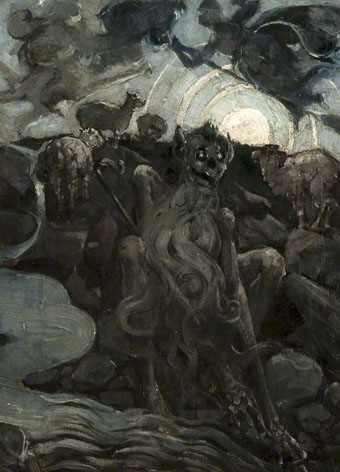
hornel.jpg

The Brownie of Blednoch (1889) by Edward Atkinson Hornel.

• “None of the theatrics of most films are available in Bresson, because in some ways Bresson’s characters, along with Dreyer’s and Cassavetes’s are the most inscrutable in motion pictures—maybe since their creators are the best believers in suggestion.” Greg Gerke explores the later films of Robert Bresson.

Iizuna Fair is a short animated film by Sumito Sakakibara that will be viewable at Vimeo for the next few months.

• Occult scholar Mitch Horowitz returns to the Aquarium Drunkard podcast for a wide-ranging discussion.

Marty [Scorsese] went to the Edinburgh Film Festival in 1974 to collect an award for Alice Doesn’t Live Here Anymore. They asked him who he wanted to present it to him, and he said Michael Powell. They had no idea who he was. No one did, but I found an American doing publicity for Kubrick’s 2001 who knew where he was. He introduced Michael to Marty at a lunch where Marty bombarded Michael with questions about how he did this and how he did that. Michael writes in his autobiography that the blood started to run in his veins again, it had been so long that he and Emeric had been living in oblivion.

Marty brought Michael to America, where we had already started working on Raging Bull. Marty had been educating me about Powell and Pressburger’s films, sending me home with VHSs. I had fallen in love with them, and then he said that Michael Powell was coming for dinner one night and asked if I would like to meet him. That’s how we met and eventually became involved, all thanks to Marty.

Thelma Schoonmaker remembering her husband, Michael Powell, and discussing the ongoing restoration of his films. Good to hear that plans are afoot to resurrect Gone to Earth

Whole Earth Index is a near-complete archive of the Whole Earth Catalog and its related publications.

• At the Daily Heller: David Byrd, the East Coast’s psychedelic poster man.

• See the winners of the Nikon 2023 Photomicrography Competition.

• New music: Golden Feelings by Better Weather.

Mikrostruktury (1963) by Wlodzimierz Kotonski | La Chasse Aux Microbes (1977) by Michael Bundt | Microscopic (1995) by Gas