Weekend links 543

cliffhouse.jpg

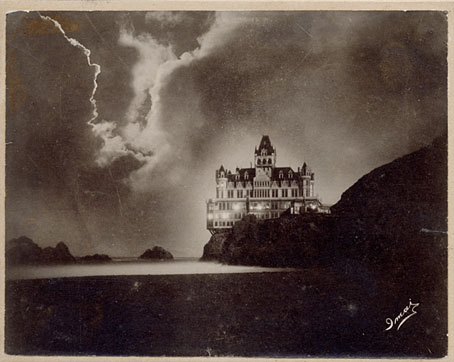
Adolph Sutro’s Cliff House in a Storm (c. 1900) by Tsunekichi Imai.

• Good to see a profile of Wendy Carlos, and to hear that she’s still working even though all her albums (to which she owns the rights) have been unavailable for the past two decades. I’d be wary of praising Switched-On Bach too much to avoid giving new listeners a wrong impression. The album was a breakthrough in 1968 but was quickly improved upon by The Well-Tempered Synthesizer (1969) and Switched-On Bach II (1973). And my two favourites, A Clockwork Orange – The Complete Original Score (1972) and the double-disc ambient album, Sonic Seasonings (1972), are superior to both.

• “[Sandy Pearlman] told me that one of the main inspirations was HP Lovecraft. I said, ‘Oh, which of his books?’ He said, ‘You know, the Cthulhu Mythos stories or At The Mountains Of Madness, any of those.'” Albert Bouchard, formerly of Blue Öyster Cult, talks to Edwin Pouncey about BÖC’s occult-themed concept album, Imaginos (1988), and his affiliated opus, Re Imaginos.

• More electronica: Jo Hutton talks to Caroline Catz, director of the “experimental documentary” Delia Derbyshire: The Myths and Legendary Tapes.

• At the V&A blog Clive Hicks-Jenkins talks to Rebecca Law about his award-winning illustrations for Hansel and Gretel: A Nightmare in Eight Scenes.

• New music: Archaeopteryx is a new album by Monolake; What’s Goin’ On is a further preview of the forthcoming Cabaret Voltaire album, Shadow Of Fear.

Celebrating A Voyage to Arcturus: details of two online events to mark the centenary year of David Lindsay’s novel.

• “Streaming platforms aren’t helping musicians – and things are only getting worse,” says Evet Jean.

• At Spoon & Tamago: the cyberpunk, Showa retro aesthetic of anime Akudama Drive.

• At A Year In The Country: a deep dive into the world of Bagpuss.

Sinister Sounds of the Solar System by NASA on SoundCloud.

• At Dennis Cooper’s: Shirley Clarke Day.

Mary Lattimore‘s favourite albums.

• Solaris, Part I: Bach (1972) by Edward Artemiev | Bach Is Dead (1978) by The Residents | Switch On Bach (1981) by Moderne
The Cthulhu Mythos in the pulps

mythos01.jpg

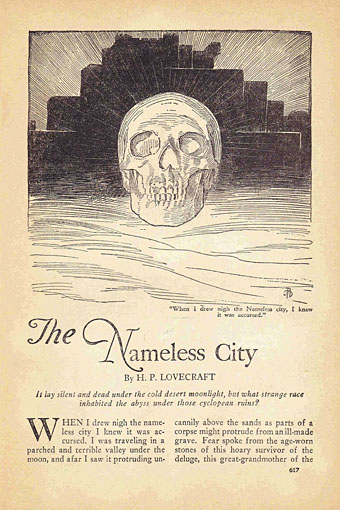
The Nameless City: First published in The Wolverine, November 1921. Reprinted in Weird Tales, November 1928. Illustration by Joseph Doolin.

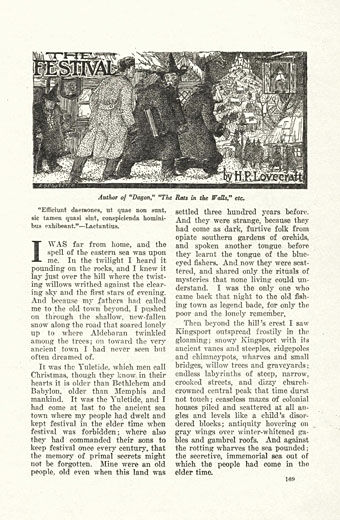
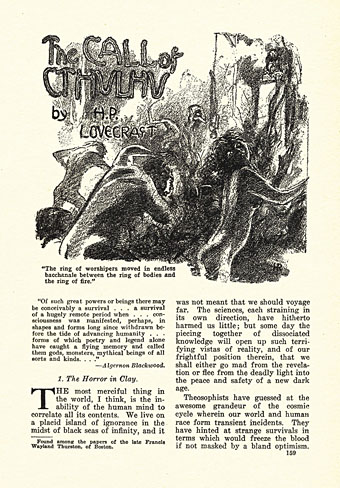
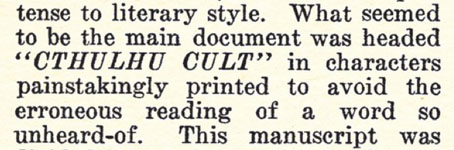
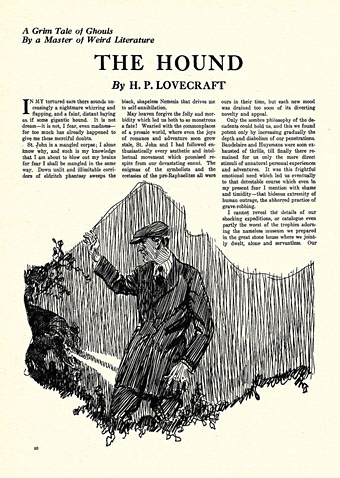
This would have been “The Cthulhu Mythos in Weird Tales” if some of HP Lovecraft’s more substantial stories hadn’t been published elsewhere. To prevent sprawl I’ve limited the list to Lovecraft’s own stories even though the Mythos takes in the work of contemporaries such as Clark Ashton Smith, Robert E. Howard, Frank Belknap Long, Zealia Bishop, August Derleth and others. I like seeing the first appearance in print of familiar tales, and I like seeing their accompanying illustrations even if the drawings are inferior pieces, which they often were for the first decade of Weird Tales. These are the short-story equivalent of first editions, and in the case of The Call of Cthulhu you get to see the first printing anywhere of that mysterious name.

mythos02.jpg

The Hound: Weird Tales, February 1924. Illustration by William Fred Heitman.

This issue is also notable for a story by Burton Peter Thom which shares a title with a Mythos-derived song by Metallica, The Thing That Should Not Be.

mythos03.jpg

The Festival: Weird Tales, January 1925. Illustration by Andrew Brosnatch.

mythos22.jpg

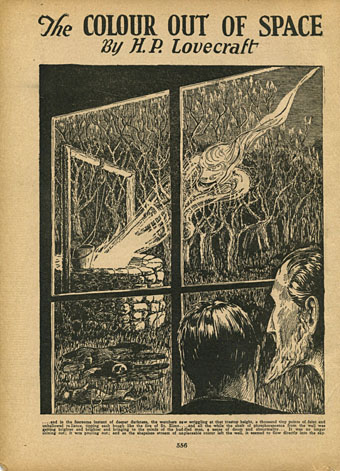
The Colour Out of Space: Amazing Stories, September 1927. Illustration by JM de Aragon.

Lovecraft didn’t think that Weird Tales would appreciate this one even though it’s more horror than science fiction so he sent it to Amazing Stories instead.

mythos04.jpg

mythos26.jpg

The Call of Cthulhu: Weird Tales, February 1928. Illustration by Hugh Rankin.

It’s doubtful that Rankin, Senf and co. would have been up to the task of depicting Great Cthulhu or the non-Euclidean nightmare of R’lyeh, but this hardly excuses editor Farnsworth Wright’s decision to give the cover to Elliott O’Donnell’s ridiculous ghost table.

Continue reading “The Cthulhu Mythos in the pulps”

Drone month

drones.jpg

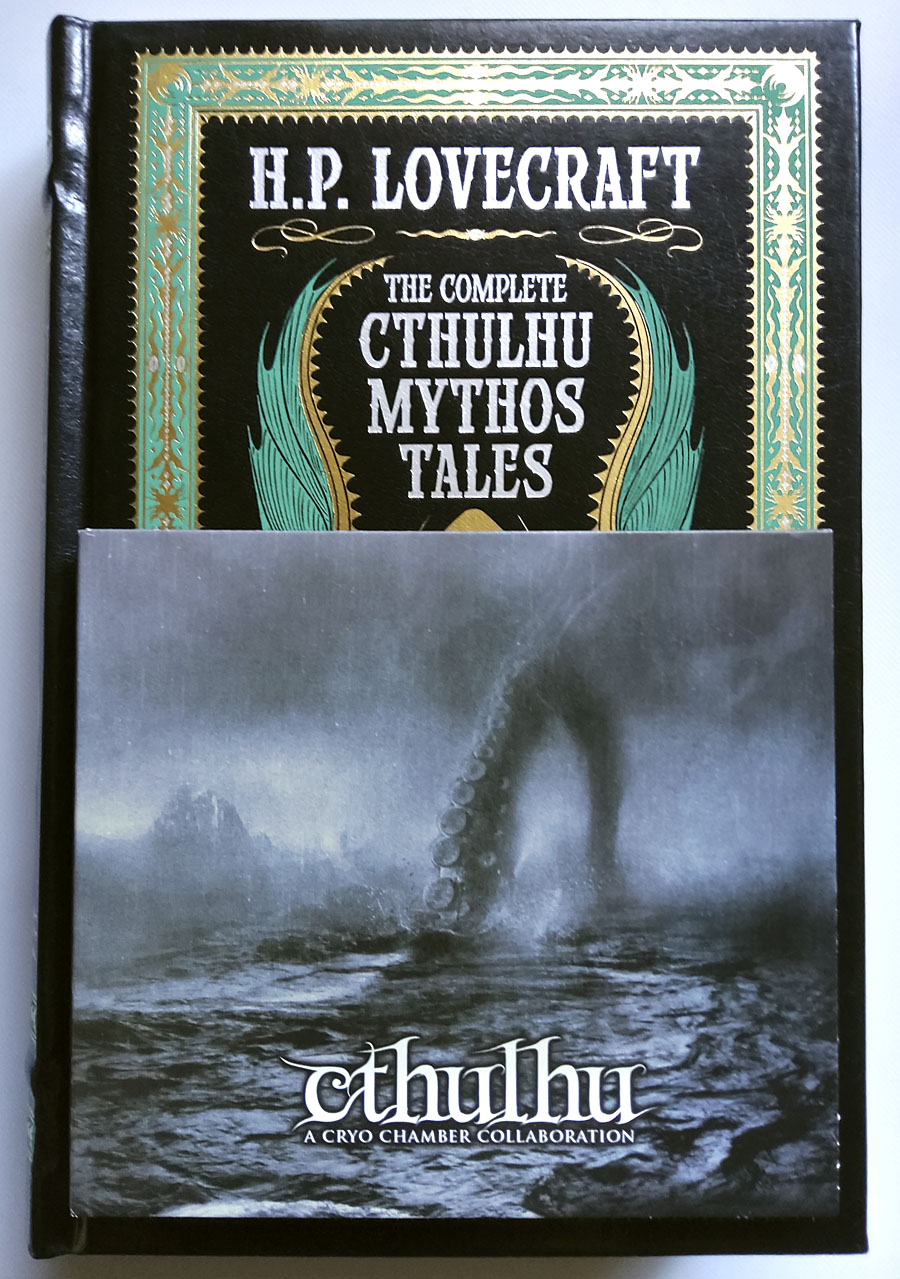
October is drone month. July is often drone month as well, if the heat rises to a degree that I can’t bear to listen to anything more taxing than Main, On Land, or the Paul Schütze recordings that feature thunderstorms. But October owns the drone because it also owns Halloween, as I noted in this Halloween playlist. The first entry there, Zeit by Tangerine Dream, is such a perennial favourite that it’s one of the few albums I can imagine writing about for the 33 1/3 books. But this year Zeit has been competing for haunted airtime with the Cthulhu album from Cryo Chamber, a label devoted to the darker end of the ambient spectrum, where choral throngs in colossal chambers are scoured by the katabatic winds that howl through vast subterranean chasms while Thrones of Darkness brood with Amorphous Abominations in the Illimitable Void etc etc.

The Cthulhu album is the first in a series of Lovecraft-themed collaborations by Cryo Chamber artists, with each release taking a Cthulhu Mythos god as its subject. I still find this one to be the best of the series so far, not least because the character of Lovecraft’s tentacled monstrosity is more clearly defined than the other gods which lends more definition to the musical illustration. There are no separate tracks on these albums, all the pieces are mixes that cover the sides of one or more compact discs, blending the contributions of the different artists into a single work. The Cthulhu drones are suitably sub-oceanic, like Eric Holm’s Barotrauma with added cosmic horror, a suite of restless stirrings from the Thing that lies dreaming at Point Nemo. Towards the end the Thing awakens to wreak havoc upon the upstart human world, but not before we’ve heard a mutant voice daring to speak aloud the invocation from The Call of Cthulhu.

Previously on { feuilleton }
Hodgsonian vibrations

Double weird

weird1.jpg

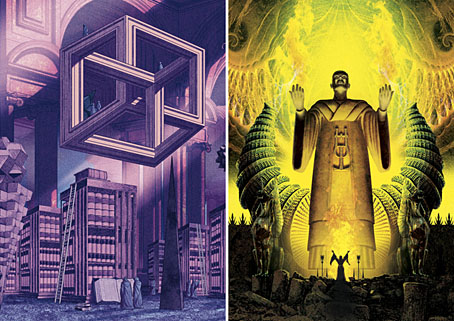
Two of the books whose covers I was working on late last year have been announced so here they are. This is more work for PS Publishing where wraparound covers are the standard, so once again I was able to work in a pictorial, landscape format. (PS also do their design in-house so I only did the art this time. Click on the pictures below for larger views.)

weird2.jpg

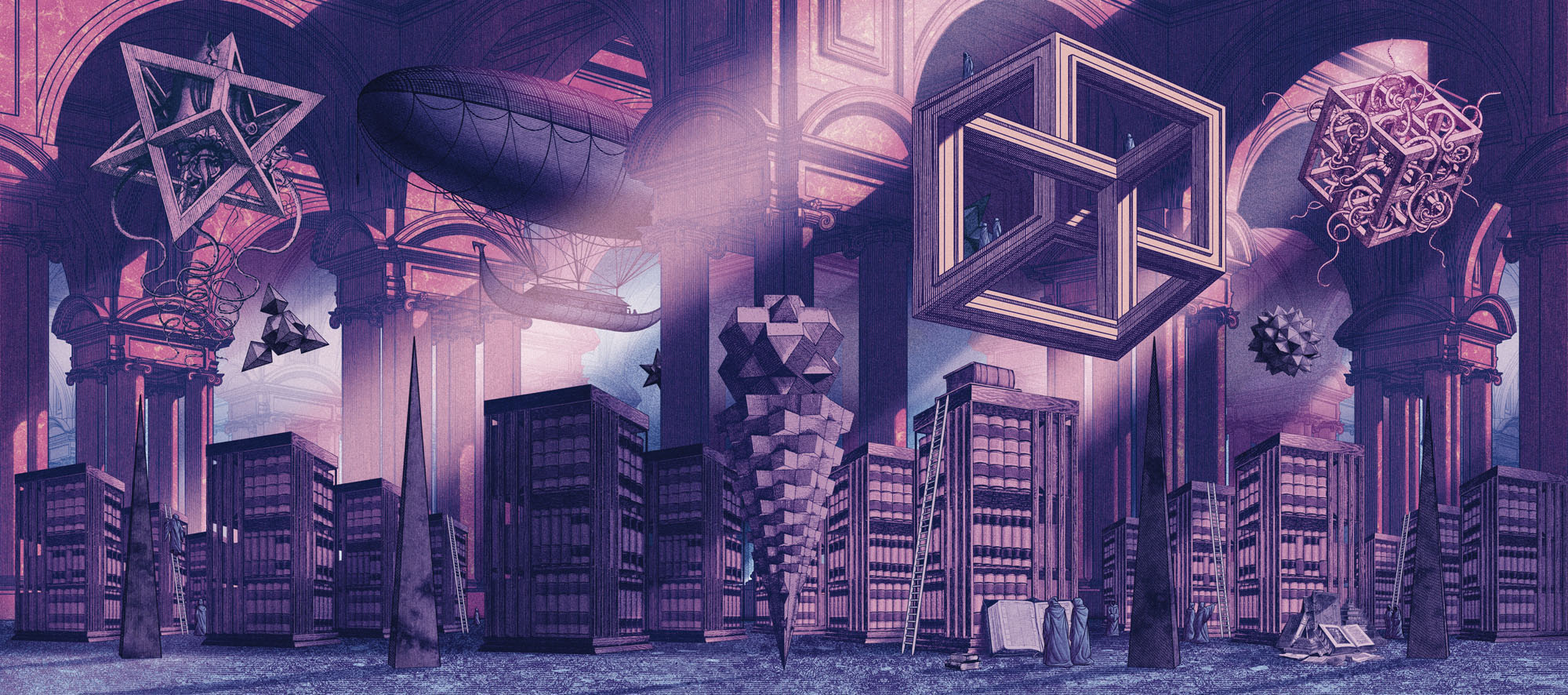
Apostles of the Weird is a collection of contemporary weird fiction edited by ST Joshi:

Weird fiction is an incredibly rich and varied genre, running the gamut from supernatural horror to imaginary-world fantasy to psychological terror. This anthology seeks to exhibit the wide range of themes, motifs, and imagery that weird fiction allows, as embodied in the work of some of the leading contemporary writers in the field. (more)

“Weird” is indeed a very broad category so rather than try and create something that represented a single genre I opted for a weird view instead. The idea was to do something like Borges’s Library of Babel in a space that was a hybrid of Piranesi and MC Escher. I was hoping originally to make this more Escher-like, with a number of gravity-defying staircases, but the underlying drawing took so long that I didn’t have time.

weird3.jpg

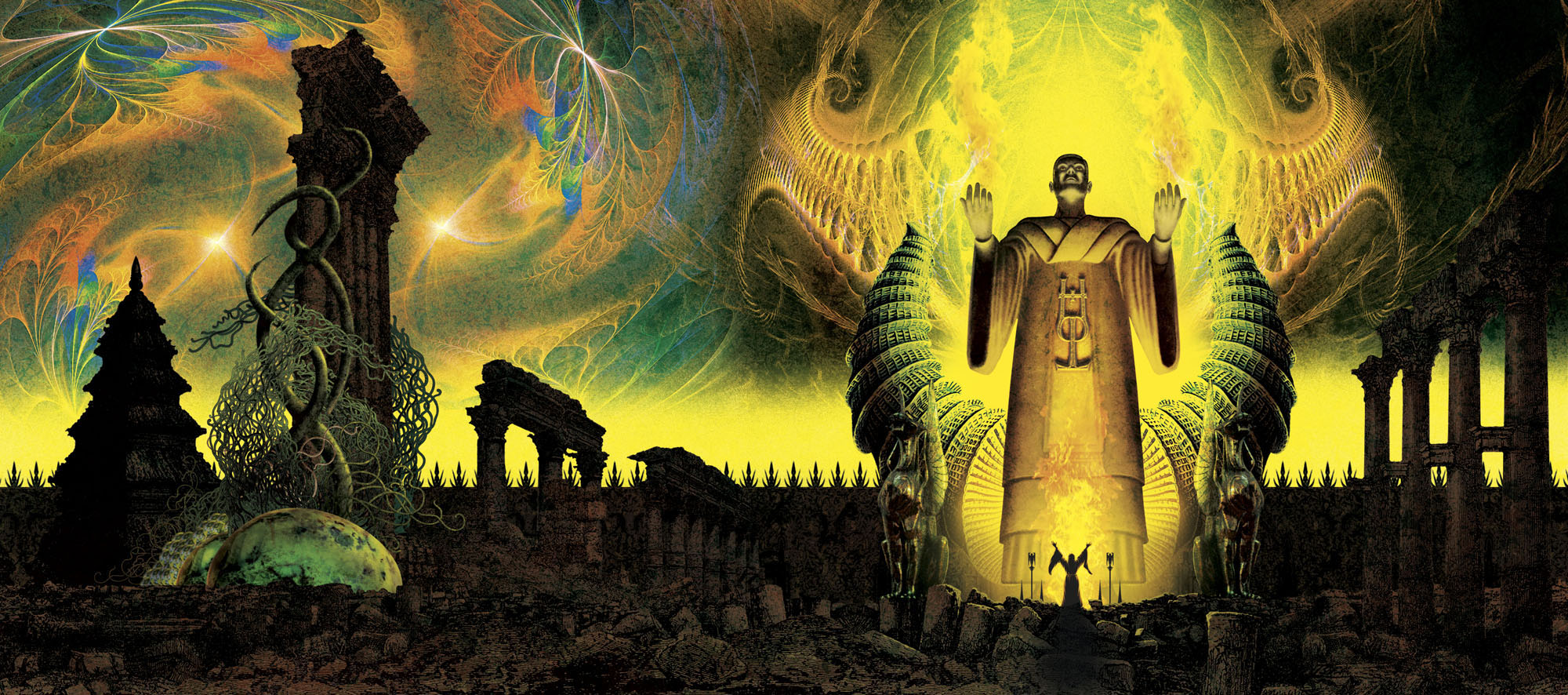
His Own Most Fantastic Creation: Stories About HP Lovecraft is also edited by ST Joshi:

HP Lovecraft (1890–1937), the pioneering writer of weird fiction, has himself become an icon in popular culture. Stories, novels, and other works featuring the gaunt, lantern-jawed gentleman from Providence, Rhode Island, have proliferated. These works have been triggered by the incredible amount of knowledge we have on the writer—his family, his friends, his idiosyncrasies and eccentricities—as found in his thousands of surviving letters. (more)

This was much easier to achieve since HP Lovecraft is familiar territory. The idea here was to do a portrait of Lovecraft situated in a Lovecraftian zone, a colossal idol of a type that might be found in some of his Cyclopean ruins. Lovecraft and his Weird Tales colleagues had a habit of referring to each other in their stories and letters as though they were ancient priests or sorcerers so portraying Lovecraft in this manner is fitting. The combination of perspective and lighting worked against creating an accurate likeness, however—it doesn’t help that Lovecraft’s features are weird in themselves—so the “HPL” icon is there to affirm the identity.

Both books will be published next month if Great Cthulhu hasn’t risen from the depths by then.

Elsewhere on { feuilleton }
The Lovecraft archive

Previously on { feuilleton }
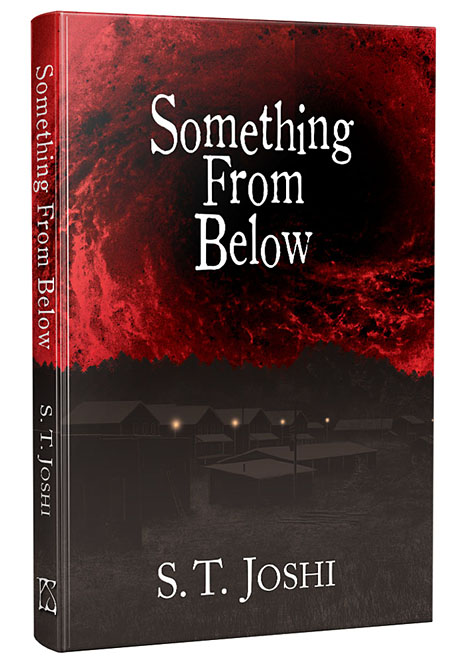
Something from Below

Something from Below

My first encounter with author, editor and Lovecraft biographer ST Joshi was in the form of an artwork request that arrived out of the blue in the late 1980s. My comic-strip adaptation of The Haunter of the Dark had just been published in a large-format edition by Caermaen Press, a small imprint run by Roger Dobson and Mark Valentine, and this prompted a flurry of interest among weird-fiction enthusiasts in Britain and the USA. Joshi was editing Lovecraft Studies for Necronomicon Press at the time, and asked if I’d be willing to contribute illustrations, something I ended up not doing for a variety of reasons. I always felt bad about this, and admitted as much when we eventually met at the Providence NecronomiCon in 2015, so my cover art for his new cosmic-horror novella may be regarded as a kind of recompense.

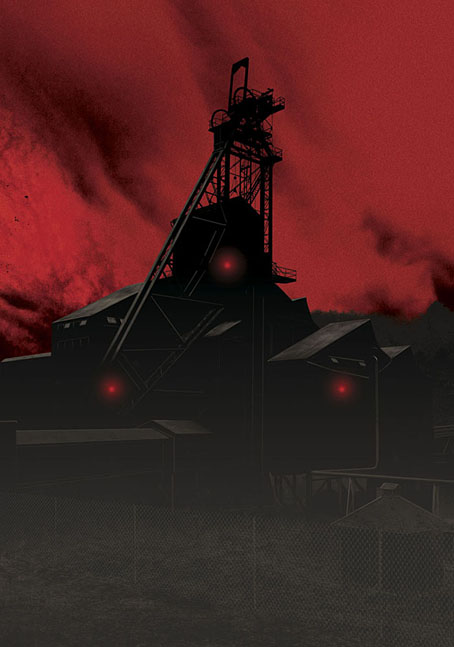
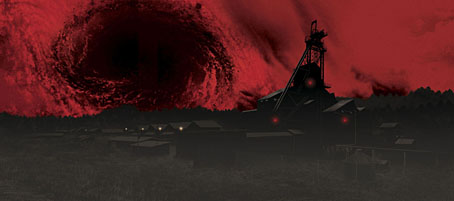
Something from Below is horror with an industrial setting and a Lovecraftian slant, hence the sinister coal mine dominating the artwork:

When 22-year-old Alison Mannering returns to her home in northeastern Pennsylvania after college, she finds a troubling situation. Her father, Guy Mannering, a longtime coal miner, has died recently under suspicious circumstances, and her mother refuses to provide any details of his passing. Alison feels she has no option but to investigate the matter herself, enlisting her high school sweetheart, Randy Kroeber, as well as Randy’s twin sister, Andrea called Andy, to assist her… (more)

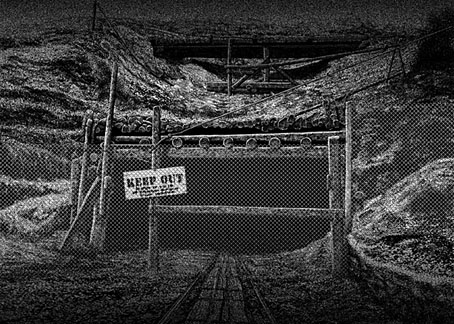
The brief for this one was to create a wraparound cover without showing anything overtly monstrous, something I was happy to do since I dislike horror covers that reveal too much. In addition to the wrap I also produced a black-and-white piece for the inner boards. As is evident from the pictures above, the artwork was flipped around in the design but that’s okay, it works both ways. The coal mine is the central location, however.

Something from Below is published this month by PS Publishing in signed and unsigned hardcovers.

Elsewhere on { feuilleton }
The Lovecraft archive