After Beardsley by Chris James

ab1.jpg

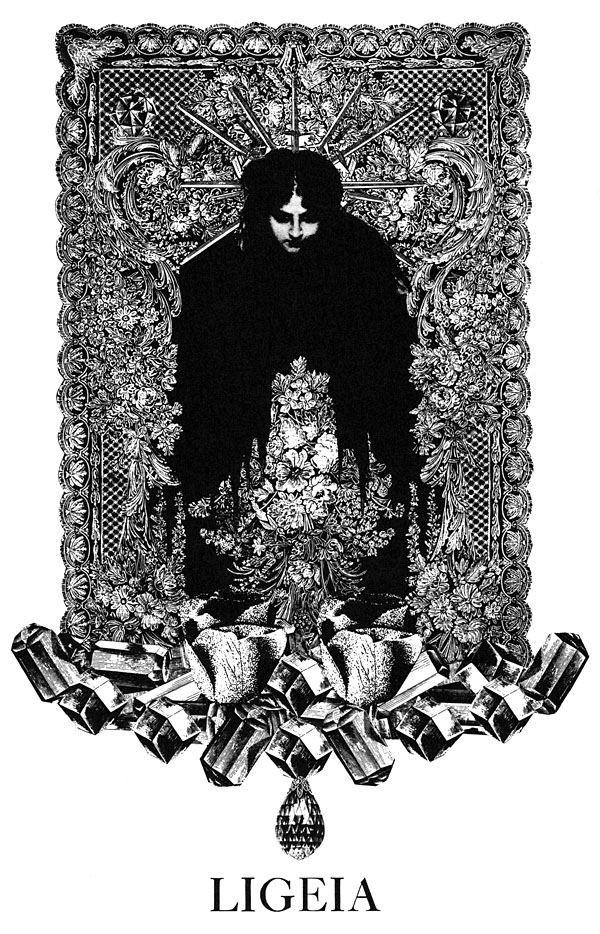
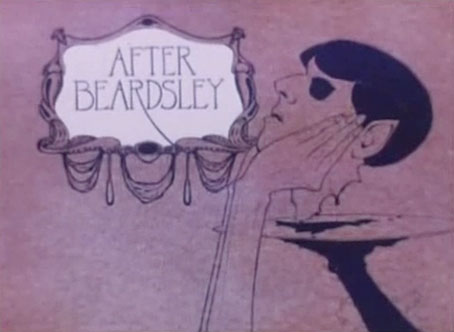
I have Greg Jarvis of Flowers of Hell to thank for prompting this discovery. Greg left a comment on an earlier post about Aubrey Beardsley’s influence in the musical world in which he drew my attention to some Flowers of Hell cover art and a video inspired by Beardsley’s Morte Darthur drawings. The video reminded me of a short animated film I’d known about for years but never seen, After Beardsley by Chris James. Sure enough it too is on YouTube, to my great surprise since I swear I’ve searched in vain for this in the past.
ab2.jpg

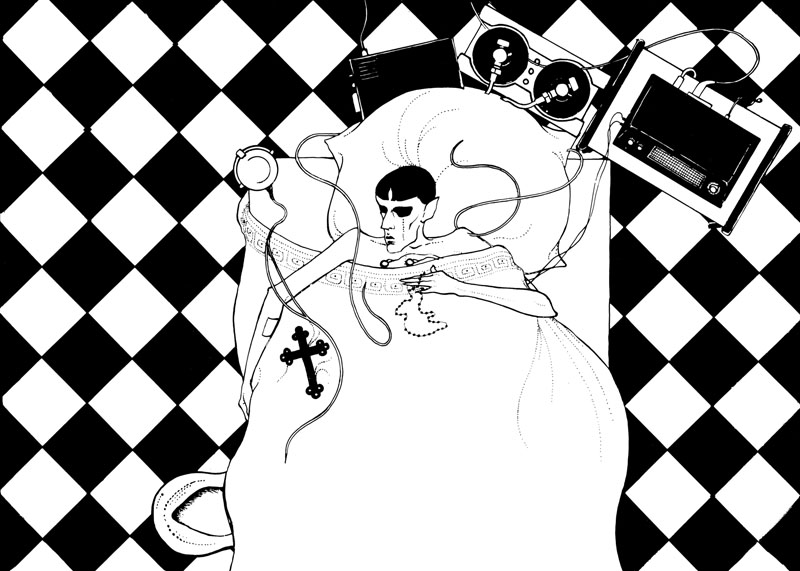
After Beardsley was made in 1981 and my knowledge of the film is a result of its being praised by V&A curator Stephen Calloway. The picture of Aubrey in a hospital bed featured in the 1993 V&A exhibition High Art and Low Life: The Studio and the fin de siècle, and is also the final picture in Calloway’s 1998 biography of the artist. Chris James describes the film thus:

The film After Beardsley attempts to depict today’s world through Beardsley’s eyes and in his drawing style…Beardsley is ‘resurrected’ from his death bed and begins to walk through time to the present. On his journey he witnesses the evolution of the car and of air and sea travel, then climbs a phallic mountain before descending into 20th century New York City. [The] ghost of Aubrey Beardsley explores the urban jungle of New York City where, amongst other things, he sees Bob Dylan as a satyr sitting by an iconic 1959 Chevy, and Lenny Bruce being injected with heroin. He is then beckoned by Patti Smith (as Beardsley’s Messalina) into a hospital room where he finds himself hooked up to life support equipment. His hospital persona shows his ghost the horrors of the present day—overpopulation, pestilence starvation, and death. Via John Lennon, he sees the horrors of a nuclear winter. The premise of the film is that, if Beardsley had been alive today instead of the 1890s, modern medicine would have kept him alive, but that, having had a glimpse of where the world was heading, he may have chosen to die anyway. Written and drawn by Chris James, after Aubrey Beardsley. Music by Ronnie Fowler.

As Beardsley pastiche the drawing is some of the best I’ve seen, it’s easy to see why Calloway would be impressed. The film is split into three parts here, here and here, and Chris James has more animation on his YT channel. I’d be tempted to ask for a better quality copy but for now seeing the film at all is good enough.

Elsewhere on { feuilleton }
The Aubrey Beardsley archive
Illustrating Poe #5: Among the others

kupka_poe.jpg

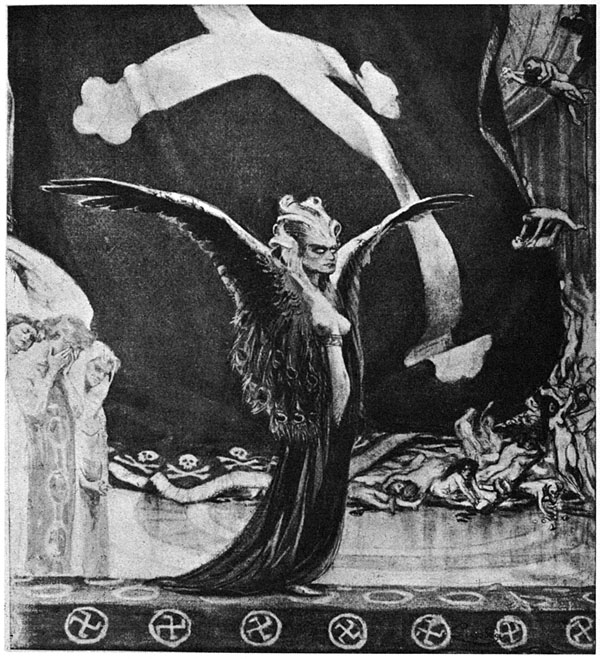
The Conqueror Worm (c. 1900) by František Kupka.

Poe’s illustrators are legion, you could easily devote an entire blog to nothing but depictions of his stories and poems. By way of rounding off this week of posts I thought I’d point to some of the works which have caught my attention over the years, several of them being obscure enough to warrant further investigation.

František Kupka’s drawing is, as far as I can gather, one of a series based on Poe’s poem; this seems to be a related piece. As with many Symbolists artists, you can spend a great deal of time scouring the available resources to find more of their work. We’re told that one of Kupka’s more well-known paintings, The Way of Silence (1903), was inspired by the poem Dream-land.

martini_poe.jpg

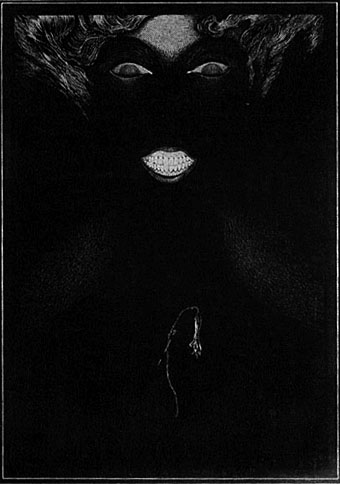
Berenice (1905) by Alberto Martini.

Alberto Martini (1876–1954) is a fascinating artist whose work bridges the decline of Symbolism and the rise of Surrealism. He’s also another talent whose work is woefully underrepresented on the web so let’s hope that changes soon. Wikipedia describes him as having produced 135 Poe illustrations of which only a small handful are visible online, and most of the ones that are go unlabelled. I know this one is for Berenice since I have it in a book but any Poe reader should guess the title from those blazing teeth. A few more of Martini’s drawings can be seen here.

Continue reading “Illustrating Poe #5: Among the others”

Illustrating Poe #4: Wilfried Sätty

satty_poe01

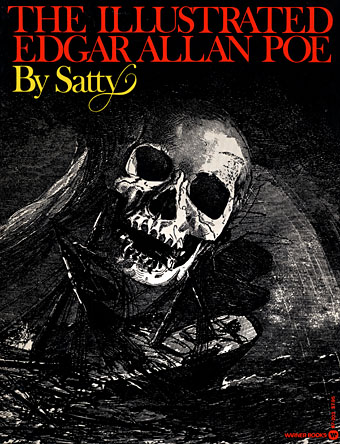
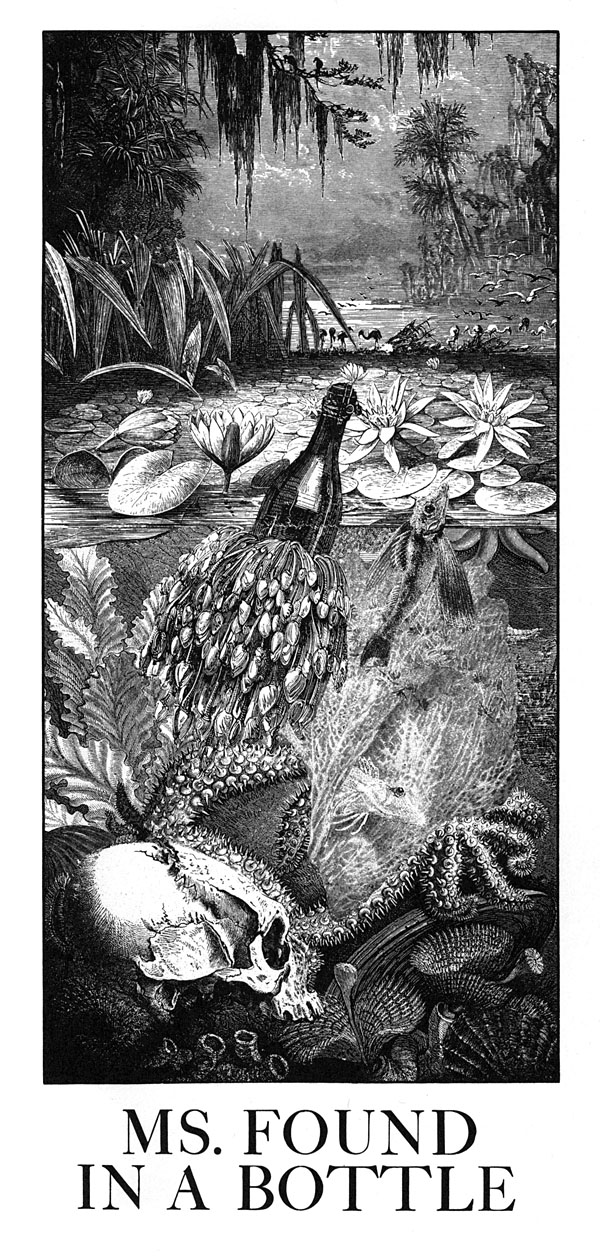
Here it is, the book that began my fascination with the collage art of Wilfried Sätty (1939–1982), a German artist and psychedelic poster designer resident in San Francisco during the 1960s and 1970s. Warner Books published his Poe collection in 1976 and for some reason omit the umlaut from his name even though it’s present in Thomas Albright’s introductory note. I bought my copy in 1979 at a time when I was writing a lot of unsuccessful “experimental” fiction, and the sight of these tremendous collages inspired a surge of writing activity which disregarded Poe’s stories altogether. I’d seen enough of Max Ernst’s engraving collages to know that Sätty was following Ernst’s example but something about Sätty’s work struck me in a manner I couldn’t articulate other than by trying to set down the thoughts they inspired. Personal obsessions aside, I’ve since come to regard this book as the only illustrated Poe which can approach Harry Clarke’s inimitable volume.

satty_poe02

I’m fortunate to own two copies of this edition otherwise I wouldn’t have attempted to scan any pages when doing so involves bending the spine rather badly. The book is profusely illustrated, with many full-page or double-spread illustrations most of which I haven’t tried to reproduce. What you have here are the title pages from nearly all the pieces and a couple of additional illustrations. Sätty’s Poe is still the easiest of his books to find secondhand if you browse the dealer pages at AbeBooks. For more of his incredible work there’s this page at Ephemera Assemblyman, and for details of the artist’s life and career there’s my 2005 essay in Strange Attractor Journal Two.

• Sätty’s illustrations for The Annotated Dracula (1975) at Flickr.

satty_poe03

Continue reading “Illustrating Poe #4: Wilfried Sätty”

Illustrating Poe #3: Harry Clarke

hc_poe1.jpg

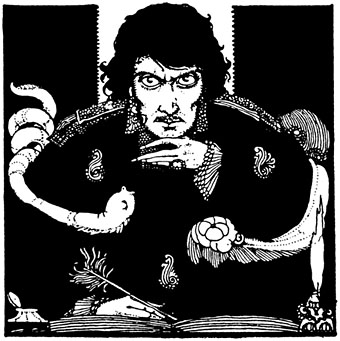
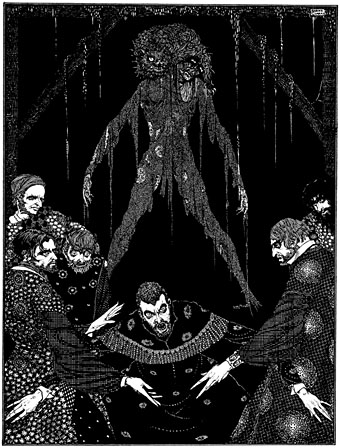
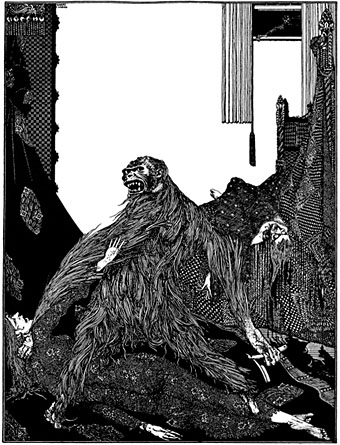
And so to the master. Harry Clarke’s illustrated edition of Tales of Mystery and Imagination was published by Harrap in 1919, with a new edition following in 1923 that featured an additional series of colour plates. I can’t imagine anyone ever producing a better illustrated version of Poe than Clarke managed, the morbid quality which some complain about in his work is perfectly suited to that most morbid of writers. So too are Clarke’s haunted and neurasthenic figures, and the many decorative details which provide an analogue to the author’s distinctive prose style. The first four drawings which follow repeat the earlier order of the Beardsley illustrations; an unfair comparison, perhaps, since the subject matter didn’t suit Aubrey’s temperament, but a comparison shows how differently the same stories might be illustrated, and how much Clarke brings the macabre elements to the fore.

There’s no need to post a large selection this time when quality scans have already appeared at A Journey Round My Skull and Golden Age Comic Book Stories. These drawings really do need to be seen showing all their fine detail.

hc_poe2.jpg

The Black Cat: “I had walled the monster up within the tomb!”

hc_poe3.jpg

The Murders in the Rue Morgue: “Gnashing its teeth, and flashing fire from its eyes, it flew upon the body of the girl.”

Continue reading “Illustrating Poe #3: Harry Clarke”

Illustrating Poe #2: William Heath Robinson

whr_poe01

The Raven.

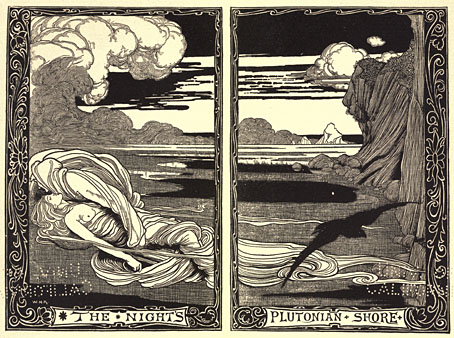
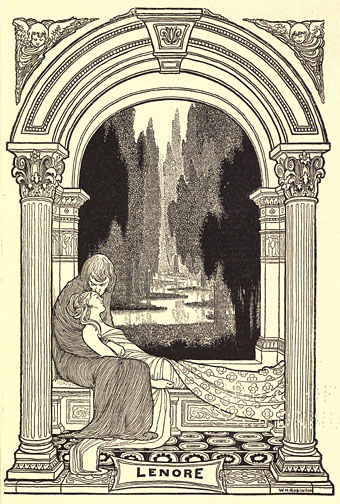
Some of these drawings have been featured here before but they’re always worth seeing again. One of the problems for the early illustrators of Poe was a lack of sympathy among many of them for the author’s doom-laden Romanticism. It’s a shame that Aubrey Beardsley didn’t try illustrating some of the poems, as William Heath Robinson does here, Poe’s verse is significantly lighter in atmosphere than his stories.

whr_poe02

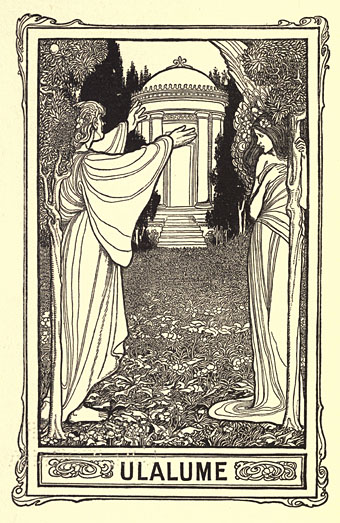
Ulalume.

This collection is from 1900 and I much prefer this style of Robinson’s to the later comic inventions which made him a household name. The complete book can be found at the Internet Archive. For a very different interpretation of Poe’s poems, Golden Age Comic Book Stories just posted the 1912 Edmund Dulac edition.

whr_poe03

Lenore.

Continue reading “Illustrating Poe #2: William Heath Robinson”